Checkr vs GoodHire vs Sterling: Background Check Pricing Playbook
A background check is the cheapest line on a bad hire and the most expensive line on a hiring process nobody budgeted. The package price is the number vendors advertise; the invoice is the package plus the county court fees, the motor vehicle report, the employment verification, and the drug test. This playbook prices all of it from the vendors' own pages, runs the arithmetic at 10, 50, and 200 checks a month, and walks the federal workflow that governs every report.
What the law calls this: a consumer report, not a Google search
A background check bought from a screening company is a consumer report under the Fair Credit Reporting Act (FCRA), and the vendor is a consumer reporting agency (CRA). That classification makes price secondary and workflow primary: the statute, not the vendor, sets the rules for ordering a report and using the result.
Section 1681b(a)(3)(B) lists employment purposes as a permissible purpose — the legal basis for the product category. But § 1681b(b) attaches conditions: a CRA may furnish a report for employment purposes only if the employer certifies it complied with the disclosure and authorization rules and will comply with the adverse-action rules, and only if the CRA provides a summary of the consumer's rights under § 1681g(c)(3). The text below is the operative language, captured from Cornell's Legal Information Institute on 14 November 2026.
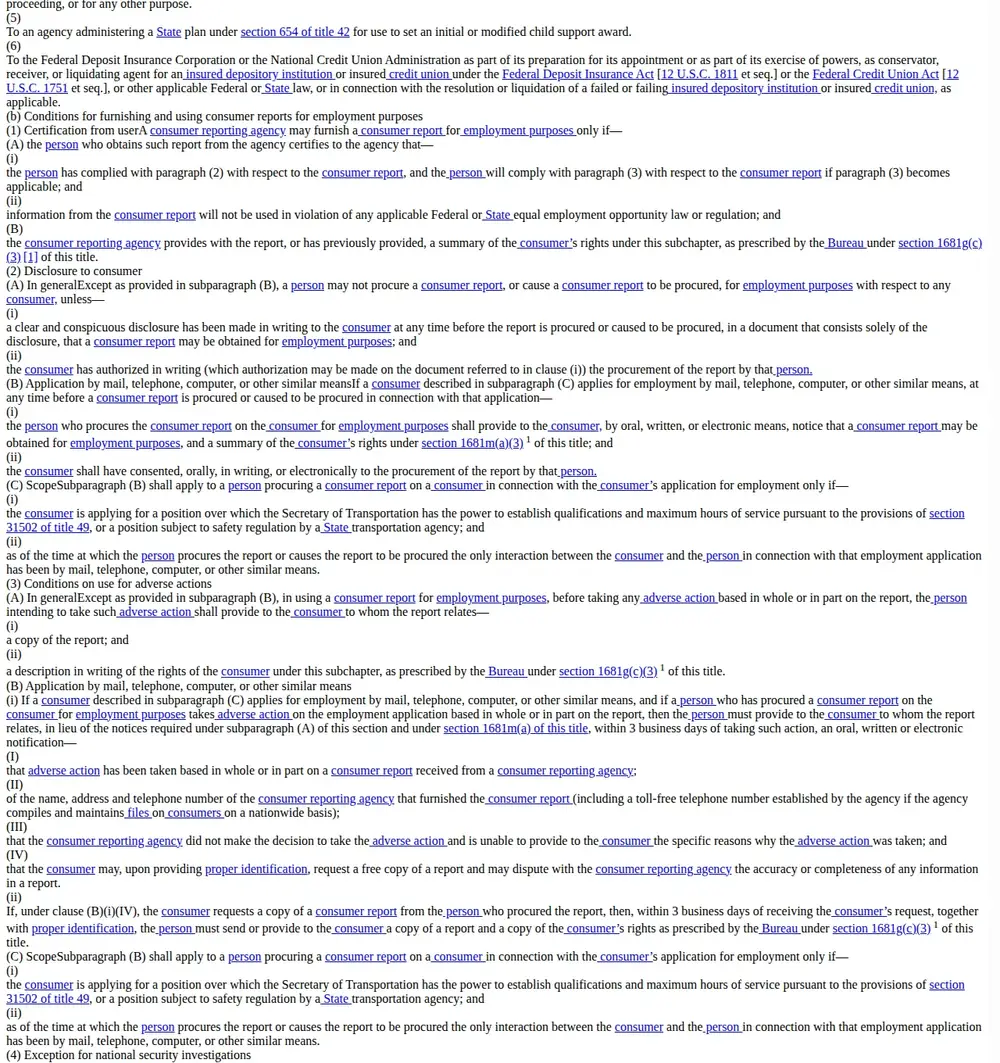
Three definitions carry the compliance burden: a CRA is the company compiling the report — Checkr, GoodHire, and Sterling are all CRAs; a consumer report is the background report itself; an adverse action is a decision against the candidate based in whole or in part on the report, usually not hiring them. You are buying a regulated report with a statutory procedure attached, not a data lookup.
The three vendors at a glance
| Dimension | Checkr | GoodHire | Sterling | Authority |
|---|---|---|---|---|
| Buying model | Pay-as-you-go; Enterprise contact-sales | Custom packages under 50 checks a year; pre-set above 50 | Quote-only contracts | Vendor pages, 2026-11-14 |
| Add-on prices published | Full menu | None published | None published | Vendor pages, 2026-11-14 |
| Compliance tooling priced | Assess $2.49/$4; Postal Adverse Action $7/letter | Not published | Not published | checkr.com/pricing |
The headline result: at list price, Checkr and GoodHire are the same product at the same price, tier for tier. Basic on both is an SSN trace, sex offender registry, global watchlist, and national criminal search; Essential adds identity verification and unlimited county criminal search; Complete adds unlimited state criminal and federal criminal search.
The package prices, verified
Prices are "starting from" — the floor before court and database passthrough fees, passed through at cost.
| Package | Checkr | GoodHire | What is inside |
|---|---|---|---|
| Basic | $29.99 / report | $29.99 / check | SSN trace; sex offender registry; global watchlist; national criminal |
| Essential | $59.99 / report | $59.99 / check | Basic plus identity verification, unlimited county criminal search |
| Complete | $94.99 / report | $94.99 / check | Essential plus unlimited state criminal, federal criminal search |
GoodHire adds one structural detail: a volume split. Under 50 checks a year it sells custom packages; above 50, pre-set packages with 100+ screening options. The page was published 3 September 2019 and updated 1 July 2026, so the figures are current for 2026. Checkr publishes no volume threshold — pay-as-you-go, larger buyers routed to an Enterprise tier priced on contact.
Worked math 1: what the packages cost at 10, 50, and 200 checks a month
| Checks/mo | Basic/mo | Basic/yr | Essential/mo | Essential/yr | Complete/mo | Complete/yr |
|---|---|---|---|---|---|---|
| 10 | $299.90 | $3,598.80 | $599.90 | $7,198.80 | $949.90 | $11,398.80 |
| 50 | $1,499.50 | $17,994.00 | $2,999.50 | $35,994.00 | $4,749.50 | $56,994.00 |
| 200 | $5,998.00 | $71,976.00 | $11,998.00 | $143,976.00 | $18,998.00 | $227,976.00 |
Complete costs $65.00 more per check than Basic:
That $156,000 buys unlimited county and state criminal searches plus a federal search per candidate. For a warehouse hiring 200 people a month from one county, the federal and state layers add little; for a remote-first employer hiring across 40 states, the same $156,000 is the difference between a search that can find a record and one that cannot. The right tier follows hiring geography, not budget. Run the same arithmetic with our Tax & Quarterly Estimator.
Worked math 2: the fully loaded per-hire cost
The package is the floor. A realistic hire for a driving or regulated role adds four line items:
The drug test is priced "from $60", so $211.99 is a floor. Add the passthrough court and database fees — which vary by county — and a $211.99 hire is routinely a $230 to $260 hire. The package price is less than half the loaded cost; any budget built on $94.99 a hire is under-budgeted by more than 100 percent.
Checkr's published à la carte menu is why its loaded cost can be priced in advance: MVR $9.50 (state DMV fees passed through at cost); continuous MVR $2.50 a month per driver; identity verification $4.99; employment verification from $12.50 (7 years $35; 10 years $50); education verification from $12.50 (up to 3 degrees $25); professional license $12; pre-employment credit from $8; county criminal $25; federal criminal $10; global watchlist $9; social media $29.99, flagged reports reviewed by a human analyst; FACIS from $6 (Level 3 $15.50); DOT physical from $110. GoodHire publishes no equivalent menu, so a GoodHire buyer cannot price a loaded hire without a sales conversation.
Two add-ons change the operating cost: continuous criminal search at $1.70 per person per month is a $340 monthly line for 200 enrolled workers, and Assess Standard at $2.49 a report is Checkr's paid adjudication tier — a vendor claim of reduced manual review, not a measured result.
Sterling: quote-only enterprise, and the one Sterling price that is published
Sterling's pricing page publishes no per-check price for employment screening. It carries a notice from the chief financial officer announcing a price increase of approximately two percent effective 1 March, the last increase having come two years earlier. No rate card, no package table, no starting price: the public position is contact sales, negotiate, sign.
That opacity is itself decision-relevant: a quote-only vendor cannot be compared on price without a sales cycle, and the quote reflects volume, geography, contract length, and negotiating position. Sterling is built for buyers who can run a procurement process — large employers, regulated industries, multinational hiring — where a dedicated account team matters more than a published rate.
The one Sterling price our editorial analysis verified from a Sterling page this cycle belongs to a different product: Sterling Volunteers, the nonprofit volunteer-screening arm, publishes Advanced at $19 per screen and Complete at $39 per screen. Both exclude state, county, and motor vehicle repository fees; a one-time set-up fee applies; and the page references volume pricing at 500+ annual screens without publishing the discounted rate. The $20 gap buys the 7-year address criminal search, the 7-year alias and maiden-name search, and the Locator Select booking-site search:
At 200 screens a year: Advanced $3,800, Complete $7,800 — a $4,000 annual difference for the deeper history. Do not carry those figures into an employment budget: they price volunteer screening for nonprofits, and the products and contracts differ.
The FCRA workflow: five steps, in order, every time
Price decides the vendor; the statute decides the process. Under § 1681b(b) and the joint FTC/EEOC guidance:
Step 1 — Standalone disclosure. Tell the applicant in writing, in a document that consists solely of the disclosure, that a consumer report may be obtained for employment purposes. The FTC guidance is explicit: it cannot be buried in the application.
Step 2 — Written authorization. Get the applicant's written permission; it may sit on the same document as the disclosure. If you want it to cover reports throughout employment, say so clearly and conspicuously.
Step 3 — Certify to the CRA. Certify to the screening company that you notified the applicant, got permission, complied with the FCRA, and will not use the information in violation of equal opportunity law. Without that certification under § 1681b(b)(1), the CRA may not furnish the report.
Step 4 — Pre-adverse action. Before rejecting someone based in whole or in part on the report, send a copy of the report and "A Summary of Your Rights Under the Fair Credit Reporting Act" — so the person can review the report and explain any negative information.
Step 5 — Post-adverse action. After the decision, tell the person — orally, in writing, or electronically — that they were rejected because of information in the report, give the CRA's name, address, and phone number, state that the CRA did not make the hiring decision, and explain the right to dispute and to a free report within 60 days.
One hard deadline and one deliberate gap. The deadline is in § 1681b(b)(3)(B): for applications made by mail, telephone, computer, or similar means, the post-adverse notice must go out within 3 business days of taking the action. The gap is the waiting period between the pre-adverse notice and the decision: the statute sets no number of days. That period is an employer policy choice — write it down, apply it identically to every candidate, and make it long enough for a candidate to obtain and dispute a report. The FTC/EEOC guidance adds the equal-treatment overlay: apply the same standards to everyone, and treat a policy excluding people with certain criminal records as a disparate-impact risk unless job related and consistent with business necessity.
Operator boundaries: who should buy which
| Vendor | Choose if | Avoid if |
|---|---|---|
| Checkr | Volume hiring; pay-as-you-go, no stated minimum; need a published add-on menu to budget the loaded cost | Hiring entirely international; need in-country compliance teams over a self-serve platform |
| GoodHire | Small or mid-size; same list prices, simpler split — custom under 50 checks a year, pre-set above | Need to price add-ons before committing; the page publishes none |
| Sterling | Large or regulated employer; formal procurement; cross-border hiring; dedicated account team over a published rate | Small team needing a price today; no public rate |
| Sterling Volunteers | Nonprofit volunteer screening only | Any employment screening |
Founder & CEO Insight — Enow A. Jovial
Execution checklist
- [x] Pick the tier by geography: Basic for single-county hiring; Essential for multi-county histories; Complete for multi-state hiring.
- [x] Price the loaded hire before signing: run the $211.99 arithmetic with your own add-ons plus county passthrough fees.
- [x] Confirm the volume split in writing: GoodHire's 50-checks-a-year line and Sterling's quote terms change the price.
- [x] Build the standalone disclosure first: a document consisting solely of the FCRA disclosure, separate from the application.
- [x] Wire the pre-adverse notice into the workflow: report copy plus summary of rights before any rejection, under a written waiting-period policy applied to every candidate identically.
- [x] Set the retention clock: one year for hiring records, two years for educational institutions, state and local governments, and covered federal contractors — then secure disposal.
- [x] Reconcile screening with payroll onboarding: a screened hire still needs an EIN-linked payroll record, FICA withholding, and — for an LLC taxed as an S-Corp or a C-Corp — correct entity paperwork before the first pay run. Our ADP vs Gusto vs Paychex playbook prices that side; the Gusto vs Rippling vs QuickBooks playbook covers the employer cost stack; and the Form 941 playbook covers the quarterly filing that follows every hire.
The only certainty on the pricing page is the arithmetic. Checkr and GoodHire charge the same list prices; Sterling charges whatever it quotes. The loaded cost is roughly double the headline package, and the FCRA workflow — disclosure, authorization, certification, pre-adverse, post-adverse — is the same whichever vendor's logo is on the invoice. Choose on the workflow and the loaded cost, not on the $29.99.