Chase vs Wells Fargo vs Bank of America Business Checking: 2026 Fee Playbook
Founder & CEO Insight — Enow A. Jovial
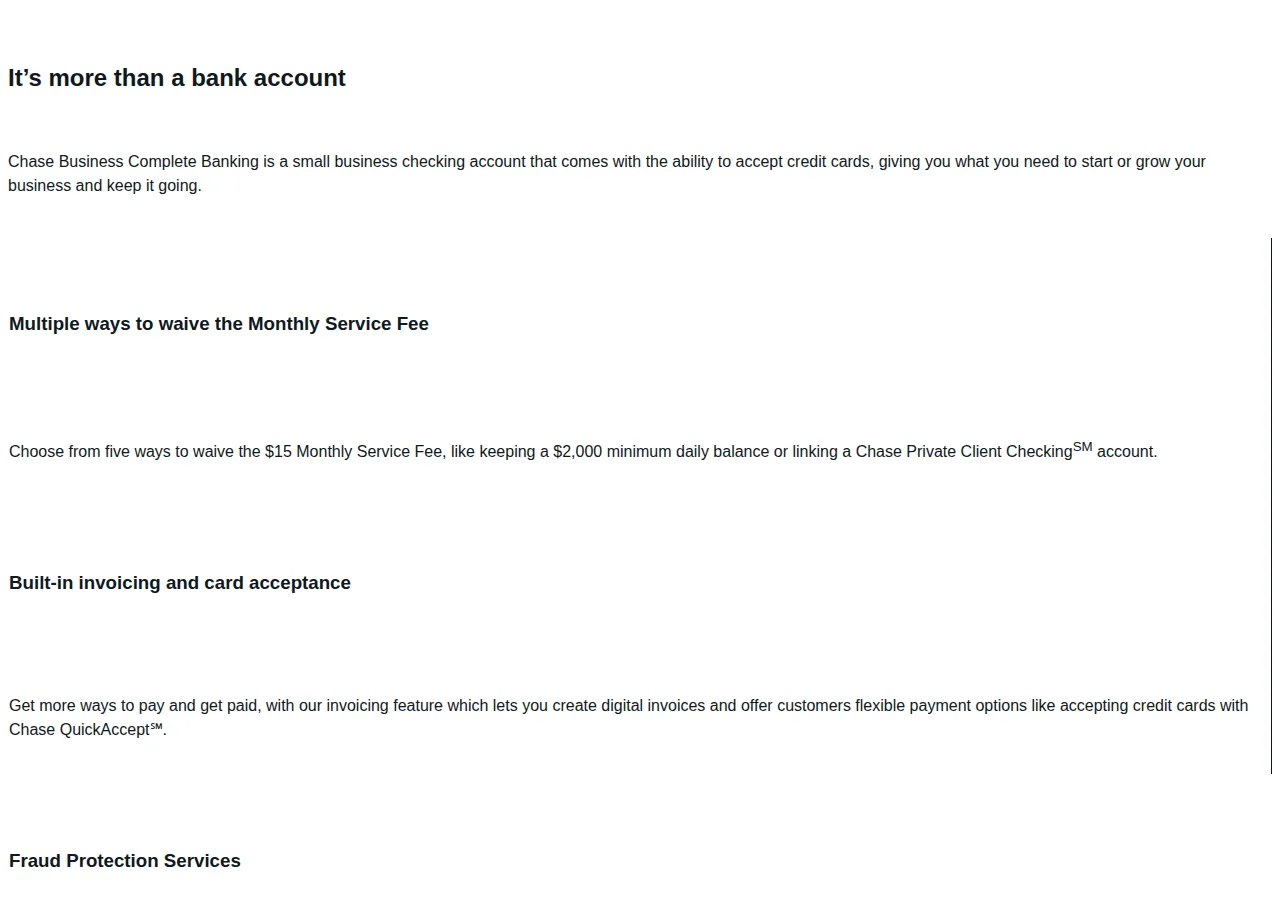
The three largest branch banks sell entry-level business checking at almost the same headline price: $15 a month at Chase and Wells Fargo, $16 at Bank of America. What decides your real cost is how many paper transactions you make, how much cash you deposit, how often you wire money, and whether you can meet a waiver without parking dead cash.
This playbook uses only the banks' own fee schedules as published in 2026, works the monthly totals for two stated profiles — a consultancy with 40 checks a month, a retailer depositing $18,000 in cash — and names the exact point where each account stops being cheap.
The fee table, from the banks' own schedules
| Fee | Chase Business Complete Banking | Wells Fargo Initiate Business Checking | Bank of America Business Advantage Fundamentals Banking | Authority |
|---|---|---|---|---|
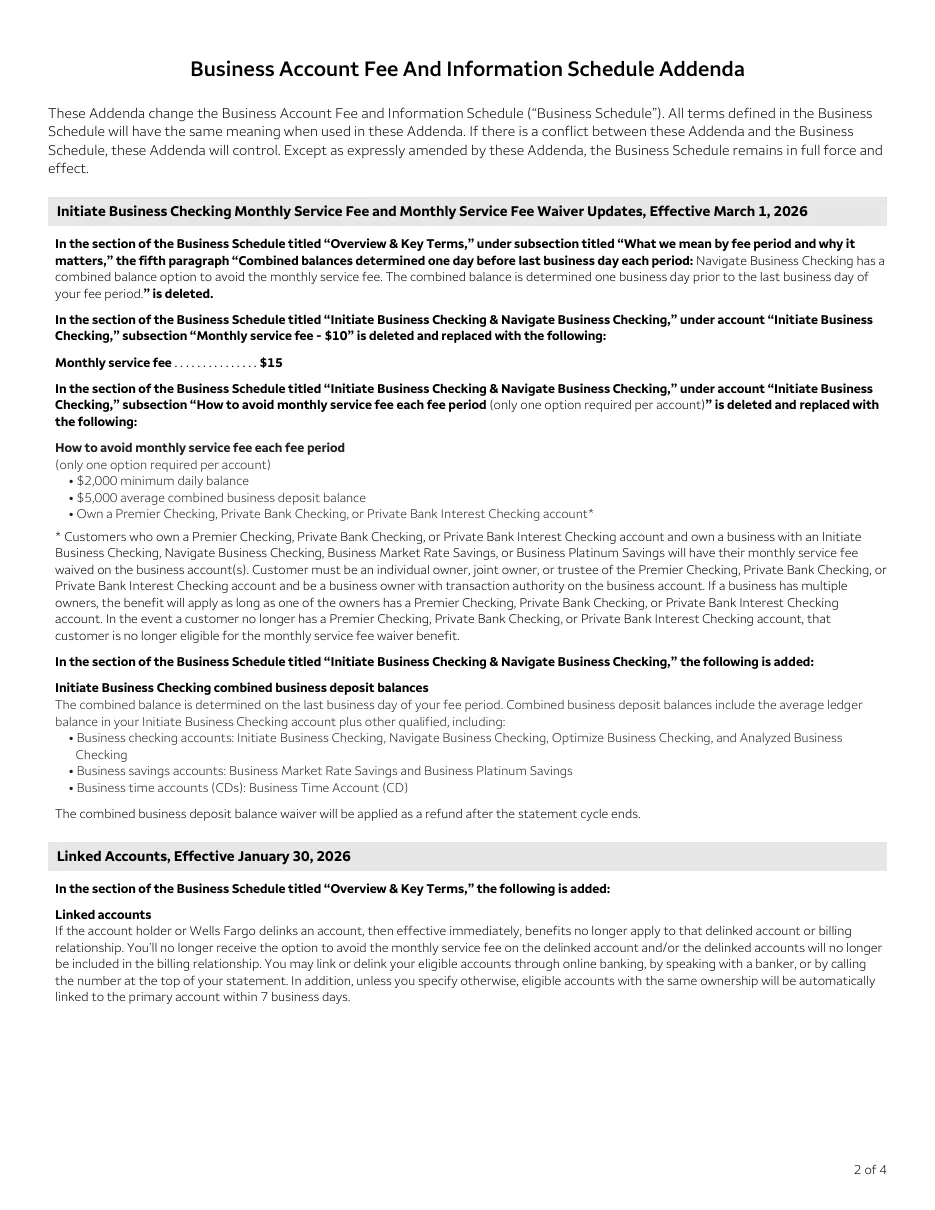
| Monthly fee | $15 | $15 (was $10 until Feb 28, 2026) | $16 | Chase fee schedule eff. 11/16/2025; Wells Fargo addenda eff. 3/1/2026; BofA schedule eff. 2/20/2026 |
| Opening deposit | $0 | $25 | $100 | Chase account page; Wells Fargo schedule; BofA schedule |
| Free transactions | Unlimited electronic; 20 teller/paper a month | 100 transactions a month, all types | 20 paper items a month; debit, electronic and mobile-deposit items exempt | Chase fee schedule; Wells Fargo schedule; BofA schedule |
| Excess transaction fee | $0.50 each from Jan 1, 2026 ($0.40 before) | $0.50 each | $0.45 each | Chase fee schedule; Wells Fargo schedule; BofA schedule |
| Cash deposits free | First $5,000 per statement cycle | First $5,000 per fee period | First $5,000 per statement cycle | Chase fee schedule; Wells Fargo schedule; BofA schedule |
| Cash deposit fee over allowance | $0.30 per $100 | $0.30 per $100 | $0.30 per $100 | Chase fee schedule; Wells Fargo schedule; BofA schedule |
| Incoming wire | $15 domestic and international ($0 from Chase) | Free | $15 domestic and international | Chase fee schedule; Wells Fargo schedule; BofA schedule |
| Outgoing domestic wire | $25 online, $35 in branch | $25 digital, $40 in branch | $30 | Chase fee schedule; Wells Fargo schedule; BofA schedule |
| Outgoing international wire | $40 online USD, $50 in branch; $5 FX online | $25 digital, $40 in branch | $45 USD; no fee in foreign currency (FX markup applies) | Chase fee schedule; Wells Fargo schedule; BofA schedule |
Three facts jump out of that table. All three banks converged on the same cash-deposit economics: $5,000 free, then $0.30 per $100. Cash is not the differentiator — transactions and wires are. Second, Chase is the only one that charges for incoming wires. Third, the transaction cap is where the accounts separate: Wells Fargo counts every transaction but gives you 100 of them; Chase and Bank of America give you 20 paper items and exempt most electronic activity.
The waiver test: what the free fee really costs
A waived fee is not free. It costs whatever the waiver condition ties up. The honest way to compare waivers is the annual return on the idle balance they demand:
Chase asks for a $2,000 minimum daily balance to waive $15 a month:
Wells Fargo asks for the same $2,000 to waive the same $15, so the same 9.00%. Bank of America asks for a $5,000 combined average monthly balance to waive $16:
Read that plainly: keeping $2,000 idle at Chase or Wells Fargo to dodge a $15 fee earns an implied 9.00% a year. That is a good trade for any business that normally holds $2,000. Bank of America's $5,000 balance waiver earns only 3.84% — and Bank of America offers a better waiver that costs no idle cash at all: $500 a month in net qualified purchases on the linked business debit card, with employee cards counting toward the total. For a business that already spends $500 a month on a debit card, the fee is waived at zero cost. Bank of America also does not assess the fee until the thirteenth statement cycle closes — a full year of free banking for a new account.
Wells Fargo offers a second balance route: a $5,000 average combined business deposit balance across linked business accounts. It also waives the fee if you own a Premier Checking, Private Bank Checking or Private Bank Interest Checking personal account. Chase offers five routes: the $2,000 balance, $2,000 in eligible Chase QuickAccept or payment-solutions deposits, $2,000 in purchases on a Chase Ink Business card, a linked Chase Private Client Checking account, or military status.
Worked Profile 1: the solo consultant
Maya runs a solo consultancy. She writes 40 checks a month and makes 30 teller deposits, so 70 paper or teller items. She deposits $3,000 in cash. She wires nothing. Her balance stays under $2,000, so no waiver is met at any bank. The monthly cost formula is the same at all three:
Chase: 20 free paper items, 50 over at $0.50, cash under the $5,000 allowance:
Wells Fargo: 70 transactions sit inside the 100 free, cash under the allowance:
Bank of America: 20 free paper items, 50 over at $0.45, cash under the allowance:
| Profile 1 monthly total | Chase | Wells Fargo | Bank of America | Authority |
|---|---|---|---|---|
| Monthly total, no waiver | $40.00 | $15.00 | $38.50 | Fee schedules cited above |
| Annual total | $480.00 | $180.00 | $462.00 | Monthly total x 12 |
| Monthly total, fee waived | $25.00 | $0.00 | $22.50 | Fee schedules cited above |
Wells Fargo wins this profile by $25 a month because its 100-transaction allowance swallows a paper-heavy month whole. Chase and Bank of America both punish paper: their 20-item cap is the binding constraint. If Maya moved her 40 checks to ACH and mobile deposit, Chase's electronic transactions are free and unlimited, and her Chase total would fall to the $15 fee alone.
Worked Profile 2: the cash-heavy retailer
Daniel runs a retail shop. He makes 150 paper and teller transactions a month and deposits $18,000 in cash. No waiver is met. The cash fee is identical at all three banks because all three allow $5,000 free and charge $0.30 per $100 after:
Chase: $15 fee, 130 excess paper items at $0.50, $39.00 cash fee:
Wells Fargo: $15 fee, 50 excess transactions at $0.50, $39.00 cash fee:
Bank of America: $16 fee, 130 excess paper items at $0.45, $39.00 cash fee:
| Profile 2 monthly total | Chase | Wells Fargo | Bank of America | Authority |
|---|---|---|---|---|
| Monthly total, no waiver | $119.00 | $79.00 | $113.50 | Fee schedules cited above |
| Annual total | $1,428.00 | $948.00 | $1,362.00 | Monthly total x 12 |
| Cash fee inside the total | $39.00 | $39.00 | $39.00 | $0.30 per $100 over $5,000 |
Wells Fargo wins again, by $40 a month over Chase and $34.50 over Bank of America, entirely on the transaction allowance. But notice the second lesson: at $18,000 of cash a month, the $39.00 cash fee is the same everywhere, and no entry-level account is the right answer for a business depositing much more cash. All three banks sell a step-up account — Chase Performance Business Checking, Wells Fargo Navigate, Bank of America Relationship Banking — with a higher cash allowance and a higher transaction cap. The entry account is the wrong product once cash passes roughly $20,000 a month.
Wires: the variable cost that ambushes the total
Four outgoing domestic wires sent online, plus two incoming wires, cost very different amounts by bank:
| Wire profile, per month | Chase | Wells Fargo | Bank of America | Authority |
|---|---|---|---|---|
| 4 outgoing domestic, online | $100.00 | $100.00 | $120.00 | Chase $25; Wells Fargo $25; BofA $30 |
| 2 incoming wires | $30.00 | $0.00 | $30.00 | Chase $15; Wells Fargo free; BofA $15 |
| Monthly wire total | $130.00 | $100.00 | $150.00 | Sum of the two rows |
| Annual wire total | $1,560.00 | $1,200.00 | $1,800.00 | Monthly total x 12 |
Wells Fargo is cheapest for wires because incoming wires are free. Chase charges $15 for an incoming wire unless the sender is also a Chase customer, which is an easy fee to miss when a client wires you payment. Bank of America is the most expensive for domestic wires at $30 outgoing, but it has one useful quirk: an international wire sent in foreign currency carries no wire fee at all — the cost sits in the exchange-rate markup instead.
Who should pick which account
| Your business | Pick | Why | Authority |
|---|---|---|---|
| Paper-heavy, under 100 transactions | Wells Fargo Initiate | 100 free transactions swallows a check-heavy month; free incoming wires | Wells Fargo schedule |
| Mostly electronic, big branch network | Chase Business Complete | Unlimited electronic transactions; 5 waiver routes; $0 opening deposit | Chase fee schedule |
| Debit-card spender, $500 a month | Bank of America Fundamentals | $500 debit-spend waiver costs no idle cash; 12 free cycles for new accounts | BofA schedule eff. 2/20/2026 |
| Cash over $20,000 a month | Step up, not entry | All three entry accounts charge $0.30 per $100 over $5,000; upgrade on the cash allowance | Fee schedules cited above |
| Frequent incoming wires | Wells Fargo Initiate | Free incoming wires; Chase and BofA charge $15 each | Fee schedules cited above |
These are branch-bank accounts with branch-bank economics. A fintech account such as Mercury, Relay or Wise Business charges no monthly fee at all — our Mercury vs Relay vs Wise business banking comparison works those totals — but it cannot take a cash deposit at a branch. If your business touches physical cash or needs a branch, you are choosing between these three. If it does not, the branch banks are competing against a $0 fee, and only the branch network justifies it.
For the cross-border side, our Wise vs Airwallex vs Payoneer payout comparison prices paying contractors and suppliers abroad. For the card on top of the account, our Amex vs Chase vs Capital One business credit card comparison prices the rewards against the same spend. Run the monthly totals through our profit calculator before you open the account — a $40-a-month fee is $480 a year, and that is a line item, not a rounding error.
The switching checklist
- [x] Step 1: Count your paper items. Pull three months of statements and count checks, teller deposits and teller withdrawals. Under 100 a month, Wells Fargo's allowance probably covers you; over 20, Chase and Bank of America charge per item.
- [x] Step 2: Measure your cash. Add up monthly cash deposits. Under $5,000, all three banks are identical. Over $5,000, budget $0.30 per $100 on the excess — and over $20,000, price the step-up account instead.
- [x] Step 3: Count your wires. Four outgoing domestic wires a month cost $100 at Chase and Wells Fargo and $120 at Bank of America; two incoming wires add $30 at Chase and Bank of America and $0 at Wells Fargo.
- [x] Step 4: Pick your waiver before you open. Chase and Wells Fargo waive on a $2,000 balance; Bank of America waives on $500 of debit spend. Choose the waiver you will actually meet every month, not the one that looks easiest on paper.
- [x] Step 5: Check the schedule date. Confirm the fee schedule you are reading is the current one — Wells Fargo's changed March 1, 2026 and Bank of America's February 20, 2026. A review quoting $10 or 200 free transactions is stale.
- [x] Step 6: Re-price every twelve months. These schedules change annually. Set a calendar reminder for the anniversary of the account opening and re-run the two profiles against the new schedule.