Apache Cassandra, ScyllaDB, and Amazon DynamoDB are the same database idea priced three different ways: by the server, by the resource, and by the request. Cassandra is open-source software you run yourself on rented machines. ScyllaDB is a C++ rewrite of the Cassandra engine, sold as a managed cluster priced on the resources it provisions. DynamoDB is a serverless AWS service priced on every read, write, and gigabyte. The data model is nearly identical across all three — wide-column rows, partition keys, tunable consistency — which is exactly why the choice is a pricing and operations decision, not a data-model decision.
The trap is comparing the sticker prices. Cassandra looks free, DynamoDB looks cheap per request, and ScyllaDB looks expensive per node — and all three impressions are wrong until the same workload is priced on all three at the same volume.
Founder & CEO Insight — Enow A. Jovial
What each product actually is
Apache Cassandra is a distributed wide-column store under the Apache 2.0 license, built for write-heavy workloads across many commodity servers with no single point of failure. Every node is equal; data is partitioned across the ring by consistent hashing of the partition key, and each row is replicated to as many nodes as the keyspace's replication factor requires. There is no license fee. The cost is the machines, the storage, and the operator who runs repairs, compaction, and upgrades.
ScyllaDB is a from-scratch C++ reimplementation of the Cassandra engine, wire-compatible with CQL and with a DynamoDB-compatible API, built on a shard-per-core architecture that pins each CPU core to its own data shard. The claim that matters is not the language — it is that one ScyllaDB node does the work of several Cassandra nodes on the same hardware, which is why its pricing is per provisioned resource rather than per request. ScyllaDB Cloud is the managed service in three tiers — Standard, Professional, Premium — and ScyllaDB X Cloud is the elastic generation that scales from 100,000 to 2,000,000 operations per second in minutes. The open-source core is licensed under AGPLv3; the managed service is where the money is made.
DynamoDB is AWS's serverless NoSQL service: no servers to size, no cluster to run, throughput and storage billed as consumed. A table is a partition key plus an optional sort key, with global secondary indexes sold as separate billable tables. The free tier is permanent and unusually generous: 25 GB of storage and 25 provisioned read and write capacity units every month, forever, on every account.
The vector database architecture playbook covers the similarity-search side of the NoSQL world; this guide is the operational wide-column side. The graph database pricing playbook covers the traversal side, and the warehouse pricing playbook covers the analytical side.
The data model is the same decision in three costumes
All three store rows under a partition key. In Cassandra and ScyllaDB the partition key decides which nodes hold the row; in DynamoDB it decides which partition holds the item. All three replicate: Cassandra and ScyllaDB by replication factor per keyspace, DynamoDB by AWS across availability zones. The difference that decides real designs is consistency, and Cassandra's answer is the most honest one in databases: tunable consistency, chosen per query, not per cluster.
The replication factor is set once per keyspace. The consistency level is chosen by the client on every read and write, and it states how many replicas must answer before the coordinator returns. ONE answers from a single replica and is fastest. QUORUM answers from a majority — floor(RF / 2) + 1. ALL answers from every replica and has zero fault tolerance: one node down for garbage collection and the query fails.
With RF = 3, a quorum is 2, and the strong-consistency rule is R + W > RF: a write at consistency level 2 and a read at consistency level 2 overlap on at least one replica, so every read sees the most recent write.
DynamoDB offers the same trade under different names: eventually consistent reads cost half a read request unit, strongly consistent reads cost one, transactional reads cost two. Cassandra's LOCAL_QUORUM — a majority inside the local datacenter — is the production standard for multi-datacenter clusters, and it has no DynamoDB equivalent: DynamoDB's answer to multi-region is global tables, billed per replicated write.
The modeling rule is identical on all three and is where most migrations fail: design the partition key around the queries, not around the entities. A partition key that concentrates a hot tenant's traffic on one partition creates a hot partition in DynamoDB — capped at 3,000 read and 1,000 write capacity units per partition — and a hot node in Cassandra and ScyllaDB.
The pricing, from the vendors' own pages
DynamoDB's current on-demand rates in US East (N. Virginia), Standard table class, are $0.625 per million write request units and $0.125 per million read request units, with storage at $0.25 per GB-month and Standard-IA storage at $0.10. Those are the post-cut rates: AWS cut on-demand throughput prices by 50 percent on November 1, 2024, so any guide still quoting $1.25 per million writes and $0.25 per million reads is pricing the old rate card. A write request unit is one write of an item up to 1 KB; a read request unit is one strongly consistent read of an item up to 4 KB, and an eventually consistent read costs half. Provisioned capacity is $0.00065 per write capacity unit per hour and $0.00013 per read capacity unit per hour — about $0.47 and $0.09 per unit per month — with the same $0.25 per GB-month for storage. Provisioned throughput becomes cheaper than on-demand at roughly 29 percent average utilization, before free allowances and discounts.
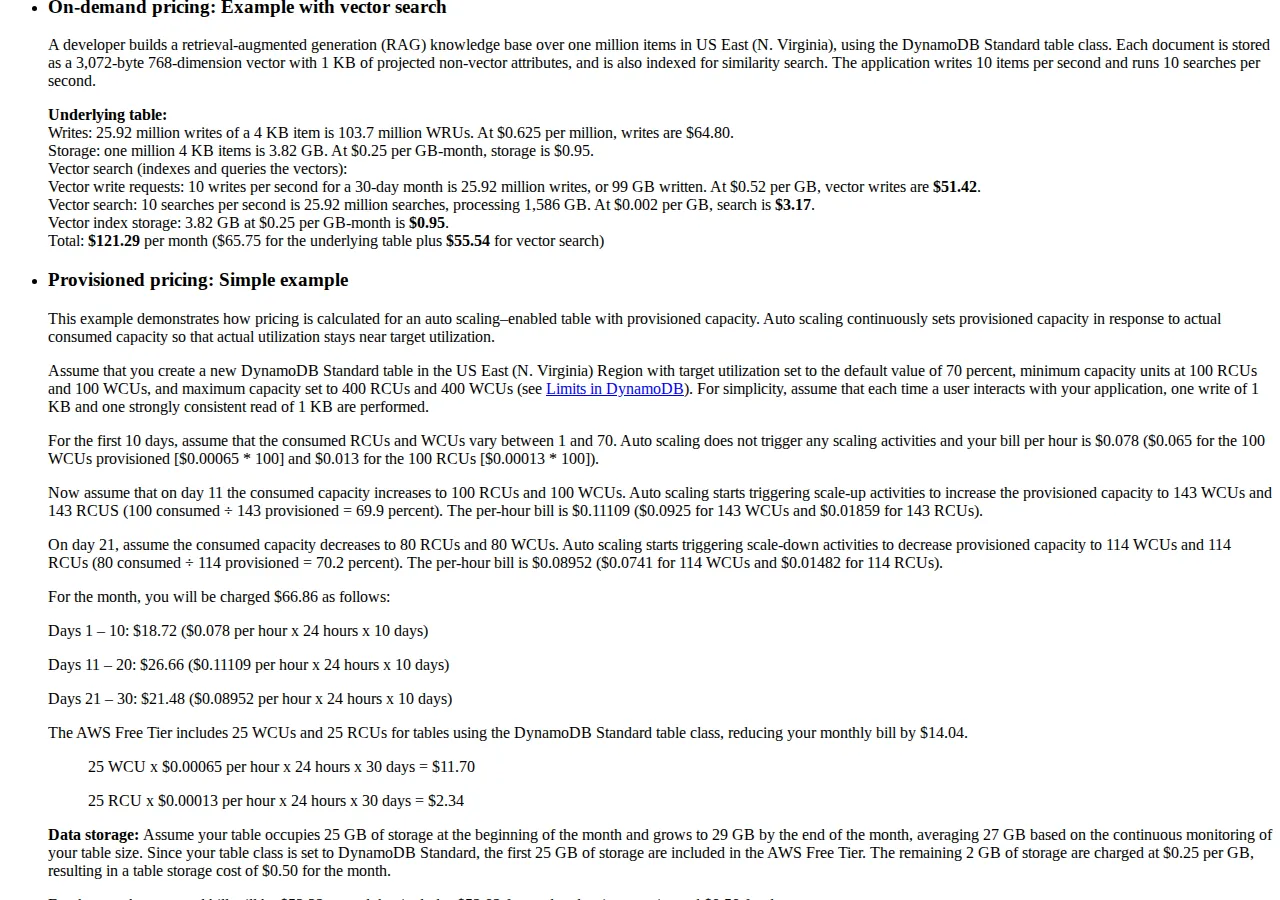
DataStax Astra DB is the managed Cassandra service built on the same engine: serverless, multi-cloud, metered per request unit. Its metered rates on AWS in the Americas are $0.62 per million write request units and $0.37 per million read request units, with storage at $0.25 per GB-month and internet data transfer at $0.11 per GB. The meters match DynamoDB's shapes — a write unit is up to 1 KB, a read unit up to 4 KB — but reads cost nearly three times DynamoDB's rate, which is the price of the Cassandra data model on a serverless meter. Since IBM's acquisition of DataStax in May 2025, Astra DB is sold inside IBM watsonx.data and priced in Resource Units at a $1 list price per unit; the metered rates above are the schedule still documented in the Astra docs, so a new buyer should confirm the RU conversion on the watsonx.data pricing page before signing. The $25 monthly credit is the honest free tier: about 30 million reads, 5 million writes, and 40 GB.
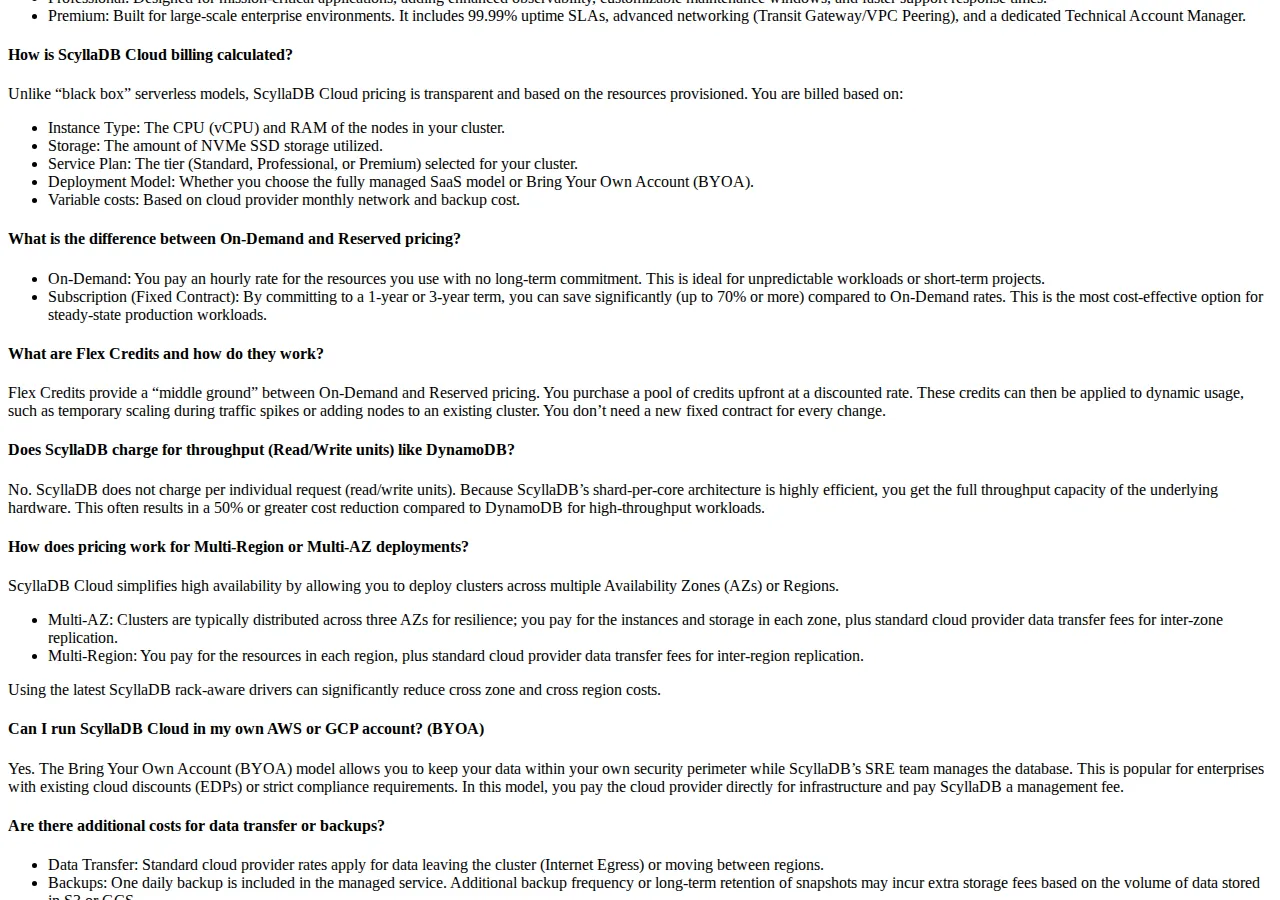
ScyllaDB Cloud publishes no list price. Billing is by instance type (vCPU and RAM), NVMe storage utilized, and service tier, with on-demand hourly rates and subscriptions of one or three years saving up to 70 percent. It charges nothing per request — the vendor's own pricing FAQ states it does not bill read or write units — which makes it the only one of the three whose bill does not grow with traffic. The priced proxy for a managed ScyllaDB cluster is a third-party host: Elestio's managed ScyllaDB starts at $16 a month for 2 vCPU, 4 GB of RAM, and 60 GB of storage, rising to $169 a month for 16 vCPU, 64 GB, and 600 GB.
| Cost driver | Cassandra (self-hosted) | ScyllaDB Cloud | DynamoDB |
|---|---|---|---|
| License | $0, Apache 2.0 | Quote-only, AGPL core | None, AWS service |
| Throughput billing | None — sized by nodes | None — sized by vCPU | $0.625/M writes, $0.125/M reads |
| Storage billing | VM disk, your price | NVMe, by tier | $0.25/GB-month Standard |
| Free tier | None | None published | 25 GB + 25 WCU/RCU, forever |
| Provisioned option | N/A | 1–3 year subscription, up to 70% off | WCU $0.00065/hr, RCU $0.00013/hr |
| Pricing authority | Apache Cassandra docs | ScyllaDB pricing page | AWS DynamoDB pricing page |
The worked month: one workload, three bills
The workload: 100 million reads a month of 4 KB items, strongly consistent; 20 million writes a month of 1 KB items; 500 GB stored. The month is 730 hours. The read rate is 38.58 reads per second; the write rate is 7.72 writes per second.
Reads cost $12.50, writes cost $12.50, and storage costs $118.75 after the 25 GB free tier. Storage is 83 percent of the bill — the exact inversion the founder callout warns about. The same workload on provisioned capacity needs 39 read capacity units and 8 write capacity units, and the bill is $126.25: $3.70 of reads, $3.80 of writes, and the same $118.75 of storage. Provisioned is 12 percent cheaper than on-demand at full utilization, which is why the 29 percent break-even matters: below it, on-demand wins; above it, provisioned wins, and the storage line never changes either way.
Astra DB on the same workload bills $37.00 of reads, $12.40 of writes, and $125.00 of storage — $174.40 gross, or $149.40 after the $25 credit. The read rate is what makes Astra the most expensive managed option here: $0.37 per million reads is nearly three times DynamoDB's $0.125, and at 100 million reads that gap is $24.50 a month before storage is counted.
ScyllaDB Cloud cannot be priced from a public page, so the reproducible number is the managed proxy. The workload's raw footprint is 500 GB times a replication factor of 3 — 1,500 GB before compaction headroom. At Elestio's tiers that needs three 600 GB nodes at $169 a month, or $507 a month for the cluster.
Who should pick which
Pick DynamoDB when the team is already on AWS, the workload is spiky or unknown, and nobody wants to run a database. The on-demand meter absorbs a 10x traffic spike without a page, and the free tier covers a prototype forever. Pick it with eyes open about the two multipliers: every global secondary index bills its own throughput and its own storage, so an index-heavy table can cost more than the base table, and storage at $0.25 per GB-month overtakes throughput on any read-heavy workload with a large dataset.
Pick Cassandra when the data must live on your own machines or across clouds, when the workload is write-heavy and steady, and when the team already operates distributed systems. The license is free and the data model is portable, but the operations are not: repairs, compaction, tombstone management, and version upgrades are a permanent headcount cost that no per-request price will ever show. Self-hosted Cassandra on rented machines runs $72 to $337 a month for the reference workload in the October 2026 snapshot — before the operator, the backups, and the 3 a.m. repair.
Pick ScyllaDB when the workload is Cassandra-shaped but the Cassandra node count is the problem — high throughput per node, predictable single-digit-millisecond P99 latency, and a bill that does not move with request volume. The honest limitation is the quote: a buyer who needs a number before a sales call cannot get one from the pricing page, and the subscription discount of up to 70 percent only exists for buyers who can commit to a year or three.
Migration checklist
- [x] Step 1: Measure the real workload for 30 days — reads and writes per second, average item size, storage growth per month, and the read-to-write ratio, because the ratio decides the winner.
- [x] Step 2: Model the partition keys against the queries — list every access pattern, name its partition key, and confirm no key carries more than a small share of traffic.
- [x] Step 3: Price the same workload on all three — on-demand and provisioned for DynamoDB, metered plus credit for Astra DB, and vCPU plus storage for ScyllaDB, with storage at replication factor 3 for the Cassandra-family legs.
- [x] Step 4: Add the index bill — every global secondary index in DynamoDB and every materialized view in Cassandra is a second table with its own throughput and storage.
- [x] Step 5: Test the failure mode before the migration — kill a node at quorum consistency, run a repair, and watch P99 latency, because the consistency level that looks fine in staging is the one that pages at 3 a.m.
- [x] Step 6: Run the break-even on utilization — if average utilization sits below 29 percent, stay on-demand; above it, reserve provisioned capacity and recheck monthly in the break-even calculator.