Carta vs Pulley vs Ledgy: Cap Table Pricing, 409A & Stakeholder Math
A cap table vendor holds the legal record of who owns your company, so switching one means exporting grants, vesting schedules, SAFEs and board consents without losing a single share.
The verdict in one table
| Question | Answer | Authority |
|---|---|---|
| Cheapest at 25 stakeholders | Carta Launch and Ledgy Launch, both $0 | Vendor pricing pages, November 14, 2026 |
| Cheapest published plan at 100 stakeholders | Pulley Growth $3,500 per year before overage, then Ledgy Scale about $5,650 per year | Pulley pricing page; Ledgy Scale €5,000 |
| Vendor a new buyer should not start on | Pulley, because it shuts down December 8, 2026 | Pulley shutdown FAQ, read November 14, 2026 |
| Best fit for a US Series A company | Carta: 409A, fund administration and investor tools in one platform | Carta plan structure; Vendr data |
Carta: one free tier, then a quote
Carta is the default cap table platform for venture-backed US startups, used by more than 55,000 companies per Pulley's shutdown FAQ, and its pricing page lists four tiers. Launch is free up to 25 stakeholders and under $1 million raised, covering the working cap table and securities issuance. Build covers up to 50 stakeholders and adds priced-round modeling. Grow is the first tier that includes 409A valuations, 409A audit support, board meetings and Form 3921. Scale adds ASC 718 and IFRS reporting, Rule 701 management and IPO advisory.
Carta does not publish its paid pricing: Build, Grow and Scale are all quote-only, and Carta's own FAQ describes the formula without numbers, a price per stakeholder with a minimum annual fee. The only reliable figures come from real contracts: Vendr analysed 679 Carta contracts and reports a median annual spend of $14,725, with early-stage companies paying $3,000 to $8,000 per year, growth-stage companies paying $10,000 to $25,000 per year, and late-stage companies paying $30,000 to $75,000 or more per year. Carta's breadth explains the premium, because 409A valuations, fund administration and investor tools live in one platform.
Pulley: the clearest price card in the market, closing in weeks
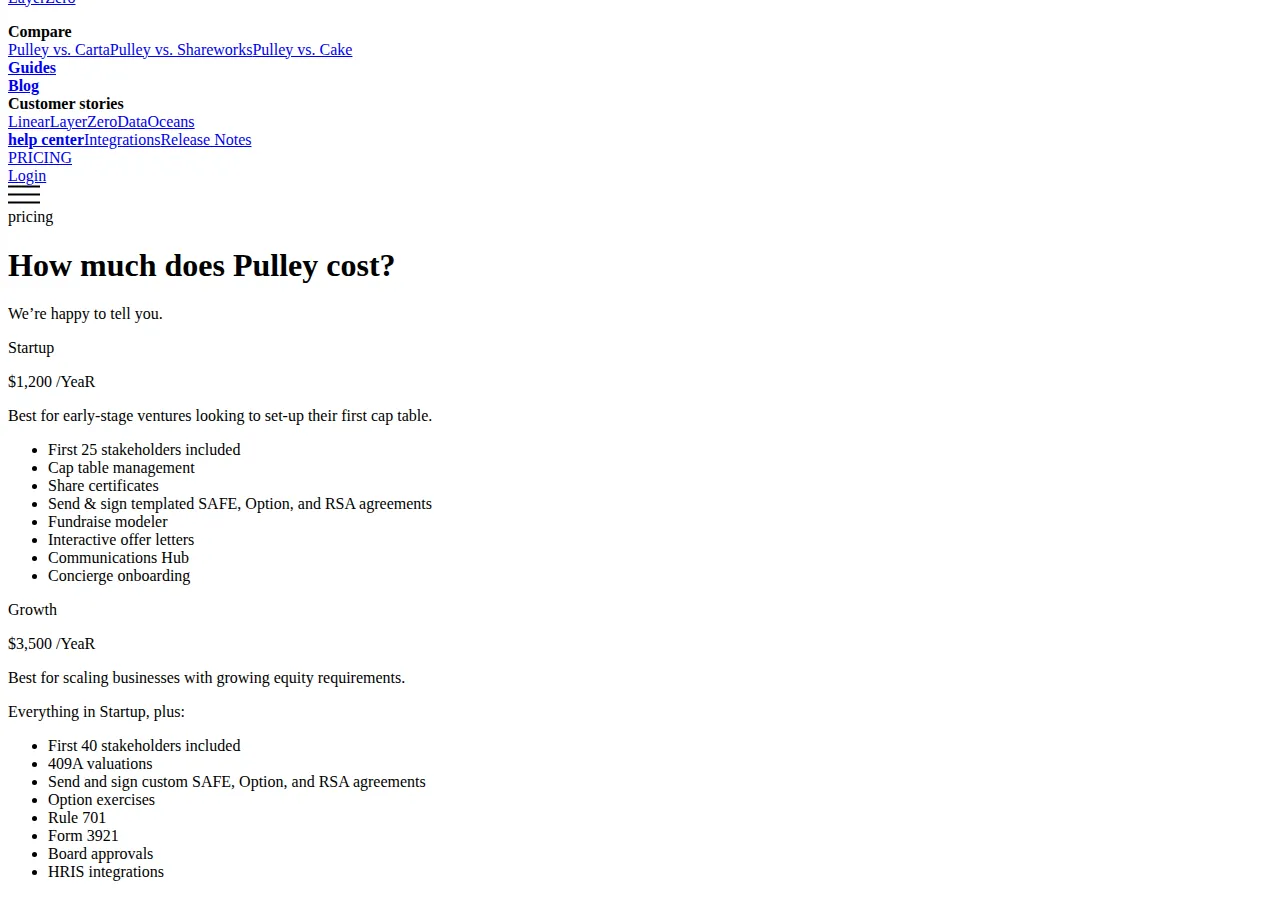
Pulley's pricing page is the most transparent of the three. Startup costs $1,200 per year and includes the first 25 stakeholders, cap table management, share certificates, templated agreements and a fundraise modeler. Growth costs $3,500 per year and includes the first 40 stakeholders plus everything in Startup, 409A valuations, custom agreements, option exercises, Rule 701 and Form 3921.
Angel investors writing checks of $50,000 or less count as half a stakeholder, so two small angels cost the same as one full stakeholder. Pulley's 409A page promises audit-defensible valuations in 3 to 5 days with a 100 percent audit pass rate and free lifetime audit review support, produced by in-house analysts. None of that changes the fact that Pulley is shutting down on December 8, 2026. Data stays reachable in a limited format until January 31, 2027, and customers who opt in keep their Pulley pricing for the first full year on Carta plus a credit for any unused prepaid balance. Opting in shares your contact and contract details with Carta, and a new 12-month Carta contract is required to complete the move; confirm the EIN on the new Carta account matches the EIN on the Pulley export before the first valuation.
Ledgy: the European answer, priced in euros
Ledgy is the Zurich-based equity platform built for companies with stakeholders across several jurisdictions, and its strength is the share-plan layer around the cap table: UK EMI schemes, French BSPCEs and other European share plans inside one platform.
Ledgy's pricing is harder to verify: when this article was researched on November 14, 2026, ledgy.com/pricing returned a 404, so the vendor no longer publishes its rate card there. The figures below come from independent comparisons that recorded Ledgy's published pricing in October 2026; confirm them with Ledgy before signing. Launch is free and covers the cap table, equity plans, simple vesting and stakeholder dashboards. Scale starts at €5,000 per year, includes 50 or more stakeholders, and adds HRIS integrations, automated granting, investor dashboards and EMI and Companies House reporting. Enterprise starts at €18,000 per year and adds single sign-on, SCIM, API access and IPO preparation support.
Founder & CEO Insight — Enow A. Jovial
The annual cost math at 25, 100 and 250 stakeholders
At 25 stakeholders
At 25 stakeholders two vendors charge nothing: Carta Launch and Ledgy Launch cost $0, while Pulley Startup costs $1,200 per year for exactly 25 included stakeholders, or $1,200 divided by 25, which equals $48 per included stakeholder per year.
Three years of either free tier costs 3 times $0, which equals $0, while three years of Pulley Startup costs 3 times $1,200, which equals $3,600.
At 100 stakeholders
At 100 stakeholders one figure goes missing. Pulley Growth costs $3,500 per year and includes 40 stakeholders, leaving 60 above the included count, because 100 minus 40 equals 60, and Pulley does not publish its overage rate, so the true cost is $3,500 plus an unknown overage. Ledgy Scale costs €5,000 per year with 50 or more stakeholders included, covering 100 stakeholders inside the base tier; at €1 to $1.13 that is €5,000 times 1.13, or $5,650 per year.
Pulley Growth costs $3,500 divided by 40, or $87.50 per included stakeholder per year, against Ledgy's $56.50, but that divides by the included count, not the real count.
At 250 stakeholders
At 250 stakeholders, Pulley Growth still lists $3,500 per year with 40 included, leaving 210 above the count, because 250 minus 40 equals 210. Ledgy Scale still lists €5,000 per year, about $5,650, although a company this size should expect Enterprise at €18,000 per year, or $20,340. Carta is quote-only, between $10,000 to $25,000 and $30,000 to $75,000 or more per year.
One secondary source reports a Carta partner rate card: Build at $1,600 per year plus $80 per stakeholder after the first 20, Grow at $3,900 per year plus $130 per stakeholder after the first 30, and Scale at $8,000 per year plus $200 per stakeholder after the first 40. A second independent comparison reports the identical ladder from the same partner page, so the card is corroborated, not single-source. Through that card, 100 stakeholders on Grow costs $3,900 plus 70 times $130, which equals $3,900 plus $9,100, or $13,000 per year, and 250 stakeholders on Scale costs $8,000 plus 210 times $200, which equals $8,000 plus $42,000, or $50,000 per year. Treat them as a scenario rather than a quote: they are corroborated figures Carta itself has not published on its main pricing page.
| Stakeholders | Carta | Pulley | Ledgy | Authority |
|---|---|---|---|---|
| 100 | $10,000 to $25,000 per year, quoted | $3,500 per year plus unknown overage for 60 stakeholders | About $5,650 per year, Scale at €5,000 | Vendr 679 contracts; Pulley; Ledgy Scale €5,000 |
| 250 | $30,000 to $75,000-plus per year, quoted | $3,500 per year plus unknown overage for 210 stakeholders | About $5,650 per year on Scale, or $20,340 on Enterprise at €18,000 | Vendr ranges; Pulley; Ledgy |
What the 409A valuation really costs
A 409A valuation sets the fair market value of your common stock, which sets the strike price of every option you grant. The rule behind it is Section 409A of the Internal Revenue Code, 26 U.S.C. Section 409A; the detail is covered in our Section 409A deferred compensation playbook. The rule covers stock issued by any corporation, C-Corp or S-Corp, so the valuation question follows the cap table, not the entity form.
Pulley includes the 409A valuation in its Growth plan at $3,500 per year, with a 3 to 5 day turnaround and free lifetime audit review support. The step from Startup to Growth therefore costs $3,500 minus $1,200, which equals $2,300 per year, and that $2,300 buys the 409A valuation plus 15 more included stakeholders, custom agreements, option exercises, Rule 701 and Form 3921. Carta includes 409A valuations from its Grow tier, which is quote-only, so the valuation cost sits inside an unseen quote. Ledgy lists independent 409A valuations on its Scale plan, delivered through valuation partners, and its Enterprise tier adds API access for programmatic cap table reads.
Who should not buy each vendor
Do not buy Pulley as a new vendor today: it ceases operations on December 8, 2026. Do not buy Carta Launch past $1 million raised or 25 stakeholders: crossing either line ends free eligibility and the next invoice is a quote you have not seen. Do not buy Carta Scale for a clean cap table and one 409A a year: you are paying for ASC 718 reporting, IPO advisory and fund administration your team may never open. Do not buy Ledgy as a US-only Delaware C-Corp or LLC with no European stakeholders: EMI and BSPCE reporting solve problems you do not have. Do not buy any of the three on the free tier if you need a 409A valuation this quarter: neither free tier includes one.
The migration math: what the Carta transition really costs
Pulley's shutdown FAQ promises that customers who opt in keep their Pulley pricing for the first full year on Carta, plus a credit for unused prepaid balance. That promise expires after year one, so the honest comparison prices two years, not one. Take a Pulley Growth customer at $3,500 per year: year one on Carta costs $3,500 under the price match, and year two costs the Vendr median of $14,725 per year if the quote lands at the median. The two-year total is $3,500 plus $14,725, which equals $18,225. The year-two increase alone is $14,725 minus $3,500, which equals $11,225, and $11,225 divided by $3,500 equals 3.21, so the second-year bill rises about 321 percent above the matched first year.
The same two years on Ledgy Scale cost 2 times $5,650, which equals $11,300, and the difference against the Carta path is $18,225 minus $11,300, which equals $6,925. That gap is an estimate built on the Vendr median, not a promise: get the year-two number in writing before signing.
The buying protocol
- Count stakeholders the way the vendor counts them, at your first renewal, not today.
- Price all three vendors at that renewal count, and treat any figure the vendor will not put in writing as unknown, not zero. For EU stakeholders, ask where the data is hosted and which data-protection rules (GDPR) apply.
- Ask each vendor for the 409A terms in writing: who performs it, the turnaround, and the audit support if it is challenged, and have your CPA read the valuation report before the board approves the strike price.
- Ask each vendor for the overage rate in writing: the price per stakeholder above the included count, and where the next tier starts.
- Ask each vendor for the year-two price in writing: a first-year discount hides the renewal, and the renewal is the price you actually pay.
- Sign the shortest term that holds the quoted price, and calendar the renewal 60 days ahead.
Execution checklist
- [x] Count stakeholders at the renewal date, including small angels at half weight.
- [x] Export the full cap table, including drafts, before starting any migration.
- [x] Confirm the free tier limits in the signed agreement.
The dilution and SAFE math behind the stakeholder counts lives in our cap table management and dilution playbook, and the vesting and 83(b) mechanics are covered in our Delaware C corp founder stock vesting and 83(b) guide. Run the return on the vendor spend through the ROI calculator: ten hours a month saved at $75 per hour returns $9,000 a year, more than the entire Pulley Growth plan.
The bottom line
Carta wins on breadth and loses on transparency: one free tier, then a quote that contract data places at a $14,725 median. Ledgy wins on published European pricing at about $5,650 per year for Scale, and loses relevance for a US-only company. Pulley wins on pricing clarity at $1,200 and $3,500 per year, and loses everything, because it shuts down on December 8, 2026. The live decision today is Carta or Ledgy, priced at the stakeholder count you will reach by renewal.