Cap Table Management and Dilution: The SAFE vs Convertible Note Playbook
A founder raises $500,000 on a SAFE with a $5,000,000 post-money cap and tells the team she sold 10 percent. Another raises the same $500,000 on a note with the same cap, a 20 percent discount, and 6 percent interest, and says the same. Both are wrong — this playbook runs one $500,000 raise through both instruments, share by share.
What a cap table is, and who maintains it
A capitalization table records every security issued, who holds it, and each holder's fully diluted percentage. For a Delaware C-Corp, the foundation is the Delaware General Corporation Law: § 151(a) lets a corporation issue classes or series of stock with rights stated in the certificate or a board resolution, and § 157(a) lets the board create rights or options to acquire shares — the hook for every option plan.
Four numbers carry the story: authorized shares, the ceiling in the certificate of incorporation, typically 10,000,000 for a new Delaware C-Corp; issued and outstanding shares, the ones actually held; the option pool, shares reserved for future grants, unissued; and fully diluted shares, issued shares plus the pool plus every convertible as if converted. Every percentage here is fully diluted. Before the first priced round, the founder or counsel keeps the table; after the round, most venture-backed companies move it to a platform such as Carta, reconciled to the signed documents, never to memory.
The option pool shuffle, worked
The option pool shuffle is the first dilution surprise in a priced round: when a Series A investor requires a pool of a given size after the round, the shares that create it are issued before the new money. The new investor's money therefore buys shares at a price set on a share count that already includes the enlarged pool.
The company this playbook follows: two founders hold 9,000,000 common shares, the pool holds 1,000,000 — 10,000,000 fully diluted pre-money shares. The Series A is $3,000,000 at a $10,000,000 pre-money valuation, with a 15 percent pool required after the round.
With the SAFE converted (1,000,000 shares), pre-money shares are 11,000,000. Solving both equations, the pool grows by 1,422,360 shares, the Series A issues 3,726,708, and the post-money total is 16,149,068. Founders fall from 62.94 percent to 55.73 percent — a 7.21-point cost.
SAFEs: the mechanics, with the math exposed
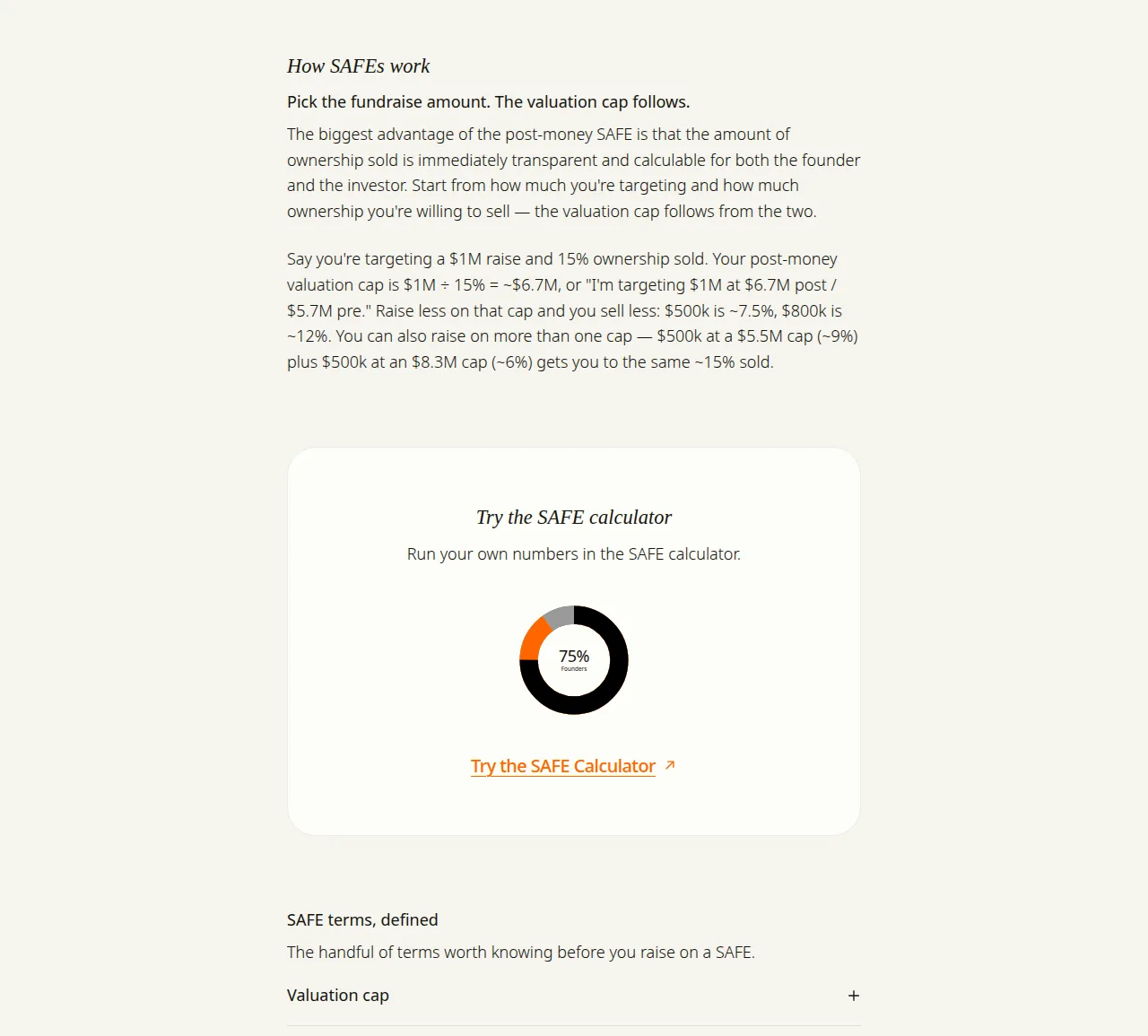
Y Combinator created the SAFE in 2013 and standardized on the post-money version in 2018. It is a contract for future equity, not debt: no interest, no maturity date, and the holder owns nothing until a triggering event converts the SAFE into preferred stock. YC publishes three post-money forms for US companies — valuation cap, discount, and uncapped most favored nation (MFN) — plus an optional pro rata side letter; conversion is automatic, with no minimum round size.
On a post-money cap SAFE, the ownership sold is fixed at signing:
YC's own example: a $1,000,000 raise at a $6,700,000 post-money cap sells about 15 percent; $500,000 on the same cap sells about 7.5 percent. The cap is measured after all SAFE money but before the priced round's new cash, and after the options and pool existing before the financing — but not after any new pool adopted in the financing, which is why the shuffle bites. Above the cap, the holder converts at the cap price; at or below it, the cap does nothing.
The discount form converts the holder below the round price, commonly 10 to 20 percent below — a 20 percent discount means the holder pays 80 percent. The MFN form has no cap and no discount; it adopts the best terms of any later SAFE, measured as of the later of signing or wiring — so close lower-cap SAFEs, fully wired, first. On an acquisition or IPO, the cap form gives the holder the greater of their money back or the as-converted value; on a shutdown, they receive their purchase amount back, junior to debt.
Convertible notes: debt that converts
A convertible note is a loan that can become stock. The SEC states it plainly: a convertible note is a loan made by an investor to a company that can be converted into a different security, typically converting from debt into preferred stock automatically upon the closing of the next funding round. Because it is debt, it carries the two features a SAFE does not: interest and maturity.
Interest accrues from the day the money arrives, usually 4 to 8 percent per year, and converts into shares:
The conversion price is the lower of the cap price and the discount price:
The maturity date, commonly 18 to 24 months, is the deadline that changes the negotiation. If no priced round has closed by maturity, the note becomes repayable, or the holder can demand repayment.
Side by side: the same $500,000, two instruments
Founders hold 9,000,000 shares, the pool holds 1,000,000 — 10,000,000 fully diluted pre-money shares. The Series A is $3,000,000 at a $10,000,000 pre-money valuation, eighteen months after the seed money arrives. The SAFE carries a $5,000,000 post-money cap; the note carries the same cap, a 20 percent discount, and 6 percent interest.
On the SAFE path, the cap price is $5,000,000 divided by 10,000,000 fully diluted shares, or $0.50 per share, and the SAFE converts into 1,000,000 shares — exactly 10 percent of the cap. On the note path, eighteen months of 6 percent interest turns $500,000 into a $545,000 conversion amount. The round price is $0.9017, so the discount price is $0.7214, but the $0.50 cap price is lower, so the note converts into 1,090,000 shares — interest alone bought 90,000 extra shares.
| Post-money SAFE | Convertible note | |
|---|---|---|
| Conversion amount | $500,000 (no interest) | $545,000 (6% over 1.5 years) |
| Conversion price | $0.50 (cap) | $0.50 (cap beats $0.7214 discount) |
| Shares issued | 1,000,000 | 1,090,000 |
| Series A shares issued | 3,300,000 | 3,327,000 |
| Post-Series A total shares | 14,300,000 | 14,417,000 |
| Founder ownership after Series A | 62.94% | 62.43% |
The gap is 0.51 percentage points, and it compounds at exit. Assuming the Series A preferred converts to common at exit:
| Exit valuation | Founder proceeds, SAFE path | Founder proceeds, note path | Cost of the note |
|---|---|---|---|
| $50,000,000 | $31,468,531 | $31,213,151 | $255,380 |
| $200,000,000 | $125,874,126 | $124,852,605 | $1,021,521 |
Pro-rata rights and how they change the math
Pro-rata rights let an investor buy enough of the next round to keep their ownership percentage. They are not in the standard SAFE; YC puts them in a separate side letter. YC's guidance: a $500,000 SAFE holder has a good case for pro-rata rights; a $10,000 holder does not.
The math has a trap. After conversion, the SAFE holder owns 1,000,000 of 11,000,000 shares, or 9.09 percent. Buying 9.09 percent of the round — $272,727 for 300,000 shares — leaves the holder at 8.90 percent, because the shares they buy also enter the denominator. To stay at 9.09 percent the holder must buy 330,000 shares for $300,000, which is 10 percent of the round:
A pro-rata right is a claim on future cash: the holder must be able to write the follow-on check. Grant them selectively.
Carta vs Pulley: what the platforms cost
Carta lists four tiers: Launch is free up to 25 stakeholders and $1,000,000 raised; Build covers up to 50 stakeholders; Grow and Scale carry a flexible stakeholder limit. Carta states that each package has a price per stakeholder with a minimum annual fee, and publishes no dollar figure for the paid tiers — the price is a quote. Pulley publishes numbers: Startup at $1,200 per year for the first 25 stakeholders; Growth at $3,500 per year for the first 40 stakeholders, including 409A valuations. Pulley counts an angel writing $50,000 or less as half a stakeholder.
| Platform | Entry tier | Published price | Stakeholders included | 409A valuations |
|---|---|---|---|---|
| Carta | Launch | Free | 25 stakeholders, up to $1M raised | Separate service |
| Carta | Build | Quote only | Up to 50 stakeholders | Separate service |
| Carta | Grow / Scale | Quote only | Flexible limit | From Grow |
| Pulley | Startup | $1,200 per year | First 25 stakeholders | Not included |
| Pulley | Growth | $3,500 per year | First 40 stakeholders | Included |
Choosing today: Carta Launch is free while the company stays under 25 stakeholders and $1,000,000 raised; get the paid quote in writing before the free tier is outgrown. Every hire with a grant, every advisor, and every SAFE holder is a stakeholder.
When to use which instrument
| Instrument | Choose it when | Cost to the founder | Authority |
|---|---|---|---|
| Post-money SAFE, valuation cap | Speed matters, round is small | Dilution fixed at investment divided by cap | Y Combinator SAFE documents |
| Post-money SAFE, discount | No valuation can be agreed | Holder converts below the round price | Y Combinator SAFE documents |
| Post-money SAFE, MFN | Early investor funds now; no cap set yet | Later SAFEs set the terms | Y Combinator SAFE documents |
| Convertible note | Investor requires debt protection | Interest accrues and converts; maturity creates a deadline | SEC, Common Startup Securities |
| Priced equity round | Valuation is agreed | Full negotiation, no conversion overhang | 8 Del. C. § 151(a), (e) |
A SAFE is the default for a first raise under about $1,000,000; a note fits when the investor insists on creditor protection; a priced round fits when a lead investor has set the valuation. Before pricing any of these, confirm the company can carry its own costs — the Break-Even Calculator shows the revenue the business must reach without another raise.
Common cap-table mistakes
The unissued option pool. Founders count the pool as founder shares because the shares are unissued. They are not — the pool belongs to future hires. Quote fully diluted percentages.
The expired note. A note that reaches maturity with no priced round gives the holder a repayment claim against a company with no cash. Calendar every maturity date at signing.
The stale cap table. A grant issued, an advisor promised shares, a SAFE converted, and none of it entered in the system of record. At the priced round, counsel rebuilds the table from email and the founders' percentage drops. Reconcile monthly, and after every issuance.
The valuation shortcut. Founders price option grants from the last round's valuation instead of a current 409A valuation; the mechanics are in the section 409A deferred compensation playbook.
Who should not use this playbook
This playbook is for Delaware C-Corp founders raising seed money on SAFEs or convertible notes before a priced round — not LLCs, where ownership is measured in membership interests — and is not a substitute for counsel. Vesting and the 83(b) election are covered in the Delaware C-Corp founder stock vesting and 83(b) guide and the section 83(b) election playbook.
Founder & CEO Insight — Enow A. Jovial
Execution checklists
Before signing:
- [x] Fix the denominator: founders' shares, pool, and every outstanding SAFE and note on one fully diluted count.
- [x] Run the two-column table: the same raise as a SAFE and as a note, at two exit valuations.
- [x] Calendar the maturity date: set a reminder six months before maturity.
- [x] Confirm board approval: a written consent filed with the signed instrument.
Monthly close:
- [x] Enter every issuance within a week, each traced to a signed document.
- [x] Reconcile the platform to the documents: counts must tie to the paper file.
- [x] Recheck the stakeholder count: crossing 25 stakeholders or $1,000,000 raised ends Carta Launch.
Raising the priced round:
- Freeze the cap table and confirm the fully diluted count with counsel.
- Model the round three ways: no pool change, the required pool, and pro-rata exercised.
- Price the round on the share count that includes the enlarged pool.
- Convert every SAFE and note, and verify each holder's share count.
- File the amended certificate, issue the new shares, and update the platform the same day.
The decision in advance
Dilution is decided at signing, not at the priced round. Run the share math on one fully diluted denominator before signing, calendar every maturity date, and reconcile monthly.