Every limited liability company that does business in California pays the state 800 dollars a year for the privilege, whether it makes a profit or not, whether it has a single customer or none. On top of that flat tax sits a second charge, a fee that scales with the company's California income and reaches 11,790 dollars a year. This guide lays out the whole operation before the bill does: the 800-dollar tax under section 17941, the fee tiers under section 17942, the forms and the calendar, the first-year exemption and its expiry, and the Delaware comparison with reproducible arithmetic.
Why it matters
The California LLC tax is a fixed cost that does not scale down with the business. A company with 100,000 dollars of net profit and 2,000,000 dollars of gross receipts pays the same fee as a company with 2,000,000 dollars of profit, because the fee is charged on gross income plus cost of goods sold, not on net profit. Founders who budget for an 800-dollar tax and are billed 6,800 dollars have not been careless, they have been uninformed. The tax is also inescapable while the entity exists: section 17941 charges it for each taxable year, or part of a year, until a certificate of cancellation is filed, and the Franchise Tax Board states plainly that the yearly tax will be due, even if you are not conducting business, until you cancel your LLC.
> [!FOUNDER]
> "Founders ask me whether they should form in Delaware to escape the California 800 dollars. Delaware escapes nothing if the business operates in California: the company pays Delaware 400 dollars and California 800 dollars, plus the California fee, and ends up worse off than a California LLC. The only escape is not doing business in California at all."
> — Enow A. Jovial, Founder & Chief Executive Officer
The 800-dollar annual tax: section 17941
Section 17941(a) imposes the tax on every limited liability company doing business in California, in the amount set in subdivision (d) of section 23153: 800 dollars. Section 17941(b) extends it to any LLC whose articles of organization have been accepted or whose certificate of registration has been issued. The tax is due on or before the 15th day of the fourth month of the taxable year under section 17941(c). For a calendar-year LLC that means April 15; for a new LLC it means the 15th day of the fourth month after filing with the Secretary of State. The Franchise Tax Board gives the example directly: an LLC that registers on June 18, 2020 owes its first annual tax on September 15, 2020. The tax is paid with the LLC Tax Voucher, FTB Form 3522.
Two exemptions are worth knowing. Section 17941(f) exempts a small business solely owned by a deployed member of the United States Armed Forces, where the LLC has total income of 250,000 dollars or less and operates at a loss or ceases operation while the owner is deployed. Section 17941(g) is the first-year exemption, and it is the one most often misunderstood: it applies only to LLCs that organise or register on or after January 1, 2021 and before January 1, 2024. An LLC formed in 2026 pays the 800 dollars in its first year.
The gross-receipts fee: section 17942
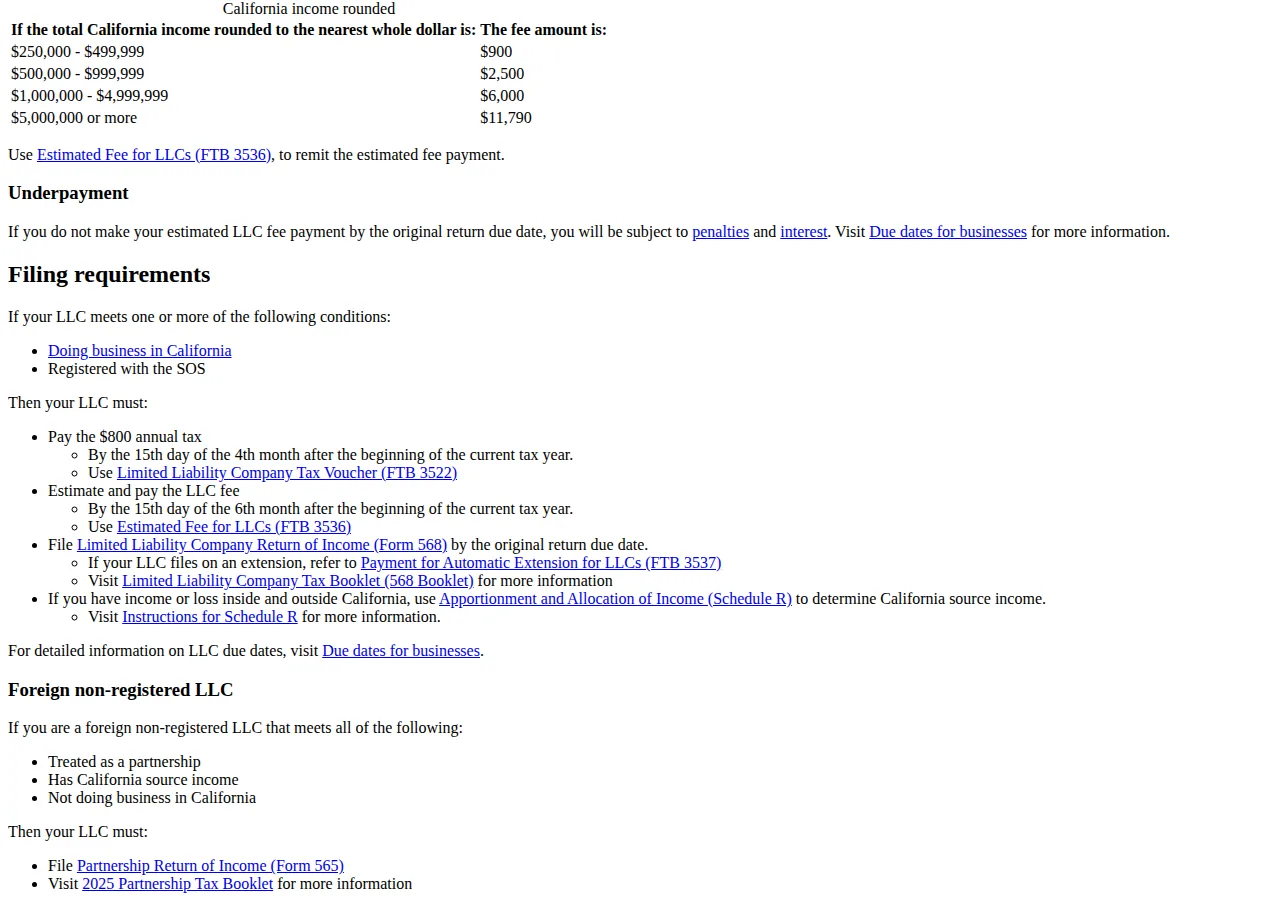
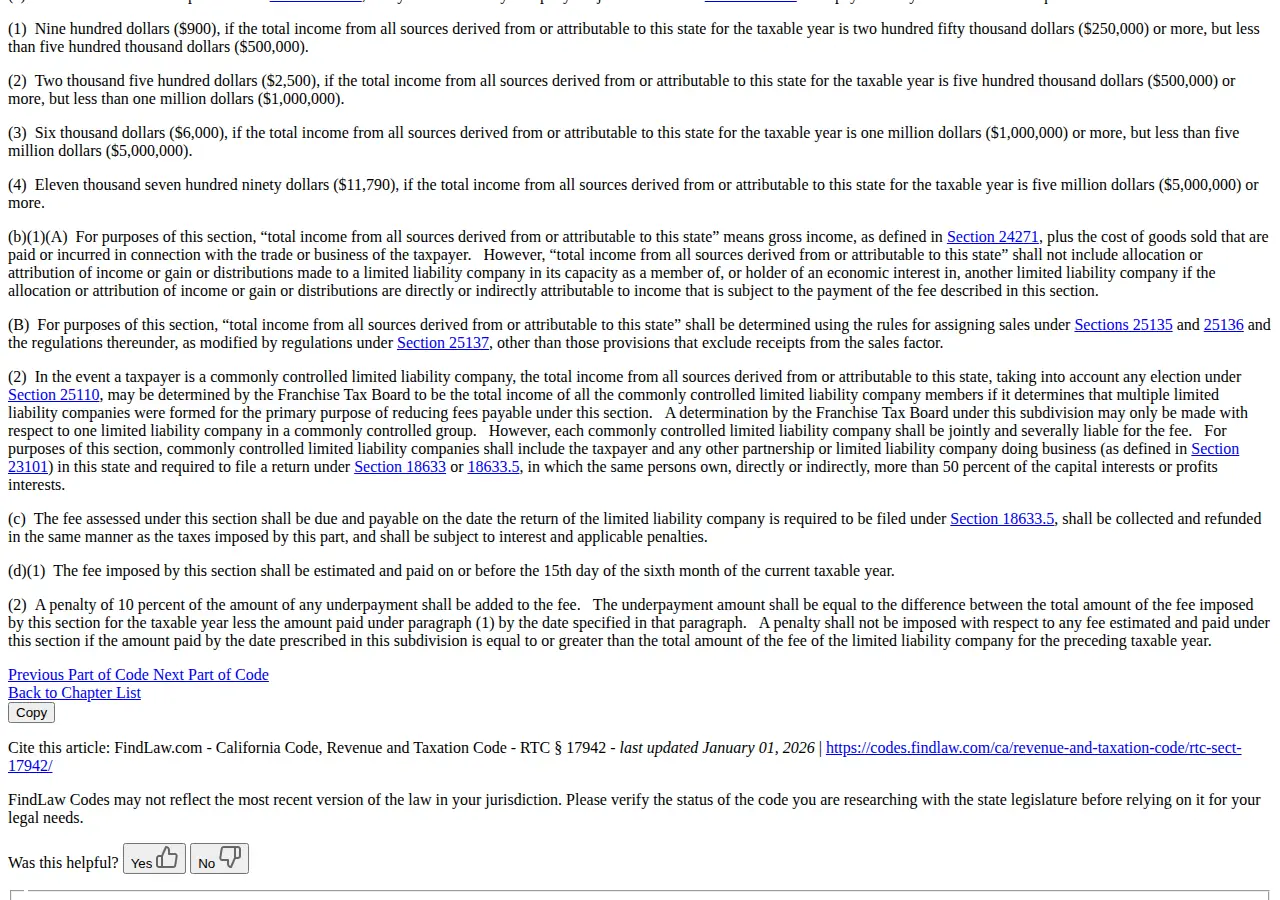
The annual tax is only half the bill. Section 17942 charges an additional annual fee on top of the 800 dollars, scaled to the LLC's total income from all sources derived from or attributable to California.
| California total income | Annual LLC fee | Authority |
| :--- | :--- | :--- |
| Under 250,000 dollars | 0 dollars | Section 17942(a); FTB LLC page |
| 250,000 to 499,999 dollars | 900 dollars | Section 17942(a)(1); FTB LLC page |
| 500,000 to 999,999 dollars | 2,500 dollars | Section 17942(a)(2); FTB LLC page |
| 1,000,000 to 4,999,999 dollars | 6,000 dollars | Section 17942(a)(3); FTB LLC page |
| 5,000,000 dollars or more | 11,790 dollars | Section 17942(a)(4); FTB LLC page |
The fee must be estimated and paid by the 15th day of the sixth month of the current taxable year, using the Estimated Fee for LLCs, FTB Form 3536. Section 17942(d)(2) adds a penalty of 10 percent of any underpayment, measured as the fee for the year minus the amount estimated and paid by the June deadline. There is a safe harbour: no penalty applies if the amount paid by the deadline is at least the prior year's fee. The fee itself is due on the date the LLC return is required to be filed, under section 18633.5.
What the LLC pays each year
The annual total is the 800-dollar tax plus the fee tier.
$
\text{Annual California cost} = \$800 + \text{section 17942 fee}
$
$
\begin{aligned}
\$200{,}000 &: \$800 + \$0 = \$800/\text{yr} = \$8{,}000/10\text{yr} \\
\$400{,}000 &: \$800 + \$900 = \$1{,}700/\text{yr} = \$17{,}000/10\text{yr} \\
\$750{,}000 &: \$800 + \$2{,}500 = \$3{,}300/\text{yr} = \$33{,}000/10\text{yr} \\
\$2{,}000{,}000 &: \$800 + \$6{,}000 = \$6{,}800/\text{yr} = \$68{,}000/10\text{yr} \\
\$6{,}000{,}000 &: \$800 + \$11{,}790 = \$12{,}590/\text{yr} = \$125{,}900/10\text{yr}
\end{aligned}
$
The step structure matters. Crossing from 499,999 dollars to 500,000 dollars of California income raises the fee from 900 to 2,500 dollars, a 1,600-dollar jump on one dollar of additional income. Crossing from 999,999 to 1,000,000 dollars raises it from 2,500 to 6,000 dollars, a 3,500-dollar jump.
The total-income trap: the fee is charged on gross receipts, not profit
Section 17942(b)(1)(A) defines total income as gross income, as defined in section 24271, plus the cost of goods sold paid or incurred in connection with the trade or business. For a company that sells goods, gross income is gross receipts minus cost of goods sold, so adding cost of goods sold back produces a figure very close to gross receipts. The fee is therefore charged on the top line, not the bottom line: a low-margin business pays the same fee as a high-margin business at the same revenue. Take a distributor with 2,000,000 dollars of gross receipts, 1,900,000 dollars of cost of goods sold, and 100,000 dollars of net profit. Total income is 2,000,000 dollars, and the fee is 6,000 dollars: 6 percent of the company's entire net profit.
> [!KEY TAKEAWAY]
> Budget the California LLC on gross receipts, not profit. The 800-dollar tax is flat, the fee is charged on total income, which for a goods business is effectively gross receipts, and the tiers jump by 1,600 dollars at 500,000 dollars of income and by 3,500 dollars at 1,000,000 dollars.
Delaware versus California: the arithmetic
Delaware charges its own LLCs an annual tax of 400 dollars under 6 Delaware Code section 18-1107(b), due on June 1, with a 200-dollar penalty for late payment and interest of 1.5 percent per month until paid. A certificate is cancelled if the tax goes unpaid for three years. The comparison that matters is three concrete cases:
$
\begin{aligned}
\text{Delaware LLC, no CA business} &: \$400/\text{yr} = \$4{,}000/10\text{yr} \\
\text{California LLC at \$2M income} &: \$800 + \$6{,}000 = \$6{,}800/\text{yr} = \$68{,}000/10\text{yr} \\
\text{Delaware LLC doing business in CA} &: \$400 + \$800 + \$6{,}000 = \$7{,}200/\text{yr} = \$72{,}000/10\text{yr}
\end{aligned}
$
A Delaware LLC that genuinely does no business in California saves 400 dollars a year against a California LLC at the lowest tier, and 6,400 dollars a year against a California LLC at 2,000,000 dollars of income. But a Delaware LLC that does business in California must register as a foreign LLC, and then it pays both states: 400 dollars to Delaware and the full California 800 dollars plus the California fee. At 2,000,000 dollars of income that is 7,200 dollars a year, or 400 dollars a year more than the California domestic LLC, and 4,000 dollars more over ten years. The Delaware formation also adds a registered agent, a foreign registration, and a second compliance calendar. Run the comparison through the break-even calculator with the company's own revenue and margin: Delaware wins only when the business genuinely operates outside California. The Delaware franchise-tax guide for corporations, Delaware franchise tax: authorised shares versus assumed par value, covers the corporate side, where a C corporation pays franchise tax on authorised shares or assumed par value, while a Delaware LLC pays the flat 400 dollars shown here.
The first-year exemption, the short-form cancellation, and the calendar
The first-year exemption under section 17941(g) applies only to LLCs that organised or registered on or after January 1, 2021 and before January 1, 2024. An LLC formed in 2026 owes the 800 dollars in its first year, due on the 15th day of the fourth month after filing with the Secretary of State. There is one narrow escape for a company that changes its mind quickly: if the LLC cancels within one year of organising, it can file a short-form cancellation, Secretary of State Form LLC-4/8, and will not be subject to the annual 800-dollar tax for its first tax year. The annual calendar for a calendar-year LLC is fixed: the 800-dollar tax with FTB Form 3522 by April 15; the estimated fee with FTB Form 3536 by June 15; the return, Form 568, by the original return due date. The penalty is mechanical: a fee of 6,000 dollars with nothing estimated by June 15 draws a 600-dollar penalty, 10 percent of the underpayment; the safe harbour is to estimate at least the prior year's fee.
> [!WARNING]
> The 800-dollar tax does not stop when the business stops. Section 17941(b) charges the tax until a certificate of cancellation is filed with the Secretary of State, and the Franchise Tax Board warns that the tax will be due even if you are not conducting business. A founder who abandons a dormant LLC instead of cancelling it accumulates 800 dollars a year plus penalties and interest.
Decision table: California domestic LLC vs Delaware LLC
| Factor | California domestic LLC | Delaware LLC, no California business | Delaware LLC doing business in California | Authority |
| :--- | :--- | :--- | :--- | :--- |
| Annual state tax | 800 dollars | 400 dollars | 400 dollars to Delaware plus 800 dollars to California | Section 17941; 6 Del. C. section 18-1107(b) |
| Gross-receipts fee | 0 to 11,790 dollars by tier | None | 0 to 11,790 dollars by tier, same as a California LLC | Section 17942(a) |
| Total at 2,000,000 dollars income | 6,800 dollars per year | 400 dollars per year | 7,200 dollars per year | Derived above |
| Total over 10 years at that income | 68,000 dollars | 4,000 dollars | 72,000 dollars | Derived above |
| Due dates | Tax April 15; fee estimate June 15 | June 1 | June 1 to Delaware; April 15 and June 15 to California | Sections 17941(c), 17942(d)(1); 6 Del. C. 18-1107(c) |
| Best fit | Operating in California | Operating outside California | Almost never; the worst of both states | Editorial analysis |
A Delaware LLC is cheaper only when the business is genuinely outside California. The moment the company hires, signs a lease, or sells into California, it is doing business there, and the Delaware structure costs more than the California one. The entity-choice guides for venture-backed companies, LLC versus Delaware C corporation for venture startups and Delaware benefit corporation versus B Corp certification, cover the cases where Delaware earns its keep: venture financing, preferred stock, and public-benefit purposes.
The annual California LLC checklist
Operator boundaries: who this guide is for, and who should stay away
This guide is for a founder forming or operating an LLC with California activity, an accountant setting the fee estimate for a client, and a cross-border operator deciding whether a Delaware LLC saves anything. It is not a substitute for a tax adviser on whether the company is doing business in California: that determination turns on facts such as employees, property, and sales in the state, and getting it wrong means either paying tax that is not owed or failing to register and facing penalties. It is not a guide to California income tax on the LLC's earnings, or to the corporate franchise tax.
Who should NOT form a California LLC
A founder with no California customers, employees, or property should not form a California LLC; a Delaware or Wyoming LLC costs less. A founder who wants a Delaware LLC purely to avoid the California tax while operating from California should not: the foreign registration brings the California tax and fee back in full, plus the Delaware 400 dollars. A founder who plans to split one business into several LLCs to keep each under the 250,000-dollar fee threshold should not: section 17942(b)(2) lets the Franchise Tax Board aggregate commonly controlled LLCs formed primarily to reduce the fee, and each LLC is jointly and severally liable. And a founder who cannot afford 800 dollars a year should not form an LLC yet; a sole proprietorship costs nothing to maintain.
> [!TIP]
> Set the fee estimate on the prior year's fee, not on a guess about this year. Section 17942(d)(2) waives the 10 percent underpayment penalty entirely when the estimate paid by June 15 is at least the prior year's fee.
The California LLC tax is not complicated once stated plainly: 800 dollars a year for the privilege, a fee on gross receipts that reaches 11,790 dollars, a first-year exemption that expired at the end of 2023, and a Delaware alternative that only saves money outside California. The expensive mistakes are all failures of timing: the fee estimate missed in June, the tier boundary crossed unknowingly in December, the dormant LLC left uncancelled for three years.