A founder asks for a benefit corporation and gets two different answers, because the words name two different things. A Delaware public benefit corporation, or PBC, is a legal form created by statute: 8 Del. C. sections 361 to 368 of the Delaware Code. B Corp is a private certification run by B Lab, which scores a company on the B Impact Assessment and licenses the B Corp mark. One changes the duties of your board and who can sue you. The other changes what you can print on your packaging. Treat them as the same purchase and you buy the wrong one first.
> [!FOUNDER]
> The mistake I see most often is a founder paying for B Corp certification to get legal protection, or filing as a PBC to get a marketing badge. A PBC gives you a statute that protects a board that chooses mission over maximum profit. B Corp gives you a verified score and a mark. The order you buy them in matters more than either one alone.
What Delaware actually created
Section 362(a) of the Delaware Code defines a public benefit corporation as a for-profit corporation organized under the Delaware General Corporation Law, the DGCL, intended to produce one or more public benefits and to operate in a responsible and sustainable manner. The corporation must be managed to balance the stockholders' pecuniary interests, the best interests of those materially affected by its conduct, and the public benefit or benefits in its certificate of incorporation.
That balancing duty is the whole point of the form. A regular Delaware C-Corp board owes its fiduciary duties to stockholders, and a director who spends stockholder money on a social goal without a business case is exposed. A PBC board has a statutory instruction to weigh three interests at once. The certificate must identify specific public benefits under section 362(a)(1) and state in its heading that the corporation is a public benefit corporation under section 362(a)(2).
Section 362(b) defines "public benefit" as a positive effect, or a reduction of negative effects, on persons, entities, communities, or interests other than stockholders in their capacities as stockholders, including effects of an artistic, charitable, cultural, economic, educational, environmental, literary, medical, religious, scientific, or technological nature.
!Delaware Code section 362, the public benefit corporation definition
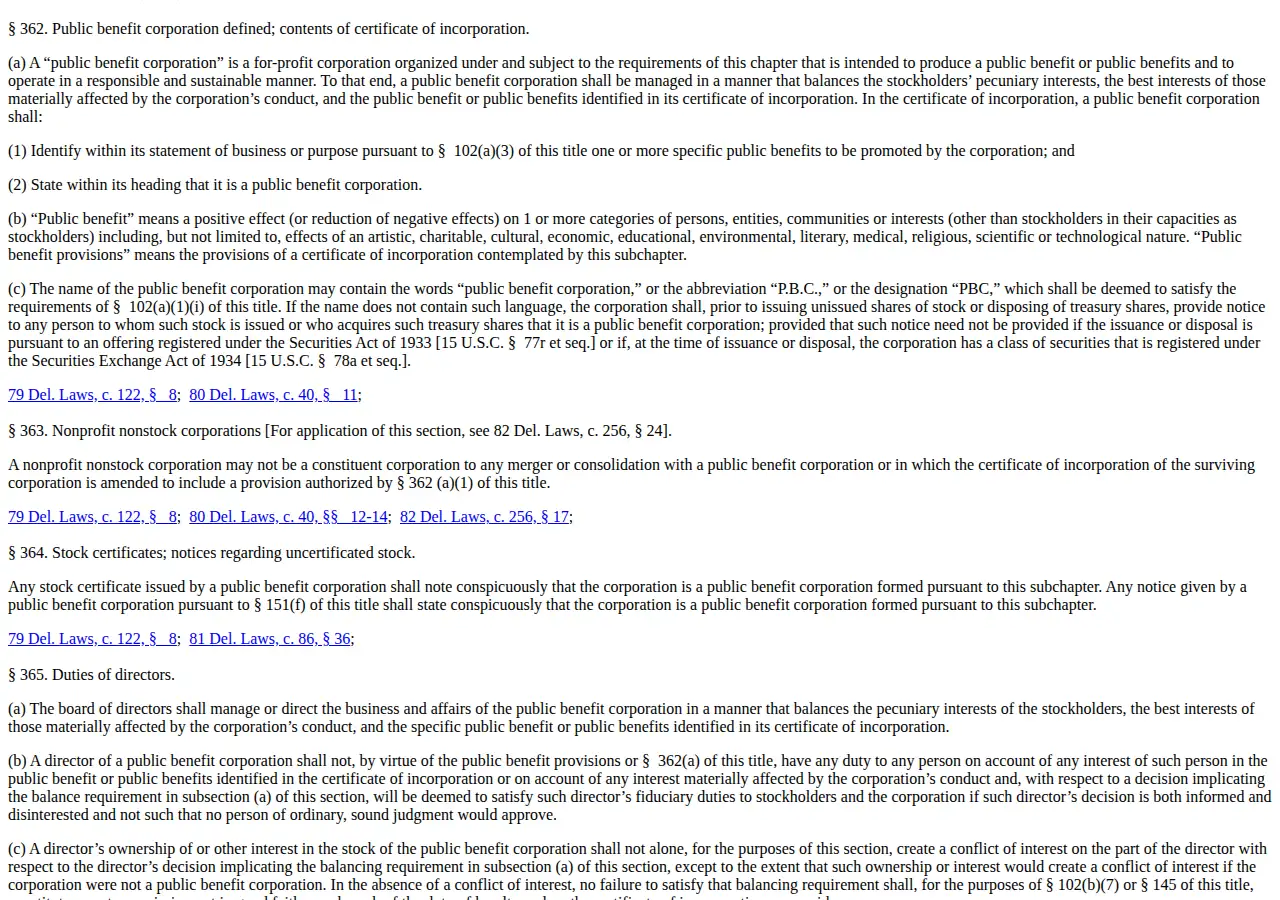
Section 362(c) adds a naming rule: the name may contain the words "public benefit corporation" or the abbreviation "P.B.C." or the designation "PBC". If it does not, the corporation must give notice to any person who receives unissued or treasury shares, unless the issuance is a registered offering under the Securities Act of 1933 or the corporation has a class of securities registered under the Securities Exchange Act of 1934.
Section 365(a) repeats the balancing duty at board level. Section 365(b) gives directors two protections. First, a director has no duty to any person on account of an interest of that person in the public benefit or in the interests of those materially affected, by virtue of the public benefit provisions alone. Second, a director is deemed to satisfy fiduciary duties if the decision is informed, disinterested, and not such that no person of ordinary sound judgment would approve it. The safe harbor is narrower than founders assume: it does not protect a board that rubber-stamps a mission project without reading the numbers, or a director who benefits personally from the mission spending.
Section 366 requires a statement to stockholders every two years with four contents: the objectives the board set, the standards it adopted, objective factual information on progress, and an assessment of success. The certificate or bylaws may require more: a statement more often, a public one, or one using a third-party standard or certification. What Delaware does not require is public reporting or a third-party standard, unless the company's own documents say so. B Lab itself notes that in Delaware, benefit corporations are not required to report publicly or against a third party standard.
Section 367 controls enforcement, the sharpest difference between the two systems here. A suit to enforce the balancing duty may be brought only by plaintiffs who own, individually or collectively, at least 2 percent of the outstanding shares, or, for a listed company, the lesser of 2 percent or shares with a market value of at least $2,000,000. Employees, customers, and the public cannot sue. Only stockholders with a real stake can, and the derivative-suit conditions of section 327 apply. The math of that threshold decides who actually holds a PBC accountable:
$
\text{Shares to sue (unlisted)} = 0.02 \times \text{outstanding shares}
$
$
\text{Shares to sue (listed)} = \min(0.02 \times \text{outstanding shares}, \frac{\$2{,}000{,}000}{\text{share price}})
$
A private company with 1,000,000 shares at $50: 2 percent is 20,000 shares worth $1,000,000, below $2,000,000, so the 2 percent test governs. A listed company with 10,000,000 shares at $50, a $500,000,000 value: 2 percent is 200,000 shares worth $10,000,000, above $2,000,000, so the dollar test governs: $2,000,000 divided by $50 is 40,000 shares, or 0.4 percent of the company.
What B Corp certification actually is
B Corp certification is not a legal form. It is a private standard owned by B Lab. To certify, a company must earn a minimum verified score of 80 points on the B Impact Assessment, the BIA, which measures governance, workers, community, environment, and customers. Certification is good for three years, then the company must recertify against the current BIA. Every certified company must amend its constitutional documents to include B Corp legal language. Start-ups with less than one year of operations are not eligible.
> [!KEY TAKEAWAY]
> A Delaware PBC is a statute you file. B Corp is a score you earn and a mark you license. The statute is enforced by stockholders in court; the score is enforced by B Lab, which can refuse or revoke certification. Need legal cover, file the PBC. Need a verified badge buyers and talent recognize, earn the score. Want both, file the PBC first, because the certification requires the legal-language amendment anyway.
The comparison, with the authority for each line
| Question | Delaware PBC | B Corp certification | Authority |
| :--- | :--- | :--- | :--- |
| What is it | A corporate form under statute | A private certification | 8 Del. C. section 362; B Lab |
| Performance bar | Self-reported against the board's own standards | Verified score of at least 80 on the BIA | 8 Del. C. section 366; B Lab |
| Reporting | Biennial statement to stockholders; public only if the company's documents require it | Recertification every 3 years against the current BIA | 8 Del. C. section 366; B Lab |
| Enforcement | Stockholders owning at least 2 percent, or the $2,000,000 listed-company test | B Lab can refuse or revoke | 8 Del. C. section 367; B Lab |
The PBC column is governance and liability; the B Corp column is verification and signaling. Protect a mission-driven board, buy the left. Win procurement teams and candidates who trust verified claims, buy the right. Want both, buy the left first: the certification's legal-language requirement is already satisfied by a PBC certificate.
The cost math
B Lab published a new fee structure for the United States and Canada in 2026, version 2.1, with a 5 percent increase for the year. The annual fee is set by revenue band and covers the average audit prices for most companies that complete the initial audit. Additional audit costs can apply for greater size, complexity, or risk. Equity Pricing is available. The bands, in US dollars:
| Annual revenue | Annual certification fee |
| :--- | :--- |
| $0 to $5,000,000 | $2,100 |
| $5,000,001 to $7,500,000 | $3,150 |
| $7,500,001 to $10,000,000 | $3,938 |
| $10,000,001 to $15,000,000 | $6,300 |
| $15,000,001 to $20,000,000 | $8,925 |
| $20,000,001 to $30,000,000 | $12,600 |
| $30,000,001 to $50,000,000 | $16,800 |
| $50,000,001 to $75,000,000 | $21,000 |
| $75,000,001 to $100,000,000 | $26,775 |
| $100,000,001 to $175,000,000 | $31,500 |
| $175,000,001 to $250,000,000 | $36,750 |
| $250,000,001 to $500,000,000 | $42,000 |
| $500,000,001 to $750,000,000 | $47,250 |
| $750,000,001 to $1,000,000,000 | $52,500 |
| Over $1,000,000,000 | Contact B Lab |
The honest unit of cost is the three-year cycle, because certification lasts three years:
$
\text{3-year certification cost} = 3 \times \text{annual fee}
$
At $4,000,000 of revenue the fee is $2,100 a year, so a cycle costs $6,300. At $12,000,000 the fee is $6,300, so a cycle costs $18,900. At $60,000,000 the fee is $21,000, so a cycle costs $63,000. The 5 percent increase shows in the entry band: $2,000 multiplied by 1.05 is $2,100.
At the top of the entry band, $2,100 on $5,000,000 is 0.042 percent. At $12,000,000, $6,300 is 0.0525 percent. At $60,000,000, $21,000 is 0.035 percent.
$
\frac{\$52{,}500}{\$2{,}100} = 25\times \quad \text{against} \quad \frac{\$1{,}000{,}000{,}000}{\$5{,}000{,}000} = 200\times
$
Compare that with the PBC side. The statute charges no certification fee. A PBC pays the same Delaware franchise tax as any Delaware corporation, on the same March 1 deadline. The biennial statement is a board-prepared document, not a state filing with a fee, and its cost is internal time. That is the real price difference: a PBC costs roughly the same as a C-Corp to run, while B Corp certification costs $2,100 a year at the entry band and $52,500 a year at the top, every year, with recertification every three years. The Delaware franchise tax guide runs the calculation for both the Authorized Shares Method and the Assumed Par Value Capital Method. Run the break-even calculator against the certification fee to see how many extra units it costs you at your margin before you apply.
The decision boundary
| Your problem | Buy this | Why |
| :--- | :--- | :--- |
| Governance: the board must be able to choose mission over maximum short-term profit | Delaware PBC | The statute, not the mark, protects the decision |
| Governance: the mission must survive a sale | Delaware PBC | The buyer inherits the mission by law, not by promise |
| Trust: buyers award points for a verified mark | B Corp certification | The 80-point verified score is what the scorecard reads |
| Trust: customers pay a premium for a verified claim | B Corp certification | The mark survives a skeptical buyer |
| Both | PBC first, then B Corp | The PBC certificate already contains the public benefit language the certification asks for |
> [!WARNING]
> Do not certify first and file later if the mission matters to the board. A certified company that is still a plain C-Corp has a verified score and a board whose fiduciary duty runs to stockholders alone. If a future board or buyer drops the mission, the certification is the only protection, and B Lab can revoke it only by removing the mark, not by stopping the decision. The statute is the protection. The mark is the signal.
Who should NOT do either
A pre-revenue startup with less than one year of operations cannot certify, and should not file as a PBC yet either: the certificate locks in a benefit before the business model is proven, and the biennial statement creates a reporting obligation the team has no data to fill. A company whose buyers never ask for certification and whose board never faces a mission-versus-profit conflict should do neither. A company that wants a tax benefit should do neither: neither a PBC nor a B Corp changes federal or state income tax treatment. A PBC is taxed as a C-Corp unless it elects S-Corp status. A founder who wants to use the B Corp mark in advertising without passing the 80-point bar should use neither and should not use the mark at all: B Lab enforces its trademark, and a false claim is a liability, not a strategy. If you are choosing between an LLC and a Delaware C-Corp in the first place, read the LLC versus Delaware C-Corp guide first, because the entity choice comes before the mission layer.
Why it matters
The two systems fail in opposite directions. A PBC fails quietly: the biennial statement is written, the board balances the three interests, and nobody outside the stockholder list ever reads it, so a company can carry the label for years without the public checking whether the benefit happened. B Corp fails loudly: a company that misses the 80-point bar or fails recertification loses the mark in public, visible to every buyer who relied on it. The quiet failure is more dangerous for a founder who believes the label alone proves the mission, because the statute protects the board without giving the public verification. The loud failure is more dangerous for a founder who treats the mark as permanent, because the three-year clock never stops. Buy the statute for the protection, buy the score for the proof.
Execution checklist
1. Pick the problem first. Governance means PBC. Trust means B Corp. Both means PBC first.
2. Draft the public benefit in one sentence with a number. "Free coding education to 500 public-school students a year in Wilmington" is a benefit.
3. Check the 80-point bar honestly. Run the B Impact Assessment as a self-assessment before you pay anything. If the score is below 80, fix the gaps first.
4. Price the three-year cycle. Multiply the annual fee for your revenue band by three, then divide by your annual revenue. If the result is above 0.1 percent, the fee is material and the decision deserves a board discussion.
5. Amend the certificate, or file as a PBC from the start. A new company files a PBC certificate. An existing C-Corp amends its certificate to add the public benefit language and the PBC heading, and should take legal advice on the vote.
6. Calendar the biennial statement. The section 366 statement is due every two years. Put it on the board calendar the day you file.
7. Decide on public reporting before you are asked. The statute does not require the biennial statement to be public. Decide now whether yours will be.
> [!TIP]
> If you are filing as a PBC and certifying as a B Corp, use the same language in both places. Write the public benefit in the certificate in the exact words you will use in the B Impact Assessment, and use the same standards to measure it in the biennial statement. One set of words, measured one way, reported twice, survives an audit.