Buzzsprout vs Libsyn vs Transistor: Podcast Hosting Pricing Playbook
A podcast host sells storage for your audio, an RSS feed that directories read, and a monthly bill. The three best-known hosts meter those things in different units: Buzzsprout charges by upload hours, Libsyn charges per show by upload hours, and Transistor charges by monthly downloads with unlimited shows. Pick the wrong meter and you pay for capacity you never use, or you hit a ceiling in the month your show takes off.
This playbook reads all three pricing pages as published on November 11, 2026, and prices four stated show profiles. Every figure traces to a vendor page opened this cycle, except Buzzsprout's month-to-month rates, which the vendor page does not show and two 2026 reads corroborate.
The meter is the price
Buzzsprout counts upload hours: every episode's length counts against your pool, unused hours do not roll over, and downloads are unlimited. Libsyn also counts upload hours, but per show: each show needs its own plan, and its page states that hosting plans "depend on how much new content you upload, not on your monthly download numbers," so audience growth never triggers a surcharge. Transistor counts monthly audio downloads instead — 20,000 on Starter, 100,000 on Professional, 250,000 on Business — plus 500 GB on Professional and 1 TB on Business.
A weekly 45-minute show publishes about 3 hours a month, which fits every entry tier. An interview show recording two hours a week publishes about 8 hours a month, which breaks Buzzsprout's Audio plan and Libsyn's Basic plan. Measure your show in the host's unit first.
The three price lists, read from the vendors' pages
Buzzsprout's page defaults to annual billing; parenthetical month-to-month rates are corroborated-secondary. Transistor's yearly price equals ten months.
| Host | Entry tier | Mid tier | Top tier | Metered by |
|---|---|---|---|---|
| Buzzsprout | Audio $15/mo annual ($18 monthly), 72 hrs/yr | Audio + Video $25/mo annual ($30 monthly), 72 hrs/yr | Multi-Podcast $30/mo annual ($36 monthly), 180 hrs/yr | Upload hours |
| Libsyn | Basic $12/mo, 3 hrs/mo | Advanced $25/mo, 10 hrs/mo | Max $150/mo, 55 hrs/mo | Hours, per show |
| Transistor | Starter $19/mo, 20,000 downloads/mo | Professional $49/mo, 100,000 downloads/mo | Business $99/mo, 250,000 downloads/mo | Downloads |
Free entry: Buzzsprout 2 hrs/mo for 90 days; Libsyn 30 days free on every plan; Transistor 14-day free trial.
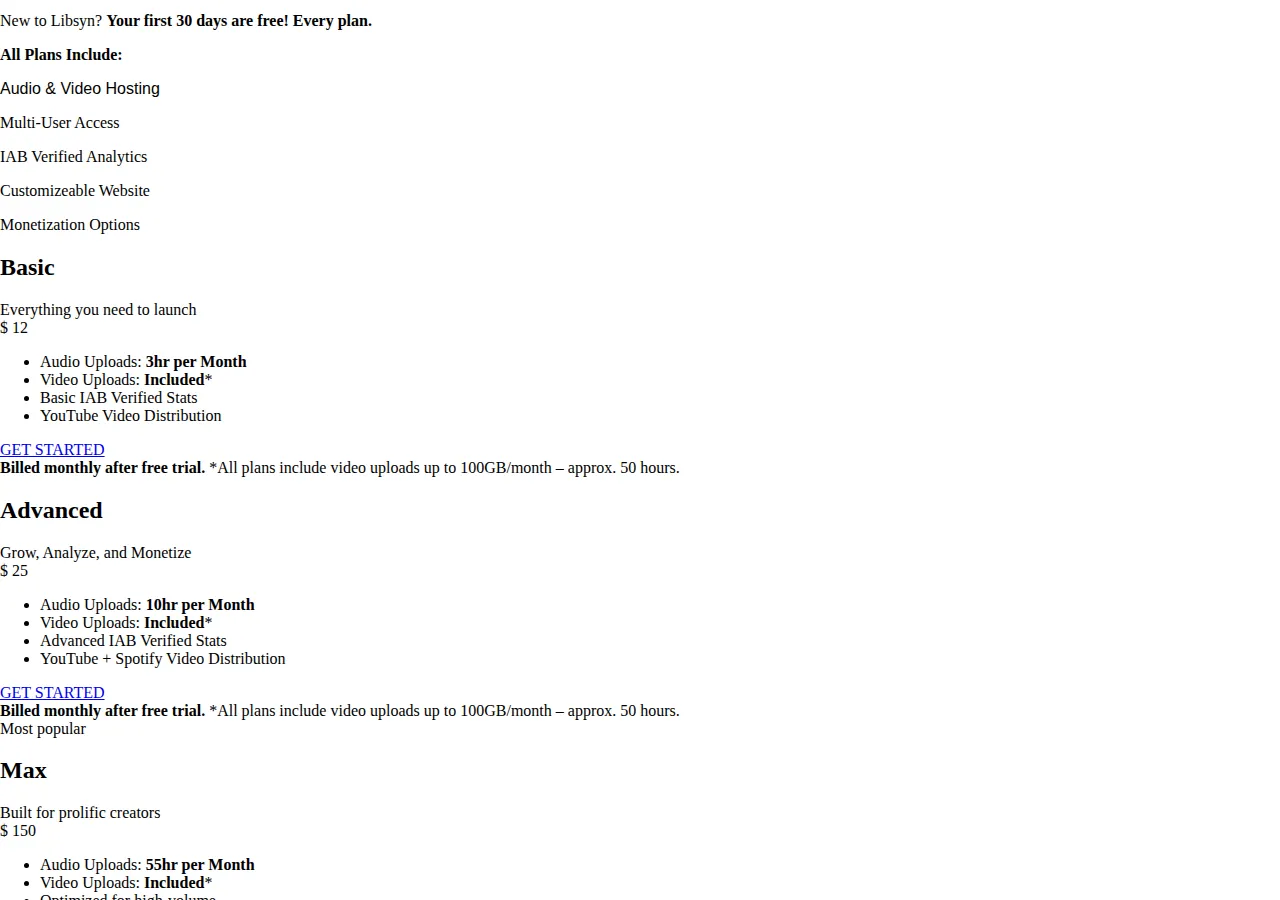
Buzzsprout: pay for hours, keep it simple
Audio at $15 a month billed annually ($18 month to month) gives one show 6 hours a month from a 72-hour yearly pool, with unlimited episodes and advanced stats. Audio + Video at $25 annual ($30 month to month) adds video distribution to Apple Podcasts, Spotify, and YouTube at 1080p. Multi-Podcast at $30 annual ($36 month to month) covers 5 shows sharing 180 hours a year. Every paid plan includes transcripts and Dynamic Content.
The catch is overage: extra time is billed at your plan's hourly rate — $4 an hour month to month, $2 an hour on annual billing. A 30-minute daily episode is about 15 hours a month, 9 hours past the Audio plan, or $36 of overage: double the plan itself. Buzzsprout suits a weekly show inside 6 hours and punishes a daily show quietly, one invoice at a time.
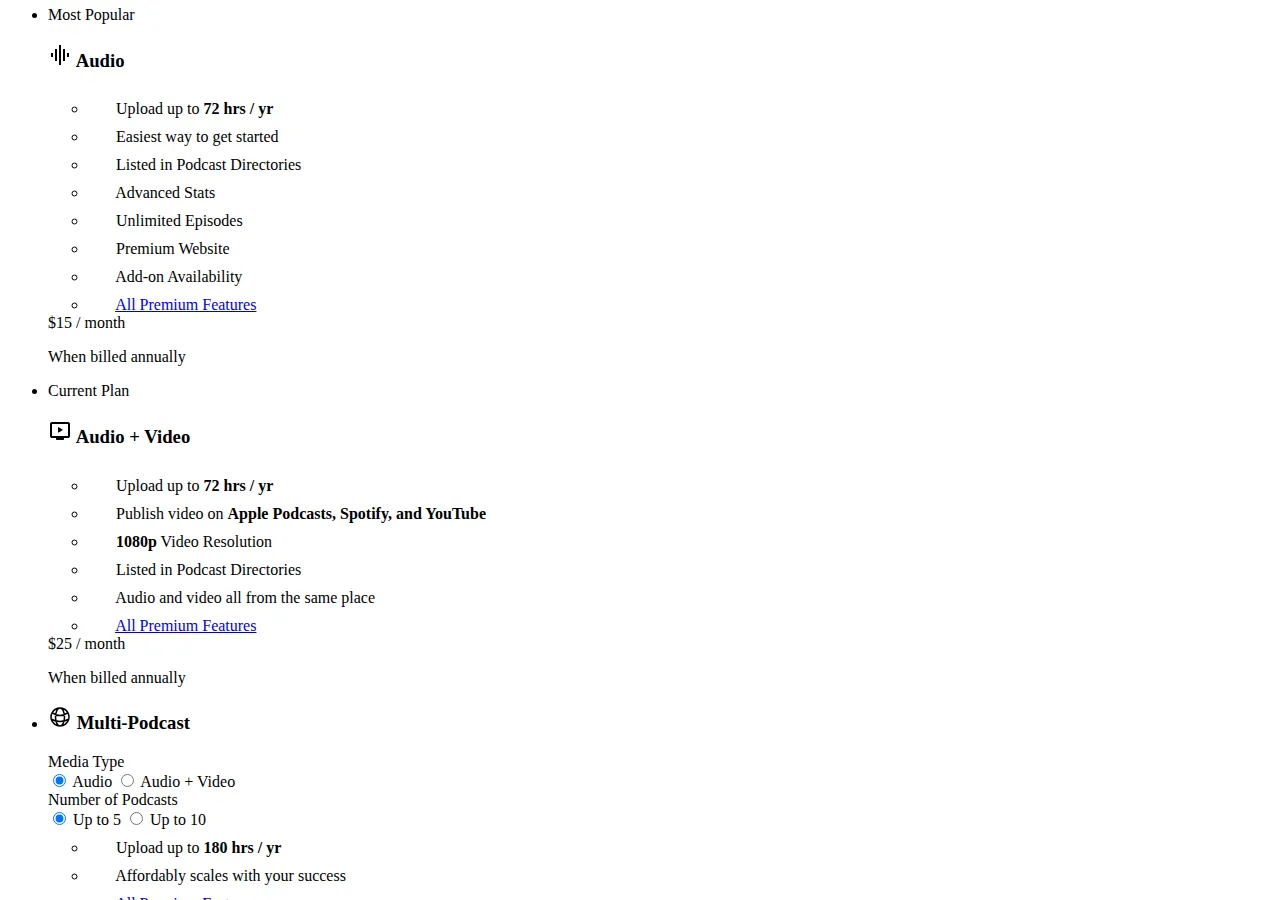
Libsyn: pay per show, never pay for downloads
Basic costs $12 a month for 3 hours of audio uploads, video uploads included up to 100 GB a month (about 50 hours), Basic IAB Verified Stats, and YouTube distribution. Advanced costs $25 a month for 10 hours, Advanced IAB Verified Stats, and YouTube plus Spotify video. Max costs $150 a month for 55 hours. The page also lists an $8 bare-essentials tier without published limits; Professional and Enterprise plans are quote-only.
Libsyn's decisive feature is the one it does not charge for: downloads. Its plans cap upload hours and nothing else, so a show with 200,000 downloads a month pays the same $12 as a show with 200 — the cheapest host here for any audio-only show publishing 3 hours or less. The weakness is the mirror image: every show needs its own plan, so a three-show network at 4 hours per show pays for three Advanced plans, or $75 a month. Every plan includes PodRoll, Automatic Podcast Ads, and Apple Podcasts Subscriptions; Libsyn states it has paid out over $112 million since 2017.
Transistor: pay for downloads, run every show on one bill
Starter costs $19 a month for unlimited podcasts, 20,000 monthly downloads, and 50 private subscribers. Professional costs $49 a month for unlimited podcasts including video, 100,000 downloads, 500 GB of storage, 500 private subscribers, and dynamic ads. Business costs $99 a month for 250,000 downloads, 1 TB of storage, 3,000 private subscribers, dynamic ads, and removal of Transistor branding. Yearly billing is ten months instead of twelve — $190, $490, $990 a year — saving 17 percent, per the page.
The risk runs the other way: a show jumping from 15,000 to 60,000 downloads in a month crosses from $19 to $49, and the bill more than doubles while the show is still celebrating. Transistor fits a creator with several shows or a private podcast, and fits worst for a single show whose audience is about to spike.
The four profiles, priced
Stated inputs, all on monthly billing. Profile A: one show, 4 episodes a month at 45 minutes, 10,000 downloads. Profile B: the same show at 50,000 downloads. Profile C: one show, 8 episodes a month at 60 minutes, 100,000 downloads. Profile D: a network of 3 shows, 4 hour-long episodes each, 100,000 downloads in total.
| Profile | Buzzsprout | Libsyn | Transistor | Cheapest |
|---|---|---|---|---|
| A: 3 hrs, 10k downloads | Audio $18 | Basic $12 | Starter $19 | Libsyn $12 |
| B: 3 hrs, 50k downloads | Audio $18 | Basic $12 | Professional $49 | Libsyn $12 |
| C: 8 hrs, 100k downloads | Audio $18 + $8 overage = $26 | Advanced $25 | Professional $49 | Libsyn $25 |
| D: 3 shows, 12 hrs, 100k downloads | Multi-Podcast $36 | 3 x Advanced $25 = $75 | Professional $49 | Buzzsprout $36 |
For Buzzsprout's Profile C, the overage is 2 extra hours at $4: $8 on top of the $18 base.
Profile B shows Libsyn's strength: the audience grew fivefold and the bill did not move, because the show still publishes 3 hours. Profile D shows its weakness: three shows mean three plans, and the network pays $75 against Buzzsprout's $36 for the same 12 hours.
One year and three years
Monthly prices hide the annual discount. Buzzsprout's annual billing cuts Audio from $18 to $15, Audio + Video from $30 to $25, and Multi-Podcast from $36 to $30. Transistor's yearly price is ten months for twelve on every tier. Libsyn publishes no annual discount.
The totals below price twelve months at the monthly-billing rates.
| Profile | 1-yr Buzzsprout | 1-yr Libsyn | 1-yr Transistor | 3-yr Buzzsprout | 3-yr Libsyn | 3-yr Transistor |
|---|---|---|---|---|---|---|
| A | $216 | $144 | $228 | $648 | $432 | $684 |
| B | $216 | $144 | $588 | $648 | $432 | $1,764 |
| C | $312 | $300 | $588 | $936 | $900 | $1,764 |
| D | $432 | $900 | $588 | $1,296 | $2,700 | $1,764 |
Annual billing changes Profile C on Buzzsprout: the Audio plan holds a 72-hour yearly pool, and 8 hours a month is 96 hours a year, so the overage is 24 hours at $2, or $48. The year costs $180 plus $48, or $228 — $84 less than the $312 monthly total, and cheaper than Libsyn's $300. The crossover moves too: monthly billing passes the $36 Multi-Podcast plan at 10.5 upload hours a month; annual billing moves it to 13.5 hours.
What each download actually costs
Cost per download falls as the audience grows. At Profile B's 50,000 downloads, Buzzsprout costs $0.36 per 1,000 downloads, Libsyn costs $0.24, and Transistor costs $0.98. At Profile A's 10,000 downloads the same three are $1.80, $1.20, and $1.90 per 1,000. The gap between Libsyn and Transistor is not a quality gap — it is the difference between metering hours and metering downloads.
Use this number to compare hosts at the same audience size, never to judge whether a show is worth running. For the revenue side, the podcast advertising CPM and sponsorship pricing playbook prices what those listeners are worth to an advertiser.
Monetization and dynamic ad insertion
Hosting is a cost; monetization is where the host either earns its keep or gets out of the way. Buzzsprout offers Subscriptions, Buzzsprout Ads, and Dynamic Content on paid plans, which swaps a segment in episodes already published. Libsyn puts PodRoll, Automatic Podcast Ads, and Apple Podcasts Subscriptions on every plan, and reserves dynamic ad insertion for its Professional and Enterprise plans, priced on application. Transistor includes dynamic ads on Professional and Business, making the $49 tier the cheapest place here to run inserted ads without a sales call.
Dynamic ad insertion turns the back catalog into inventory: without it, an ad read is baked into the audio file and listeners who find an old episode next year hear an expired offer; with it, the host stitches a current ad into the slot at download time, so the same episode earns again. If your plan is to earn from ads, price the tier that includes insertion, not the tier that hosts the audio. The newsletter world has the same tier logic, and the ConvertKit vs Beehiiv vs Substack newsletter pricing playbook shows how it plays out there.
Analytics: what you can actually see
Buzzsprout includes Advanced Stats on every paid plan, covering downloads by app, location, and episode. Libsyn's differentiator is verification: its stats are IAB Verified on every plan, with the Advanced tier adding deeper breakdowns and exports — the credential an advertiser asks for before paying. Transistor includes advanced analytics on every plan, with per-show pages, a network view, and API access. None publishes listener-level data: podcast analytics are download counts and app shares, not a customer list.
The business side: paying for hosting as a company
A podcast is a business expense the moment it earns or is run to earn. Register the show under an LLC or an S-Corp, get an EIN, and pay from the business account so the subscription is deductible. If you hire an editor or a producer, collect a W-9 before the first payment, pay by ACH for domestic contractors or by Wire when the bank requires it, and keep the invoices in a CSV export alongside your hosting receipts. Watch the FX line if you pay from a non-dollar account: a $19 charge can carry a conversion spread on every payment. Measure the show like a business: CAC is what a listener costs to acquire, LTV is what that listener returns, and the host is worth keeping only while LTV beats CAC plus the hosting bill. A video campaign can move both numbers; the YouTube ads vs TikTok ads video ROAS playbook prices that trade.
Which host for which show
| Show | Pick | Why | Authority |
|---|---|---|---|
| Weekly audio, under 6 hrs | Buzzsprout Audio | Simplest bill, transcripts included | Buzzsprout pricing page |
| Fast-growing audience | Libsyn Basic or Advanced | Downloads uncapped | Libsyn pricing page |
| Three or more shows | Transistor Professional | Unlimited shows, dynamic ads at $49 | Transistor pricing page |
| Daily show, 10+ hrs | Buzzsprout Multi-Podcast or Libsyn Max | Cheaper past 10.5 hrs/mo | Buzzsprout page; corroborated overage |
Founder & CEO Insight — Enow A. Jovial
Execution checklist: choose and launch in one sitting
- Measure your show: episodes per month, average minutes, downloads for the last 90 days.
- Pick the meter: under 6 hrs favors Buzzsprout; under 3 hrs with big downloads, Libsyn; several shows, Transistor.
- Price the year, not the month; check the pricing calculator.
- Start on the free trial: Libsyn's 30 days or Transistor's 14 days, with real episodes before paying.
- Publish two episodes; confirm Apple Podcasts and Spotify list the show.
- Set the monetization tier deliberately: confirm it includes dynamic ads before you record a sponsor read.
- Export your audio and feed data monthly, so a migration is a redirect, not a rebuild.
- Re-price every six months; when hours or downloads cross a tier boundary, move tiers the same week.