What podcast advertising costs
Podcast advertising is priced by the thousand. An advertiser pays a CPM, cost per mille, for every 1,000 downloads an episode earns in its first 30 days. A host-read spot costs more than a pre-produced spot served programmatically, because the buyer pays for reach and for the host's recommendation.
The market is large enough that the mistakes are expensive. United States podcast advertising reached $2.862 billion in 2025, up 17.6% on 2024, according to the IAB and PwC Internet Advertising Revenue Report for full year 2025. The 2024 figure was $2.433 billion.
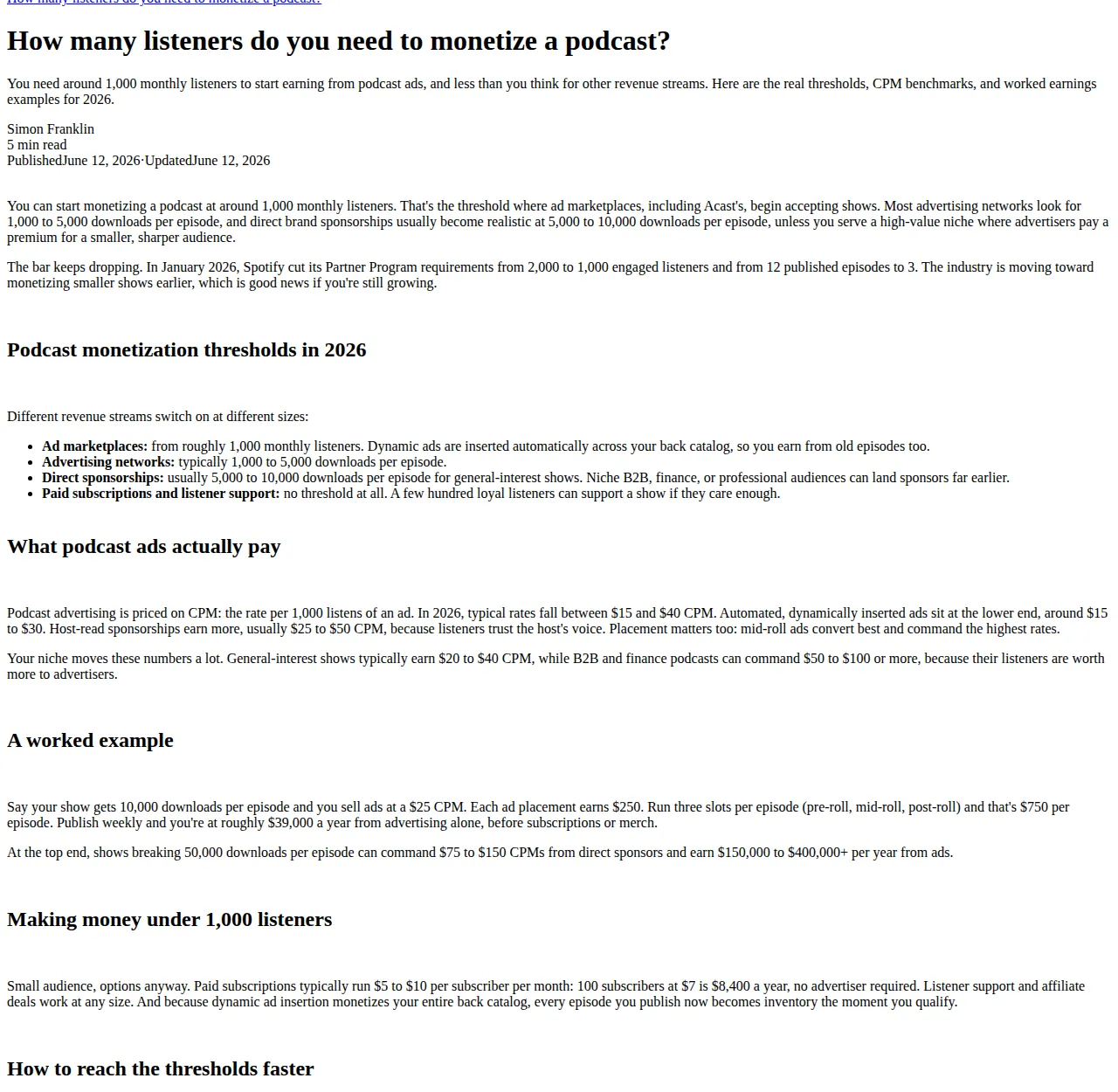
One fact first. No organisation publishes a measured, market-wide average podcast CPM for 2026. Libsyn Ads published a monthly average from real transactions for four years; the final edition reported $21.37 for a 60-second spot in September 2024. The series was discontinued and nothing replaced it. Every current figure here is a published rate card or starting rate, or arithmetic on the last measured average.
How a podcast CPM actually works
CPM stands for cost per mille, Latin for 1,000. In podcasting the thousand is counted in downloads, and Libsyn Ads counts the downloads an episode receives in its first 30 days. An episode keeps earning downloads for months, but the advertiser pays only for the first 30.
Example: a show with 50,000 downloads per episode in its first 30 days, at a $25 CPM, costs $1,250 for one placement, because 50,000 times 25 divided by 1,000 equals $1,250. At a $30 CPM it costs $1,500. Production, agency fees, and the landing page sit outside the CPM.
Downloads are not listens. A download is a file request, and the IAB Tech Lab guidelines strip bots and duplicate requests out of the raw count. Ask for IAB-compliant figures before you price a show. Magellan AI reported ads took up 8.75% of episode time in the second quarter of 2026, up from 8.25% in the first.
The rate card: host-read, dynamic, and programmatic
Libsyn Ads publishes the only full public CPM rate card among the major podcast marketplaces. Acast publishes starting rates: pre-recorded ads at $15 to $30 CPM and host-read sponsorships at $25 to $40 in 2026, with business and finance at $40 and above.
| Buy | CPM | What you are buying | Authority |
|---|---|---|---|
| Baked-in host read, 60 seconds | $24 to $26 | Host reads the spot while recording; it stays in the episode permanently | Libsyn Ads rate card, 2026 |
| Baked-in host read, 30 seconds | $18 to $22 | Shorter host read, same permanent placement | Libsyn Ads rate card, 2026 |
| Dynamic episodic | $18 to $22 | Host-read or pre-produced ad inserted into a new episode | Libsyn Ads rate card, 2026 |
| Dynamic back catalog | $14 to $16 | Same ad inserted into any episode in the archive | Libsyn Ads rate card, 2026 |
| Programmatic | $12 to $15 | Pre-produced ad delivered across many shows by targeting rules | Libsyn Ads rate card, 2026 |
| Host-read sponsorship, Acast range | $25 to $40 | Host-read sponsorship, starting rate | Acast cost guide, 2026 |
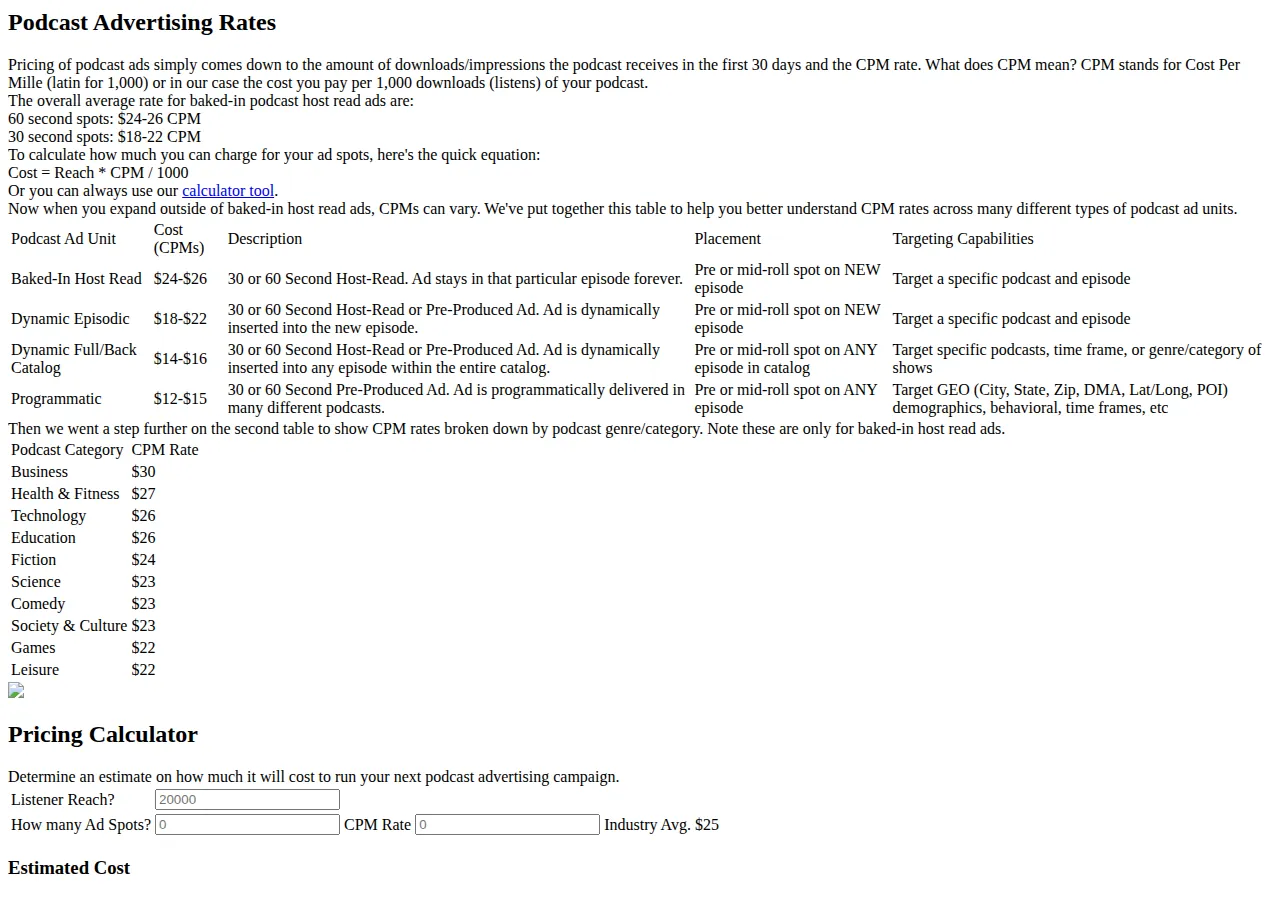
Genre moves the price, but less than format does. Libsyn's baked-in host-read averages span $8 per thousand: Business $30, Health and Fitness $27, Technology and Education $26 each, Fiction $24, Science, Comedy, and Society and Culture $23 each, Games and Leisure $22 each.
Baked-in ads versus dynamic insertion
A baked-in ad is recorded into the episode file and plays forever; it cannot be changed or removed. A dynamically inserted ad is stitched in at download time and can be changed, rotated, geo-targeted, and switched off. The trade is permanence against control: baked-in carries the highest CPM and the strongest response, while dynamic buys flexibility and turns the back catalog into inventory.
Price follows the trade. A baked-in 60-second host read costs $24 to $26 per thousand; the same read dynamically inserted into new episodes costs $18 to $22, and into the back catalog $14 to $16. Buy baked-in for the endorsement; buy dynamic to test five messages across twenty shows. Measure accordingly: 30 days minimum for dynamic, longer for baked-in, because Magellan AI found responses kept building through day 30.
Sponsorship versus per-episode buys
A sponsorship and a per-episode buy are different contracts. A per-episode buy purchases placements: one spot, in one episode, at the CPM. A sponsorship purchases an association over a season or a quarter, usually as a flat fee, with the host reading the spot and mentioning the brand in the show notes.
Sponsorships suit the buyer who has already proved the show works: the flat fee removes the download-count argument and buys category exclusivity. Per-episode buys suit the buyer still testing. The crossover is arithmetic: at 800 downloads, the last measured average of $21.37 values a slot at about $17, which is not worth either party's paperwork.
Minimums decide who can play. Libsyn Ads requires 20,000 downloads per episode for its host-read marketplace. Acast accepts shows from around 1,000 monthly listeners, and direct sponsorships become realistic at 5,000 to 10,000 downloads per episode. Acast self-serve starts from $500 a campaign; Spotify's Ads Manager carries a $250 minimum.
Flight lengths follow the same split: two weeks for a programmatic or dynamic test, four to six weeks for a host-read test, a full season or quarter for a sponsorship. IAB data puts CPM buying at 94% of podcast ad revenue in 2020 and 2021.
Worked example: campaign cost at 10,000, 50,000, and 100,000 downloads
Worked example is where the rate card meets a real budget.
Worked example one: 10,000 downloads, one host-read slot at a $25 CPM, four episodes a month. Each placement costs $250; four episodes cost $1,000; three slots per episode cost $3,000 a month. Acast's own example agrees: roughly $39,000 a year for a weekly show.
Worked example two: 50,000 downloads, two host-read slots at a $25 CPM, four episodes a month. Each placement costs $1,250; four episodes cost $10,000. At a $30 CPM the flight costs $12,000. That $2,000 gap is the negotiation, and it is 20% of the media budget.
Worked example three: 100,000 downloads, two slots at a $30 CPM, eight episodes a month. Each placement costs $3,000, and the month costs $48,000. At that size, negotiate a flat-fee sponsorship instead.
| Downloads per episode | One placement at $25 CPM | One placement at $30 CPM | Month: 4 episodes, 2 slots, $25 CPM |
|---|---|---|---|
| 10,000 | $250 | $300 | $2,000 |
| 50,000 | $1,250 | $1,500 | $10,000 |
| 100,000 | $2,500 | $3,000 | $20,000 |
Check the table against the formula: at 10,000 downloads and a $30 CPM, one placement is $300.
A cheaper buy is not always a cheaper customer. Programmatic inventory at $12 to $15 CPM costs roughly half a host read, but the response gap is wide. Magellan AI tracked campaigns from January to June 2026: host-read ads sent a median 3.22% of listeners to the advertiser's website, against 2.09% for produced ads. At 50,000 downloads and a $1,250 placement, that is about $0.78 per visit against $1.20. Medians in a planning example.
Attribution: proving a podcast ad worked
Podcast advertising has no click. The listener hears an ad while driving or walking, and the purchase happens later, on a different device. Attribution is four imperfect tools used together.
First, the pixel. Podsights, now part of Spotify, and Chartable place a tracking pixel on the advertiser's site and match visits and purchases back to listeners served the ad.
Second, the promo code. Give each show its own code, so one weak show cannot hide behind a strong one. Codes undercount, because listeners forget them, but they never misattribute.
Third, the vanity URL. A short address spoken by the host is the audio equivalent of a click. Give each show its own, and watch its traffic separately from the promo code.
Fourth, the post-purchase survey. Ask every buyer "How did you hear about us?" at checkout, with show names listed. Expect attributed return to show 30% to 50% lower than true return, and set the target before the campaign starts.
Judge on the right window: Magellan AI measures on a 30-day lookback, the minimum for a fair verdict. Measure over 30 to 60 days, renew the shows under target, and drop the rest.
Who should buy podcast ads, and who should not
Podcast advertising suits a buyer with a product that needs explaining, a customer worth more than $50, and a story a host can tell in 60 seconds without a visual. It suits a buyer who can wait 30 days for a verdict.
It does not suit a buyer who needs a click today, whose product costs $5, or who cannot track a sale back to a show. A $5 product cannot carry a $25 CPM: at a 3.22% visit rate and a 10% visit-to-purchase rate, 10,000 downloads produce about 32 purchases, and $250 of media against 32 purchases is about $7.81 per purchase, more than the product's price.
Paying creators and hosts: the back office
The rate card is the easy half of a podcast buy. The hard half is paying the people. An individual host is paid against a W-9, with their SSN on file, and the payer issues a 1099 at year end. A host operating as an LLC is paid against the same W-9, with the EIN on file. A host outside the United States is paid against a W-8BEN, not a W-9.
Get the tax form before the first episode airs, because chasing a W-9 after the campaign has run is the slowest job in media buying. Pay by ACH wherever the bank allows it: a wire costs $25 to $45 per payment, an ACH costs cents. Keep payment records in a CSV export, with show, episode, CPM, and download count on each line. A CPA will ask for it at year end, and GAAP booking needs the same file.
Cross-border payments need the host's IBAN and the SWIFT code of their bank, and the payer should confirm who bears the FX cost before sending, because a $1,000 payment can arrive as $960 after conversion and bank fees. An S-Corp host and a C-Corp host are taxed differently on the same fee. Where money moves through an API, reconcile the API report against the bank statement monthly. An ITIN belongs to a non-resident with no SSN, collected on the W-8BEN path.
The five-step buying workflow
- Shortlist on audience, not downloads. Pick ten shows whose listeners match the buyer, using the show's audience data and the genre CPMs in this guide. A business show at a $30 CPM with 10,000 of the right listeners beats a comedy show at $23 with 100,000 of the wrong ones.
- Price every show with the same formula. Run each show through the placement-cost formula at the Libsyn card rate, and rank them by cost per expected visit, not by CPM. Use the profit calculator to turn each quote into a cost per customer: profit calculator.
- Buy a four-week host-read test on three shows. One slot per show, per week, for four weeks, each show on its own promo code and vanity URL, pixel attribution live before the first episode airs. Three shows separate a show problem from a message problem.
- Measure at 30 days, not at seven. Wait for the full 30-day lookback, because the seven-day number understates the result by more than half. At 30 days, divide what each show cost by the customers it brought, renew the shows under target, and drop the rest.
- Scale the winners into a sponsorship. Move the best one or two shows into a season-long flat-fee sponsorship with category exclusivity. Price the fee from the measured cost per customer, not the rate card. Re-price every quarter.
Pre-flight checklist
- [x] 30-day download average confirmed in writing
- [x] CPM agreed by format and genre
- [x] Placement agreed: pre-roll, mid-roll, or post-roll
- [x] Flight length agreed: four weeks minimum for a host-read test
- [x] Each show has its own promo code and vanity URL
- [x] Pixel attribution live before the first episode airs
- [x] Post-purchase survey live, with show names listed
- [x] Cost-per-acquisition ceiling set before the first invoice
- [x] W-9 or W-8BEN collected before the first payment is due
- [x] 30-day measurement date written into the insertion order
Founder & CEO Insight — Enow A. Jovial
How podcast ads compare with the rest of paid media
Podcast advertising is not a replacement for search or social; it explains a product to a listener who is not looking at a screen. Compare channels here: YouTube ads vs TikTok ads, TikTok ads vs Meta ads, and the influencer marketing rate card.
Podcast advertising rewards patience: the response arrives over 30 days, the host needs three episodes to settle into the read, and the best shows are booked a quarter ahead. Start with the test in this guide: three shows, four weeks, one slot each, separate codes, pixel live, 30-day verdict. That test costs $3,000 at 10,000 downloads and a $25 CPM.
Webinar slots price like podcast ads — see the webinar platform pricing playbook.