A founder who needs a working app without hiring developers faces three tools that all promise the same thing — a real app, no code — and bill in three completely different currencies. Bubble sells workload units: every database search, workflow run, and API call draws from a monthly allowance, and the plan is priced per app. Adalo sells flat monthly plans with no meter at all: a fixed price, a fixed number of published apps, and no charge per action. Glide sells credits: a monthly pool that pays for AI features and app actions, with the app count as the second ceiling. At the entry paid tier the three look close — $25 to $65 a month — but the meter decides the second-year bill.
The decision in one table
| Attribute | Bubble | Adalo | Glide | Authority |
|---|---|---|---|---|
| Free plan | $0, 50,000 workload units/month | $0, 500 records per app | $0, limited credits, 0 published apps | Vendor pages, Nov 2026 |
| Entry paid plan | Starter $32/mo annual ($39 monthly), web only | Builder $65/mo ($624/yr) | Basic $25/mo | Vendor pages, Nov 2026 |
| What the meter measures | Workload units per app per month | Nothing — flat price, no per-action fees | Credits per month for AI features and app actions | Vendor pages, Nov 2026 |
| Published apps on entry plan | 1 per plan — each app billed separately | 2 published apps | 2 published apps | Vendor pages, Nov 2026 |
| Mid-tier plan | Growth $119/mo annual, 250,000 units | Business $200/mo, 5 published apps | Plus $50/mo, 5 published apps, 250 credits | Vendor pages, Nov 2026 |
| Team ceiling | 1 editor on Starter, 2 on Growth, 5 on Team | 5 editors on Builder, 10 on Business | 2 members on Basic, 3 on Plus, 5+ on Pro | Vendor pages, Nov 2026 |
| Native mobile | Mobile builds on web + mobile plans from $59/mo annual | Native iOS and Android publishing included | Published apps, no separate build fee | Vendor pages, Nov 2026 |
| Overage | $0.30 per 1,000 extra workload units | No overage — flat price | Extra credit top-ups; 1/month on Basic, 2/month on Plus, unlimited on Pro | Vendor pages, Nov 2026 |
Bubble: the meter is the workload unit
Bubble is the most powerful of the three and the hardest to price in advance, because the meter is usage. The free plan costs nothing and includes 50,000 workload units a month — enough to learn the tool, not enough to run a live product: no custom domain, no live deployment. Starter is the first plan that puts an app on your own domain. It costs $32 a month billed annually for a web-only app, or $39 month-to-month. Growth costs $119 a month billed annually ($134 monthly) and Team costs $349 billed annually ($399 monthly). Each plan is priced per app, per platform — web plus mobile costs $59, $209, and $549 a month billed annually across the three tiers.
The allowance is the whole decision. Starter includes 175,000 workload units a month, Growth 250,000, and Team 500,000. A workload unit is Bubble's count of the server work your app does, and Bubble does not publish a per-action price list, so you cannot convert a feature into units before you build it. The included rate is the tell: Starter gives 175,000 units for $32, Growth 250,000 for $119, Team 500,000 for $349. The bigger plan costs more per unit, not less — the extra money buys editors, version control, server logs, and AI credits, not cheaper compute. That is the opposite of how most software pricing works: if you only need more units, the $0.30-per-1,000 overage is cheaper than the jump from Starter to Growth.
ext{Starter cost per 1,000 units} =
rac{$32}{175{,}000} imes 1{,}000 approx $0.18
ext{Growth cost per 1,000 units} =
rac{$119}{250{,}000} imes 1{,}000 approx $0.48
ext{Team cost per 1,000 units} =
rac{$349}{500{,}000} imes 1{,}000 approx $0.70
Bubble's pricing page is rendered client-side, so the figures here are corroborated across multiple independent reads of that page in November 2026. The October 2026 repricing moved Starter from $29 to $32 a month billed annually, and added AI credits — 1,000 a month on Starter, 2,000 on Growth, 4,000 on Team. Treat any guide that still quotes $29 as stale.
Adalo: flat, per-app, no meter
Adalo is the simplest bill in this comparison because there is no meter to model. The free plan costs nothing forever, lets you build unlimited test apps with up to 500 records per app and unlimited screens, and includes 5 AI prompts a month. You can build and fully test an app before paying anything, which is the honest free tier of the three: Bubble's free plan cannot go live, and Glide's free plan publishes zero apps.
Builder costs $65 a month, or $624 a year, or $175.50 a quarter — quarterly billing saves 10% and yearly saves 20% against the monthly rate. A launch offer cuts the first month to $30; budget $65. Builder includes 2 published apps, 5 app editors, and AI building with no monthly prompt limit. Business costs $200 a month, or $1,920 a year, or $540 a quarter, and includes 5 published apps, 10 app editors, localization, and more AI building each month. There are no per-action fees — the flat structure is the product's main selling point against Bubble's workload meter.
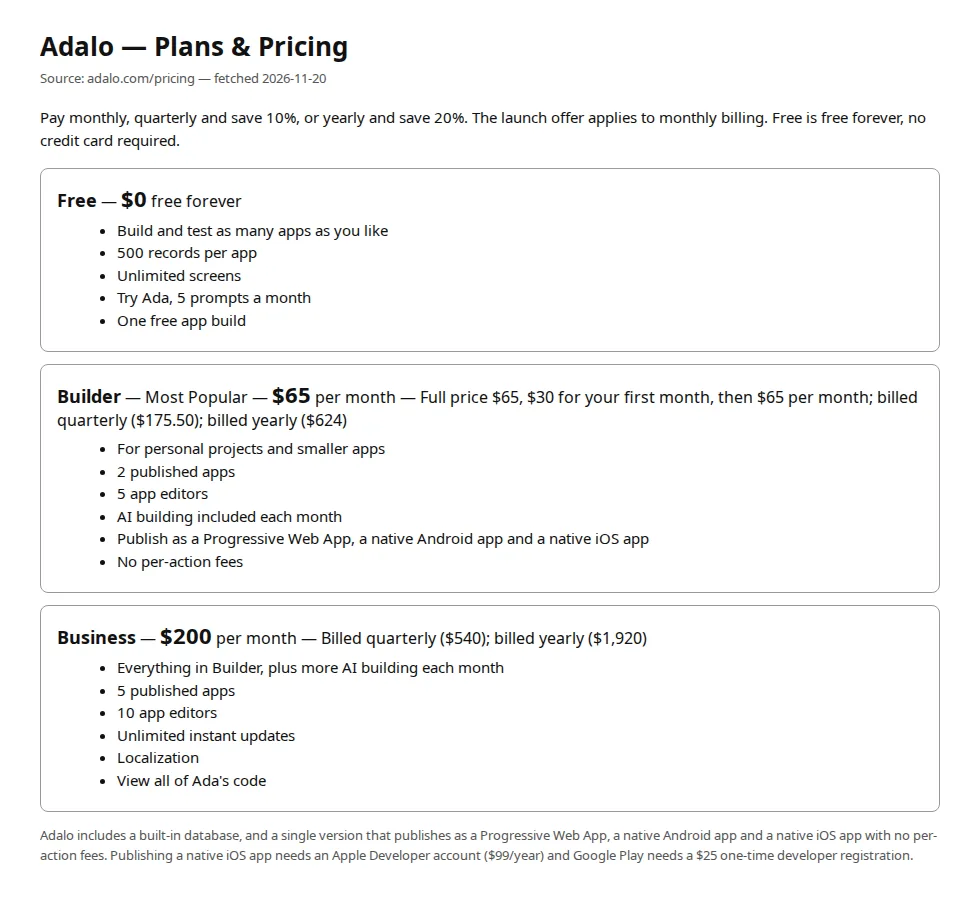
The costs Adalo does not include are the store fees. Publishing a native iOS app needs an Apple Developer account at $99 a year, and Google Play needs a $25 one-time developer registration. Those are Apple's and Google's charges, not Adalo's — but a Builder plan plus the Apple fee is $879 in year one on monthly billing. Localization, crash monitoring, and analytics are paid add-ons on both paid plans, so a production app that needs them pays more than the headline price.
Glide: credits for AI, apps by count
Glide prices in two dimensions at once: a credit pool for AI features and app actions, and a ceiling on published apps. The free plan costs nothing and includes limited credits, 2 team members, 10 projects, and zero published apps — it is a trial of the builder, not a way to ship. Basic costs $25 a month and includes 100 credits, 2 team members, 2 published apps, 10 projects, and 1 enabled workflow, with 1 credit top-up a month. Plus costs $50 a month and includes 250 credits, 3 team members, 5 published apps, 20 projects, and 5 enabled workflows, with 2 top-ups a month. Pro costs $125 a month and includes 250 credits plus 50 per team member — 500 credits at the 5-member starting size — with unlimited published apps, 100 projects, and unlimited workflows and top-ups. Enterprise is custom, with single sign-on, audit logs, and a dedicated success manager.
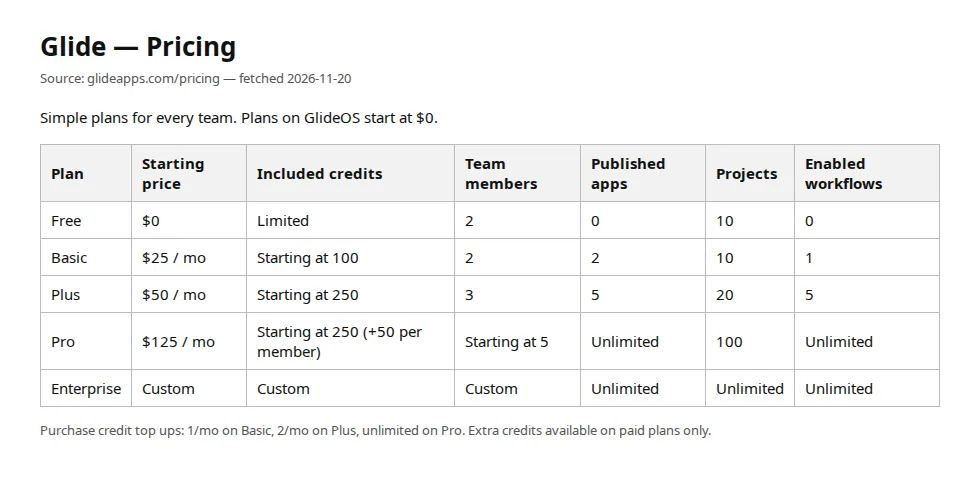
The three tiers price credits differently. Basic costs $25 for 100 credits, or $0.25 a credit. Plus costs $50 for 250 credits, or $0.20 a credit — the cheapest credit in the trio. Pro costs $125 for 500 credits at five members, or $0.25 a credit. Plus is the only tier where the credit gets cheaper as you spend more, which makes it the sweet spot for an app whose users trigger AI features often. Glide does not publish a per-action credit table, so run a real app on the free plan, watch the balance, and divide the monthly allowance by your daily burn before you commit.
ext{Basic cost per credit} =
rac{$25}{100} = $0.25
ext{Plus cost per credit} =
rac{$50}{250} = $0.20
ext{Pro cost per credit} =
rac{$125}{500} = $0.25
The math: three apps, one month
Run the same portfolio through all three tools: three small web apps, one editor, light traffic. On Bubble, each app needs its own Starter plan at $32 a month billed annually, so the portfolio costs $96 a month, or $1,152 a year. On Adalo, three apps do not fit Builder's 2-app ceiling, so the portfolio needs Business at $200 a month, or $2,400 a year. On Glide, three apps fit inside Plus's 5-app ceiling at $50 a month, or $600 a year. Glide is the cheapest way to run three small apps by a wide margin: Bubble bills per app and Adalo's app ceiling forces a tier jump, while Glide's mid-tier already includes five.
ext{Three apps, Bubble Starter annual} = 3 imes $32 = $96/ ext{month}
ext{Three apps, Glide Plus} = $50/ ext{month}
ext{Three apps, Adalo Business} = $200/ ext{month}
Now run one app that gets busy. A Bubble Starter app that burns 300,000 workload units in a month pays the $32 plan plus 125,000 units of overage at $0.30 per 1,000 units — $37.50 — for a $69.50 month. The same app on Growth would cost $119 for the plan alone, so the overage route is $49.50 cheaper that month, and it stays cheaper until the app burns roughly 465,000 units. The upgrade is worth buying for the second editor, the 14-day server logs, and the premium version control — not for the units.
ext{Bubble Starter at 300,000 units} = $32 +
rac{125{,}000}{1{,}000} imes $0.30 = $32 + $37.50 = $69.50
Year one for one web app on annual billing: Bubble Starter $384, Adalo Builder $624, Glide Basic $300. For three apps: Glide Plus $600, Bubble Starter $1,152, Adalo Business $2,400. Run your own app count through the profit calculator before you commit to a year.
Who should pick which — and who should pick none
Pick Bubble when the app is the business and you need the deepest logic, the largest plugin ecosystem, and the most control over the database — and you accept a per-app price and a meter you cannot fully predict. Pick Adalo when you want a native iOS and Android app on the App Store with a bill that never moves: $65 a month, two apps, no meter. Pick Glide when you run several internal tools or client portals and want the most apps per dollar.
Pick none of the three when the app needs custom code, a public API with heavy traffic, or a data model that outgrows a visual database — all three export your work only in limited ways. The v0 vs Bolt vs Lovable AI app builder pricing playbook covers the prompt-to-app side of the same buy for builders who want to type a description instead of dragging components, the Webflow vs Framer vs WordPress no-code website builder pricing guide covers the website-builder side when the deliverable is a site rather than an app, and the Cursor vs Windsurf vs Claude Code AI coding assistant pricing guide prices professional editors for builders who write code by hand.
Founder & CEO Insight — Enow A. Jovial
The build-week checklist
Do the first three in order, then run the rest as checks:
- Count your apps: list every app you will run in year one, including the internal tools and the client portals, and price each tool by the app count, not the sticker price.
- Measure the meter for two weeks: run the real app on the free plan and record workload units per day on Bubble or credits per day on Glide, then divide the monthly allowance by your daily burn.
- Price the team, not the seat: multiply the per-editor price by every person who will edit, and compare it with the flat team ceilings on Adalo and Glide at the same headcount.
- [x] Budget the store fees on Adalo: add Apple's $99 a year and Google Play's $25 one-time fee to the first-year total before you compare it with Bubble or Glide.
- [x] Test the exit before you need it: export the data and confirm you can leave with your records — before the first paid month.
- [x] Pick the annual plan only after a paid month: Adalo's yearly billing saves 20% and Bubble's annual billing saves roughly 18% on Starter, but only if you are still on the tool in month twelve.
The decision is not which builder is best. It is which meter matches how you build: workload units per app, a flat price per app count, or credits per workspace.