Railway vs Render vs Fly.io: PaaS Hosting Pricing Playbook
A platform-as-a-service bill is a meter reading, not a price tag. Railway, Render, and Fly.io all host the same container, yet a 1 vCPU, 2 GB service with 100 GB of monthly traffic costs $46.58 on one, $41.75 on another, and $16.20 on the third — and those numbers flip when the app idles, the database grows, or the build pipeline runs hot. The gap comes from three metering philosophies: Railway sells raw seconds of CPU and RAM, Render sells fixed-size monthly instances, and Fly.io sells small machines by the second with an off switch.
This playbook prices all three from the vendors' own pricing pages, opened and read on 7 November 2026, and rebuilds the monthly bill at three stated profiles. Where a vendor publishes no figure, the playbook says so instead of guessing.
Three meters, three philosophies
Railway charges for what the app uses, by the second: CPU $0.00000772 per vCPU, memory $0.00000386 per GB, volumes $0.00000006 per GB, egress $0.05 per GB. No fixed instance price, no separate build-minute line. The plan is a floor, not the bill: Hobby carries a $5 minimum usage that includes $5 of monthly credits, Pro a $20 minimum with $20 of credits; a month with $3 of usage on Hobby still costs $5. The trial is a one-time $5 credit grant expiring in 30 days, after which the free tier drops to $1 per month. Hobby caps a service at 48 vCPU and 48 GB RAM; Pro at 1,000 vCPU and 1 TB RAM.
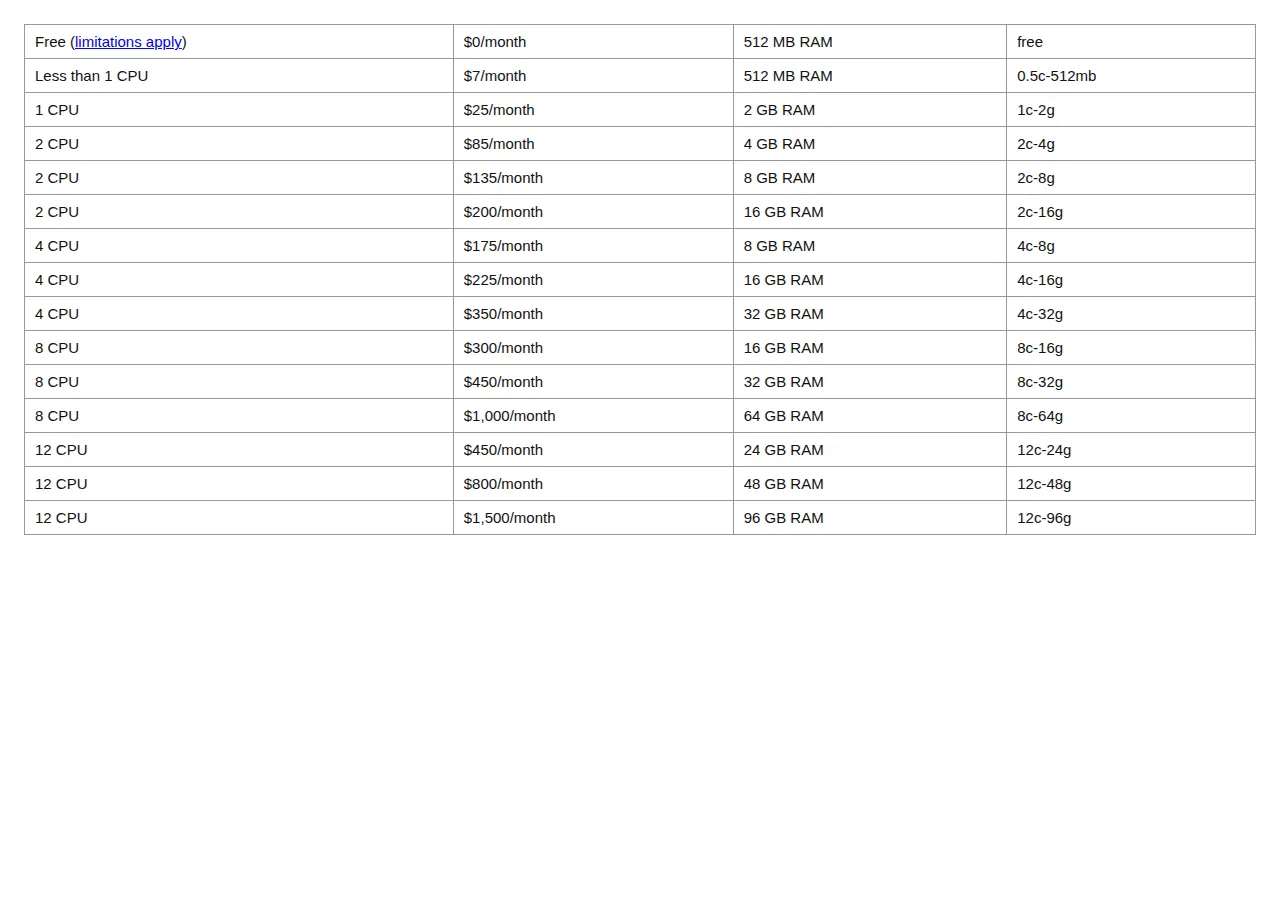
Render charges the opposite way: pick a fixed instance size, pay a fixed monthly price, add meters for the extras. A 1 CPU, 2 GB web service costs $25 per month; 2 CPU and 4 GB costs $85; the largest size, 12 CPU and 96 GB, costs $1,500. The workspace plan sits on top — Hobby $0, Pro $25, Scale $499 per month, each plus compute — and a month with no services and no activity has it waived. Compute is prorated to the second. Extras are metered: persistent disks $0.25 per GB per month, Postgres storage $0.30 per GB, bandwidth $0.15 per GB after the allowance — 5 GB on Hobby, 25 GB on Pro, 1 TB on Scale.
Fly.io charges per resource with no monthly platform fee. A started shared-cpu-1x Machine with 256 MB of RAM costs $2.19 per 30 days of continuous runtime in Ashburn or Secaucus, the lowest-priced regions; 512 MB costs $3.69, 1 GB costs $6.70, and a shared-cpu-2x with 2 GB costs $13.39. Dedicated performance Machines start at $33 per month for 1x with 2 GB; additional RAM costs $6.00 per GB per month. Volumes cost $0.15 per GB per month, and outbound data costs $0.02 per GB in North America and Europe, $0.04 in Asia Pacific, Oceania, and South America, and $0.12 in Africa and India. New organisations have no free tier — only a $1 credit trial lasting 7 days.
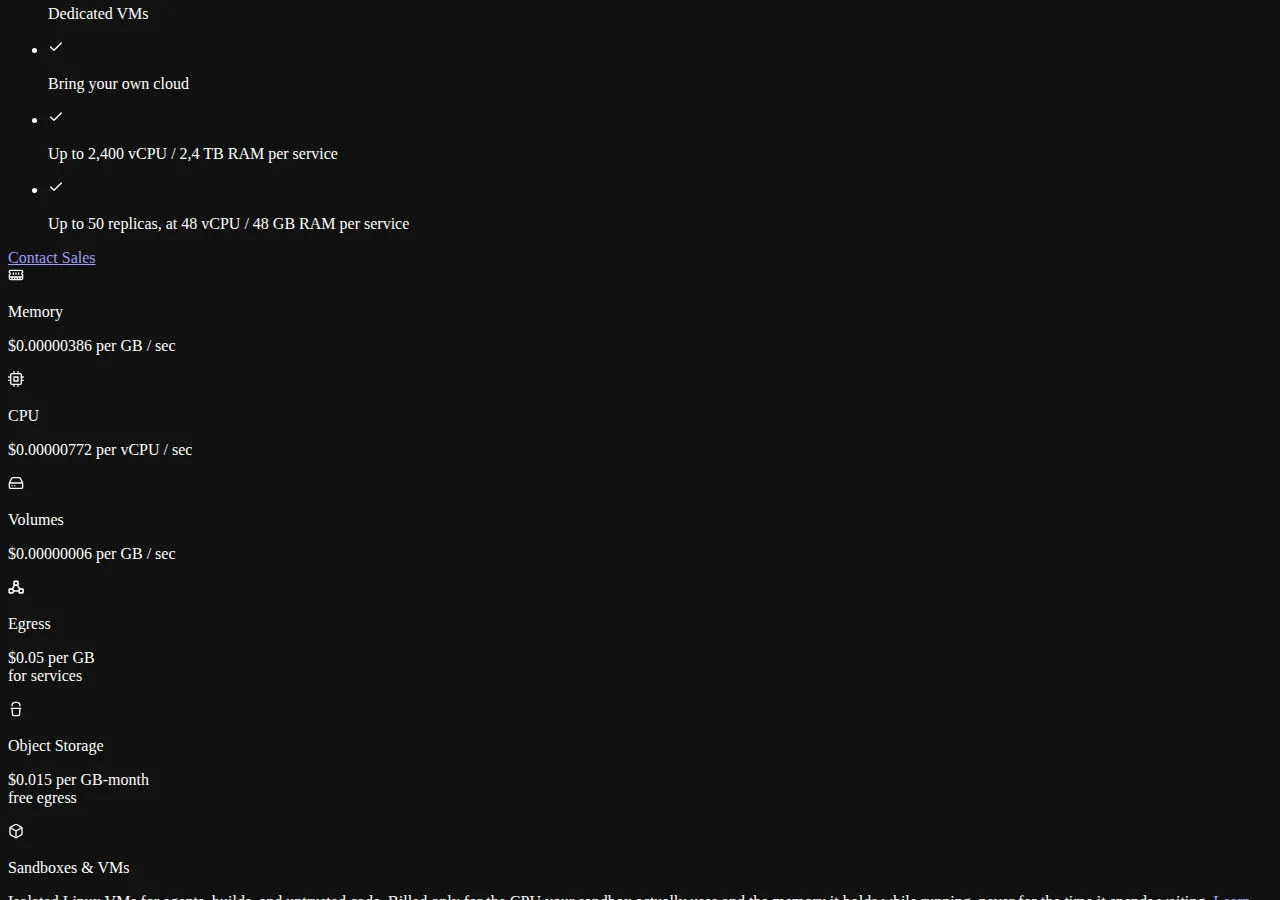
The per-unit price table
Side by side: Railway and Fly.io price the raw ingredients, Render prices the finished serving.
| Meter | Railway | Render | Fly.io | Authority |
| --- | --- | --- | --- | --- |
| 1 vCPU, continuous month | $20.01 | $25.00 (1 CPU / 2 GB) | $6.70 (shared 1x, 1 GB) | Vendor pages |
| 1 GB RAM, continuous month | $10.01 | Included in instance | $6.00 (added RAM) | Vendor pages |
| 1 GB volume / month | $0.16 | $0.25 | $0.15 | Vendor pages |
| 1 GB outbound data | $0.05 | $0.15 after allowance | $0.02 (NA / EU) | Vendor pages |
| Build minutes | No separate meter published | 500/mo included, then $5 per 1,000 | Free (builders uncharged) | Vendor pages |
| Monthly platform fee | $5 / $20 minimum usage | $0 / $25 / $499 | $0 | Vendor pages |
Two readings matter. Fly.io's shared CPU is the cheapest raw compute on the table — $6.70 for a 1 GB shared Machine against Railway's $30.02 for the same 1 vCPU and 1 GB bought separately — with the caveat that shared CPU is not a dedicated vCPU. Render's $25 for 1 CPU and 2 GB undercuts Railway's $40.02, but Render charges $0.15 per GB of bandwidth, three times Railway's $0.05 and more than seven times Fly.io's $0.02.
> [!KEY TAKEAWAY]
> Compare the whole monthly stack — compute, volume, bandwidth, plan fee — at your own traffic shape. The cheapest Machine on the page is not the cheapest bill.
Free tiers and sleep: what zero actually costs
The three free offers are not the same kind of free. Render's is the most generous and the most conditional. A free web service gets 512 MB of RAM at $0, and each workspace receives 750 free instance hours per month — but the service spins down after 15 minutes without inbound traffic and takes about one minute to spin back up. Any change to the local filesystem is lost on spin-down, redeploy, or restart, because free services run on an ephemeral filesystem. A genuine $0 home for a personal project; a poor home for anything that must answer the first request fast or keep a file on disk.
Railway's free offer is a trial with a clock on it: $5 of credits, 30 days, then a $1-per-month tier capped at 1 vCPU and 0.5 GB RAM per service. There is no sleep behaviour to manage: the cost control is to stop the service. Hobby's $5 of included credits covers a small always-on service for about ten days, and credits reset each cycle without rolling over.
Fly.io has no free tier for new organisations, and its pricing page says so plainly; the trial is $1 of credit for 7 days. What it offers instead is the cheapest always-on floor here: $2.19 per month for a 256 MB Machine. When a Machine auto-stops while idle, billing stops with it except for a $0.15-per-GB-per-month charge on the Machine's root filesystem. For an app serving a few requests a day, that off switch is worth more than any free tier.
> [!WARNING]
> Render's free tier deletes local filesystem changes on every spin-down. Uploads and local SQLite files vanish unless they live on a persistent disk at $0.25 per GB per month. Budget the disk before the first upload.
Turning per-second rates into a monthly bill
Railway's per-second rates look trivial until they are multiplied out. For a 30-day month — 720 hours, 2,592,000 seconds — the conversion is:
$
\text{Monthly cost} = \text{rate per second} \times 2{,}592{,}000 \ \text{seconds}
$
Applied to Railway's published rates, that gives $20.01 per vCPU per month, $10.01 per GB of RAM per month, and $0.16 per GB of volume per month — the whole of Railway's compute pricing, plus $0.05 per GB of egress. Part-time workloads multiply by the fraction of the month the service runs.
The profile formula adds plan fee, volume, and traffic on top of compute:
$
\text{Monthly bill} = \text{compute} + \text{volume} + \text{egress} + \text{plan fee}
$
For Render, compute is the fixed instance price; for Railway and Fly.io, it is the per-second rate scaled by uptime.
Three profiles, priced to the cent
Profile A — small always-on app: 1 vCPU, 2 GB RAM, 10 GB volume, 100 GB egress, all month.
| Profile A: 1 vCPU / 2 GB, always-on | Railway | Render | Fly.io |
| --- | --- | --- | --- |
| Compute | $40.02 | $25.00 | $12.70 |
| Volume (10 GB) | $1.56 | $2.50 | $1.50 |
| Egress (100 GB) | $5.00 | $14.25 | $2.00 |
| Monthly total | $46.58 | $41.75 | $16.20 |
Railway's compute is 1 vCPU plus 2 GB RAM at the rates above, $40.02; Render's is the 1c-2g instance at $25 with 95 GB beyond the 5 GB Hobby allowance at $0.15; Fly.io's is the shared-cpu-1x 1 GB Machine at $6.70 plus 1 GB of added RAM at $6.00. Fly.io wins by more than half.
Profile B — production app: 2 vCPU, 4 GB RAM, 50 GB volume, 500 GB egress.
| Profile B: 2 vCPU / 4 GB, always-on | Railway | Render | Fly.io |
| --- | --- | --- | --- |
| Compute | $80.04 | $85.00 | $25.39 |
| Volume (50 GB) | $7.78 | $12.50 | $7.50 |
| Egress (500 GB) | $25.00 | $71.25 | $10.00 |
| Plan fee | $0.00 | $25.00 (Pro) | $0.00 |
| Monthly total | $112.82 | $193.75 | $42.89 |
Render's bill nearly doubles between compute and traffic: 475 GB beyond the 25 GB Pro allowance at $0.15 costs $71.25, more than the $25 Pro plan fee. Railway's flat $0.05 makes 500 GB cost $25.00; Fly.io's $0.02 makes it $10.00. Bandwidth decides here.
Profile C — idle hobby app: 0.5 vCPU, 1 GB RAM, 5 GB volume, 10 GB egress, ~240 of 720 hours.
| Profile C: idle app, ~240 h/month | Railway | Render | Fly.io |
| --- | --- | --- | --- |
| Compute | $6.68 | $0.00 | $2.23 |
| Volume (5 GB) | $0.78 | $0.00 | $0.75 |
| Egress (10 GB) | $0.50 | $0.75 | $0.20 |
| Monthly total | $7.96 | $0.75 | ~$3.18 |
Railway's compute is 0.5 vCPU for 864,000 seconds at $0.00000772 plus 1 GB RAM at $0.00000386 — $3.34 plus $3.34 — and the operator must stop the service to earn that saving, because Railway does not sleep it. Render's free tier covers compute and volume at $0, assuming the app fits the free 512 MB shape, but 10 GB of egress exceeds the 5 GB allowance, so 5 GB at $0.15 adds $0.75. Fly.io's compute is the $6.70 shared Machine scaled to one-third of the month, $2.23.
Builds, volumes, and the database next door
Build minutes are the quietest meter in the comparison. Render includes 500 build pipeline minutes per month on Hobby, 1,000 on Pro, and 5,000 on Scale, then charges $5 per 1,000 minutes; the faster performance pipeline costs $25 per 1,000 minutes. Ten deploys a day at three minutes a build burns about 900 pipeline minutes a month — inside Pro's allowance, an extra $2.00 on Hobby. Fly.io charges nothing for builds at present: no charge for builders, build time, or registry storage. Railway publishes no separate build-minute meter, so a Railway build is priced only through the compute it consumes.
Volumes follow the same pattern. Railway's volume rate converts to about $0.16 per GB per month, Fly.io charges $0.15 per GB per month of provisioned capacity — including while detached or its Machine is stopped — and Render charges $0.25 per GB per month for persistent disks. Fly.io adds snapshots at $0.08 per GB per month with the first 10 GB free; Render's Postgres storage is $0.30 per GB. Beside compute sits the database: Fly.io's Managed Postgres starts at $38 per month for the Basic plan with storage at $0.28 per GB, and its worked example puts a small web app with Managed Postgres at $43.67 per month, mostly the database. Render's free Postgres tier is 256 MB at $0, paid tiers from $6.
> [!TIP]
> Price the database before the app: on Fly.io, Managed Postgres at $38 per month costs more than ten times the $3.69 Machine in front of it.
The decision, by shape
| Your shape | Pick | Why |
| --- | --- | --- |
| Small always-on app, light traffic | Fly.io | Cheapest shared compute and egress |
| Production app, heavy egress | Fly.io or Railway | $0.02–$0.05/GB vs Render $0.15/GB |
| Fixed budget, predictable bill | Render | Fixed instance price |
| Personal project, near-$0 month | Render free tier | 512 MB free, 750 free hours |
| Bursty or idle app | Fly.io auto-stop | Billing stops with the Machine |
| Compliance, SSO, audit logs | Render Scale / Railway Enterprise | HIPAA BAAs and SSO live on top tiers |
The table is a starting point: preview environments, one-click rollbacks, and multi-region Machines are features the price table cannot see.
A numbered workflow to pick and prove it
1. Write down the profile first: vCPU, RAM, volume gigabytes, monthly egress, and running hours.
2. Price the profile on all three vendors with the formula above, and keep the arithmetic in a spreadsheet.
3. Deploy the same container to the two cheapest vendors for a week, then compare the invoices to the forecast line by line.
4. Test the sleep path: leave the app idle and confirm Render spins down after 15 minutes, wakes in about a minute, and Fly.io auto-stop stops the Machine.
5. Add the database and the build pipeline to the forecast: a $38 Managed Postgres plan can double a small app's bill.
6. Set a billing alert on day one, at 50% and 80% of the forecast.
7. Re-price every quarter: the formula stays the same, only the rates move.
Running a hosting bill through a business also means running it through the books. The invoice is a deductible business expense for an LLC, S-Corp, or C-Corp, and the vendor's monthly invoice — Railway emails one with every payment, Render's billing page holds the usage breakdown — is the record the CPA asks for at year end. Keep the EIN on the billing profile, pay by card or ACH, and export the usage CSV each month so a disputed charge can be traced to a specific service and day. Where a client reimburses hosting, invoice it as a pass-through line with the vendor's invoice attached.
For the neighbouring options, compare the Docker vs Kubernetes vs Amazon ECS container deployment pricing guide, the Vercel vs Netlify vs Cloudflare Pages frontend hosting pricing guide if the workload is static, and the Google Cloud Run vs AWS App Runner vs Azure Container Apps pricing guide. Run the totals through the Website Cost Estimator.
> [!FOUNDER]
> "The cheapest host is the one whose meter matches your traffic. Price the month you actually run — idle hours, egress gigabytes, build minutes — and the right vendor picks itself."
> — Enow A. Jovial, Founder & Chief Executive Officer
The three vendors are not three prices for the same thing. Railway sells raw seconds with no sleep and no build meter. Render sells fixed instances with a free tier that sleeps and forgets. Fly.io sells the cheapest small Machines with an off switch and the cheapest egress. Write the profile, run the formula, read one real invoice — and the meter that fits is the one to pay.