Compare the three clouds on one machine and they look interchangeable. Compare them at the platform level — the free tier, the egress tax on every byte leaving, the commitment discount, the support plan that answers at 3 a.m. — and they diverge by thousands of dollars a month. Two of the three rebuilt their pricing in 2026: AWS replaced its 12-month free tier with a credit window and repriced support as a percentage of spend. Prices as read on November 15, 2026; compute pricing lives in the service-level comparisons below.
The free tiers: three different clocks
| Vendor | Trial credit | Credit window | Always-free core | What ends the trial | Authority |
|---|---|---|---|---|---|
| AWS | Up to $200 ($100 immediately, up to $100 more as you explore) | 6 months | Free usage of select services on both plans | Account closes at 6 months or when credits run out | AWS Free Tier page, Nov 15, 2026 |
| GCP | $300 Welcome credit | 90 days | 1 e2-micro VM/month, 30 GB-months disk, 1 GB outbound transfer/month | Auto-closes; 30-day grace period, then resources permanently deleted | Google Cloud free-tier docs, Nov 15, 2026 |
| Azure | $200 credit | 30 days | 12 months free on 20+ services; 750 hours/month each of B1s, B2pts v2 and B2ats v2 VMs; 65+ always-free services | Credit expires after 30 days | Azure free account page, Nov 15, 2026 |
The clocks matter more than the headline credit: it is a burn rate, not a balance:
GCP's $300 buys the most experimentation. AWS's $200 buys the longest runway at the lowest monthly rate, and the account closes on its own at 6 months — no charge unless you convert to a Paid plan. Azure's $200 is the shortest fuse, but the 12-month free services and 750 burstable-VM hours a month are the real offer: a small workload can run free for a year. GCP's grace period is the one to respect: if the trial ends and you do not upgrade within 30 days, resources are deleted.
Egress: the bill that actually diverges
| Vendor | Free egress | First paid tier | Next tiers | Authority |
|---|---|---|---|---|
| AWS | First 100 GB/month free, aggregated across all services and regions | $0.09 per GB (first 10 TB) | Further tiers above 10 TB exist; rates not priced in this guide | EC2 pricing page; S3 pricing page, Nov 15, 2026 |
| GCP (Premium Tier, to North America) | First 1 GiB/month free | $0.12 per GiB (1–1,024 GiB) | $0.11 per GiB (1,024–10,240 GiB); $0.08 per GiB above | VPC pricing page, Nov 15, 2026 |
| Azure (Premium network, NA/Europe) | First 100 GB/month free | $0.087 per GB (next 10 TB) | $0.083, then $0.07, then $0.05 per GB | Bandwidth pricing page, Nov 15, 2026 |
| Azure (ISP routing, NA/Europe) | First 100 GB/month free | $0.08 per GB (next 10 TB) | $0.065, then $0.06, then $0.04 per GB | Bandwidth pricing page, Nov 15, 2026 |
At 500 GiB a month out, the ranking is set by the free allowance, not the headline rate. All three bill pay-as-you-go; the unit difference compounds — 1 GiB is 1.0737 GB — so the model is stated in GiB throughout. AWS bills EC2 per second with a 60-second minimum and aggregates data-transfer tiers across EC2, S3, RDS and Redshift. GCP bills per GiB by destination region; Azure bills per GB by source continent and routing choice.
Two cautions sit under those numbers. First, the AWS figure prices the first 10 TB tier only; further tiers above 10 TB exist but the rendered page did not expose their rates. Second, Azure's egress is priced by source continent: Asia, Australia and the Middle East start at $0.12 per GB, and South America at $0.181 — a workload served from São Paulo pays more than double the North America rate.
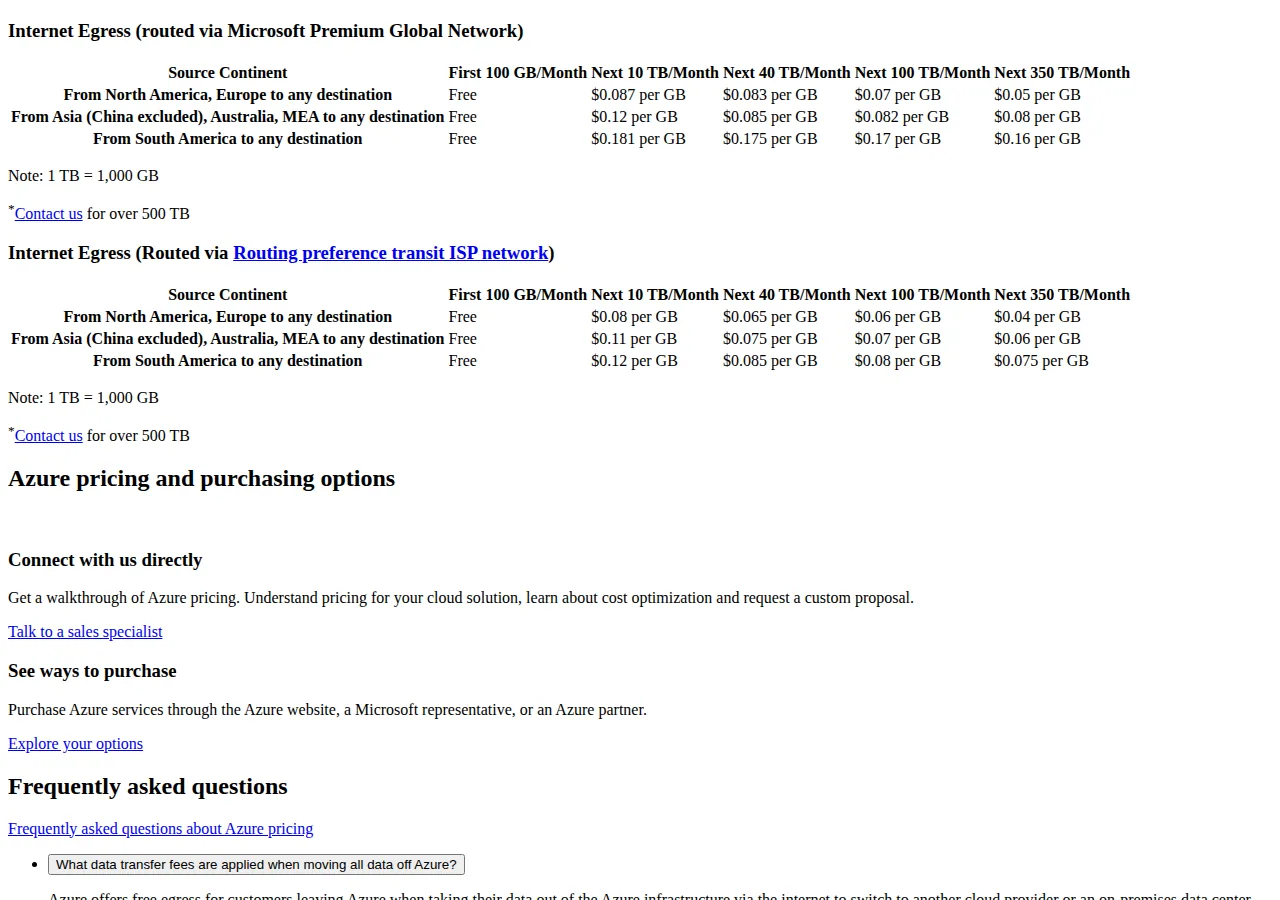
Azure's egress tables, above: the first 100 GB a month is free, then $0.087 a GB on the premium network and $0.08 a GB with ISP routing.
Commitments: up to 72%, up to 57%, up to 72%
| Vendor | Mechanism | Maximum discount | Term | Authority |
|---|---|---|---|---|
| AWS | Savings Plans (commit to an instance family in a region) | Up to 72% | 1- or 3-year | AWS Savings Plans pricing, Nov 15, 2026 |
| GCP | Committed use discounts on Compute Engine | Up to 57% | 1- or 3-year plan | Google Cloud pricing page, Nov 15, 2026 |
| Azure | Reserved VM Instances | Up to 72% vs pay-as-you-go | 1- or 3-year terms | Azure reservations page, Nov 15, 2026 |
On a $1,000-a-month steady compute baseline:
"Up to" is doing the work in every row: the discount on your instance type, in your region, on your term is lower than the ceiling, and the commitment is a promise to pay whether the workload still runs or not. For the compute rates themselves, see the service-level comparisons: our EC2 vs Compute Engine vs Azure VM pricing, our Lambda vs Cloud Functions vs Azure Functions serverless pricing, and our Cloud Run vs App Runner vs Container Apps pricing.
Support: flat fees against percentage ladders
| Vendor | Entry paid tier | Price | Production tier | Price at scale | Authority |
|---|---|---|---|---|---|
| AWS | Business Support+ | 9% of first $10K, 7% of $10K–$80K | Enterprise Support | 10% up to $150K, 7% to $500K, 5% to $1M | AWS Support pricing, Nov 15, 2026 |
| GCP | Standard Support | Greater of $29/month or 3% of monthly charges | Enhanced Support | Greater of $100/month or 10% / 7% / 5% / 3% by spend band | Google Cloud Customer Care, Nov 15, 2026 |
| Azure | Developer | $29/month flat | Standard $100/month flat; Professional Direct $1,000/month flat | Professional Direct $1,000/month flat | Azure support plans, Nov 15, 2026 |
AWS's ladder scales worst: the fee is a percentage of spend with no flat cap. At $20,000 a month of charges:
At $750,000 a month the gap becomes the story — AWS's own worked example puts Enterprise Support at $52,000 a month:
Response times follow the pattern: GCP Standard answers a P1 case in 1 hour, Enhanced in 15 minutes; AWS Business Support+ answers a system-down case in under 30 minutes. Every Google Cloud customer, including free-trial customers, gets Basic Support; every Azure customer gets Basic. AWS bills support monthly with a 30-day minimum (90 for Unified Operations), charging the greater of the minimum fee or the percentage of charges.
The cost-management tooling
All three ship a pricing calculator for estimating a workload. GCP adds cost-management tools with cost trends and forecasts, and free 24/7 billing support. Azure adds FinOps guidance, savings plans, reservations and the Hybrid Benefit. One accounting rule matters: AWS calculates support fees on each month's gross charges before discounts or credits, and upfront commitment charges land in the support calculation in the month of purchase — a commitment that cuts the usage bill raises the support bill that month.
The monthly total: 500 GiB out, $20,000 of spend
Putting the platform charges together for a workload moving 500 GiB a month out on $20,000 a month of spend:
| Platform charge (monthly) | AWS | GCP | Azure |
|---|---|---|---|
| Egress, 500 GiB | $36.00 | $59.88 | $34.80 premium / $32.00 ISP |
| Support, $20,000 spend | $1,600 Business Support+ | $600 Standard / $1,700 Enhanced | $100 Standard |
| Platform subtotal | $1,636.00 | $659.88 / $1,759.88 | $134.80 / $132.00 |
Azure wins this profile on support alone: $1,501.20 a month cheaper than AWS, $18,014.40 a year. GCP Standard is the middle of the road; GCP Enhanced is the dearest at this spend because its ladder starts at 10%. The egress ranking never changes the outcome — the support ladder decides it. Our Cloudflare vs Fastly vs AWS CloudFront CDN pricing and latency playbook covers the other way to cut the egress line: serve the bytes from a CDN edge instead of the origin cloud.
Founder & CEO Insight — Enow A. Jovial
Who should pick which — and who should not
| Profile | Pick | Avoid | Why |
|---|---|---|---|
| Learning and prototyping, no revenue yet | GCP | Azure's 30-day credit | $300 over 90 days is the longest free runway |
| Small production site, 12-month horizon | Azure | AWS Business Support+ | 750 free VM hours a month for 12 months; $100 flat support |
| Heavy egress, video or downloads | Azure | GCP | $0.08–$0.087 a GB against GCP's $0.12 a GiB |
| Steady-state compute, 3-year horizon | AWS or Azure | GCP at full list | 72% commitment ceilings beat GCP's 57% |
| Large spend with 24/7 production support | Azure Professional Direct | AWS Enterprise | $1,000 flat against $52,000 at $750,000 of spend |
The buying checklist
- [x] Step 1: Measure the egress before choosing the cloud. Pull 30 days of data-transfer-out from the current bill: at 500 GiB a month the vendors differ by $27.88.
- [x] Step 2: Price support at your real spend. AWS Business Support+ is $1,600 at $20,000 of spend, GCP Enhanced is $1,700, Azure Standard is $100.
- [x] Step 3: Take the free tier in the right order. GCP first for the 90-day runway, Azure for the 12-month free services, AWS last for the 6-month credit window — and diary the expiry: GCP deletes resources 30 days after trial end.
- [x] Step 4: Commit only the steady state. Reserve the forecastable baseline for 1 or 3 years at up to 72% off on AWS and Azure or up to 57% on GCP; leave the variable peak on pay-as-you-go.
- [x] Step 5: Choose the egress route, not just the vendor. On Azure, ISP routing is $0.08 a GB against $0.087 on the premium network; on GCP, destination sets the tier.
- [x] Step 6: Check the support-fee basis before signing a commitment. AWS charges support on gross charges before discounts; upfront commitment charges land in the support calculation in the month of purchase.
- [x] Step 7: Model the whole month before you migrate. Run the egress, support and commitment figures through the pricing calculator and compare the platform subtotal.
The verdict: at platform level, Azure is the cheapest home for a small production workload — $100 flat support and the lowest egress — and GCP gives the longest runway. AWS is the dearest on support by a wide margin at any real spend, and its free tier is now a $200 credit window over 6 months. Commitments close the compute gap — up to 72% on AWS and Azure, up to 57% on GCP — but they do not touch the support ladder, and that ladder is where the three clouds now differ most.