The anchor: one 2-vCPU, 8-GiB machine, three vendors
The three vendors price the same unit in three dialects. AWS sells an instance type by the hour. Google sells vCPUs and GiB separately. Azure sells a size by the hour, monthly figure beside it. The only honest comparison fixes one shape and one region per vendor.
The anchor is 2 vCPUs with 8 GiB, Linux, in AWS US East (N. Virginia), Google Iowa, and Azure East US. Figures below were read from vendor pricing pages on 7 November 2026. Monthly figures use 730 hours — Azure's month length. The anchor machines are the AWS m6i.large, Google e2-standard-2, and Azure D2s v5.
> [!KEY TAKEAWAY]
> At the 2-vCPU, 8-GiB anchor, on-demand is $0.096 per hour at AWS and Azure and $0.06701142 at Google's E2 — a 30.2% gap before commitment or spot.
On-demand: the headline rates
On-demand is the price of refusing to commit: pay by the hour or second, stop any time, at the highest unit rate. It suits a workload measured in days, not one running in twelve months.
| Vendor | Machine | vCPU | Memory | $/hour | $/month (730 h) | Authority |
| --- | --- | --- | --- | --- | --- | --- |
| AWS | m6i.large | 2 | 8 GiB | $0.096 | $70.08 | AWS data file |
| AWS | m7i.large | 2 | 8 GiB | $0.1008 | $73.58 | AWS data file |
| Google | e2-standard-2 | 2 | 8 GiB | $0.06701142 | $48.92 | Google page |
| Google | n2-standard-2 | 2 | 8 GiB | $0.097118 | $70.90 | Google page |
| Azure | D2s v5 | 2 | 8 GiB | $0.096 | $70.08 | Azure page + API |
The n2-standard-2 is the honest Google comparator: same shape, current Intel platform. At $0.097118 it costs $0.001118 more per hour than the m6i.large — $0.82 a month. E2 is the outlier: Google's cost-optimised family, priced to move volume.
As unit rates:
$
\text{Cost per vCPU-hour} = \frac{\text{On-demand price per hour}}{\text{vCPU count}}, \quad \text{Cost per GiB-hour} = \frac{\text{On-demand price per hour}}{\text{Memory in GiB}}
$
AWS m6i.large is $0.048 per vCPU-hour and $0.012 per GiB-hour. Azure D2s v5 lands on the same two numbers. Google's e2-standard-2 is $0.03350571 and $0.00837643; the n2-standard-2 is $0.048559 and $0.01213975. The per-unit view survives scaling, because all three vendors price linearly inside a family.
AWS EC2: m6i is the value pick, and m7i costs 5% more
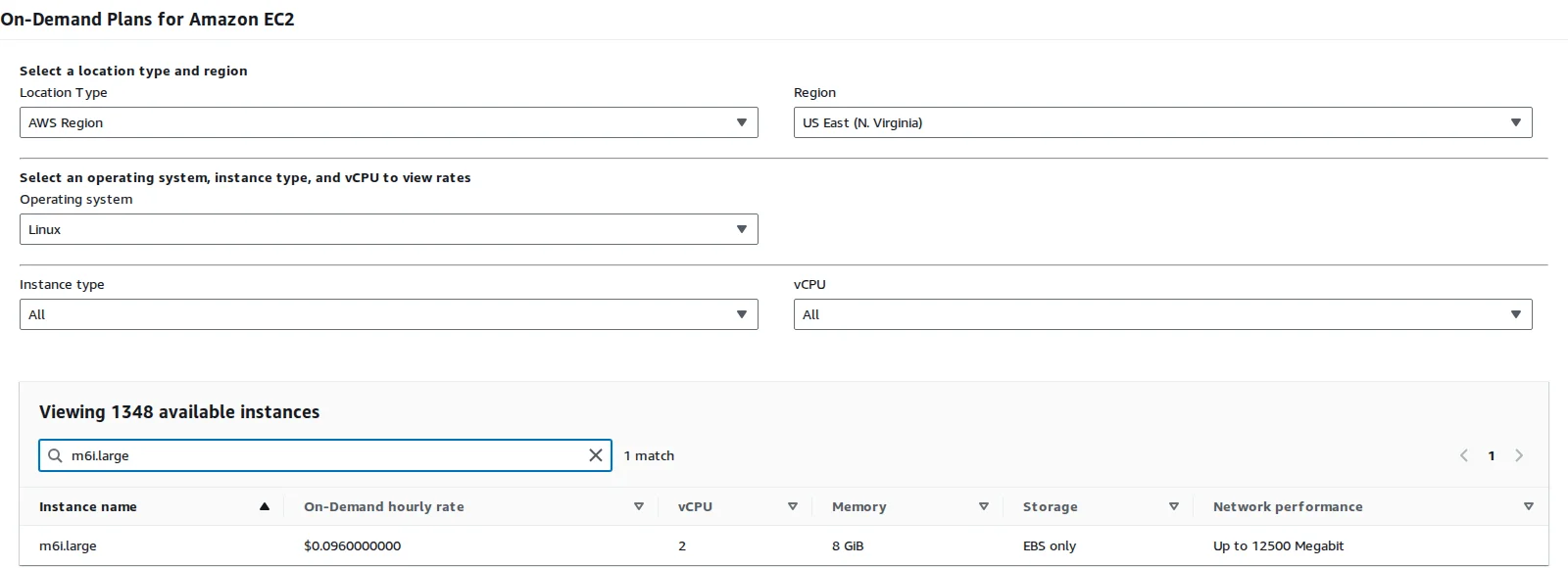
AWS publishes on-demand prices as a data file. The US East (N. Virginia) Linux file, published 7 November 2026, gives m6i.large at $0.096 per hour and m7i.large at $0.1008. The m7i premium is exactly 5%. Unless your workload needs the newer Sapphire Rapids CPUs, the m6i is the same shape for less money. The screenshot below is the live EC2 pricing app for m6i.large.
!AWS EC2 m6i large on-demand price
Commitment comes in two products buyers confuse. Reserved Instances reserve capacity for a specific family in a specific Availability Zone, at up to 72% off on-demand. Savings Plans are a flexible hourly spend commitment across families and sizes, also up to 72%. The 72% is a ceiling, not a quote. AWS publishes no static Reserved Instance hourly rate, so this article prints none as a vendor quote. At the ceiling, m6i.large costs $0.096 × 0.28 = $0.02688 per hour, or $19.62 a month.
Spot is the third AWS price, and the only one that moves. AWS states Spot Instances run at up to 90% off on-demand, with prices updated every 5 minutes. There is no static spot price: it changes with spare capacity in each Availability Zone. At the 90% ceiling the anchor machine would cost $0.096 × 0.10 = $0.0096 per hour, or $7.01 a month — ceiling arithmetic, not a price you can buy at.
> [!WARNING]
> A Spot instance can be reclaimed with two minutes' notice. A workload that cannot survive an interruption must never run on Spot, because eviction arrives exactly when capacity is scarcest.
Google Compute Engine: E2 is the cheapest on-demand box, and N2 is the like-for-like
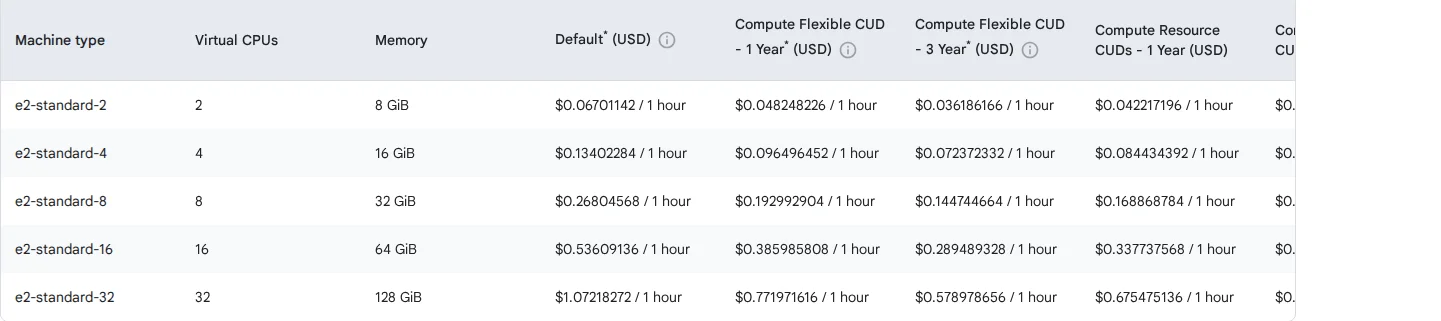
In Iowa, e2-standard-2/4/8 are $0.06701142, $0.13402284, and $0.26804568 per hour; N2 is $0.097118, $0.194236, and $0.388472. Google bills vCPU and memory separately, with a one-minute minimum. E2 is the budget family, with the fewest discount options.
A flexible committed use discount is a spend commitment across machine types: e2-standard-2 is $0.048248226 per hour on one year and $0.036186166 on three years — 28% and 46% below on-demand. A resource-based discount commits to specific vCPUs and memory: $0.042217196 on one year and $0.030155144 on three years — 37% and 55% below on-demand. Google states the same ceilings: 37% on one year, 55% on three, 70% for memory-optimised types.
Sustained-use discounts apply automatically above 25% of a billing month, reaching 30% for a full month. The catch is eligibility: the 30% tier covers N2 and N2D, N1, C2, and M1/M2 — not E2. An e2-standard-2 that runs all month gets none. An n2-standard-2 that runs all month gets up to 30% off: $0.097118 × 0.70 = $0.0679826 per hour, or $49.63 a month — within a dollar of E2's on-demand price. E2 wins on the sticker; N2 closes the gap automatically because its sustained-use discount applies when the machine never stops.
Unlike AWS, Google publishes a current spot price per machine type. For Iowa, e2-standard-2 spot is $0.040212 per hour and n2-standard-2 is $0.058256 — both exactly 40% below on-demand. Google claims Spot VMs can cut costs by up to 91%, but that ceiling belongs to other machine types — here the observed discount is 40%.
!Google E2 standard pricing table
Azure VMs: the Dsv5 table does the arithmetic for you
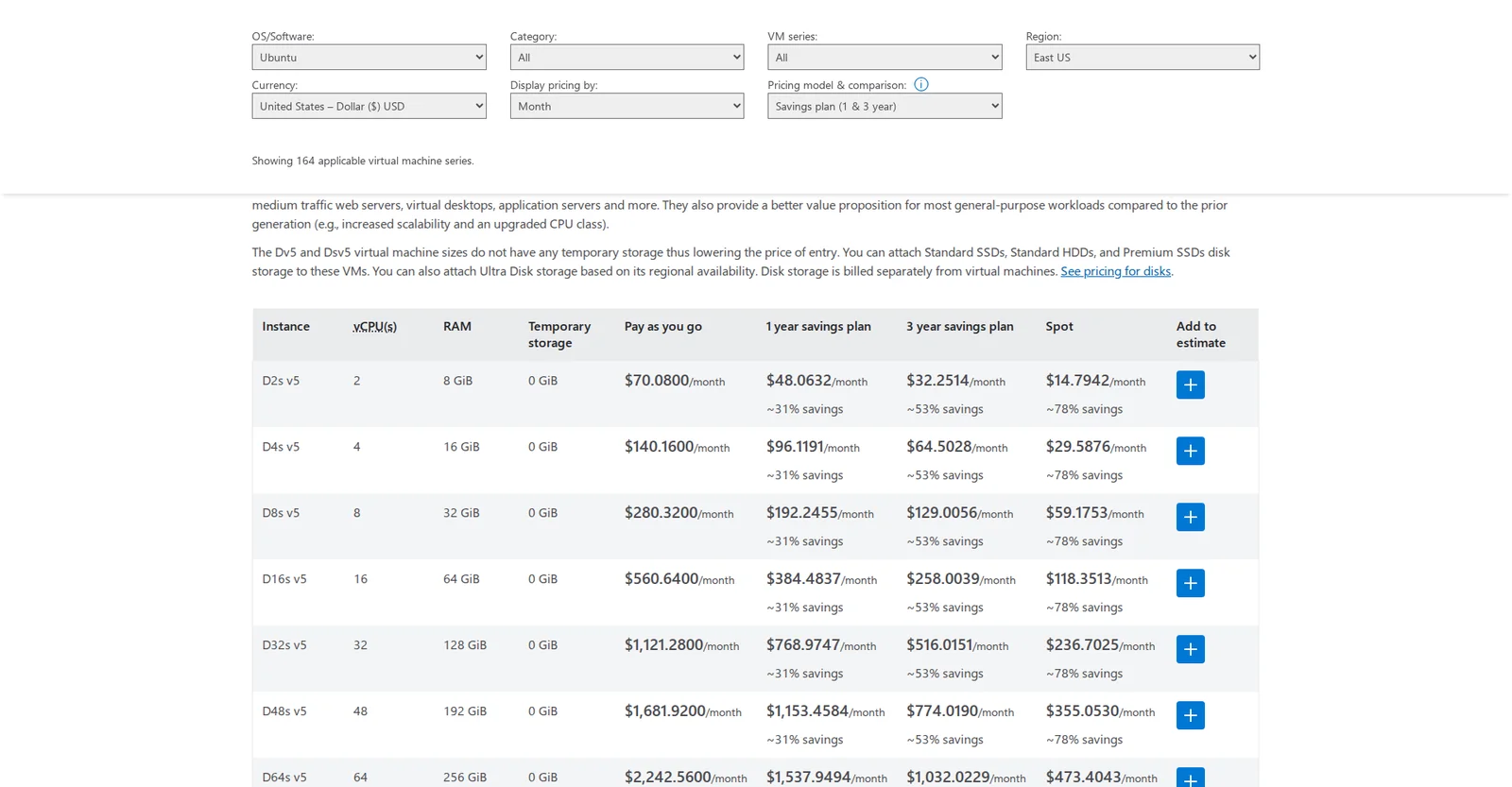
Azure's Linux VM page prints four columns per size: pay as you go, one-year plan, three-year plan, Spot. For the D2s v5: $70.08 pay as you go, $48.06 one-year plan (~31%), $32.25 three-year plan (~53%), $14.79 Spot (~78%). The Retail Prices API agrees: D2s v5 $0.096/hr, D4s v5 $0.192, D8s v5 $0.384.
Two Azure products share the word "reservation". The savings plan is an hourly commitment with no upfront payment: $0.06584 an hour for one year, 31.4% below pay as you go. The Reserved VM Instance is an upfront payment: $519 for one year, $997 for three. The one-year reservation is $519 / 8,760 = $43.25 a month — 38.3% below pay as you go, $4.81 cheaper than the savings plan. The three-year reservation is $997 / 26,280 = $27.69 a month — 60.5% below pay as you go, $4.56 cheaper than the savings plan. The reservation wins on price; the savings plan on flexibility.
Azure Spot is the cheapest interruptible price here. D2s v5 Spot is $0.020266 an hour — 78.9% below pay as you go. Microsoft states Spot offers up to 90% off pay-as-you-go prices, with eviction when the price rises above your maximum or capacity runs out. At 78.9% observed, it is the strongest discount here for interruptible work.
> [!TIP]
> Buy the reservation when the machine is fixed for the whole term: it saves $4.81 a month over the one-year savings plan and $4.56 over the three-year plan. Buy the savings plan when the fleet changes size.
The decision table
| Decision | AWS EC2 | Google Compute Engine | Azure VM | Authority |
| --- | --- | --- | --- | --- |
| Cheapest on-demand | m6i.large $0.096/hr | e2-standard-2 $0.06701142/hr | D2s v5 $0.096/hr | Vendor pages |
| Cheapest like-for-like | m6i.large $0.096/hr | n2-standard-2 $0.097118/hr | D2s v5 $0.096/hr | Vendor pages |
| Best 1-year commitment | 72% ceiling | e2 CUD 37% off | Reservation 38.3% off | Vendor docs |
| Best 3-year commitment | 72% ceiling | e2 CUD 55% off | Reservation 60.5% off | Vendor docs |
| Best interruptible | Up to 90% off | e2 Spot $0.040212/hr | D2s v5 Spot $0.020266/hr | Vendor pages |
| Full-month discount | None | N2 SUD 30%; E2 none | None | SUD docs |
Read the table by workload shape. A fleet that runs all month and never changes size belongs on a three-year commitment: Azure's reservation at 60.5% off is the deepest fixed discount with a published price. A fleet that changes size belongs on Google's flexible CUD or Azure's savings plan. Bursts belong on Spot because eviction is tolerable there; days on on-demand, where E2 at $0.06701142 is cheapest — unless the workload needs current-generation performance, in which case n2-standard-2 at $0.097118 is the honest Google price.
Profile math: one, five, and twenty machines
The anchor is one machine. Real fleets are five or twenty, and the ranking does not change with size — stated here at 730 hours.
| Profile | AWS m6i | AWS m7i | Google E2 | Google N2 | Azure Dsv5 |
| --- | --- | --- | --- | --- | --- |
| S: 1 × 2 vCPU / 8 GiB | $70.08/mo | $73.58/mo | $48.92/mo | $70.90/mo | $70.08/mo |
| M: 5 × 4 vCPU / 16 GiB | $700.80/mo | $735.84/mo | $489.18/mo | $708.96/mo | $700.80/mo |
| L: 20 × 8 vCPU / 32 GiB | $5,606.40/mo | $5,886.72/mo | $3,913.47/mo | $5,671.69/mo | $5,606.40/mo |
Profile S: m6i.large $0.096 × 730 = $70.08; m7i.large $0.1008 × 730 = $73.58; e2-standard-2 $0.06701142 × 730 = $48.92; n2-standard-2 $0.097118 × 730 = $70.90; D2s v5 $0.096 × 730 = $70.08. Profiles M and L use the same unit rates. The E2 saving at Profile L is $1,692.93 a month, or $20,315.20 a year — the largest gap here, because E2 is a different performance class.
Commitment changes the ranking. The cheapest committed hour is the AWS 72% ceiling at $19.62 a month — but that is a ceiling; the cheapest with a published price is Google's three-year e2 resource CUD at $22.01 a month. Next: e2 flexible CUD $26.42, Azure reservation $27.69, n2 resource CUD $31.91, Azure savings plan $32.25. Read that as a ladder: the top is the least flexible money.
Worked Example: twenty machines for a year
A SaaS company runs twenty 8-vCPU, 32-GiB servers for a year. On-demand, the year costs $5,606.40 × 12 = $67,276.80 at AWS on m6i.2xlarge, $3,913.47 × 12 = $46,961.60 at Google on e2-standard-8, and $5,606.40 × 12 = $67,276.80 at Azure on D8s v5. The E2 fleet is $20,315.20 cheaper than either rival before any commitment is signed.
Commitment closes the gap, then reverses it for the two vendors that charge more on-demand. Google's three-year resource CUD for the e2-standard-8 is $0.120620576 an hour:
$
\text{Google CUD year} = \$0.120620576 \times 730 \times 20 \times 12 = \$21,132.72
$
That is $25,828.88 a year less than Google on-demand. Azure's three-year reservation is $3,986 per machine: twenty cost $79,720 for three years, $26,573.33 a year — $40,703.47 less than Azure on-demand. AWS at its 72% ceiling is $0.10752 an hour: the ceiling year is $18,837.50 — $48,439.30 less than AWS on-demand — but only if every machine achieves the full 72%.
Three lessons follow. First, the cheapest on-demand vendor is not the cheapest committed vendor: Google wins both, but Azure's saving is larger in absolute dollars because its starting point is higher. Second, the commitment decision is worth more than the vendor decision: the on-demand-to-committed spread at one vendor ($25,828.88 to $48,439.30 a year) beats the spread between vendors on-demand ($20,315.20). Third, $21,132.72 a year is the lowest figure here — and the one a finance team should weigh against the performance E2 gives up.
Who should NOT buy on commitment
A three-year reservation is a liability when the workload changes. Do not buy one for a product that may be re-architected, a team that may move to containers, or a workload whose size is still being found — the discount is payment for certainty you do not have. Do not buy Spot for anything that holds state or serves users directly: eviction arrives when capacity is scarcest. Do not choose E2 on price alone for latency-sensitive work: it trades single-thread performance for cost, and two slow instances are not cheaper than one fast one. If the workload should not be a VM at all, see the serverless functions pricing; if the fleet should be orchestrated, the container deployment pricing; if the control plane is the cost, the managed Kubernetes pricing.
Paying for it: entity, billing, and cost allocation
All three vendors bill the operating entity, not the individual: an LLC or a C-Corp holds the account under its EIN, and the monthly invoice is a deductible business expense recorded under GAAP as an operating cost — because the machines are rented by the hour and never owned. A sole proprietor files it under an SSN or ITIN on Schedule C, with a CPA reviewing the allocation. Each vendor exports the bill as a CSV or JSON file through its billing API, so a finance team can allocate cost per team, per product, or per customer. Set billing alerts before the fleet grows: an idle machine bills at the on-demand rate. The pricing calculator models the monthly total from the hourly rates in this article before the spend is committed.
The buying sequence: a twelve-step checklist, in order
1. Fix the shape: vCPU and GiB from measured need.
2. Fix the region: one region per vendor.
3. Price on-demand first: the anchor machine's hourly rate.
4. Reduce to unit rates: divide by vCPU and GiB.
5. Measure the duty cycle: 30 days of run hours.
6. Test Spot on a stateless slice: batch and CI first; watch evictions a week.
7. Price the one-year commitment: flexible CUD, savings plan, reservation.
8. Price the three-year commitment: same comparison; note what you give up.
9. Check the automatic discounts: E2 gets none; N2 does.
10. Run the worked example: your fleet for a year.
11. Set the billing alert: cap monthly spend.
12. Re-price quarterly: last year's commitment is this year's liability.
> [!FOUNDER]
> "The vendors do not compete on the price of one machine — they compete on the price of your certainty. On-demand is the price of keeping your options open, a reservation is the price of giving them up, Spot is the price of admitting you do not need the machine at all."
> — Enow A. Jovial, Founder & Chief Executive Officer
Cheapest on-demand: e2-standard-2 at $0.06701142. Cheapest committed: three-year e2 resource CUD at $0.030155144. Cheapest interruptible: D2s v5 Spot at $0.020266. None is the answer alone — the right price matches the workload's lifetime.