EKS vs GKE vs AKS: The Managed Kubernetes Pricing Playbook
Every managed Kubernetes service sells the same promise: the cloud runs etcd, the API server, and the scheduler for you. The price looks identical — $0.10 per cluster per hour — and that sameness is the trap. The control-plane fee is the smallest line on a Kubernetes bill, which is why vendors put it first. What separates Amazon EKS, Google GKE, and Azure AKS is everything around the fee: what is free, what the surcharge is when you refuse to upgrade, and what the hands-off modes charge on top.
This playbook prices the managed control plane itself, not the nodes under it. Node costs vary by instance type, region, and commitment, and are excluded from the profiles below. Every figure comes from the vendor's own pricing page, fetched on November 7, 2026.
The three control-plane meters
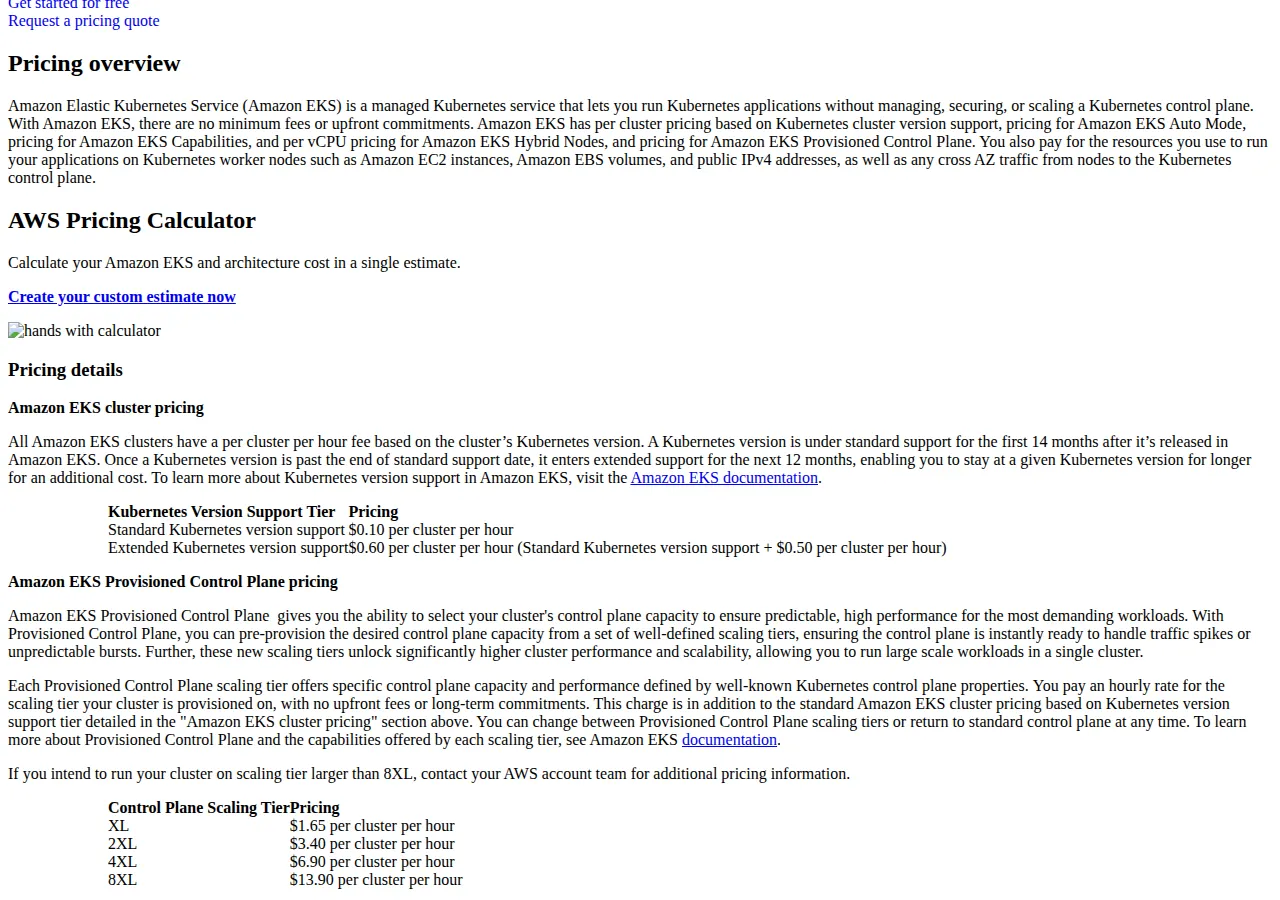
Amazon EKS charges $0.10 per cluster per hour for a cluster on a version under standard support, with no minimum fees and no upfront commitments. Google GKE charges a flat $0.10 per cluster per hour, billed in one-second increments, applying to every cluster "irrespective of the mode of operation, cluster size, or topology." Azure AKS charges $0.10 per cluster per hour for its Standard tier, the tier that carries the financially backed API server uptime SLA.
The difference is what costs nothing. AKS has a genuine free tier: the control plane is free and you pay only for the underlying resources, but there is no SLA, and Microsoft states plainly that free-tier clusters are not meant to run at scale or support workloads that require high availability. GKE gives $74.40 in monthly credits per billing account, "equivalent to one free Autopilot or zonal Standard cluster per month" — one cluster's fee, zeroed out, with no rollover. EKS has no free tier: the first cluster costs $0.10 an hour from the first hour.
| Service | Control-plane fee | Free option | What free actually means | Authority |
| --- | --- | --- | --- | --- |
| Amazon EKS | $0.10/cluster/hour | None | Every cluster billed from hour one | AWS EKS pricing page |
| Google GKE | $0.10/cluster/hour | $74.40/month credit | One free Autopilot or zonal Standard cluster per billing account; no rollover; not for regional fees | Google GKE pricing page |
| Azure AKS | $0.10/cluster/hour (Standard) | Free tier, $0 | Control plane free; no SLA; 1,000-node limit, not recommended above 10 | Azure AKS pricing page |
> [!KEY TAKEAWAY]
> The headline rate is a three-way tie at $0.10 per cluster per hour. The decision is made by the free tier, the extended-support surcharge, and the managed-mode premium.
The monthly math, exposed
AWS's own examples use 730 hours per month, and this playbook uses the same convention. The monthly control-plane cost at the standard rate is:
$
\text{Monthly control-plane cost} = \text{Clusters} \times \$0.10 \times 730 \text{ hours} = \text{Clusters} \times \$73.00
$
One cluster costs $73.00 a month on all three at standard rates. Five clusters cost $365.00 a month on EKS and AKS Standard; on GKE the $74.40 credit brings five clusters to $290.60. Twenty clusters cost $1,460.00 a month on EKS and AKS Standard, and $1,385.60 on GKE. The credit is worth exactly $74.40 a month however large the fleet grows — 100 percent off cluster one, 5 percent off cluster twenty.
At $0.60 per cluster per hour, one cluster costs $438.00 a month and twenty cost $8,760.00 — six times the standard rate.
$
\text{Extended support, 20 clusters} = 20 \times \$0.60 \times 730 = \$8,760.00/\text{month}
$
Extended support: the $0.60 club
All three vendors give a Kubernetes minor version a standard support window, then charge extra to stay on it. The windows differ — and matter more than the identical $0.60 rate.
On EKS, a version gets 14 months of standard support after release, then 12 months of extended support. The extended rate is $0.60 per cluster per hour, and AWS is explicit that the figure is inclusive: "The $0.60 per cluster per hour is inclusive of the $0.10 per cluster per hour you pay for Amazon EKS clusters." Total supported life is 26 months, and AWS publishes the average for a cluster that rides the whole window: $0.10 for 14 months, then $0.60 for 12 months — "on average, you will pay $0.33 per hour to run this cluster."
On GKE, the Extended release channel lets a cluster stay on a minor version for up to 24 months past standard support, with no additional charge during standard support. Once the version passes end of standard support, "you will be charged an additional GKE extended period cluster management fee," priced at $0.50 per cluster per hour, "in addition to the GKE cluster management fee at $0.10 per cluster per hour, for a total of $0.60 per cluster per hour."
On AKS, long-term support is the Premium tier: SLA plus LTS at $0.60 per cluster per hour. Microsoft's footnote states that "AKS Long Term Support can be applied to an LTS-capable Kubernetes version to provide extended support from Microsoft for a period of 2 years," and that LTS is only available for Standard clusters. The comparison table describes LTS as bug fixes and security updates extended one year beyond the community window.
> [!WARNING]
> Extended support is priced identically everywhere: $0.60 per cluster per hour on EKS, GKE, and AKS. A twenty-cluster fleet that drifts one version behind pays $8,760 a month for not upgrading. Put the upgrade date on the calendar the day the cluster is created.
The hands-off modes: Autopilot, Auto Mode, Automatic
Each vendor sells a mode that manages the nodes too, each priced on a different meter. This is where the three-way tie breaks.
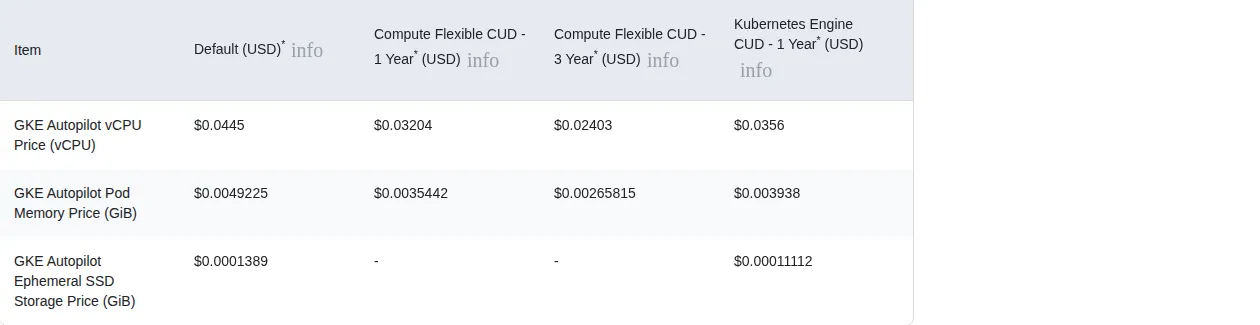
GKE Autopilot is the most transparent of the three. Autopilot clusters still pay the $0.10 management fee, but node pricing disappears: "In the Pod-based billing model, you are charged in one-second increments for the CPU, memory, and ephemeral storage resources that your running Pods request." The table lists general-purpose Autopilot pods at $0.0445 per vCPU-hour and $0.0049225 per GiB-hour of memory, with ephemeral SSD storage at $0.0001389 per GiB-hour. A pod requesting 2 vCPU and 4 GiB therefore costs 2 × $0.0445 + 4 × $0.0049225 = $0.10869 per hour, or $79.34 a month at 730 hours — plus the cluster fee, unless the free-tier credit absorbs it. Workloads that select specific hardware switch to node-based billing: Autopilot creates nodes with at least the requested capacity, "bills you for the entire node," and adds a management premium. The Docker vs Kubernetes vs ECS comparison prices EKS inside a deployment-model choice; Autopilot is where the GKE bill stops looking like node rental and starts looking like pod rental.
EKS Auto Mode works the other way around: the control-plane fee stays $0.10, EC2 instances are billed at normal EC2 prices, and Auto Mode adds a management fee on top — "You pay for EKS Auto Mode based on the duration and type of Amazon EC2 instances launched and managed by EKS Auto Mode. The EKS Auto Mode prices below are in addition to the Amazon EC2 instance price." The fee varies by instance type, is billed per second with a one-minute minimum, and is independent of whether the EC2 capacity is On Demand, Reserved, Savings Plan, or Spot. There is no single Auto Mode rate: the premium is instance-shaped, so it can only be totalled once the instance mix is known.
AKS Automatic is the simplest to state and the hardest to compare. The pricing page lists an "Automatic Hosted Component" at $0.16 per cluster per hour — more than the $0.10 Standard fee, less than the $0.60 Premium tier — on top of the compute the cluster runs. Five Automatic clusters cost 5 × $0.16 × 730 = $584.00 a month for the hosted component alone, before any VM charges. Automatic targets teams that want production-ready clusters with upgrades, node provisioning, scaling, and network configuration handled for them; the $0.16 is the price of that handling, per cluster rather than per node or per pod.
The 1 / 5 / 20-cluster profiles
The profiles below price control-plane fees only, at US rates as fetched on November 7, 2026, using 730 hours per month. Node costs are excluded, so the gap is between the vendors' control-plane policies, not their VM prices.
| Profile | EKS | GKE | AKS Standard | AKS Free |
| --- | --- | --- | --- | --- |
| 1 cluster, standard support | $73.00/month | $0.00 (credit covers it) | $73.00/month | $0.00 |
| 5 clusters, standard support | $365.00/month | $290.60/month | $365.00/month | $0.00 |
| 20 clusters, standard support | $1,460.00/month | $1,385.60/month | $1,460.00/month | $0.00 |
| 20 clusters, extended support | $8,760.00/month | $8,760.00/month | $8,760.00/month (Premium) | Not available |
AKS Free is $0.00 at every scale, but it carries no SLA and Microsoft recommends against running more than 10 nodes; the 20-cluster row is $0.00 on paper and unsuitable in production. GKE's $0.00 at one cluster is a credit, not a tier: the second cluster costs full price, and the credit cannot be applied to regional cluster fees. EKS has no zero row — the price at one cluster is the price at twenty, times twenty.
The five-cluster profile should decide most purchases: two environments plus staging and a sandbox. At five clusters the differences are already visible — GKE is $74.40 a month cheaper because of the credit, AKS Free is $365 a month cheaper and carries no SLA. Run the website cost calculator alongside these profiles when the Kubernetes bill sits inside a wider hosting budget.
Availability and scale limits
EKS commits to at least 99.95 percent for the Standard control plane (5-minute intervals) and 99.99 percent for Provisioned (1-minute intervals). GKE's financially backed SLA promises 99.95 percent for Autopilot and regional Standard control planes, 99.5 percent for zonal Standard, and 99.9 percent for Autopilot Pods in multiple zones. AKS Standard carries a financially backed API server uptime SLA; the pricing page states no percentage, and the Microsoft Learn SLA page returned a 404 on fetch this cycle, so no AKS percentage is printed here — verify it in the current SLA terms first.
AKS Free caps at 1,000 nodes, and Microsoft advises against running more than 10; AKS Standard raises the limit to 5,000 nodes. EKS sells extra control-plane headroom as Provisioned Control Plane tiers — XL at $1.65, 2XL at $3.40, 4XL at $6.90, and 8XL at $13.90 per cluster per hour — each "in addition to the standard Amazon EKS cluster pricing." GKE states no node limit on the pricing page; its lever is the choice between zonal and regional clusters, and the regional cluster fee is the one the free-tier credit cannot cover.
The identifiers that decide the bill
Kubernetes pricing is unreadable until the vocabulary is concrete. The API server is the front door every kubectl command and CI pipeline talks to; the control plane is the API server plus etcd, the scheduler, and the controller manager — and it is the control plane, not your pods, that the $0.10 buys. A cluster is one control plane plus its node pools; a namespace is a partition inside a cluster, and one EKS cluster can run many applications "by taking advantage of Kubernetes namespaces and IAM security policies" — which is why consolidating workloads into fewer clusters is the cheapest optimisation in this playbook. IAM gates who can call the EKS API; RBAC gates what they can do inside the cluster. The CNI plugin assigns pod IPs inside the VPC or VNet, the CSI driver attaches persistent volumes, and the kubelet reports what each node can run. The SLA is the availability promise, the release channel is the version track, and the manifest is the YAML that declares what should run. If a line on the bill cannot be traced to one of these identifiers, it is a node, a load balancer, or an egress fee wearing a Kubernetes label. Check the CDN pricing comparison for the egress side, and the infrastructure-as-code comparison for repeatable cluster definitions.
> [!TIP]
> Consolidate before you multi-cluster. One EKS cluster with namespaces and IAM policies costs $73 a month; three clusters for three teams cost $219. Every cluster you merge away is $73 a month back — before a single node is resized.
Which one to pick
Choose EKS when the workload already lives on AWS — the control plane is the same $0.10, and IAM, VPC networking, and EBS volumes are the services the team already operates. Choose GKE for pod-shaped, bursty workloads: Autopilot's per-pod billing means idle capacity stops costing money the moment the pods stop, and the $74.40 credit makes the first cluster free. Choose AKS Standard when the organisation is already on Azure and wants the SLA; choose AKS Free only for experiments — a control plane with no SLA and a 10-node recommendation is a lab, not a platform. Choose Premium or extended support only with an expiry date: $0.60 an hour is a migration budget spent as rent.
Execution checklist
1. Count the clusters first: list every cluster across every account and region — the fee is per cluster per hour, so the count is the bill.
2. Apply the free tier deliberately: one GKE cluster per billing account is covered by the $74.40 credit; AKS Free is $0 with no SLA and a 10-node recommendation.
3. Date every version: record each cluster's minor version and its standard-support end date; the surcharge starts the day after, at $0.60 an hour.
4. Price the managed mode on its own meter: Autopilot per pod, Auto Mode per instance type, Automatic per cluster at $0.16 — never compare them as one unit.
5. Check the SLA percentage in the contract: EKS 99.95 percent Standard and 99.99 percent Provisioned, GKE 99.95 percent Autopilot and regional, AKS unverified — confirm it first.
6. Re-price at 5 and 20 clusters: $73 a month becomes $1,460; extended support makes it $8,760.
> [!FOUNDER]
> "Three clouds charge the same ten cents, and that is the whole lesson: the price was never the differentiator. The differentiator is what happens when you stay on an old version, add the twentieth cluster, and the free tier runs out. Price the fleet you will have in a year."
> — Enow A. Jovial, Founder & Chief Executive Officer