Stock-based compensation is the largest non-cash line on most startup income statements and the one auditors flag first. A Series B SaaS company with $20M of ARR can report $5M of annual SBC — a quarter of revenue, with no cash leaving the bank. Founders treat it as a footnote; auditors treat it as a top-three audit risk — and the gap produces restatements.
The rule itself is short. FASB ASC 718, Compensation — Stock Compensation, requires every equity award granted for services to be measured once at its fair value on the grant date, then recognized as compensation expense over the requisite service period — usually the vesting schedule. PwC's stock-based compensation guide states it plainly: companies recognize the fair value of those awards in their financial statements, generally beginning on the date the awards are granted.
The four award types and how each is measured
Not every equity award is valued the same way. The measurement method follows the award type.
| Award | Grant-date fair value | Recognition pattern |
|---|---|---|
| Stock options (ISO / NSO) | Black-Scholes or lattice model on grant date | Over vesting; straight-line for cliff, straight-line or graded for graded schedules |
| RSUs (restricted stock units) | Stock price on grant date — no model needed | Over vesting; nothing until both triggers probable for double-trigger RSUs |
| Restricted stock awards (RSAs) | Stock price on grant date, less any amount paid | Over vesting, subject to § 83(a) income timing for the employee |
| Cash-settled SARs / phantom stock | Fair value, remeasured every reporting period | Liability-classified: expense moves with the stock price until settlement |
Equity-classified awards are measured once and never remeasured, whatever the stock price does later. Liability-classified awards — anything that settles in cash — are remeasured to fair value at the end of every reporting period until settlement, which produces volatile expense. Most startup RSU programs settle in shares precisely to avoid that volatility.
The journal entry is the same every month for every open grant:
ext{Monthly SBC Expense} =
rac{ ext{Grant-Date Fair Value} imes ext{Awards Expected to Vest}}{ ext{Vesting Period in Months}}
Debit compensation expense, credit APIC; on exercise, cash and cumulative APIC reclassify to common stock at par.
Black-Scholes, worked with real inputs
For options, the grant-date fair value comes from a model: Black-Scholes for plain-vanilla awards, a lattice model for awards with performance or market conditions. The formula for a call option with no dividends is:
C = S cdot N(d_1) - K e^{-rT} cdot N(d_2), quad d_1 =
rac{ln(S/K) + (r + sigma^2/2)T}{sigmasqrt{T}}, quad d_2 = d_1 - sigmasqrt{T}
Take a real grant: 10,000 options, strike $10.00, stock valued at $10.00 by the latest 409A, expected term 6 years, volatility 60% (a peer-group figure), risk-free rate 4%, no dividends. The inputs give d1 = 0.898 and d2 = -0.572, so N(d1) = 0.815 and N(d2) = 0.284, and the option is worth $5.92:
C = 10.00 imes 0.815 - 10.00 imes e^{-0.24} imes 0.284 = 8.15 - 2.23 = $5.92
Total grant-date fair value is 10,000 × $5.92 = $59,219 — $14,805 per year, $1,234 per month for 48 months, booked whether or not any option is ever exercised. The RSU version of the same grant — 1,000 units at $10.00 — is $10,000 total, $2,500 per year: RSUs cost more per share than options because no strike price discounts them.
Three inputs decide whether that $5.92 survives an audit: the 409A price, current within 12 months and refreshed after any material event; the volatility peer set, documented rather than picked to minimize value; and the expected term, with the simplified-method election in the policy memo.
Vesting attribution: straight-line, graded, and the double trigger
The vesting schedule decides the shape of the expense, not just its total. A cliff schedule — nothing vests for 12 months, then 25% vests at the cliff and the remaining 75% monthly over 36 months — is recognized straight-line. A graded schedule, where tranches vest on different dates, can be recognized straight-line or on an accelerated (graded) basis, treating each vesting tranche as its own award. Accelerated attribution front-loads expense into the early years.
Double-trigger RSUs are the startup standard and the most misunderstood pattern in this whole area. The two triggers are time-based service and a liquidity event, usually an IPO or acquisition. Under ASC 718, no expense is recognized until both conditions are probable of being met. When the liquidity event becomes probable — typically the IPO quarter — the company catches up the entire service-period cost at once.
The forfeiture election under ASU 2016-09 is entity-wide and must be applied consistently to all awards:
| Policy | How it works | Best for |
|---|---|---|
| Estimate up front, true up | Apply an estimated forfeiture rate to each grant; adjust when actuals differ materially | Large, stable populations where turnover is predictable |
| Account as they occur | Recognize the full cost assuming zero forfeitures; reverse previously recognized expense on actual forfeiture | Startups with volatile headcount and small grant counts |
Most startups elect actual forfeitures to avoid estimation work. The failure mode is switching methods without resetting the cumulative balance, or estimating 5% while never truing up a 30% actual rate. Either is a control failure, not a policy choice.
Modifications are the trap that catches teams around founder departures and M&A. A board approving accelerated vesting, a repricing, or an exercise extension is a modification: it triggers a recalculation of fair value on the modification date and incremental expense for any increase in value.
Book vs tax: IRC § 83 runs a different clock
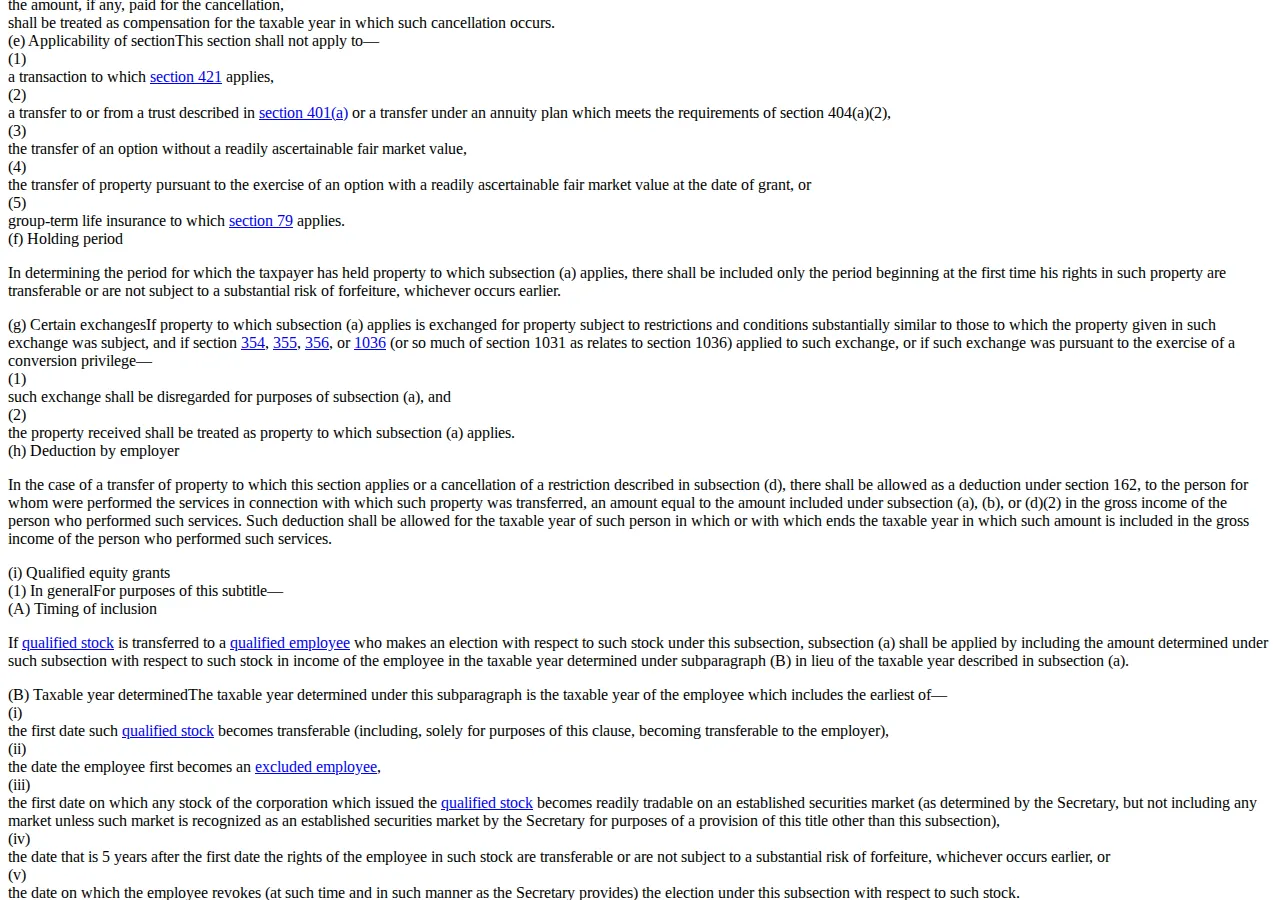
The book expense and the tax treatment answer different questions, and the employee and the employer sit on opposite sides of the same statute. IRC § 83(a) sets the employee's general rule: when property is transferred in connection with services, the excess of its fair market value — at the first time the rights are transferable or are not subject to a substantial risk of forfeiture — over the amount paid is included in the employee's gross income in that year. Subsection (c)(1) defines the substantial risk of forfeiture: the rights are conditioned on the future performance of substantial services. That is vesting, in statutory language.
Three elections and carve-outs decide real cases. First, the § 83(b) election: within 30 days of transfer, the employee may elect to include the spread at transfer value instead of waiting for vesting. If the election is made, subsection (a) does not apply — and if the property is later forfeited, no deduction is allowed for the forfeiture. That 30-day deadline is absolute; the companion 83(b) election playbook runs the filing mechanics. Second, § 83(i) qualified equity grants let a qualified employee of a private company where at least 80% of US employees receive options or RSUs on the same terms defer inclusion up to 5 years after vesting — but 1% owners, the CEO, the CFO, and the four highest-compensated officers are excluded. Third, § 83(e)(3): the transfer of an option without a readily ascertainable fair market value is outside § 83 entirely, which is why most nonstatutory options are taxed at exercise rather than at grant.
The employer's side is § 83(h): a deduction under § 162 equal to the amount included in the employee's income, for the employer's year in which or with which ends the employee's year of inclusion. The timing table is the whole book-to-tax story:
| Event | Book expense (ASC 718) | Employee income (§ 83) | Employer deduction (§ 83(h)) |
|---|---|---|---|
| Grant | Fair value locked; expense begins | None (no readily ascertainable FMV) | None |
| Vesting of restricted stock / RSUs | Expense continues over the period | FMV at vesting less amount paid | Same year as employee inclusion |
| Exercise of NSO | Expense already recognized over vesting | FMV of stock less exercise price | Exercise year |
| ISO exercise | Expense already recognized over vesting | None at exercise (AMT may apply) | None, unless disqualifying disposition |
| Forfeiture | Previously recognized expense reversed | None (or no deduction if § 83(b) elected) | None |
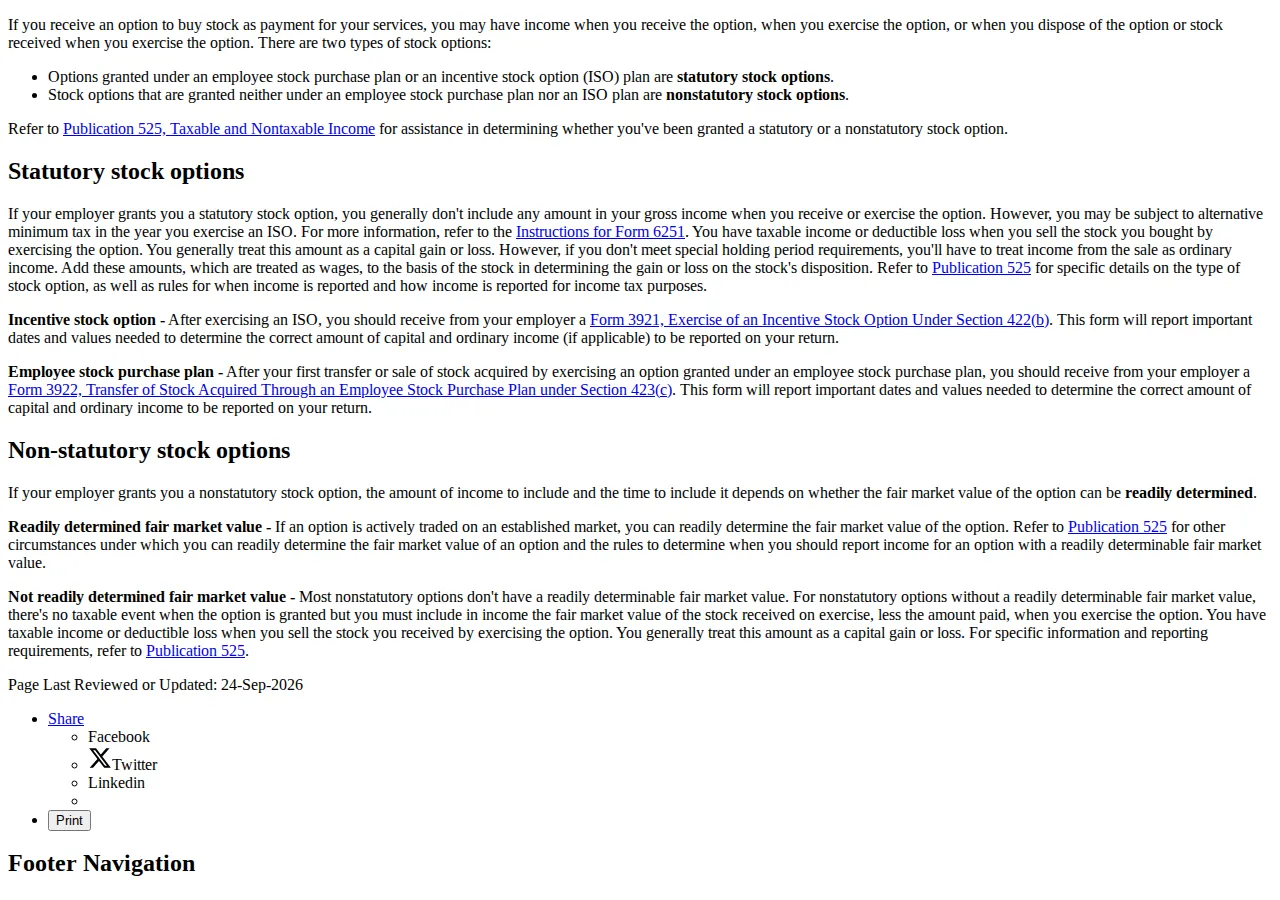
The IRS's Topic 427 draws the employee line the same way: statutory options (ISOs and employee stock purchase plans) generally produce no income at grant or exercise, though an ISO exercise can trigger alternative minimum tax, and the sale is capital gain or loss unless the holding-period requirements fail — a disqualifying disposition turns part of the gain into ordinary income. Nonstatutory options without a readily determinable fair market value produce no income at grant; the employee includes the fair market value of the stock received on exercise, less the amount paid, and that spread is wages for income tax and FICA purposes. After an ISO exercise the employer issues Form 3921, which carries the employer's EIN and the dates and values the return needs; after an ESPP transfer or sale it issues Form 3922.
The book-tax gap is a deferred tax asset. Book expense runs over vesting; the deduction lands at vesting or exercise, and for ISOs it may never land at all unless there is a disqualifying disposition. Under ASU 2016-09, excess tax deductions — the deductible amount at exercise or vesting above the book cost — generally flow through income tax expense, but the resulting deferred tax asset needs a valuation allowance analysis like any other DTA. A company with a history of losses and no convincing evidence of future taxable income carries the DTA behind a full valuation allowance, and the SBC deduction does nothing for cash tax until the company turns profitable.
The dilution math founders ignore
SBC is non-cash, which is exactly why founders underweight it. The cost is not cash — it is ownership. Run the dilution arithmetic on the same grant: 10,000 options against 1,000,000 shares outstanding is 1% of the company at grant, before counting the 1,000 RSUs and every other open grant.
ext{SBC as % of Revenue} =
rac{ ext{Annual SBC Expense}}{ ext{Annual Revenue}} imes 100
At $5M of annual SBC on $20M of ARR, that ratio is 25%. At $14,805 per year for one 10,000-option grant, the ratio looks trivial — until the cap table holds 40 such grants. The monthly close must carry a roll-forward that ties out: granted, exercised, forfeited, and outstanding quantities and values must foot to the general ledger every month. Price the dilution break-even with our Break-Even Calculator, with SBC as a fixed cost line.
Founder & CEO Insight — Enow A. Jovial
Who should not use this playbook as written
This playbook covers equity-classified employee awards under US GAAP. It does not cover cash-settled awards beyond flagging their remeasurement, performance awards with market conditions that need a Monte Carlo lattice, or the § 409A deferred-compensation rules for discounted options. Companies reporting under IFRS 2 face a different framework, and awards with a market condition need a valuation specialist: Black-Scholes does not value them.
Monthly close protocol
- Pull the grant register — every open grant, its fair value, vesting schedule, and forfeiture status.
- Book the monthly entry — debit compensation expense, credit APIC, for each grant's monthly slice.
- True up forfeitures — reverse expense for unvested awards of departed employees.
- Check the 409A clock — valuation age and any material event since it was issued; refresh before the next grant cycle.
- Reconcile the roll-forward — granted, exercised, forfeited, and outstanding quantities and values foot to the GL.
Operator checklist
- [x] Grant-date fair value locked — Black-Scholes inputs documented: 409A price, strike, term, volatility, risk-free rate, dividend yield.
- [x] 409A current — valuation dated within 12 months and refreshed after any material event before the next grant cycle.
- [x] Vesting attribution elected — straight-line vs graded documented in the policy memo and applied consistently.
- [x] Forfeiture policy elected — estimate-and-true-up or as-they-occur, entity-wide, with the cumulative balance reconciled monthly.
- [x] Modifications tagged — every acceleration, repricing, and exercise extension logged as a modification with a remeasurement on the modification date.
- [x] Book-tax tracked — deferred tax asset for the ASC 718 vs § 83(h) timing gap, with a valuation allowance analysis each quarter.
- [x] Double-trigger RSUs monitored — liquidity-event probability reassessed each quarter; catch-up computed and ready before the IPO quarter.
- [x] Cap-table roll-forward ties out — granted, exercised, forfeited, and outstanding quantities and values foot to the GL every month.
- [x] Forms issued — Form 3921 after ISO exercises, Form 3922 after ESPP transfers or sales.
Equity is the currency a startup spends before it has cash, and ASC 718 is the ledger that prices it. Measure once at grant date, expense over vesting, deduct at vesting or exercise, and keep the 409A current. For the related equity mechanics, read the ESOP playbook for employee ownership structures and the § 162(m) executive compensation limit for the $1M deductibility cap that sits on top of the § 83(h) deduction.