A public company that pays its chief executive $4,200,000 deducts $1,000,000 of it. The other $3,200,000 is spent, taxed, and never deducted. That is the whole of IRC § 162(m) in one sentence: a $1,000,000 annual deduction cap per covered employee, with no inflation adjustment, no performance-based escape hatch, and a roster of covered employees that only grows. The statute has read this way since the Tax Cuts and Jobs Act rewrote it in 2017, and the next change is already on the books — five more employees join the roster for tax years beginning after December 31, 2026.
The cap, in the statute's own words
Section 162(m)(1) is one sentence long: "no deduction shall be allowed under this chapter for applicable employee remuneration with respect to any covered employee to the extent that the amount of such remuneration for the taxable year with respect to such employee exceeds $1,000,000." Three terms do all the work, and each is defined in the same subsection.
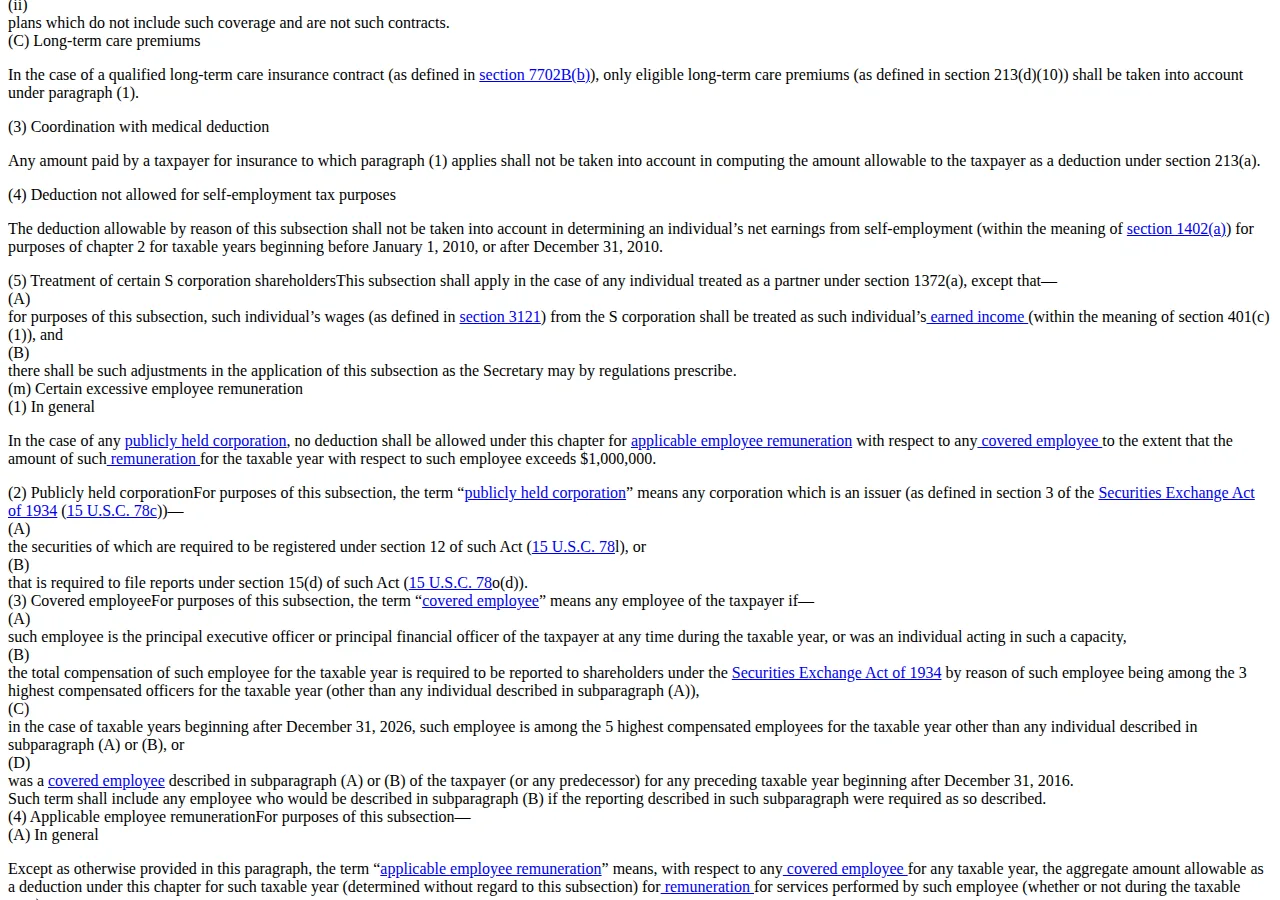
Publicly held corporation — § 162(m)(2). Any corporation that is an issuer whose securities must be registered under section 12 of the Securities Exchange Act of 1934, or that must file reports under section 15(d) of that Act. The TCJA widened this definition: before 2018 it covered only § 12 registrants. A company that files reports under § 15(d) — typically a debt issuer that never listed equity — is now inside the cap. The test is the issuer's reporting status, not its size: a small public company is capped exactly like a large one.
Covered employee — § 162(m)(3). Four clauses, and the fourth is the trap:
| Clause | Who is covered | Since when |
|---|---|---|
| (A) | Principal executive officer (PEO) and principal financial officer (PFO), at any time during the year, including anyone acting in that capacity | 2018 |
| (B) | The 3 highest compensated officers for the year (other than the PEO/PFO) | 2018 |
| (C) | For tax years beginning after December 31, 2026: the 5 highest compensated employees (not just officers) other than (A) and (B) | 2027 |
| (D) | Anyone who was a covered employee under (A) or (B) for any preceding tax year beginning after December 31, 2016 | Permanent |
Section 162(m)(3)(C) was added by § 9708 of the American Rescue Plan Act (P.L. 117-2). Note the deliberate wording change: clause (B) says "officers"; clause (C) says "employees." From 2027, a highly paid engineer, salesperson, or trader who is not an officer at all can be a covered employee. And clause (D) means the roster never shrinks: a CFO who leaves in 2025 is still a covered employee when deferred compensation is paid to them in 2030, and the cap still applies in the year the deduction would otherwise be taken.
Applicable employee remuneration — § 162(m)(4). The aggregate amount allowable as a deduction for the year for remuneration for services performed by the employee, whether or not during that year. Salary, bonus, stock options, RSUs, commissions — all of it counts, and a bonus tied to an EBITDA target counts exactly like salary now that the performance-based exception is gone. RSUs are remuneration when they vest, and the vesting is also a FICA event for the employee even though the employer's deduction is still capped at $1,000,000. Two exclusions survive in § 162(m)(4)(C): payments under a qualified retirement plan (the § 3121(a)(5) carve-out) and benefits the employee can exclude from gross income. Everything else is in.
What died in 2017, and what survived
Before the Tax Cuts and Jobs Act, § 162(m) had two famous escape hatches: remuneration payable on a commission basis, and qualified performance-based compensation — the provision that let companies deduct nine-figure stock-option grants so long as a committee of outside directors certified pre-set goals. TCJA § 13601 (P.L. 115-97) struck both exclusions from § 162(m)(4). IRS Notice 2018-68 states it plainly: "Section 13601(a) of the Act amended the definition of 'applicable employee remuneration' in section 162(m)(4) to remove these two exclusions."
One bridge survived. Section 13601(e) grandfathers remuneration payable under a written binding contract that was in effect on November 2, 2017, and was not modified in any material respect on or after that date. Notice 2018-68 explains the boundary: a material modification occurs when the contract is amended to increase the amount of compensation payable, and a modified contract is treated as a new contract entered into on the modification date — which kills the grandfather protection for everything paid after it.
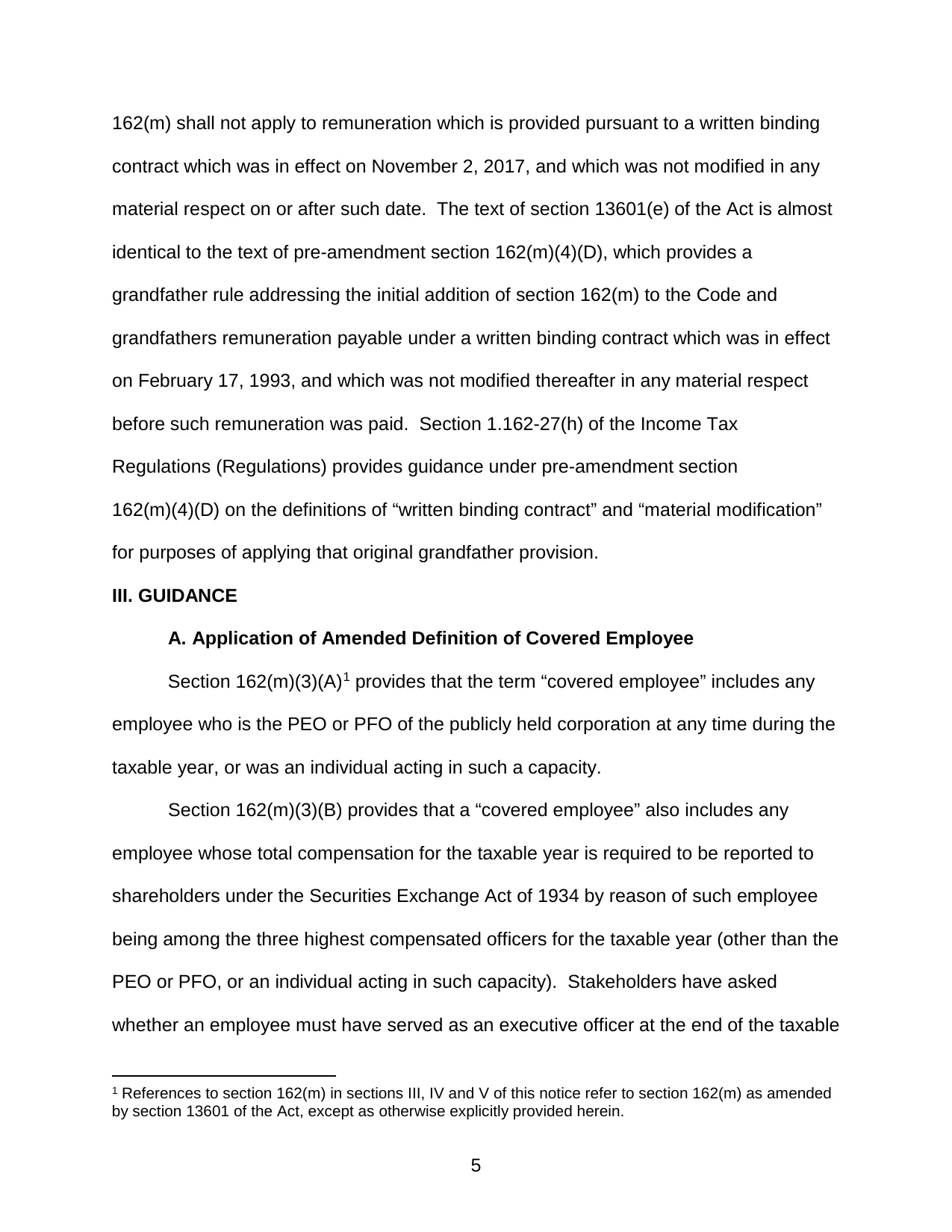
The practical consequence is a calendar test every compensation committee should run before it touches a legacy contract. Three questions, in order: was the contract in effect on November 2, 2017; has it been amended since to increase pay; and is the amount in question payable under that contract as written. A "yes" to the first and "no" to the second keeps the old rules for that pay. Any increase amendment — even one that raises pay for an unrelated reason — converts the whole contract to post-2017 treatment. Notice 2018-68 is explicit that amounts received before a material modification stay grandfathered, and amounts after it do not.
The cost math, worked
The cap is a tax-shield problem, so the math is one multiplication. At the 21 percent flat corporate rate under § 11(b):
ext{Lost Tax Shield} = ( ext{Total Pay} - $1{,}000{,}000) imes 21%
Example 1 — a single CEO. Total pay $4,200,000: $2,000,000 salary, $1,200,000 cash bonus, $1,000,000 in RSUs vesting this year. Deductible: $1,000,000. Nondeductible: $3,200,000. Lost shield:
ext{Lost Shield} = $3{,}200{,}000 imes 21% = $672{,}000
The company still spends $4,200,000 in cash and equity. Its after-tax cost is $672,000 higher than the same pay at a private company, where the full amount would be deductible subject only to the reasonable-compensation standard.
Example 2 — the 2027 roster. Five covered employees in 2026 (PEO, PFO, three officers) become ten in 2027 when clause (C) adds five more. Suppose each of the ten is paid $2,000,000. Nondeductible pay is $1,000,000 per person, $10,000,000 in total:
ext{Lost Shield} = 10 imes $1{,}000{,}000 imes 21% = $2{,}100{,}000
That is $2.1 million of tax the company pays because of the cap alone — before any other tax item. A board that approves a pay package without this line in the model is approving a number it has not seen.
Example 3 — the § 280G interaction. Section 162(m)(4)(D) reduces the $1,000,000 limit by the amount of any golden parachute payment disallowed under § 280G. A covered employee with $400,000 of disallowed parachute pay in a change-in-control year has an effective § 162(m) limit of $600,000, not $1,000,000:
ext{Effective Limit} = $1{,}000{,}000 - $400{,}000 = $600{,}000
Change-in-control years are where the two provisions stack, and where the surprise is largest.
Who this does not touch — and the IPO boundary
Section 162(m) applies only to publicly held corporations. A private company — an LLC taxed as a partnership, an S-Corp, or a private C-Corp — deducts executive pay under § 162(a)(1), which allows a deduction for "a reasonable allowance for salaries or other compensation for personal services actually rendered." Reasonable compensation is a facts-and-circumstances test — the territory of our S-Corp reasonable compensation guide — not a hard cap. Equity pay is still expensed under GAAP (ASC 718) whether or not it is deductible, so the book expense and the tax deduction diverge by the full nondeductible amount; have a CPA reconcile the two before the audit committee signs the 10-K. That is why the planning moment for § 162(m) is the IPO, not the first public filing: the cap starts applying in the year the company becomes publicly held, and pay structures designed for a private company — large founder salaries, uncapped bonuses — become partly nondeductible overnight.
Founders of Delaware C-Corps heading toward a listing should read this alongside our Delaware C-Corp founder stock vesting and 83(b) playbook, because vesting equity is remuneration when it becomes deductible, and the § 162(m) roster is decided by titles and pay rank, not by who founded the company. A founder who stays on as CEO is a covered employee under clause (A) from the first public year. A founder who steps down to a non-officer role can still be covered under clause (C) from 2027 if their pay ranks in the top five.
Founder & CEO Insight — Enow A. Jovial
The planning levers that actually work
There are only three honest levers, and two of them are narrow:
- Pay into the excluded buckets. Qualified retirement plan contributions and excludable benefits are outside § 162(m)(4)(C). They are real, but they are small relative to executive pay — a 401(k) contribution is capped by § 402(g) and § 415, not by the board's generosity.
- Keep total pay at or under $1,000,000 per covered employee. The only lever with no ceiling problem, and the one boards almost never pull, because it means restructuring pay rather than re-labelling it. Deferred compensation does not help: the cap applies in the year the deduction would otherwise be taken, and clause (D) keeps the employee covered after departure, so deferring pay past retirement just moves the nondeductible dollar to a later year.
- Do not touch a grandfathered contract. If a written binding contract was in effect on November 2, 2017, and has not been materially modified, leave it alone. Any amendment that increases compensation converts it to post-2017 treatment for all later payments. Run the three-question calendar test before any amendment is signed.
What does not work: re-labelling salary as a "performance bonus" (the exception is gone), paying through a subsidiary (the deduction belongs to the publicly held corporation and the cap follows the remuneration), and assuming the cap resets when an executive changes role (clause (D) is permanent). The statute was written to close exactly those doors.
Operator checklist
- [x] Identify the roster: list the PEO, PFO, and three highest compensated officers for the current year, then add the five highest compensated employees for tax years beginning after December 31, 2026.
- [x] Price every package: for each covered employee, compute (total pay − $1,000,000) × 21% and put the lost shield on the same page as the pay number.
- [x] Audit legacy contracts: find every written binding contract in effect on November 2, 2017; confirm none was materially modified after that date before relying on grandfather treatment.
- [x] Check the § 280G overlap: in any change-in-control year, reduce the $1,000,000 limit by disallowed parachute amounts before computing the cap.
- [x] Model the IPO year: the cap starts the year the company becomes publicly held — re-price founder and executive pay in the listing model, not after it.
- [x] Price the package through the tax estimator: run the lost-shield figure against the company's actual effective rate before the board votes.
Section 162(m) rewards one habit above all: counting the tax cost before the pay is promised. The cap is fixed, the roster only grows, and the performance-based door is shut. A company that prices the lost shield into every package makes the same pay decisions as its competitors — it just makes them with its eyes open.