Zoho, HubSpot, and Salesforce all sell the same product — a CRM that holds your pipeline — and all three will quote you under $25 a seat a month to start. The bill diverges the moment you count what each one actually meters. Zoho charges per user per month on a five-rung ladder that starts at free and tops out at $52. HubSpot charges per seat per month on a three-rung ladder that starts at free and tops out at $150. Salesforce charges per user per month on a five-edition ladder that starts at $25 and tops out at $550. At 25 seats the three cheapest honest answers are $1,000, $2,500, and $4,875 a month — a spread of nearly five times for the same headcount.
The figures below come from the vendors' own pricing pages, read on November 20, 2026 — Zoho's ladder from the pricing data its own page renders, HubSpot's from its server-rendered product page, Salesforce's from its Sales Cloud pricing page. All are annual-billing figures unless marked monthly.
The three ladders, side by side
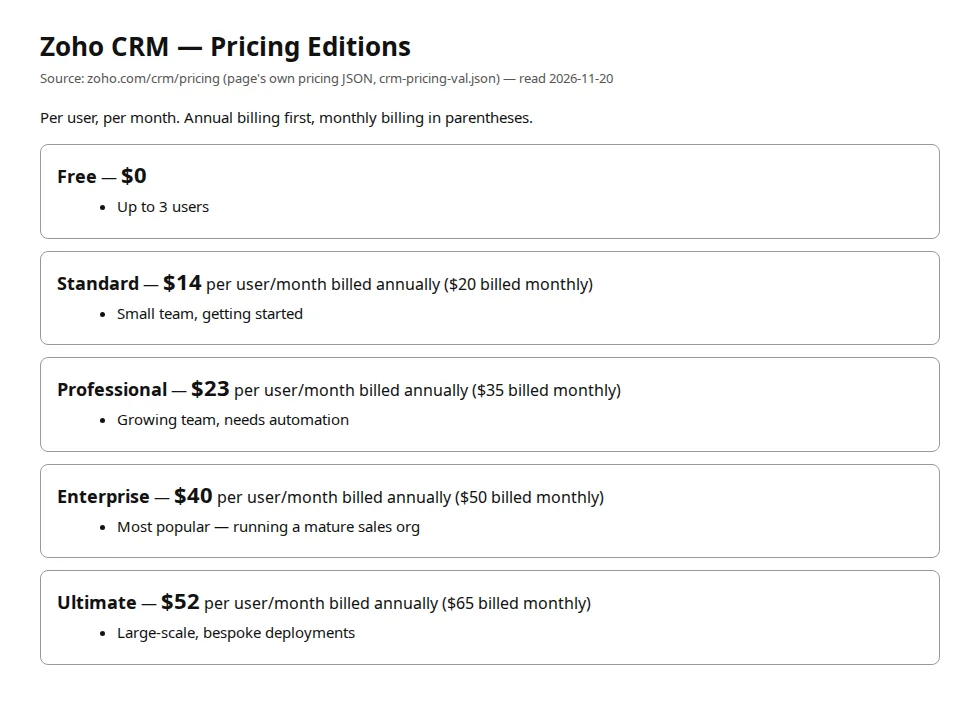
Zoho CRM runs five editions. Free is $0 for up to 3 users. Standard is $14 a user a month billed annually, $20 monthly. Professional is $23 billed annually, $35 monthly. Enterprise is $40 billed annually, $50 monthly, and the edition Zoho marks most popular. Ultimate is $52 billed annually, $65 monthly, for large-scale bespoke deployments.
HubSpot Sales Hub runs four tiers. Free is $0 with no credit card required. Starter starts at $20 a seat a month — the page also shows a $10 limited-time figure for new customers, a promotion, not the list price. Professional starts at $100 a seat a month. Enterprise starts at $150. HubSpot also sells additional Core Seats at $45 a seat a month on Enterprise, for staff who need CRM access without a full paid seat.
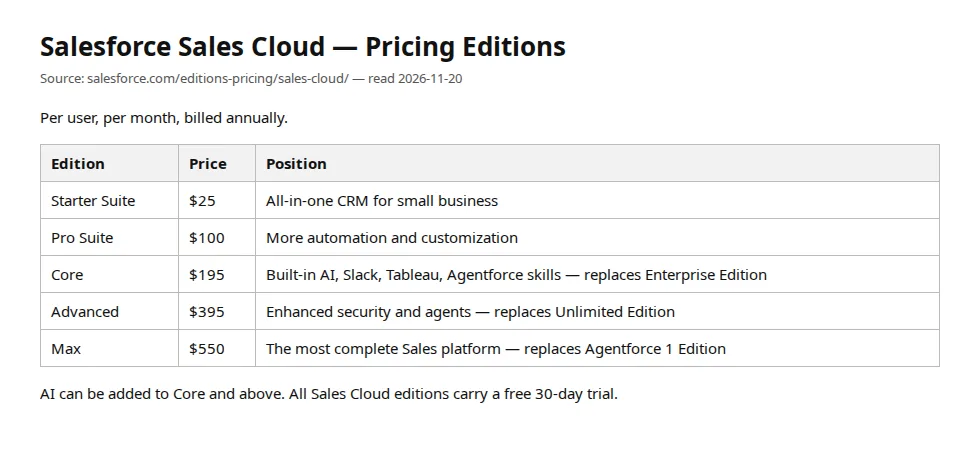
Salesforce Sales Cloud runs five editions. Starter Suite is $25 a user a month. Pro Suite is $100. Core is $195. Advanced is $395. Max is $550. The current ladder replaced the old one: Core replaces Enterprise Edition, Advanced replaces Unlimited Edition, and Max replaces Agentforce 1 Edition. AI can be added to Core and above. Every edition carries a free 30-day trial; Salesforce sells no free tier.
| Vendor | Entry paid tier | Mid tier | Top tier | Free tier |
|---|---|---|---|---|
| Zoho CRM | Standard $14 | Professional $23 / Enterprise $40 | Ultimate $52 | $0, up to 3 users |
| HubSpot Sales Hub | Starter $20 | Professional $100 | Enterprise $150 | $0 |
| Salesforce Sales Cloud | Starter Suite $25 | Pro Suite $100 / Core $195 | Advanced $395 / Max $550 | None — 30-day trial |
The entry tier tells you who each vendor is built for. Zoho's $14 Standard and HubSpot's $20 Starter are both aimed at a team of five that needs a shared pipeline and nothing else. Salesforce's $25 Starter Suite is aimed at the same team but bundles service, marketing, and commerce into one suite — the only entry tier that is not a pure sales product. That bundling is the first hint that Salesforce's ladder is priced for breadth, not for cheap seats.
The seat math: 5, 25, and 100 seats
Per-seat pricing punishes teams that count heads instead of makers. The only honest comparison is the same headcount on all three ladders, on annual billing.
| Monthly bill, annual billing | 5 seats | 25 seats | 100 seats |
|---|---|---|---|
| Zoho Standard $14 | $70 | $350 | $1,400 |
| Zoho Professional $23 | $115 | $575 | $2,300 |
| Zoho Enterprise $40 | $200 | $1,000 | $4,000 |
| HubSpot Starter $20 | $100 | $500 | $2,000 |
| HubSpot Professional $100 | $500 | $2,500 | $10,000 |
| Salesforce Starter Suite $25 | $125 | $625 | $2,500 |
| Salesforce Core $195 | $975 | $4,875 | $19,500 |
At 25 seats, Zoho Enterprise costs $1,000 a month against $2,500 for HubSpot Professional and $4,875 for Salesforce Core — 60% below HubSpot and 79% below Salesforce at the same headcount, because Zoho prices Enterprise for team size while the other two price their serious tiers for automation and AI. At 100 seats the three are $4,000, $10,000, and $19,500 a month.
The five-year totals make the gap impossible to ignore. A 25-seat team on annual billing pays $60,000 over five years for Zoho Enterprise, $150,000 for HubSpot Professional, and $292,500 for Salesforce Core. The $232,500 difference between Zoho Enterprise and Salesforce Core is more than a full-time sales hire's salary for two years — and it buys no extra pipeline, only a different vendor's ecosystem. Run your own headcount through the pricing calculator before you sign.
The monthly-billing penalty: what paying month to month costs
Every vendor discounts annual billing, and Zoho discounts it hardest. The penalty for paying monthly is the tax on indecision.
| Zoho edition | Annual billing | Monthly billing | Monthly penalty |
|---|---|---|---|
| Standard | $14 | $20 | +43% |
| Professional | $23 | $35 | +52% |
| Enterprise | $40 | $50 | +25% |
| Ultimate | $52 | $65 | +25% |
At 25 seats on Zoho Enterprise, monthly billing costs $1,250 a month against $1,000 on annual billing — a $3,000-a-year penalty for the same seats and features. On Professional the penalty is steeper in percentage terms: $875 a month against $575, or $3,600 a year at 25 seats.
The ceilings: what each tier actually gates
Price is only half the decision. The other half is the ceiling — the feature that forces the upgrade — and each vendor puts it in a different place.
Zoho puts the ceiling on team structure. Standard is built for a small team getting started: email integration and mass emails, but no automation depth. Professional adds the automation a growing team needs — process management and AI agents that execute tasks. Enterprise, the most popular edition, adds multi-team management across territories and a reporting hierarchy that gives every manager a real-time view. Ultimate is for large-scale bespoke deployments with the highest feature limits, consultation, and migration assistance. Buy the edition that matches the org chart, not the feature list.
HubSpot puts the ceiling on automation and objects. Starter automates personalized outreach, schedules meetings, and reports on outcomes. Professional adds the ability to find and engage high-value prospects, customize sales workflows and sequences, and record and transcribe calls. Enterprise adds custom objects, complex pipeline management, and advanced analytics. The ladder is a sophistication ladder: the upgrade buys workflow depth, not seats. A team that buys Professional for the sequences and never builds one pays $80 a seat a month for a feature it does not use.
Salesforce puts the ceiling on AI and scale. Starter Suite is the all-in-one CRM for a small business. Pro Suite adds more automation and customization across sales, service, marketing, and commerce. Core adds built-in AI, Slack, Tableau, and Agentforce skills. Advanced adds enhanced security and agents. Max is the most complete Sales platform, uniting AI, CRM, and data with unmetered Agentforce. The ladder is an AI ladder: every rung above Pro Suite is priced on how much intelligence the team wants inside the CRM. A team that does not use Agentforce should not be on Core.
| Ceiling | Zoho | HubSpot | Salesforce |
|---|---|---|---|
| What forces the upgrade | Team structure and reporting hierarchy | Workflow depth and custom objects | AI, security, and scale |
| Mid-tier unlock | Professional: automation and AI agents | Professional: sequences and workflows | Pro Suite: automation and customization |
| Top-tier unlock | Ultimate: bespoke limits and migration | Enterprise: custom objects and analytics | Max: unmetered Agentforce |
Operator boundaries: who should avoid each
Zoho is the wrong buy for a team already inside HubSpot's marketing stack or Salesforce's ecosystem. Migrating a live pipeline, retraining a sales team, and rebuilding every integration costs more in the first quarter than the price gap saves in the first year. It is also the wrong buy for a team that needs the deepest app marketplace on day one.
HubSpot is the wrong buy for a team that prices by the seat and counts heads honestly. At $100 a seat, a 25-person team pays $2,500 a month for Professional, and every dormant seat — the manager who logs in once a month, the contractor who finished in March — is billed at the same $100. HubSpot's $45 additional Core Seats on Enterprise are the pressure valve, but they are Enterprise-only. A team with more than a fifth of its seats dormant should audit the seat list before it audits the vendor.
Salesforce is the wrong buy for a team of five that needs a pipeline and nothing else. Starter Suite at $25 a seat is $125 a month for five people, which is fair — but the moment the team wants the AI Salesforce markets, the price is Core at $195 a seat, or $975 a month for the same five people. Max at $550 a seat is $2,750 a month for five people, more than most five-person teams spend on their entire software stack. The ladder is priced for companies that have already decided Salesforce is the platform, not for companies still choosing one.
The free tier and the trial: what zero actually buys
Zoho Free is $0 for up to 3 users — a real free tier for a founding team of three, and a hard wall at the fourth hire, when the whole team moves to Standard at $14 a seat. HubSpot Free is $0 with no credit card required and no published user cap on the page read for this guide, which makes it the most generous free tier of the three — but the free tools are feature-limited, and the first paid seat is Starter at $20. Salesforce has no free tier at all: every edition carries a free 30-day trial, and day 31 is the first invoice. A team that needs more than 30 days to decide should decide on HubSpot Free or Zoho Free, because a Salesforce trial expires mid-evaluation.
For the wider picture, our HubSpot vs Salesforce vs Pipedrive CRM pricing automation guide prices the same two vendors against Pipedrive, and our HubSpot vs Pipedrive for agencies covers the agency side. Teams scoring leads inside the CRM should read our AI lead scoring and CRM integration guide before paying for an AI tier to do what a scoring rule already does.
Founder & CEO Insight — Enow A. Jovial
Decision table: which CRM, at which headcount
| Team shape | Buy | Monthly bill | Authority |
|---|---|---|---|
| 5 seats, pipeline only | Zoho Standard $14 | $70 | zoho.com/crm/pricing |
| 5 seats, inside HubSpot marketing | HubSpot Starter $20 | $100 | hubspot.com/products/sales |
| 25 seats, serious sales org | Zoho Enterprise $40 | $1,000 | zoho.com/crm/pricing |
| 25 seats, HubSpot marketing stack | HubSpot Professional $100 | $2,500 | hubspot.com/products/sales |
| 25 seats, Salesforce ecosystem | Salesforce Core $195 | $4,875 | salesforce.com/editions-pricing/sales-cloud |
| 100 seats, cost-led | Zoho Enterprise $40 | $4,000 | zoho.com/crm/pricing |
The rule behind the table: buy the cheapest tier whose ceiling you will not hit in the next twelve months, and re-price the ladder every renewal. A team that buys Zoho Enterprise today and outgrows it in a year has still saved $18,000 against HubSpot Professional at 25 seats — enough to fund the migration twice over.
Execution checklist
- [x] Step 1: Count real seats — list everyone who needs CRM access, mark the dormant ones, and price on makers, not headcount.
- [x] Step 2: Price all three at your headcount — run the table at your actual number; do not trust the entry-tier price.
- [x] Step 3: Test the ceiling — map the one workflow that forces your upgrade on each vendor, and confirm it is gated where the table says.
- [x] Step 4: Choose the billing period — annual billing on Zoho saves 25% to 52%; confirm the monthly figure in writing on HubSpot and Salesforce.
- [x] Step 5: Run the trial on real data — import the live pipeline, not a demo file; a CRM that cannot hold your real deals in 30 days will not hold them in a year.
- [x] Step 6: Audit seats quarterly — remove dormant seats before every renewal; at Core prices, five cost $11,700 a year.
- [x] Step 7: Re-price at renewal — vendors change ladders; Salesforce replaced its whole edition set. The ladder you signed is not the ladder you renew on.