Zero-Based Budgeting Playbook
Zero-Based Budgeting Playbook
Zero-based budgeting (ZBB) starts the budget at zero: no line survives because it existed last year, and every activity must be justified again at a stated service level and cost before it receives a dollar. Peter A. Pyhrr, an accounting manager at Texas Instruments, developed the method and described it in the Harvard Business Review in 1970. Jimmy Carter applied it to Georgia's 1973 fiscal budget as governor, and the federal government adopted it in 1977. It was eliminated from federal budgeting on 7 August 1981. The method keeps returning because last year's spending becomes this year's budget by default.
This playbook covers the method: building a budget from zero, writing decision packages, ranking them, drawing the cut-line. It is not variance analysis; tracking actuals against the finished budget belongs in the budget-vs-actual variance analysis playbook. It is not marketing allocation either; splitting a fixed marketing pot between channels is covered in the SEO versus PPC budget allocation playbook. Reported figures come from the practitioner sources listed at the end; worked numbers are derived arithmetic on stated assumptions.
Step 1: Set the top-down target and the scope
ZBB fails when it starts bottom-up with no target. McKinsey's 2014 paper is blunt: the cost-reduction degree is set by the company's top-down target, not discovered by the exercise. Its examples run from a 30\% year-one target in the most aggressive cases to a 10\% target with half the savings reinvested, leaving 5\% to the bottom line. Set the target first, in writing, with the CFO behind it — Böhm puts it plainly: if the CFO does not support the process, the whole thing is over.
Scope is second: McKinsey recommends ZBB only where potential savings are highest — capital expenditures, certain operating expenditures, procurement — because it adds a couple of months to a four-to-six-month process. Start where the money is biggest and most movable: payroll and branch real estate are inflexible, while advertising and most capital expenditures can be reset every year.
Worked target math. Meridian, a fictional company: revenue \$12,000,000, SG\&A baseline \$2,400,000 (20\% of revenue). McKinsey and Deloitte both report that, properly implemented, ZBB can cut SG\&A costs by 10 to 25\%, often within six months. Applied to Meridian:
A 10\% target frees \$240,000; a 25\% target frees \$600,000.
Step 2: Define decision units and appoint cost-category owners
A decision unit is the smallest part of the organisation that can own a budget request: a department, a programme, a product line, or a single site. Each unit must be independent enough to rank against other units without double-counting shared costs. If two units both claim the same software licenses, the boundary is wrong; fix it before writing packages.
Appoint cost-category owners: senior leaders who vet one spending category across every unit — property rental, security, travel, software — rather than inside one department. Böhm says a large corporate might expect 12 to 15 of them; the role changes the discussion: instead of assuming funding stays the same, the owner asks why it should stay, and whether it needs to be that way.
Step 3: Build decision packages at three funding levels
The decision package is the unit of the whole method: one activity, with purpose, cost, alternatives, performance measures, and the consequence of not doing it. The GFOA's 2011 report lists what a complete package carries: positions, costs, measures, an impact narrative, revenue impacts. A package without a performance measure cannot be ranked: no way to compare what different funding levels buy.
Each unit prepares packages at three funding levels. The minimum is the cheapest way to keep the activity alive — the Iowa League of Cities puts it at often 75\% of current operating level. The current level continues today's service; the enhanced level buys more and must justify the increment as if new.
Worked minimum-level math. A Meridian department at a current operating level of \$800,000 a year has a minimum package of:
Its current-level package is \$800,000, and an enhanced package at 15\% above current is:
The three packages cost \$600,000, \$800,000, and \$920,000 for the same department. Ranking decides which one is funded — never all three: they describe the same activity.
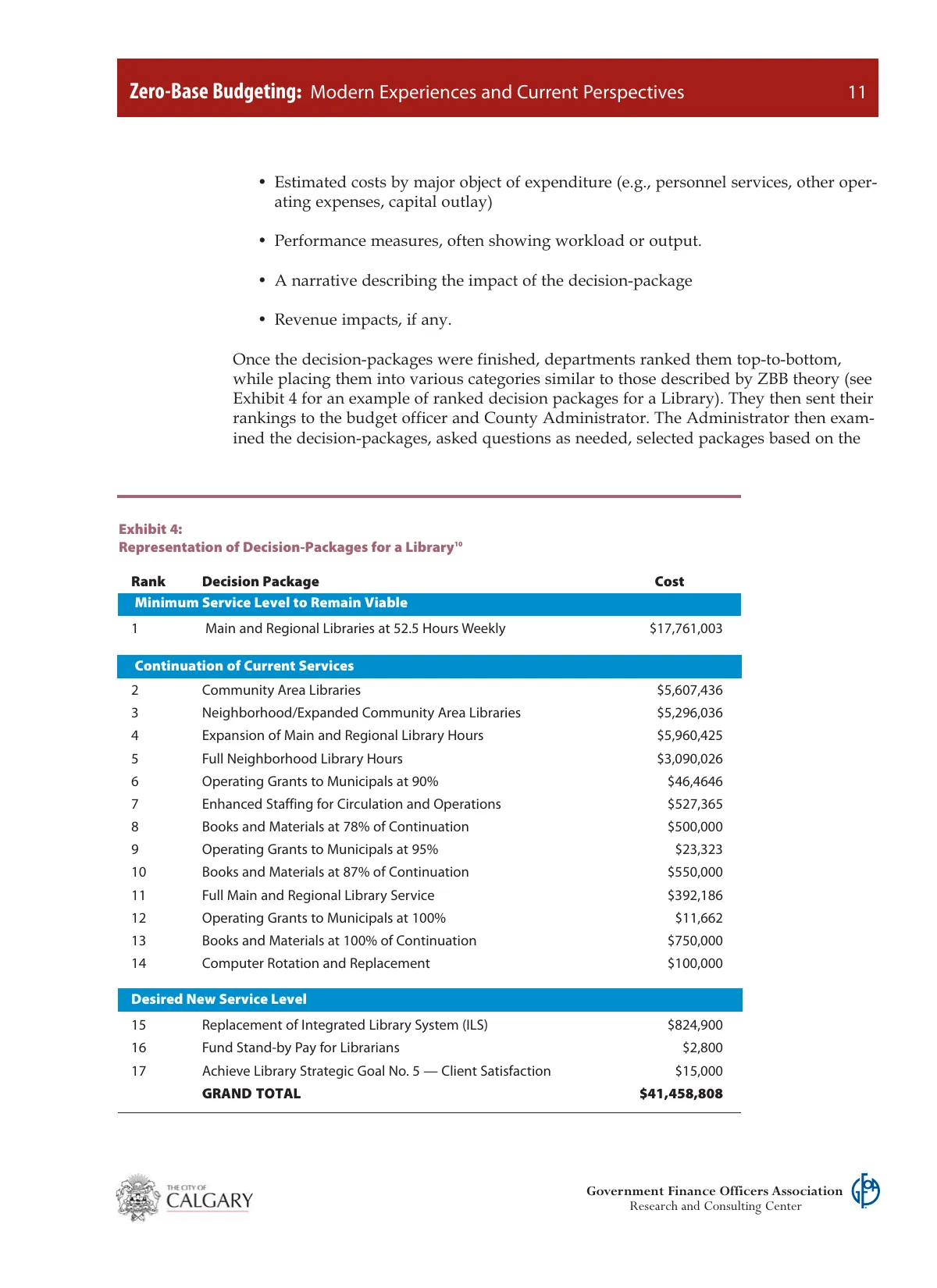
The screenshot above is the GFOA report's Exhibit 4: ranked packages for a library, from a \$17,761,003 minimum level for main and regional libraries at 52.5 hours weekly to new service levels, grand total \$41,458,808. The minimum package alone is 42.8\%.
Step 4: Rank the packages and draw the cut-line
Ranking is where the budget is made. Packages from every unit go onto one list, ordered by value — strategy alignment, return on the spend, cost of not doing it — funded top-down until the money runs out. Everything below the cut-line is unfunded, however worthy.
Worked cut-line. Meridian has \$1,850,000 for seven packages, ranked by the finance committee; the cumulative column is the running total:
| Rank | Decision package | Cost | Cumulative | Funded? |
|---|---|---|---|---|
| 1 | Core operations (minimum) | \$620,000 | \$620,000 | Yes |
| 2 | Compliance and payroll | \$410,000 | \$1,030,000 | Yes |
| 3 | Customer support (current) | \$380,000 | \$1,410,000 | Yes |
| 4 | Software licenses (current) | \$260,000 | \$1,670,000 | Yes |
| 5 | Staff training (enhanced) | \$180,000 | \$1,850,000 | Yes — cut-line |
| 6 | Trade-show programme | \$240,000 | \$2,090,000 | No |
| 7 | Office expansion | \$310,000 | \$2,400,000 | No |
Requested: \$2,400,000. Funded: \$1,850,000. Unfunded is:
Rank 5 lands exactly on the available money, so the cut-line falls between ranks 5 and 6. To fund the trade-show programme, the committee must move it above the line, and something else must fall below it. The total does not move; only the order does. Incrementally, ranks 6 and 7 would have been funded automatically because they were funded last year.
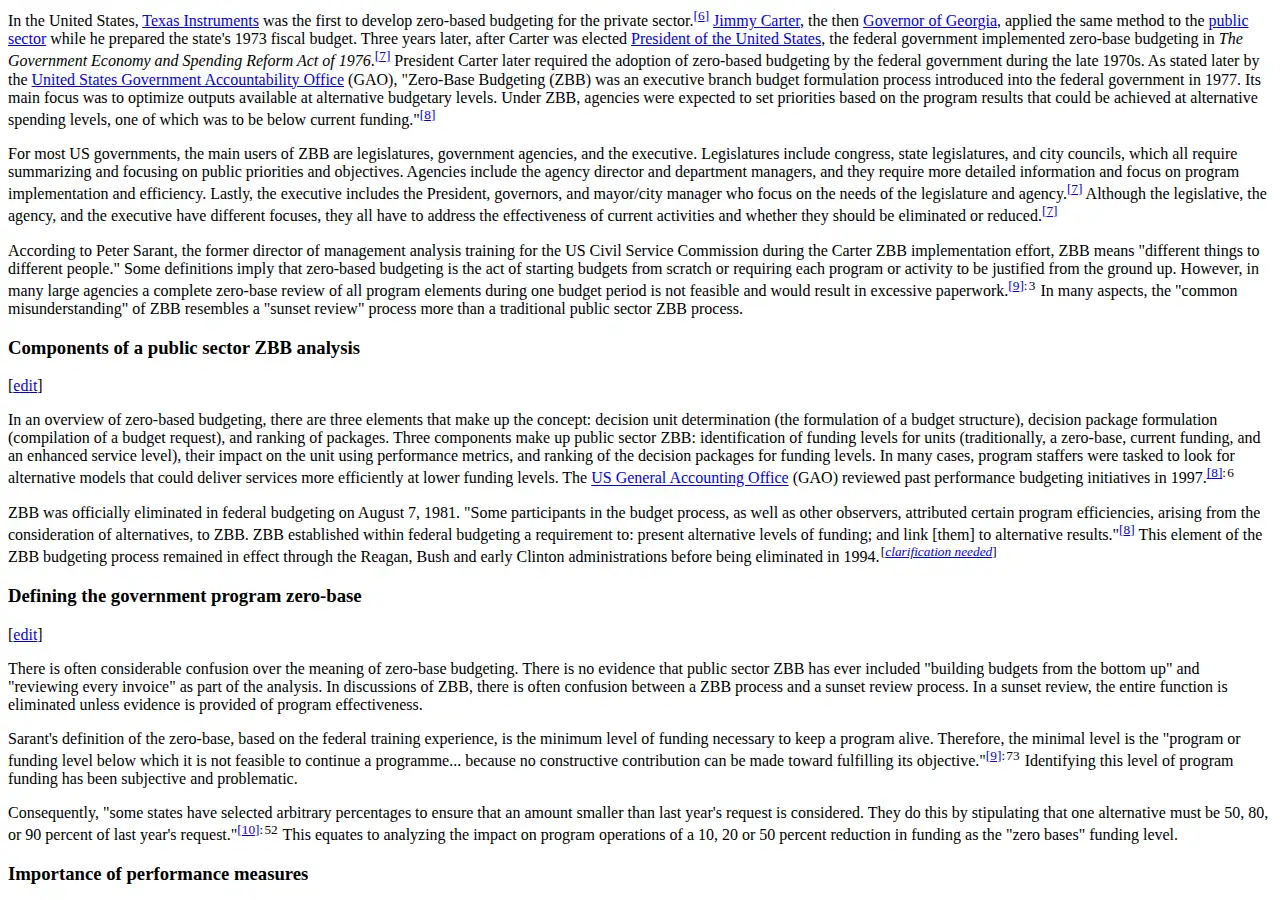
The three elements of a public-sector ZBB analysis are decision-unit determination, decision-package formulation, and ranking of packages — the same three moves this playbook uses, in the same order.
Founder & CEO Insight — Enow A. Jovial
Step 5: Fund, execute, and manage the budget monthly
The budget is not finished at the cut-line. McKinsey's core correction: ZBB is a repeatable process, not a one-off rebuild — review every dollar annually, manage performance monthly, build a culture of cost management.
Rollout takes time: McKinsey puts setup at four to ten months, led by a central team with full-time finance and IT support and part-time P&L and category owners. A large European utility took about eight months; for a smaller private company, Böhm puts it at eight weeks.
Monthly management is where savings survive or leak away. Each owner reports actual spend against the package, not a departmental total, and volume-adjusts for variable costs. An overspending package triggers the ranking question again: what service level are we buying? Run any package that claims to earn its keep through the ROI calculator before defending it; one whose return does not clear its cost is a candidate for the next cut-line.
Step 6: ZBB against incremental budgeting — the honest trade-off
Incremental budgeting takes last year's budget as the base and adjusts it for inflation, wage rises, new programmes, or cuts. It is simple and predictable, and for services that barely change year to year — police and fire protection, street maintenance, water and sewer operation — it works well. Its flaw is structural: it funds the past, and small annual increases accumulate. The Iowa League of Cities states the limitation directly: it may perpetuate inefficiencies by funding expenditures that are no longer necessary or effective.
Worked comparison: incremental budgeting at a 3\% uplift on the \$2,400,000 baseline gives:
A ZBB rebuild 15\% below the same baseline — inside the published 10 to 25\% range — gives:
The \$432,000 gap is the cost of never asking the question — but not free money: the rebuild costs months of staff time and needs clean cost data.
| Approach | How the budget is set | When it wins | Authority |
|---|---|---|---|
| Incremental budgeting | Last year's budget, adjusted | Stable services, small teams | Iowa League of Cities, Budget Systems |
| Zero-based budgeting | Every package justified from zero, ranked, funded to a cut-line | Cost reset, post-acquisition, discretionary spend | McKinsey (2014), Five myths and realities |
| Priority-based | Programmes ranked by impact on outcomes | Cutting back with clear priorities | GFOA (2011), Zero-Base Budgeting report |
| Target-based | A top-down target is set; units build to it | A fixed savings number must be hit | GFOA (2011), Zero-Base Budgeting report |
Who this is for, and who should avoid it
ZBB fits an organisation with discretionary spend large enough to justify the effort, a cost base grown by accumulation, and a finance lead willing to run the ranking in public. It fits a first round after an acquisition, a cost category — procurement, marketing, travel — where duplication is likely, and a genuine cutback, where across-the-board cuts would damage high-value services and protect low-value ones.
Avoid full ZBB if the organisation is small and its services barely change: incremental budgeting is cheaper. Avoid it if the cost data cannot price packages honestly; a ranking built on guessed costs lends false precision. And avoid running it every year in full: even its defenders rebuild selectively, with lighter versions for the largest categories in between.
Entity form, vendors, and payments: where the budget meets the books
Entity form changes which costs are fixed. In a single-member LLC taxed as a sole proprietorship, the owner's draw is not salary and carries no payroll tax; in an S-Corp, the owner must take reasonable salary subject to FICA, the remainder as distributions; in a C-Corp, all owner pay is salary, and the corporation pays its own tax. The owner-compensation package must therefore state the entity form and the split. A CPA should review the register against GAAP before ranking; wrong entity assumptions misrank a package by the size of the error.
Every vendor file carries the vendor's EIN, renewal date, and payment rail — most recurring vendor payments run by ACH, which leaves a clean audit trail. Export the register as a CSV each month, reconcile it to the ledger, and pull actuals through the accounting API. The largest hidden duplication in B2B SaaS spending is one tool bought by three departments under three names. Whether an expense is deductible is a separate question; see the Section 162 business expense deduction playbook.
What the evidence actually says
McKinsey reports one company realising 11\% savings in its operating budget within four months, with over 40\% reinvested in customer-facing teams and sales staff. On a stated \$5,000,000 operating budget, that is:
A European telecom player cut its target capital expenditure level by 20\%. On an illustrative \$40,000,000 budget, that releases \$8,000,000 and funds \$32,000,000. A large European utility saved \$150 million from about \$900 million of baseline — 16.7\%:
The GFOA surveyed 413 budget-award participants (±3.5\% at 90\% confidence): 44\% were considering ZBB, just over 20\% using it at least in part — up more than 50\% on the pre-2008 figure. The leading reason for rejecting ZBB, cited by almost 60\% of governments that had considered it, was that it is too much work for the benefits. Textbook ZBB is almost unheard of in local government today. What organisations run are practical versions — packages for the largest categories, ranking for the contested money, incremental budgeting for the rest.
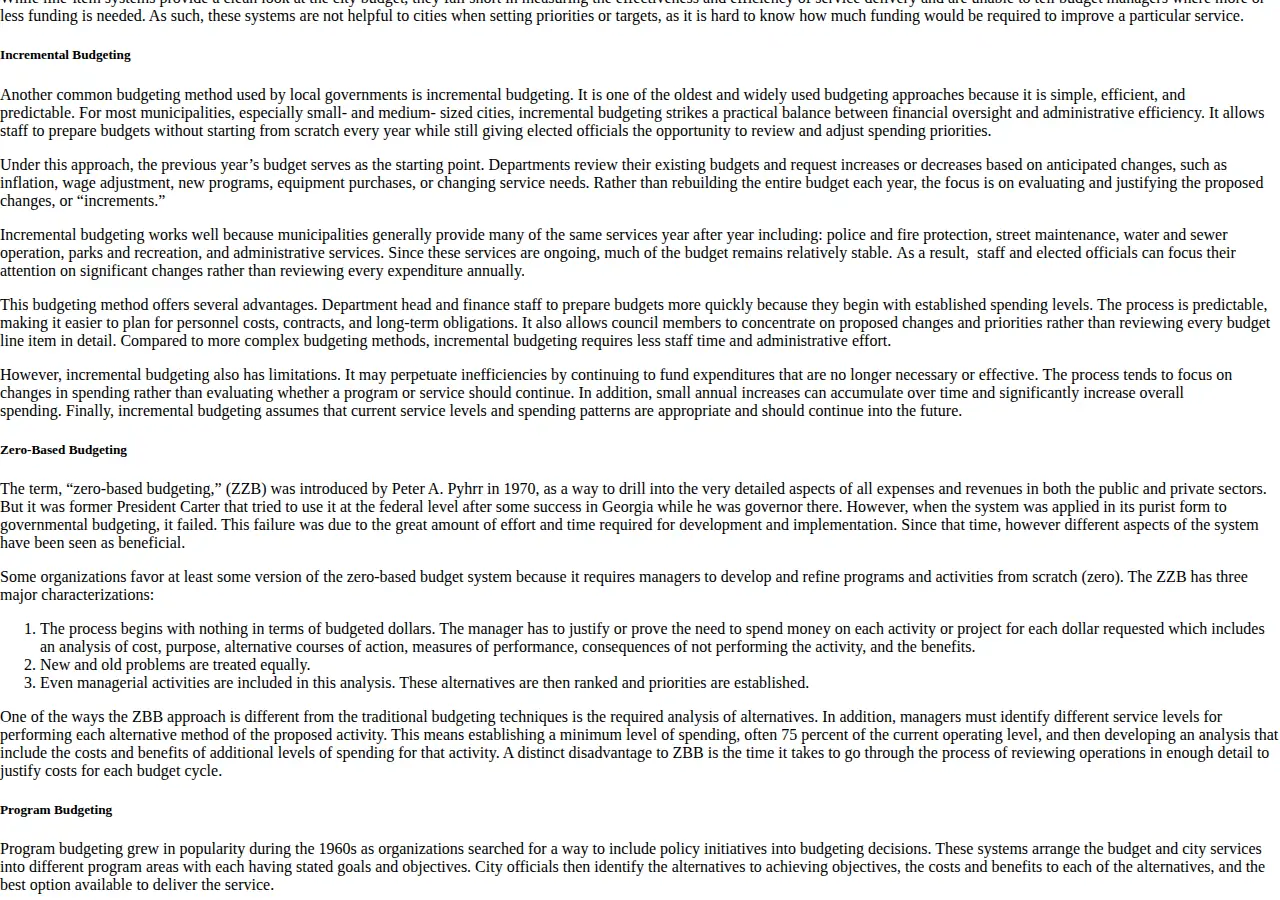
The Iowa League page above records the history in one paragraph: Pyhrr introduced the term in 1970, Carter tried it federally after success in Georgia, and the purist form failed for the effort and time required. It also states this playbook's working rule — the minimum is often 75\% of current operating level — and the standing drawback: the time a detailed review takes. Our editorial analysis found the same pattern in every source opened: the method works where the savings pay for the work, and is abandoned where they do not.
- [x] Set the top-down target in writing, with CFO sponsorship, first.
- [x] Define clean unit boundaries; appoint 12 to 15 cost-category owners.
- [x] Write one package per activity at three levels: minimum (often 75\%), current, enhanced.
- [x] Attach a performance measure and the consequence of not funding to each package.
- [x] Rank all packages on one list; draw the cut-line at available funding and fund nothing below it.
- [x] Reconcile the package register as a CSV to the ledger monthly; volume-adjust variable-cost packages.
- [x] Review funded packages monthly against service level; re-rank before the next cycle.
- [x] Keep workpapers: register, ranking, cut-line decision, target memo.
ZBB does not make budgeting easy. It makes it honest: every dollar carries a reason, a rank, a consequence.