Wyoming DAO LLC Playbook: Forming a Decentralized Autonomous Organization Under W.S. § 17-31
Wyoming wrote the first DAO LLC statute in the United States: effective July 1, 2021, the Wyoming DAO Supplement (W.S. § 17-31-101 through § 17-31-116) lets an LLC elect DAO status and be governed, in whole or in part, by a smart contract. The filing costs the same $100 as a plain Wyoming LLC; the securities analysis and the smart-contract build cost far more — and no Wyoming court has yet tested the liability veil when code makes the decisions.
What the statute actually creates
W.S. § 17-31-104(a) defines a decentralized autonomous organization as "a limited liability company whose articles of organization contain a statement that the company is a decentralized autonomous organization." W.S. § 17-31-103 applies the Wyoming LLC Act to the DAO LLC "to the extent not inconsistent" with the supplement. The DAO layer sits on top of the LLC, so the filing fee, annual report, and registered-agent rule are the LLC's. The name must include "DAO", "LAO", or "DAO LLC" under W.S. § 17-31-104(d), and W.S. § 17-31-104(c) requires this notice to appear conspicuously in the articles or the operating agreement:
>
Two definitions carry the structure: a "smart contract" (§ 17-31-102(a)(ix)) is blockchain code executing agreement terms, including asset custody and transfer or administering votes; a "membership interest" (§ 17-31-102(a)(vi)) may be designated a digital security or a digital consumer asset under W.S. § 34-29-101. One hard boundary: W.S. § 17-31-116 bars the SOS from issuing a certificate of authority for a foreign DAO. A series LLC is a different tool — see our Delaware registered series vs protected series LLC guide.
The 2022 rewrite: management is a spectrum, not a switch
The original 2021 law described two types — member-managed and algorithmically managed. SF0068, enacted March 9, 2022 and effective immediately, struck the binary. W.S. § 17-31-104(e) now requires the articles to "establish how the decentralized autonomous organization shall be managed by the members, including to what extent the management will be conducted algorithmically." The drafter must now place the DAO on a spectrum in the articles: on-chain treasury votes with human signatories at one end, member votes on everything with the contract only counting at the other. Either is lawful if the articles say so — silence is not. W.S. § 17-31-109 sets the floor: "Management of a decentralized autonomous organization shall be vested in its members or the members and any applicable smart contracts. All smart contracts utilized by a decentralized autonomous organization shall be capable of being updated, modified or otherwise upgraded."
Formation: the articles carry the weight
W.S. § 17-31-105(a) allows any person to form a DAO LLC with one or more members (the person forming it need not be a member); § 17-31-105(c) allows any lawful purpose, "regardless of whether for profit." The articles must contain the DAO statement under W.S. § 17-31-106(a) plus the matters required by W.S. § 17-29-201, and under § 17-31-106(b) "a publicly available identifier of any smart contract directly used to manage, facilitate or operate the decentralized autonomous organization" — a contract address on a public chain. W.S. § 17-31-105(e) gives thirty days to supply a missing identifier — otherwise "the secretary of state shall dissolve the decentralized autonomous organization." W.S. § 17-31-106(c) requires the articles and the smart contracts to govern twelve matters, from voting rights to transferability, withdrawal, distributions, contract revision, and dispute resolution. W.S. § 17-31-105(b) requires a continuously maintained Wyoming registered agent (W.S. § 17-28-101 through § 17-28-111). W.S. § 17-31-115 resolves paper-versus-code conflicts: "the smart contract shall preempt any conflicting provisions of the articles of organization, except as it relates to W.S. 17-31-104 and 17-31-106(a) and (b)." Check the name first with our LLC and brand name search tool.
Voting and quorum math: the turnout trap
W.S. § 17-31-111(a)(i) provides that, unless the articles, smart contract, or operating agreement provide otherwise, a membership interest "shall be calculated by dividing a member's contribution of digital assets to the organization by the total amount of digital assets contributed to the organization at the time of a vote." W.S. § 17-31-111(a)(ii) provides the alternative default: if contributing digital assets is not a prerequisite to membership, "each member shall possess one (1) membership interest and be entitled to one (1) vote."
The pass threshold surprises founders: W.S. § 17-31-102(a)(v) defines "majority of the members" as "more than fifty percent (50%) of the membership interests eligible to participate in a vote" — eligible, not cast:
With 1,000,000 eligible units, a proposal needs 500,001 yes units — so if 600,000 units participate, 83.3 percent of the votes cast must be yes. If only 400,000 units participate, the proposal cannot pass at all. Every default here is overridable — each provision begins "unless otherwise provided for in the articles of organization, smart contract or operating agreement." Replace the majority definition with a quorum-of-participation rule before the first proposal.
What it costs
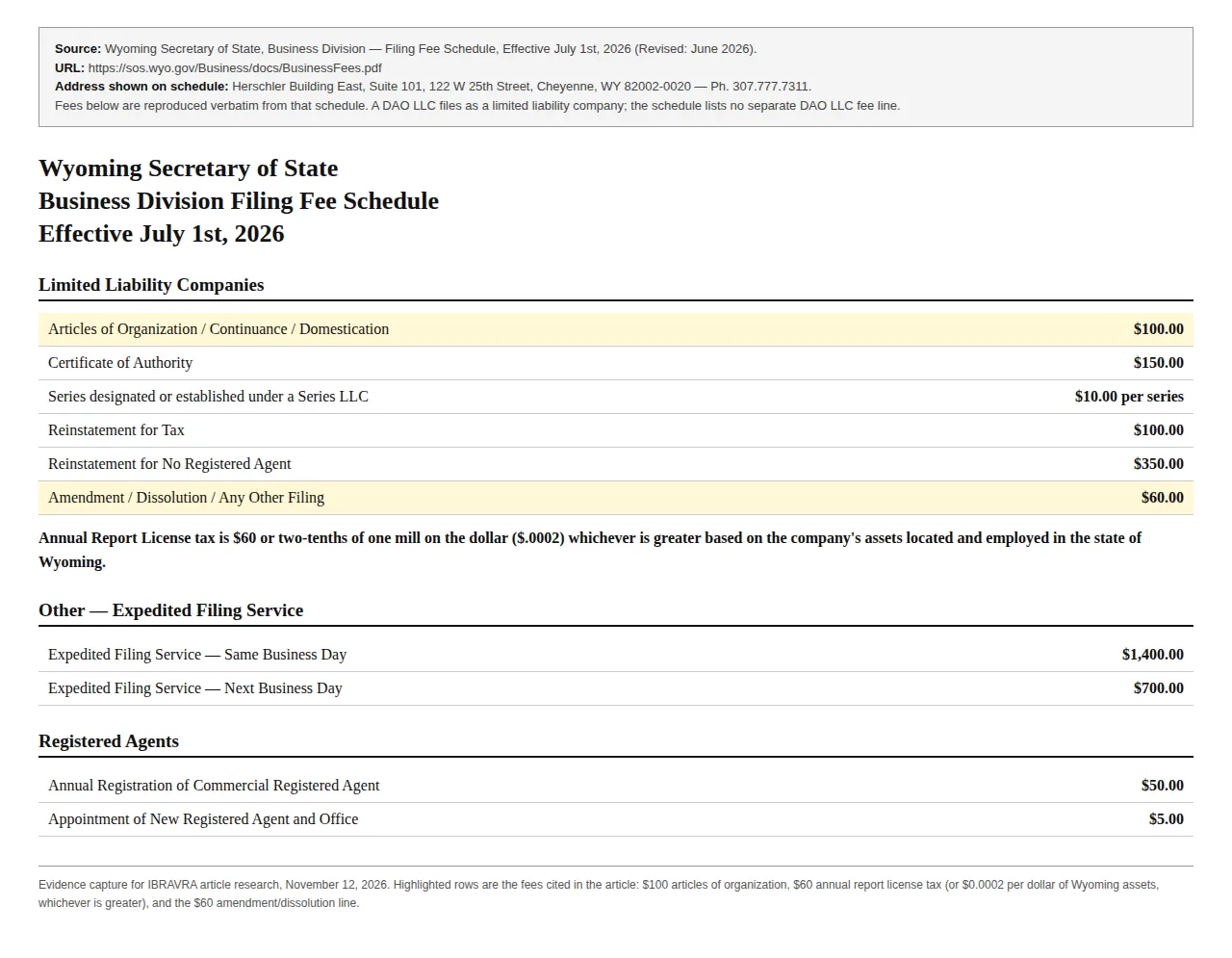
The Wyoming SOS fee schedule, effective July 1, 2026, lists no separate DAO LLC fee: a DAO LLC files as an LLC — articles of organization $100, annual report license tax $60 or $0.0002 per dollar of Wyoming assets, whichever is greater. Other filings are $60; reinstatement is $100 for tax and $350 for a missing registered agent.
The table assumes a November 2026 formation, state fees only: first annual report November 1, 2027 (W.S. § 17-29-209), Delaware's $400 tax June 1, 2027. Check your own timing with our break-even calculator.
| State cost | Wyoming DAO LLC | Plain Wyoming LLC | Delaware LLC |
|---|---|---|---|
| Formation filing | $100 | $100 | $110 |
| Recurring annual state charge | $60/yr license tax | $60/yr license tax | $400/yr annual tax |
| First 12 months, state fees only | $160 | $160 | $510 |
| Five years, state fees only | $400 | $400 | $2,110 |
Delaware's figures come from its fee schedule revised August 1, 2026 ($110 formation) and its annual tax page ($400 due June 1; $200 late penalty plus 1.5 percent monthly interest). The license tax scales with Wyoming assets:
The $60 minimum covers Wyoming assets up to $300,000 ($60 ÷ 0.0002); at $1,000,000 the tax is $200, at $5,000,000 it is $1,000. An all-on-chain treasury still pays the $60 minimum and still files the annual report (W.S. § 17-29-209). Beyond state fees, budget three operator lines: a commercial registered agent service (confirm the price in writing), a CPA review of the tax election, and a professional smart-contract audit — the largest first-year line after formation. Get a written audit quote before filing.
The decision table
| Question | Wyoming DAO LLC | Plain Wyoming LLC | Delaware LLC | Authority |
|---|---|---|---|---|
| On-chain voting in the statute | Yes | No | No | W.S. § 17-31-106(c)(v) |
| Formation filing fee | $100 | $100 | $110 | WY + DE fee schedules |
| Annual state charge | $60 license tax | $60 license tax | $400 annual tax, due June 1 | W.S. § 17-29-209; corp.delaware.gov |
| Member withdrawal | Only as governing documents allow; withdrawn member forfeits interests | Per operating agreement | Per operating agreement | W.S. § 17-31-113 |
| Liability veil tested in court | No published decision found | Decades of case law | Decades of case law | Editorial analysis, Nov. 2026 |
If the endgame is venture capital, compare the entity choice first: our LLC vs. Delaware C-Corp guide for venture startups.
Tax treatment: the default is a partnership
Under Treas. Reg. § 301.7701-3(b)(1), a domestic eligible entity that does not file an election "is — (i) A partnership if it has two or more members; or (ii) Disregarded as an entity separate from its owner if it has a single owner." Two or more token-holder members means partnership taxation: Form 1065 and a Schedule K-1 for each member — including one known only by a wallet address. Form 8832 elects association (corporate) treatment under § 301.7701-3(c)(1)(i), and an S corporation election is a deemed association election under § 301.7701-3(c)(1)(v)(C). Under § 301.7701-3(c)(1)(iv), once an entity changes classification by election, it generally cannot change it again by election for sixty months. Make the choice with a CPA before the first token distribution. Our editorial analysis found no IRS revenue ruling, regulation, or published guidance that addresses a DAO LLC by name. This is the general LLC rule applied to a DAO LLC — no DAO-specific authority exists. Wyoming levies no state income tax on the LLC itself.
Dissolution: the statute dissolves quiet DAOs by itself
W.S. § 17-31-114(a) lists six dissolution events: fixed duration expires; a majority votes to dissolve; an event specified in the governing documents occurs; the DAO "has failed to approve any proposals or take any actions for a period of one (1) year"; the DAO no longer performs a lawful purpose or is "no longer under the control of at least one (1) natural person"; or all members have withdrawn. After any of these, § 17-31-114(b) requires a statement of intent to dissolve. The one-year inactivity trigger dissolves a DAO whose treasury is untouched for twelve months, with no proposal approved and no action taken. The natural-person trigger dissolves a DAO whose last human operator walks away, leaving only autonomous code. Under W.S. § 17-31-113, a member may withdraw only as the governing documents allow and forfeits all membership interests on withdrawal unless the documents provide otherwise.
Who should NOT form a DAO LLC
- You are raising money from United States investors without a securities opinion. A Wyoming filing does not answer the SEC's DAO Report.
- No one on the team can maintain the smart contract. Section 17-31-109 requires every governing contract to be updatable, and § 17-31-107(a)(iii) requires an articles amendment on every change.
- The project has one founder and no token holders. A single-owner DAO LLC defaults to disregarded tax status and buys nothing a plain Wyoming LLC does not already provide. Wyoming's charging-order protection — see our single-member LLC charging-order protection guide — needs no DAO election.
- You expect anonymity to defeat reporting. Partnership K-1s, an EIN, and federal beneficial-ownership reporting all assume identifiable humans.
Founder & CEO Insight — Enow A. Jovial
Execution checklist
- [x] Name: pick a name containing DAO, LAO, or DAO LLC; verify it with the name search tool.
- [x] Articles: draft the DAO statement, NOTICE OF RESTRICTIONS, and § 17-31-104(e) management statement.
- [x] Smart contract: deploy with an upgrade path and a public identifier in the articles — or file it within thirty days.
- [x] Registered agent: appoint and continuously maintain a Wyoming agent (W.S. § 17-28-101 through § 17-28-111).
- [x] File and EIN: submit the articles to the SOS ($100), then apply for the EIN on Form SS-4.
- [x] Tax election: decide the Form 8832 question with a CPA before the first distribution (sixty-month lock).
- [x] Securities opinion: obtain it before distributing tokens in the United States.
- [x] Voting override: replace the eligible-interest majority with a quorum-of-participation rule.
- [x] Calendar: annual report due the first day of the anniversary month ($60), articles amendment on every smart-contract change, and at least one proposal per year.
File the election, then run the company like one.