Vimeo, Wistia and YouTube sell the same promise — a video that plays anywhere, on any device, without the viewer waiting — but they charge for it in three different currencies. Vimeo charges per seat per month, Wistia a flat monthly price, YouTube nothing to host and a share of the revenue instead: 55% of net long-form ad revenue, 45% of the Shorts pool, 70% of memberships and tips.
The three meters, side by side
| Vendor | What you pay for | Entry paid price | Ceiling that matters | Authority |
|---|---|---|---|---|
| Vimeo | Per seat, per month | Starter $12/seat/mo | Starter caps at 60 videos per seat per year; 2TB storage, 2TB bandwidth a month | vimeo.com/pricing, read Nov 20, 2026 |
| Wistia | Flat monthly plan | Business $79/mo billed annually | Business holds 250GB+ storage and 1TB bandwidth a month; extra users $25 each | wistia.com/pricing, read Nov 20, 2026 |
| YouTube | Revenue share, $0 to host | Free, no paid hosting tier | YPP entry: 1,000 subscribers plus 4,000 watch hours or 10M Shorts views | support.google.com/youtube, read Nov 20, 2026 |
YouTube has no hosting bill, which makes it the default answer. The comparison gets interesting when the video earns money. A video earning $1,000 of net long-form ad revenue pays YouTube $450; the same $1,000 on Shorts pays $550 of the allocated pool.
Vimeo: the per-seat meter, and the 60-video cap
Vimeo's pricing page lists four paid rungs above a free tier. The free plan costs $0 and allows two videos a month up to 25 videos in total, with 2TB of player bandwidth a month. Starter costs $12 a seat a month and includes one seat, 2TB of storage, 2TB of bandwidth a month, and a cap of 60 videos per seat per year. Standard costs $25 a seat a month and includes five seats, 4TB of storage, and the same 2TB of monthly bandwidth, with player branding, a custom watermark, branded galleries, and lead capture. Advanced costs $75 a seat a month and includes ten seats, 7TB of storage, and hosted livestreamed events with Q&A, polls, and chat. Enterprise is quoted, with custom seats and storage and SSO.
The 60-video cap on Starter is the trap: a creator publishing two videos a week makes 104 a year, and 104 does not fit in 60. The fix is a second seat, which doubles the Starter bill to $288 a year, or a jump to Standard. The cap is per seat per year, so the arithmetic is exact:
Storage is where Vimeo wins outright. Standard costs $300 a seat a year for 4TB. Wistia Business costs $948 a year for 250GB. Per gigabyte per year, Vimeo Standard is about 52 times cheaper:
Bandwidth runs the same way: every Vimeo tier includes 2TB of player bandwidth a month, against 1TB on Wistia Business. The per-seat meter is the only thing that can make Vimeo expensive — a ten-person team on Advanced pays $750 a month, or $9,000 a year, for seats that mostly watch the same library. Our Cloudflare vs Fastly vs AWS CloudFront CDN pricing playbook prices the delivery layer underneath Vimeo's player, where the same per-gigabyte logic applies at larger numbers.
Wistia: the flat meter, and the $250 jump to Signals
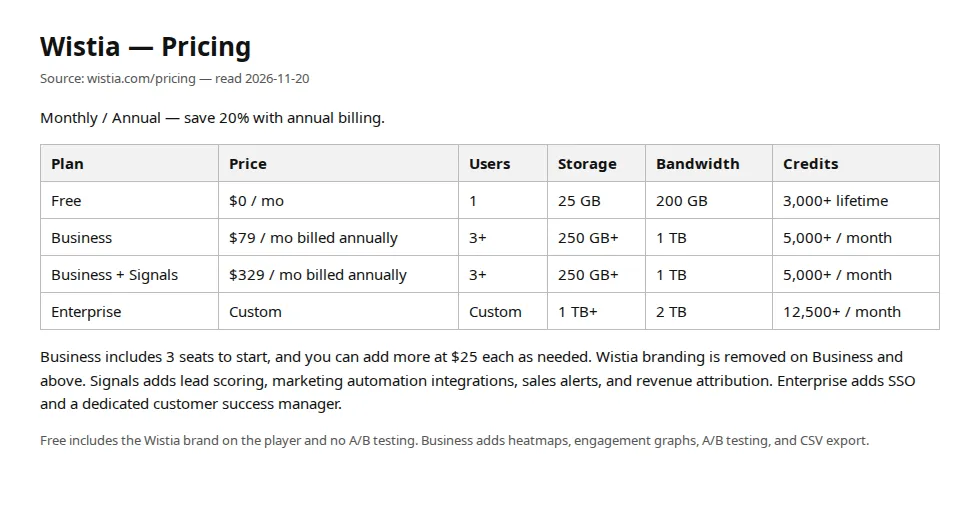
Wistia's pricing page lists four rungs. Free costs $0: one user, 25GB of storage, 200GB of bandwidth, 3,000+ credits for the lifetime of the account, and the Wistia brand on the player. Business costs $79 a month billed annually, with three seats to start, 250GB or more of storage, 1TB of bandwidth, 5,000+ credits a month, branding removed, heatmaps, and A/B testing. Extra users cost $25 each a month. Business plus Signals costs $329 a month billed annually, with the same capacity, plus marketing automation integrations, lead scoring, audience segmentation, sales alerts, and revenue attribution. Enterprise is quoted, with 1TB or more of storage, 2TB of bandwidth, 12,500+ credits a month, and SSO.
The $250-a-month jump from Business to Signals is the whole decision. Signals is not more hosting — the storage, bandwidth and credits are the same as Business. It is attribution: the tool that tells the CRM which contact watched which video for how long, scores the lead, and alerts sales. A business without a CRM to score gets nothing from Signals except a bill $3,000 a year higher. A business running HubSpot or Marketo gets the one feature Vimeo and YouTube do not sell: video viewing as a scored lead signal inside the CRM.
YouTube: the revenue-share meter, and the 55/45 split
YouTube charges nothing to upload, store, or stream a video, and the price of that generosity is a share of everything the video earns. The YouTube Partner Program is the gate: a channel needs 1,000 subscribers plus either 4,000 qualified watch hours on long-form video in the last 365 days, or 10 million qualified Shorts views in the last 90 days. Once inside, the splits are published on YouTube's own partner earnings overview: 55% of net revenues from long-form watch-page ads, 45% of the revenue allocated from the Shorts Creator Pool after music licensing, and 70% of net revenues from memberships, Super Chat, Super Stickers, and Super Thanks. YouTube pays out once the AdSense balance reaches $100.
YouTube Premium adds a second pool: 30% of net Premium revenue — 60% for Premium Lite — split 55% to long-form and 45% to Shorts by watch time. On $1,000 of net Premium revenue, the pool is $300: $165 to long-form creators, $135 to Shorts. The numbers were published by YouTube on August 10, 2026.
From February 1, 2027, new applicants will need 1,000 subscribers plus either 8,000 qualified watch hours in 365 days or 20 million qualified Shorts views in 90 days — double today's thresholds. From the same date, any channel under 10 million qualified Shorts views over the trailing 90 days stops earning ad money on Shorts at all, including current members. A channel built on Shorts that coasts below 10 million views a quarter loses its Shorts income overnight. The free host is free, but the gate moves.
The head-to-head math: three buyers, three winners
The creator publishing 100 videos a year. Vimeo Starter needs two seats for the 60-video cap: $288 a year. Wistia Business: $948 a year, with 250GB of storage the creator may never fill. YouTube: $0, with no upload cap. YouTube wins on price alone — until the videos earn. At $1,000 of net long-form ad revenue, the creator keeps $550 and YouTube keeps $450. At $2,107 of net ad revenue, YouTube's $948 share equals the whole Wistia Business bill, and past that point the paid host is cheaper than the free one:
The business with a 500GB video library. Vimeo Standard holds 4TB for $300 a seat a year — the library fits with 3.5TB to spare. Wistia Business holds 250GB, so the same library needs the Enterprise tier at a quoted price, or a second Business account. YouTube holds it for $0, but the videos sit on a page with competitors' ads and a recommendation rail that sends viewers away. Vimeo wins on storage cost by a factor of 52, and on control.
The marketing team that needs to know who watched. Wistia Business plus Signals at $3,948 a year is the only option that writes viewing data onto the contact record and scores the lead. Vimeo Advanced has engagement analytics but no lead scoring. YouTube has the best analytics of the three and the worst attribution — it knows everything about the viewer and shares almost none of it. The team that buys Signals is buying the answer to "who watched past minute two," and $3,000 a year is cheap for that answer if the sales team acts on it.
Founder & CEO Insight — Enow A. Jovial
The regulator in the room: children's privacy and takedowns
A video host does not write the video, and it does not carry the liability for what the video collects. The uploader does. In September 2019 the FTC and the New York Attorney General settled with Google and YouTube for $170 million over alleged violations of the Children's Online Privacy Protection Act — YouTube was alleged to have collected personal information from viewers of child-directed channels without parental consent. The settlement forced YouTube to build the "made for kids" designation every uploader now answers. A business publishing children's content must get the designation right, because $170 million is the price of getting it wrong at scale.
The second regulator is the DMCA. Section 512 of the Digital Millennium Copyright Act gives a host a safe harbour against copyright liability only if it acts quickly on takedown notices, and all three platforms run takedown systems that remove first and ask later. A business hosting product videos on YouTube can lose the video, the views, and the revenue on a single claim, and the appeal runs on the platform's clock. The same video on Vimeo or Wistia sits on infrastructure the business controls. The free host is free, but the free host can delete the product. Our Kajabi vs Teachable vs Thinkific online course pricing playbook covers the same hosting-versus-platform trade-off for course creators, where the video library is the business itself.
Who should not buy which
| Situation | Buy this | Avoid this | Authority |
|---|---|---|---|
| Creator, 100 videos a year, no earnings yet | YouTube at $0 | Vimeo Starter — the 60-video cap forces a second seat | Vendor pages, Nov 2026 |
| Creator, 100 videos a year, earning $2,000+ a year in ads | Wistia Business at $948/yr | YouTube — the 45% share passes the paid plan's price | Vendor pages, Nov 2026 |
| Business, 500GB library, no ads allowed | Vimeo Standard at $300/seat/yr | Wistia Business — 250GB storage does not hold the library | Vendor pages, Nov 2026 |
| Marketing team, CRM lead scoring needed | Wistia Business + Signals at $3,948/yr | YouTube — analytics without attribution | Vendor pages, Nov 2026 |
| Team streaming live events weekly | Vimeo Advanced at $75/seat/mo | Wistia Business — no livestreaming on the plan | Vendor pages, Nov 2026 |
Five steps before you sign
- Count the year's uploads. Two videos a week is 104 a year — past Starter's 60-video cap.
- Measure the library in gigabytes. A 500GB library fits Vimeo Standard's 4TB and overflows Wistia Business's 250GB entirely.
- Price the revenue share, not the hosting. At $2,107 of net long-form ad revenue a year, YouTube's 45% share equals the whole Wistia Business bill.
- Check the February 1, 2027 gate. New applicants face doubled thresholds, and Shorts earnings need 10 million qualified views a quarter. A channel built on Shorts should model the income at zero.
- Answer the "made for kids" question before uploading. The $170 million COPPA settlement is the price of getting children's privacy wrong at scale.
- [x] Honest upload count completed for the full year, not the month
- [x] Library measured in gigabytes against the storage ceiling
- [x] Revenue share priced against the paid plan's annual cost
- [x] February 1, 2027 eligibility gate checked against the channel's real numbers
- [x] "Made for kids" designation decided before the first upload
Three meters wearing the same product name: Vimeo charges per seat and wins on storage, Wistia a flat plan and wins on attribution, YouTube a revenue share and wins on reach — until the share passes the price of a paid plan. Count the uploads, measure the library, price the revenue share — then check the Loom vs Vidyard vs Wistia video messaging pricing playbook for the async-messaging tier underneath these hosts, and the Cloudflare vs Fastly vs AWS CloudFront CDN pricing playbook for the delivery layer that carries every play. Run the break-even math in our break-even calculator before the renewal meeting.