Three platforms, three ways to charge for the same app
Vercel, Railway, and Render will all host the same application, and the invoice will look nothing alike. Vercel charges per seat plus metered usage, with a fixed-price CDN option. Railway charges almost purely for what the app consumes, metered per second. Render charges a flat workspace fee plus fixed-price compute, with bandwidth metered per gigabyte. The cheapest platform for a static site is not the cheapest for an always-on API. Every figure below traces to a pricing page or documentation page read on November 20, 2026.
The price lists, side by side
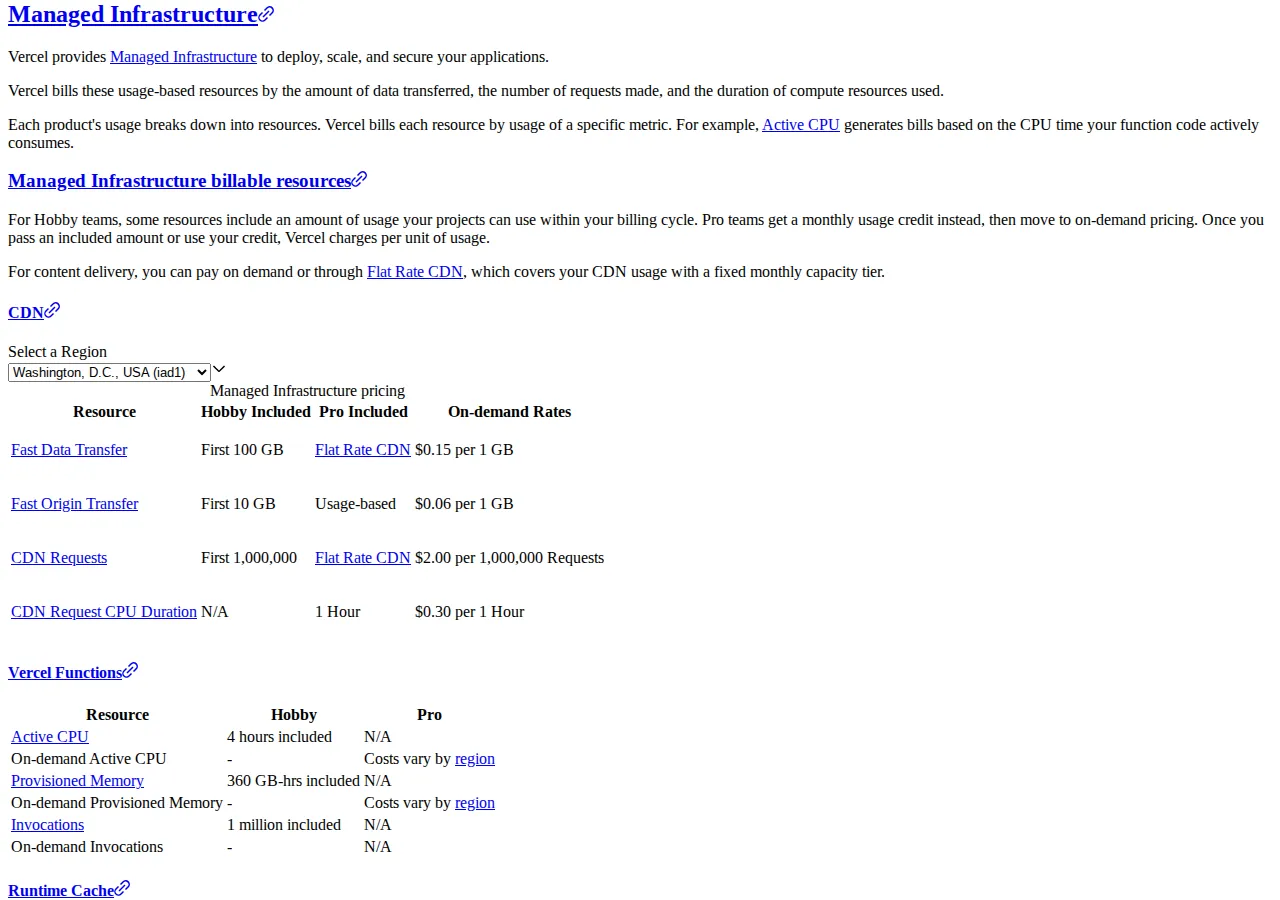
Vercel sells three plans. Hobby costs 0 dollars per month and includes 100 GB of Fast Data Transfer, 1,000,000 CDN requests, 4 hours of Fluid Active CPU, 360 GB-hours of provisioned memory, and 1,000,000 function invocations per month. Pro costs 20 dollars per month per additional paid seat and includes a 20-dollar usage credit. Enterprise is custom pricing. On Pro, bandwidth is covered by Flat Rate CDN, a fixed monthly price with no overages, offered as an alternative to usage-based billing. The usage-based rates, from Vercel's documentation pricing table, are 0.15 dollars per GB of Fast Data Transfer beyond the first 100 GB, 0.06 dollars per GB of Fast Origin Transfer beyond the first 10 GB, and 2.00 dollars per 1,000,000 CDN requests beyond the first 1,000,000.
Railway sells no tiers of compute. It sells usage. The Trial plan costs 0 dollars per month, with a 30-day trial that includes a one-time grant of 5 dollars in credits and no credit card required; services wake on request. Hobby costs 5 dollars of minimum monthly usage and includes 5 dollars of monthly usage credits. Pro costs 20 dollars of minimum monthly usage and includes 20 dollars of monthly usage credits. The unit rates, from Railway's pricing page, are 0.00000772 dollars per vCPU per second, 0.00000386 dollars per GB of memory per second, 0.00000006 dollars per GB of disk per second, 0.05 dollars per GB of outbound transfer, and 0.015 dollars per GB per month of object storage.
Render sells a flat workspace fee plus fixed-price compute. The Hobby workspace costs 0 dollars per month and includes 5 GB of bandwidth, up to 25 services, 500 build minutes, and 2 custom domains. The Pro workspace costs 25 dollars per month flat, with unlimited seats and services, 25 GB of bandwidth, 1,000 build minutes, and 15 custom domains. The Scale workspace costs 499 dollars per month flat and includes 1 TB of bandwidth. Bandwidth beyond the included amount costs 0.15 dollars per GB on every plan, per Render's pricing announcement of August 1, 2026. Web service compute is fixed-price: Free at 0 dollars with 512 MB of RAM and less than 1 CPU, 7 dollars per month for 512 MB and 0.5 CPU, 25 dollars for 2 GB and 1 CPU, 85 dollars for 4 GB and 2 CPU, 135 dollars for 8 GB and 2 CPU, and 200 dollars for 16 GB and 4 CPU. Render Postgres starts at 6 dollars per month for 256 MB of RAM and 100 connections.
| Dimension | Vercel | Railway | Render |
|---|---|---|---|
| Entry price | Hobby 0 dollars per month | Trial 0 dollars, 5 dollars one-time credits | Hobby 0 dollars per month plus compute |
| Paid plan | Pro 20 dollars per seat per month, 20 dollars credit included | Hobby 5 dollars minimum, Pro 20 dollars minimum | Pro 25 dollars per month flat, Scale 499 dollars |
| Compute model | Fluid functions, Active CPU plus provisioned memory | Per-second vCPU and RAM | Fixed-price instances by size |
| Bandwidth rate | 0.15 dollars per GB usage-based; Flat Rate CDN on Pro | 0.05 dollars per GB egress | 0.15 dollars per GB beyond included |
| Bandwidth included | 100 GB per month on Hobby | None; egress billed from the first GB | 5 GB Hobby, 25 GB Pro, 1 TB Scale |
| Hard spend cap | Configurable hard limit on Pro; Hobby cannot buy more usage | Minimums only; usage bills as consumed | No spend-cap control on the pricing page |
| Authority | vercel.com/pricing, vercel.com/docs/pricing | railway.com/pricing | render.com/pricing, Render pricing blog |
The unit math: per-second rates become monthly bills
One always-on vCPU with 2 GB of RAM therefore costs 20.01 dollars plus 20.02 dollars, or 40.03 dollars per month before egress, on Railway. The same arithmetic exposes the egress rate: 0.05 dollars per GB means 100 GB of outbound transfer costs 5.00 dollars and 1,024 GB costs 51.20 dollars. Railway's minimums work as a floor, not as an addition: on Hobby, the 5-dollar minimum includes 5 dollars of credits, so a 20-dollar usage month bills 20 dollars. On Pro, the 20-dollar minimum includes 20 dollars of credits, so a 91-dollar usage month bills 91 dollars.
Vercel's meter works differently. The 20-dollar seat is a fixed charge, and the 20-dollar credit offsets the first 20 dollars of metered usage. The usage-based transfer rate is 0.15 dollars per GB, the same number as Render's overage rate, so the difference is the seat, the credit, the included allowance, and the compute model. Railway undercuts both on transfer at 0.05 dollars per GB, one third of the Vercel and Render rate.
Scenario one: a static site at 100 GB of transfer
The workload is a marketing site with 100 GB of monthly transfer, 1,000,000 requests, and one developer. Vercel Hobby costs 0 dollars: the 100 GB of Fast Data Transfer is included, the 1,000,000 CDN requests are included, and the 4 hours of Fluid Active CPU cover a lightly dynamic site. Railway costs 20.01 dollars per month: 0.5 vCPU costs 10.01 dollars, 0.5 GB of RAM costs 5.00 dollars, and 100 GB of egress costs 5.00 dollars.
Render costs 21.25 dollars per month: the Hobby workspace is 0 dollars, the smallest paid web service is 7 dollars for 512 MB and 0.5 CPU, and bandwidth is 5 GB included with 95 GB over at 0.15 dollars per GB, which is 14.25 dollars.
Scenario two: an always-on app at 1 TB of transfer
The workload is a dynamic application running one always-on service with 1 vCPU and 2 GB of RAM, serving 1,024 GB of transfer and 10,000,000 requests per month. Railway costs 91.23 dollars per month: 1 vCPU at 20.01 dollars, 2 GB of RAM at 20.02 dollars, and 1,024 GB of egress at 0.05 dollars per GB, which is 51.20 dollars.
Render on the Pro workspace costs 199.85 dollars per month: the workspace is 25 dollars, the 1 CPU and 2 GB web service is 25 dollars, and bandwidth is 25 GB included with 999 GB over at 0.15 dollars per GB, which is 149.85 dollars. On the Hobby workspace the same app costs 177.85 dollars: the workspace is 0 dollars, the service is 25 dollars, and bandwidth is 5 GB included with 1,019 GB over at 0.15 dollars, which is 152.85 dollars.
Vercel Pro on the usage-based meter costs 171.60 dollars per month: the seat is 20 dollars, transfer is 1,024 GB at 0.15 dollars, which is 153.60 dollars, and requests are 9,000,000 beyond the first 1,000,000 at 2.00 dollars per million, which is 18.00 dollars. Usage totals 171.60 dollars, the 20-dollar credit brings billed usage to 151.60 dollars, and the 20-dollar seat brings the total to 171.60 dollars.
One boundary must be stated plainly. The Vercel column above covers the seat, the transfer, and the requests. It does not include Fluid compute, because Vercel bills Active CPU seconds and provisioned memory GB-hours at rates that vary by region, and no single published figure converts an always-on 1 vCPU service into a Vercel compute line. A function-heavy application adds a metered compute charge on Vercel that this scenario does not capture. The Railway and Render columns include compute, because their compute is priced per vCPU or per fixed instance. Vercel's 171.60 dollars is a floor for this workload, not a ceiling.
The 12-month totals for the always-on app are Railway at 1,094.76 dollars, Vercel at 2,059.20 dollars on the usage-based meter before compute, Render on Hobby at 2,134.20 dollars, and Render on Pro at 2,398.20 dollars. Railway wins by a wide margin, because its egress rate is one third of the other two.
The traps: where each platform gets expensive
Vercel Hobby has hard caps. The pricing FAQ states that a free Hobby account is limited to the usage caps and cannot purchase additional usage. A site that outgrows 100 GB of transfer, 1,000,000 requests, or 4 hours of Active CPU does not get a bigger Hobby bill; it hits a wall and must upgrade to Pro at 20 dollars per seat per month.
Render cut its included bandwidth on August 1, 2026, and the cut was large. Hobby went from 100 GB included to 5 GB included, and Pro went from 500 GB included to 25 GB included, a twentyfold reduction on both plans. Overage billing moved at the same time from 100 GB blocks to per-GB billing at 0.15 dollars. A site that cost 7 dollars per month on the legacy Hobby plan at 100 GB of transfer now costs 21.25 dollars for the same traffic.
Railway's trap is the opposite of Vercel's: there is no wall, only a meter. An always-on service bills the full monthly rate for every vCPU and every GB of RAM it holds, 24 hours a day, because the per-second rate never stops while the service runs. The Trial plan's services wake on request, the only scale-to-zero behaviour in the comparison. A team that deploys five services and forgets two of them pays for all five.
When each platform wins
Vercel wins for frontend-heavy products where the team is small and traffic fits inside the Hobby inclusions; it loses for always-on backends with heavy transfer, where the usage-based meter and the unquoted compute line push the bill above Railway. Railway wins for always-on backends, APIs, and workers with steady workloads, at the cheapest 1 TB price here; it loses for teams that need a hard spending ceiling, because the platform bills what is consumed. Render wins for teams that want fixed-price compute with a flat workspace fee and unlimited seats on Pro; it loses for high-transfer workloads, where 5 GB included on Hobby and 25 GB on Pro leave almost every gigabyte billable at 0.15 dollars.
Founder & CEO Insight — Enow A. Jovial
Who should not choose each platform
Do not choose Vercel Hobby for a production application with unpredictable traffic, because the hard caps cannot be bought past and the failure mode is an outage, not a bill. Do not choose Railway for a workload that must never exceed a fixed monthly budget, because the meter has no ceiling. Do not choose Render for a high-transfer application on the Hobby workspace, because 5 GB included against 1,024 GB of traffic means 152.85 dollars of overage before the 25-dollar service is counted.
Execution checklist
- [x] Measure the real workload first: monthly transfer in GB, requests per month, vCPU and RAM held always-on, and the seat count.
- [x] Convert Railway rates to monthly: multiply by 2,592,000 seconds; the result is 20.01 dollars per vCPU and 10.00 dollars per GB per month.
- [x] Price the transfer on each meter: Vercel 0.15 dollars per GB, Railway 0.05 dollars per GB, Render 0.15 dollars per GB beyond the included allowance.
- [x] Apply the inclusions first: Vercel Hobby 100 GB, Render Hobby 5 GB and Pro 25 GB, Railway none.
- [x] Add the seat and the workspace fee: Vercel Pro 20 dollars per seat, Render Pro 25 dollars per workspace, Railway minimums of 5 or 20 dollars.
- [x] Check the Hobby wall: Vercel Hobby cannot buy more usage; confirm the workload fits inside 100 GB, 1,000,000 requests, and 4 hours of Active CPU.
- [x] Re-price after any plan change: Render's August 1, 2026 cut moved Hobby from 100 GB to 5 GB included.
- [x] Run the 12-month total: the Railway advantage at 1 TB is 964.44 dollars per year against Vercel.
The decision is a workload question, not a vendor question. A static site belongs on Vercel Hobby at 0 dollars. An always-on API with a terabyte of transfer belongs on Railway. A team that wants fixed compute and unlimited seats belongs on Render Pro. See also our Railway vs Render vs Fly.io and Vercel vs Netlify vs Cloudflare Pages comparisons. Before you commit, model the full stack cost including the database: our website cost calculator prices the hosting, the database, and the bandwidth together.