Vapi quotes $0.05 a minute, Bland $0.14, Retell $0.07 to $0.31 — and none of those numbers is the price of an AI voice call. Vapi's $0.05 is a hosting fee with the model, voice, and transcription passed through at cost. Bland's $0.14 is an all-in talk rate with a separate transfer-minute charge underneath. Retell's range is so wide it contains both the cheapest and the most expensive call here. This playbook prices all three from their own pricing pages as read on November 15, 2026, rebuilds the bill at 10,000 minutes a month, and names the volume where each vendor stops being the cheap option.
The three price ladders
| Vendor | Entry tier | Mid tier | Enterprise | What the headline rate covers | Authority |
|---|---|---|---|---|---|
| Vapi | $0 to start; $0.05/min hosting | Core $29/mo | Pro $999/mo minimum, 10% of hosting fee | Hosting only; models pass through at cost | Vapi pricing page, Nov 15, 2026 |
| Bland | Start $0.14/min, $0 platform fee | Build $0.12/min + $299/mo platform fee | Custom, contracted to volume | Talk, transfer, and models, all-in | Bland pricing page, Nov 15, 2026 |
| Retell | Pay as you go $0.07–$0.31/min | None — PAYG scales to Enterprise | Custom | Infra, LLM, voice, itemised per minute | Retell pricing page, Nov 15, 2026 |
Vapi's ladder is the most honest about its structure and the easiest to misread. By Usage starts at $0 with $5 of free credits, 2 organisations, 1 included phone number, 4 concurrent calls, and 14 days of retention. Core is $29 a month for 5 phone numbers, 10 concurrent calls, and 30 days of retention. Pro is a $999 monthly minimum plus 10% of the hosting fee, with zero-data-retention and a 1-business-day SLA. HIPAA handling is a $2,000-a-month add-on; extra lines are $10 each.
Bland's ladder is simpler. Start gives 2 credits plus an inbound number valued at $15 a month, no card required, at $0.14 per talk minute and $0.05 per transfer minute, with 10 concurrent calls and a 100-call daily cap. Build drops the rates to $0.12 and $0.04, adds a $299 monthly platform fee, and raises the caps to 50 concurrent calls and 2,000 calls a day. Retell has no mid tier: pay as you go starts at $0 with $10 in free credits, and Enterprise is custom.
What the headline rate hides: the component math
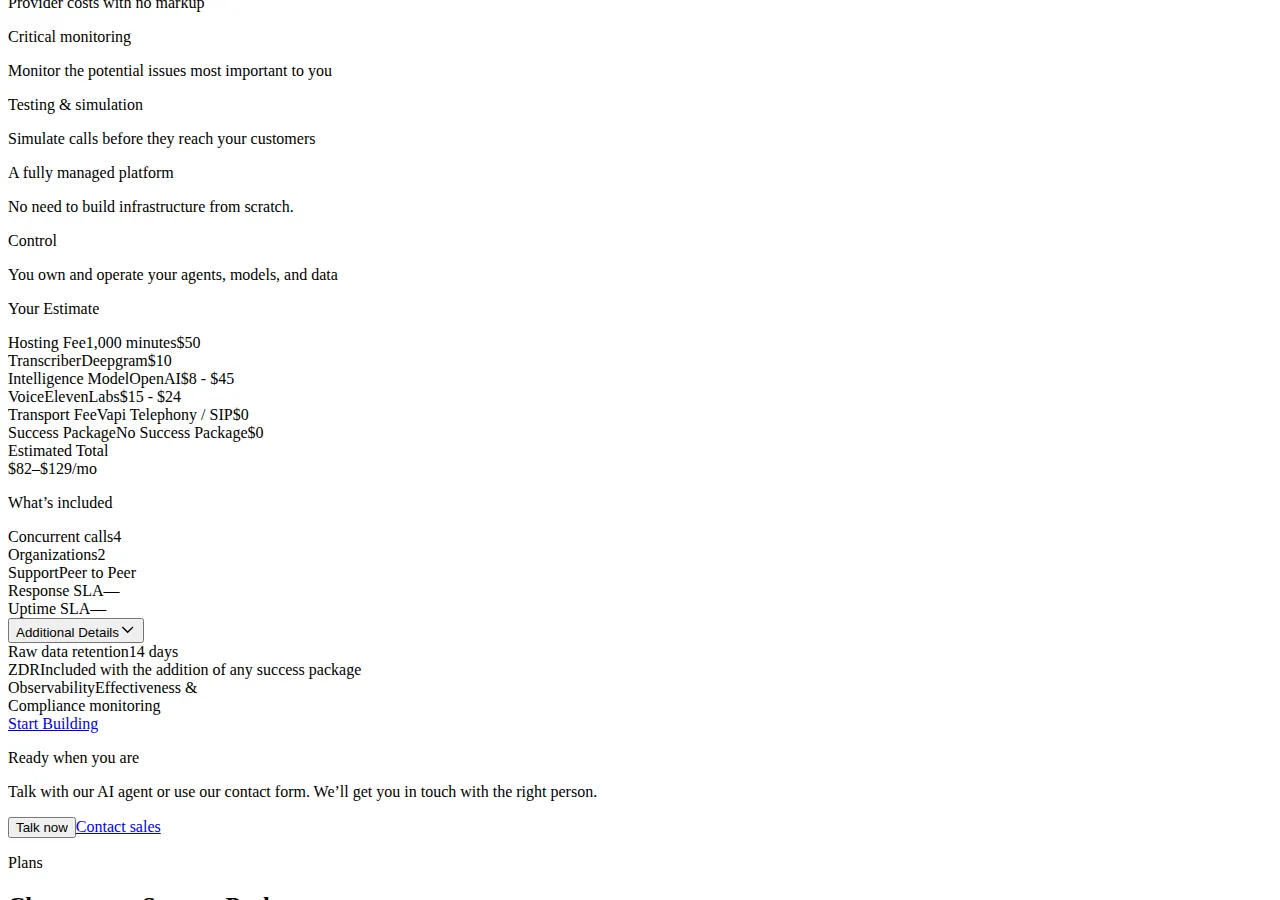
A voice agent call is four bills stacked on one minute: hosting, speech-to-text, the language model, and text-to-speech, plus a fifth for the phone line. Vapi itemises all four: Deepgram transcription at $0.0095 to $0.0099 a minute, OpenAI models at $0.0077 to $0.0452, and ElevenLabs voices at $0.0146 to $0.0238, all pass-through at cost on top of the $0.05 hosting fee:
The midpoint stack — Deepgram $0.0097, OpenAI $0.0265, ElevenLabs $0.0192 — costs $0.1054 a minute. Vapi's own estimator agrees: $82-$129 a month for 1,000 minutes, against our recomputed $81.80-$128.90.
Retell itemises the same stack as a flat $0.055-a-minute voice infrastructure charge plus the model and the voice as separate per-minute lines. Model rates run from GPT 5.6 Luna at $0.0064 a minute to GPT Realtime at $0.345, with GPT 5.4 at $0.08 in between. Voices run from Retell platform voices at $0.015 to ElevenLabs v3 at $0.10, with ElevenLabs Flash at $0.04. The mid stack — GPT 5.4 plus ElevenLabs Flash — costs $0.175 a minute before telephony, $0.19 with Retell's $0.015 Telnyx telephony. The cheap stack — GPT 5.6 Luna plus a platform voice — is $0.0764 before telephony, $0.0914 with it. The expensive stack — GPT Realtime plus ElevenLabs v3 — is $0.50 before telephony, $0.515 with it. Retell's own calculator agrees: with GPT 5.4 it shows $0.150 a minute for a platform-voice configuration.
Bland charges no component lines at all: the $0.14 Start rate includes the model and the voice, and the page says so plainly — no token charges, no model-provider pass-throughs, no surprise bills. The charge that is easy to miss is transfer time — $0.05 a minute on Start, $0.04 on Build — billed for the minutes a call spends being transferred to a human. Our editorial analysis models transfer time at 5% of talk time, a planning assumption, not a vendor figure: a receptionist-style agent transferring half its calls pays far more. Bland's own FAQ states the same comparison: Vapi's $0.05 and Retell's $0.07 are platform fees only, with a full stack at roughly $0.13 to $0.30 on Vapi and $0.11 to $0.25 on Retell.
The 10,000-minute bill
| Vendor and stack | Per-minute rate | Telephony | Monthly total at 10,000 min |
|---|---|---|---|
| Vapi, mid stack | $0.1054 | Vapi Telephony $0 | $1,054 |
| Bland Start | $0.1425 incl. transfer | Included | $1,425 |
| Bland Build | $0.122 incl. transfer + $299 fee | Included | $1,519 |
| Retell, low stack | $0.0764 | Telnyx $0.015/min | $914 |
| Retell, mid stack | $0.175 | Telnyx $0.015/min | $1,900 |
| Retell, high stack | $0.50 | Telnyx $0.015/min | $5,150 |
Three readings matter. First, the cheapest and the most expensive minute here both belong to Retell: $0.0914 on the cheap stack, $0.515 on the expensive one. Second, Bland Build costs more than Bland Start at 10,000 minutes, $1,519 against $1,425, because the $299 platform fee outweighs the $0.02 rate cut. Third, Vapi Telephony is free while Twilio outbound is $0.014 a minute: $140 a month at this volume.
A five-minute call costs $0.53 on Vapi mid, $0.71 on Bland Start, $0.95 on Retell mid, and $0.46 on Retell low:
A team running 2,000 five-minute calls a month pays $1,060 on Vapi mid, $1,420 on Bland Start, and $1,900 on Retell mid, or $920 on Retell low — a spread of more than two to one, decided entirely by model and voice selection.
The break-evens that decide the switch
Bland's Build tier only pays for itself past a specific volume. Start costs $0.1425 a minute including the transfer assumption; Build costs $0.122 a minute plus $299 a month:
Below about 14,585 talk minutes a month, Start is cheaper. Above it, Build wins by $0.0205 for every minute past the line: a team at 30,000 minutes saves $316 a month on Build, while a team at 10,000 loses $94 a month on it. Start caps at 100 calls a day, Build at 2,000 — a team making 150 calls a day cannot stay on Start at any price.
Vapi Core against Bland Start breaks the other way. Core adds a $29 monthly fee to Vapi's mid-stack rate:
Past about 781 minutes a month — roughly 156 five-minute calls — Vapi Core undercuts Bland Start, and the gap widens by $0.0371 a minute from there. Below that volume, Bland Start is cheaper, because Vapi's $29 buys phone numbers and concurrency a tiny deployment does not need.
Vapi Pro is priced for deployments doing millions of minutes: its $999 monthly minimum binds until the hosting fee reaches $9,990 a month.
A deployment under roughly 200,000 minutes a month pays the full $999 minimum for Pro regardless of usage.
Latency: three numbers that cannot be compared
Every vendor publishes a latency figure, and no two of them measure the same thing. Vapi's homepage claims sub-500ms average latency. Bland's homepage claims 200ms response time and first audio in 199ms. Retell's homepage claims about 600ms response time. None of the three publishes the test conditions on the pages read this cycle, and none publishes a latency figure on its pricing page at all.
Concurrency, caps, and the add-ons that move the bill
| Limit or add-on | Vapi | Bland | Retell |
|---|---|---|---|
| Concurrent calls included | 4 (By Usage); 10 (Core) | 10 (Start); 50 (Build) | 20 free |
| Extra concurrency | $10 per line per month | Not published; Enterprise sized to volume | $8 per concurrent call per month |
| Call add-ons | Not itemised | Not itemised | Batch +$0.005/dial; Branded +$0.10/outbound; Denoising, Guardrails +$0.005/min; PII Removal +$0.01/min; AI QA first 100 min free, then $0.10/min |
Retell's add-on menu is the most detailed of the three and the easiest to under-budget. Turning on the knowledge base, denoising, guardrails, and PII removal adds $0.025 a minute — $250 a month at 10,000 minutes — before the model or the voice. AI quality assurance past the free 100 minutes costs $0.10 a minute per minute reviewed, more than the voice infrastructure itself. Price the add-ons in the same spreadsheet as the model.
The law that prices the call: TCPA and FCC 24-17
The cheapest call in this comparison is not the one with the lowest per-minute rate. It is the one with consent behind it. Under 47 U.S.C. § 227(b)(1)(B), it is unlawful to initiate a call to a residential telephone line using an artificial or prerecorded voice without the prior express consent of the called party, unless an emergency purpose or an exemption applies. The FCC confirmed in FCC 24-17, adopted February 2, 2024 and effective February 8, 2024, that the TCPA's restrictions encompass current AI technologies that generate human voices — including voice cloning. Telemarketing calls need prior express written consent, and every artificial-voice message must identify the responsible business and offer a way to opt out.
The exposure arithmetic is blunt. Section 227(b)(3) gives a private right of action for $500 in damages for each violation, or actual monetary loss if greater, and up to $1,500 per violation where the defendant willfully or knowingly violated the section:
One thousand non-consented calls at the statutory minimum cost $500,000. The compliance cost is a consent record, a disclosure in the first sentence of the call, and an opt-out that works. Our AI voice agents inbound sales Twilio WebRTC Gemini Live guide covers the architecture side of the same deployment, and our Twilio vs Vonage vs MessageBird SMS API pricing playbook prices the telephony underneath it.
Who should use each — and who should not
| Vendor | Use it if | Avoid it if |
|---|---|---|
| Vapi | You want to choose model, voice, and phone line separately and tune as prices move | You want one all-in rate with no component spreadsheet, or you run under ~800 minutes a month, where the $29 Core fee outweighs the rate advantage |
| Bland | You want one rate with no pass-throughs and a transfer-heavy flow — reception, routing, handoff to humans — with the transfer line budgeted | You will not count transfer minutes, the one part of the bill that scales invisibly, or you have outgrown Start's daily cap but not reached Build's break-even |
| Retell | You want itemised control — 20 free concurrent lines, a visible per-component price list, and the cheapest model for bulk work | You will leave the defaults on: the default mid stack is the most expensive per minute here, and the add-ons can add $0.025 a minute unnoticed |
Founder & CEO Insight — Enow A. Jovial
The buying sequence
- Count your minutes honestly. Pull the last 90 days of call volume, convert to minutes, and divide by three.
- Count your transfers. Measure the share of calls that reach a human and the average transfer duration, then multiply by the transfer rate.
- Pick the stack, then the vendor. Choose the model and voice first, then price that stack on all three vendors.
- Price the telephony line. Vapi Telephony is free; Twilio outbound is $0.014 a minute; Retell Telnyx is $0.015.
- Check the caps. Bland Start caps at 100 calls a day; Vapi By Usage includes 4 concurrent calls; Retell includes 20.
- Run a 100-call pilot on your own traffic. Measure time to first audio, time to first correct answer, and transfer rate.
- File the consent before the first outbound call. Prior express consent on file, written consent for telemarketing, identity in the first sentence, and a working opt-out. Run the numbers in the pricing calculator and the voice side in our ElevenLabs vs PlayHT vs Murf playbook before you sign.
The verdict in one paragraph: Vapi wins at volume, Bland wins on simplicity and on transfer-heavy flows below 14,585 minutes, and Retell wins on its cheapest stack and on concurrency — 20 free lines against Vapi's 4 and Bland's 10. Price the stack, price the phone line, file the consent, and the cheapest vendor picks itself.