Twilio vs Vonage vs MessageBird SMS API Pricing: The Real Cost Playbook
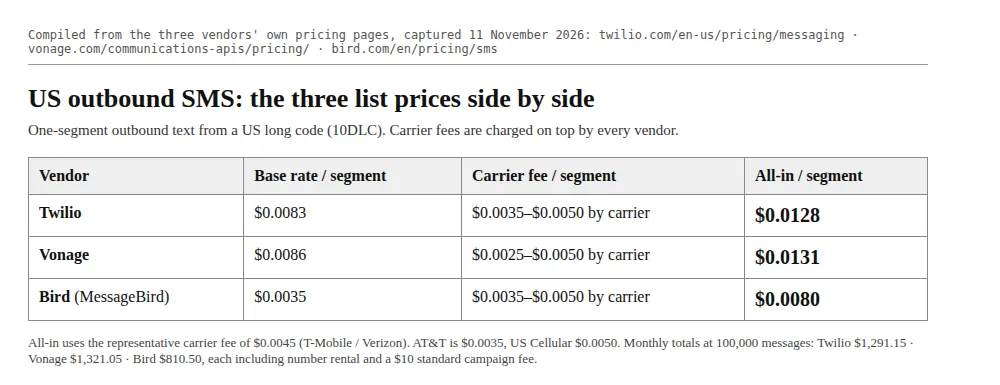
Send 100,000 texts a month from a US long code and the bill reads $1,291.15 on Twilio, $1,321.05 on Vonage, and $810.50 on Bird (formerly MessageBird). The stickers are $0.0083, $0.0086, and $0.0035 a segment — a 59 percent gap. The bills differ by 37 percent: the carrier fee. Every figure below was read from the vendors' own pricing pages on 11 November 2026, or from independent reads that agree where the vendor page stays silent.
An SMS API lets your code send a text: your server calls the vendor's API over HTTP with a JSON payload, the vendor hands the message to a carrier, and a delivery receipt (DLR) comes back over a webhook. The three vendors differ on the per-message price, the number you send from, the registration paperwork, and how fast they let you send. They do not differ on the carrier fee, which the carrier sets and every vendor passes through.
The four lines on every SMS invoice
First, the base rate per segment: one 160-character GSM-7 chunk, or 70 characters once an emoji or non-Latin character switches the message to Unicode. A 200-character message bills as two segments on every vendor.
Second, the carrier fee: what the destination carrier charges for application-to-person (A2P) traffic, passed through with no markup. The published long-code fees are AT&T $0.0035, T-Mobile $0.0045, Verizon $0.0050, US Cellular $0.0050, and all other carriers $0.0042; which applies depends on the recipient's handset. This guide uses $0.0045 as the representative fee.
Third, number rental: Twilio lists numbers from $1.15 a month for a long code, Vonage's long code rents for $1.05, and Bird's US local number for $0.50. One secondary read puts Twilio's toll-free number at $2.15 a month — treat that as single-source until Twilio prints it.
Fourth, A2P 10DLC registration: the US carrier system's brand and campaign fees, covered below. A standard campaign costs $10 a month on Twilio and on Vonage; Bird bills campaign subscriptions every three months without printing the amount. The monthly math applies the $10 standard campaign fee to all three vendors, since all three pass through the same registry charges.
The three base rates
| Vendor | US outbound / segment | US inbound / segment | UK outbound / segment |
|---|---|---|---|
| Twilio | $0.0083 | $0.0083 | $0.056 |
| Vonage | $0.0086 | $0.00649 | Not published |
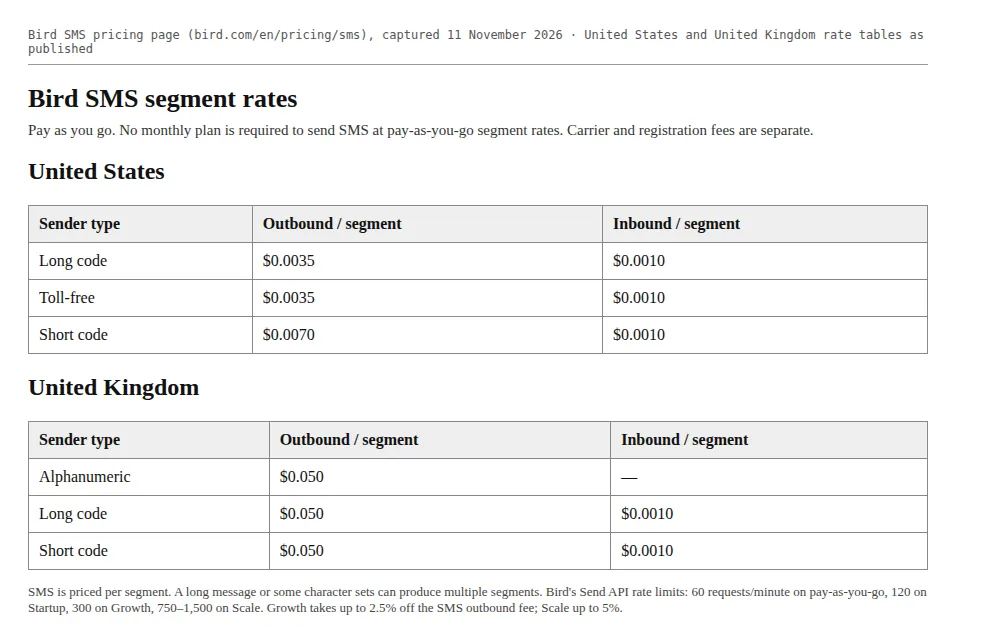
| Bird (MessageBird) | $0.0035 | $0.0010 | $0.050 |
Twilio's $0.0083 applies to outbound and inbound, on long codes, toll-free numbers, and short codes alike. Vonage's $0.0086 is its US local virtual number (LVN) rate, quoted as "as low as"; Vonage points buyers to its dashboard and pricing sheet for exact numbers. Bird's $0.0035 covers long code and toll-free; its short code rate is $0.0070, its inbound rate $0.0010 on every sender type. Bird's UK rate is a flat $0.050 a segment for alphanumeric, long code, and short code alike.
Vonage's UK rate is the honest gap in this guide: it does not publish one, and two secondary reads disagree by nearly tenfold, so no figure is printed here.
The all-in math
The all-in price of one outbound US segment is the base rate plus the carrier fee:
At the $0.0045 carrier fee: Twilio $0.0083 + $0.0045 = $0.0128; Vonage $0.0086 + $0.0045 = $0.0131; Bird $0.0035 + $0.0045 = $0.0080. Bird's sticker is 58 percent below Twilio's; Bird's all-in price is 37.5 percent below. The carrier fee is 35.2 percent of Twilio's all-in price and 56.2 percent of Bird's.
The monthly total adds the fixed lines to the message charges:
| Messages / month | Twilio | Vonage | Bird |
|---|---|---|---|
| 10,000 | $139.15 | $142.05 | $90.50 |
| 100,000 | $1,291.15 | $1,321.05 | $810.50 |
| 1,000,000 | $12,811.15 | $13,111.05 | $8,010.50 |
Fixed costs: Twilio $11.15 a month ($1.15 number + $10 campaign), Vonage $11.05, Bird $10.50. At 100,000 messages Bird saves $480.65 a month against Twilio ($5,767.80 a year) and $510.55 against Vonage ($6,126.60 a year). Twilio beats Vonage by $2.90 a month at 10,000 messages and $299.90 at 1,000,000.
Is there a crossover volume?
No. Bird's base rate sits $0.0048 a segment below Twilio's, and Bird's fixed cost sits $0.65 a month below Twilio's too. There is no volume where Twilio catches up: the gap grows from $48.65 a month at 10,000 messages to $480.65 at 100,000 and $4,800.65 at 1,000,000. Bird's volume discounts widen it further — Growth takes up to 2.5 percent off the SMS outbound fee and Scale up to 5 percent, saving another $175.00 a month at 1,000,000 messages. Twilio and Vonage publish no per-message volume tiers; both sell committed-use contracts instead.
That does not make Bird the automatic pick. Twilio's documentation, SDKs, and ecosystem are the deepest in the category, and Vonage's Messages API puts SMS, MMS, RCS, WhatsApp, Messenger, and Viber behind one integration, with a platform fee from $0.00129 a message on top of channel and carrier fees. If your team already runs on Twilio or Vonage, migration can exceed a year of Bird's saving. The Mailgun vs SendGrid vs Amazon SES transactional email pricing playbook makes the same point for email.
The UK comparison
Twilio charges $0.056 an outbound segment to the UK, 6.75 times its US rate. Bird charges $0.050, 14.29 times its own US rate — Bird's UK multiple is steeper because its US rate is so low. At 100,000 UK messages: Twilio $5,600.00, Bird $5,000.00, a $600.00 monthly saving, or 10.7 percent. The UK has no carrier-fee or 10DLC layer, so the base rate is the whole story.
A2P 10DLC: the registration layer
US long-code texting runs through A2P 10DLC, the carrier system that registers your brand and campaign with The Campaign Registry (TCR) before a single message goes out. Unregistered 10DLC traffic to US numbers has been blocked since 1 September 2023, and blocked messages still incur the charge. Registration has three parts: the brand (who is sending, verified against a business tax ID such as an EIN), the campaign (what you send and how people agreed to receive it), and the numbers attached to it.
Twilio's fee schedule: a standard brand pays $44 once, plus $15 campaign vetting, plus $1.50 to $10 per campaign a month. A low-volume standard brand — an EIN business sending under 6,000 segments a day — pays $4 once, plus the same $15 vetting and $1.50 to $10 a month. A sole proprietor with no EIN pays $4 once, plus $15 vetting, plus $2 a month, capped near 1,000 messages a day to T-Mobile on one number through one campaign. Vonage's fees run close: $4.50 brand, $41.50 standard vetting, $15 campaign vetting, $10 a month for a standard campaign, $1.50 for a low-volume mixed campaign. Bird confirms 10DLC fees exist and bill every three months, but prints no amounts.
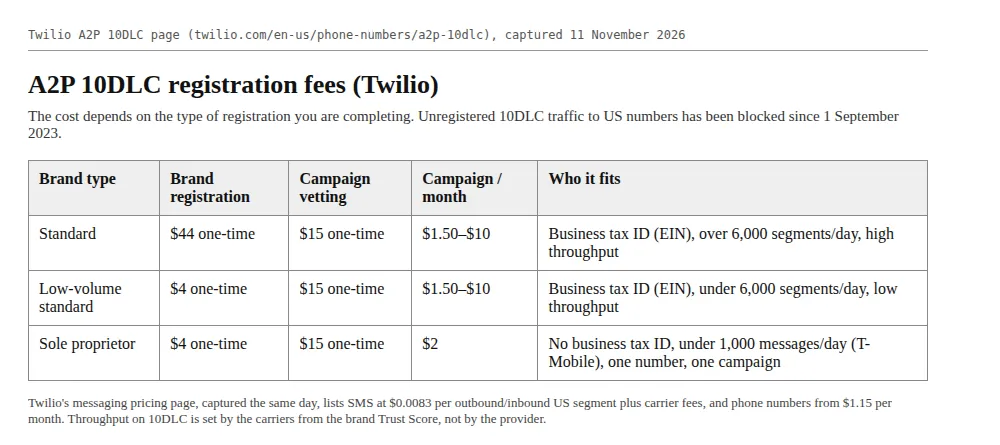
One discrepancy: several October 2026 guides cite $46 and $4.50 brand fees, saying Twilio raised them on 1 August 2025. Twilio's own page as captured today says $44 and $4, and this guide uses it.
Throughput and rate limits
On 10DLC, the carriers set the ceiling from your Trust Score: AT&T allows 75 messages a minute at a low score and 4,500 at a high score, and T-Mobile caps daily volume per campaign from 2,000 segments to unlimited.
Bird controls throughput at the API instead: its Send API accepts 60 requests a minute on pay-as-you-go, 120 on Startup, 300 on Growth, and 750 to 1,500 on Scale — at 60 a minute, a 100,000-message campaign takes over 27 hours. Vonage publishes no throughput figure, so none is printed here.
Inbound, MMS, and short codes
Replies cost money too, and the inbound gap is wider than the outbound one: ten thousand replies cost $83.00 on Twilio, $64.90 on Vonage, and $10.00 on Bird. If your flow is two-way, price the replies too.
MMS costs more everywhere. Twilio's outbound MMS is $0.022 a message, so 10,000 picture messages cost $220.00 before carrier fees. Bird and Vonage price MMS per destination; no Bird or Vonage MMS figure appeared on the pages opened this cycle.
Short codes are a different purchase. The per-message rate barely changes — Bird charges $0.0070 a segment from a short code against $0.0035 from a long code, Twilio the same $0.0083 either way — but the lease dominates: a US short code leases for around $1,000 a month, replacing the number rental. At 100,000 short-code messages, Bird totals $2,160.00 a month and Twilio $2,290.00, each including the lease.
The decision table
| Your situation | Pick | Why | Authority |
|---|---|---|---|
| US-only, cost-first, 10k–1M messages a month | Bird | Lowest base rate and fixed cost at every volume | Vendor pricing pages |
| Already built on Twilio, deep SDK and add-on use | Twilio | Migration cost beats Bird's $480.65 a month saving at 100k messages | Twilio pricing page |
| Omnichannel in one API (SMS, RCS, WhatsApp, Messenger) | Vonage | Messages API covers six channels in one integration | Vonage pricing page |
| UK-heavy sending | Bird, narrowly | $0.050 against Twilio's $0.056; a 10.7 percent gap, not 37 percent | Bird UK page |
| Two-way messaging with heavy replies | Bird | Inbound $0.0010 vs Twilio's $0.0083 and Vonage's $0.00649 | Bird pricing page |
| Burst campaigns over 100k messages in an hour | Short code or high-Trust-Score 10DLC | 10DLC throughput is capped by Trust Score; Bird PAYG allows 60 requests a minute | Twilio 10DLC page; Bird rate limits |
Who should avoid each vendor
Avoid Bird if your team needs Twilio's documentation depth, SDK coverage, and integrations. Avoid Twilio if your volume is high, your messages are plain SMS, and nothing in your stack depends on Twilio-only features: at 1,000,000 messages a month you pay $4,800.65 extra for the ecosystem. Avoid Vonage if your decision turns on published pricing alone — Vonage publishes starting rates and points you to the dashboard for exact numbers, including the UK rate this guide could not verify. Avoid any vendor if you have not registered a 10DLC brand and campaign: unregistered traffic is blocked, and blocked messages still bill. The Hotjar vs Microsoft Clarity vs Fullstory session replay pricing playbook shows the same pattern in another category.
Founder & CEO Insight — Enow A. Jovial
The execution checklist
- Count your real monthly volume, outbound and inbound separately — replies bill too.
- Check your message length: a 200-character message is two segments. Trim to 160 or pay double.
- Price the all-in cost: base rate plus $0.0045 carrier fee, plus number rental, plus the $10 campaign fee.
- Register your 10DLC brand and campaign before promising a launch date. Budget $44 plus $15 vetting for a standard brand.
- Confirm your Trust Score tier: a low score caps AT&T at 75 messages a minute.
- Check the destination rate card for every country you send to.
- Run the projection with the ROI calculator: monthly total times 12 vs the migration cost of switching.
- Send a test batch first and read the delivery receipts.
The acronyms, decoded
An SMS API is a CPaaS product — communications platform as a service — an API over HTTP that takes JSON and returns a message ID, with SDKs in the usual languages. A2P means application-to-person, your code texting a human, as opposed to P2P, person-to-person. A segment is the billing unit: 160 GSM-7 characters or 70 Unicode characters. SMPP is the older binary protocol carriers use behind the API. A DLR, delivery receipt, is the webhook callback that says the handset got the message. 10DLC is a 10-digit long code registered for A2P use, and TCR is The Campaign Registry. Throughput is measured in MPS, messages per second, and the SLA is what the vendor promises about uptime. On compliance: the TCPA, the US Telephone Consumer Protection Act, requires prior express consent before a business text; the CTIA publishes the messaging principles carriers enforce; the GDPR governs the same messages in Europe. A US business registers with an EIN, its employer identification number, and many senders hold the number in an LLC.