Trustpilot, G2 and Capterra sell the same promise — reviews that move buyers — but they charge for it in three different currencies. Trustpilot sells a subscription priced per domain: Plus starts at $319 a month per domain, billed annually, with 300 review invitations a month. G2 sells a subscription priced per vendor profile: Starter is $299 a month, or $2,999 for the first year, for vendors with 1 to 100 employees. Capterra sells clicks: listing is free, and sponsored placement runs on a pay-per-click auction with bids from $2 a click and a $500 monthly minimum. The meter decides the bill.
G2 completed its acquisition of Capterra, GetApp and Software Advice in February 2026. On November 10, 2026, G2 made my.G2 the single platform for all four sites, and Capterra pay-per-click now runs as G2 Ads Clicks, one campaign and one budget across all four sites. Since that date, a vendor buying Capterra clicks and a vendor buying a G2 subscription buys from the same sales organisation. The choice is not between three independent marketplaces. It is between Trustpilot's invitation model, G2's subscription model, and the auction model G2 now runs on both sides of its own house.
The three meters, side by side
| Platform | What you pay for | Entry price | Ceiling that matters | Authority |
|---|---|---|---|---|
| Trustpilot | Subscription per domain | Free; Plus from $319/mo per domain, billed annually | 300 review invitations/month on Plus; 1,000 on Premium | business.trustpilot.com/pricing, read Nov 20, 2026 |
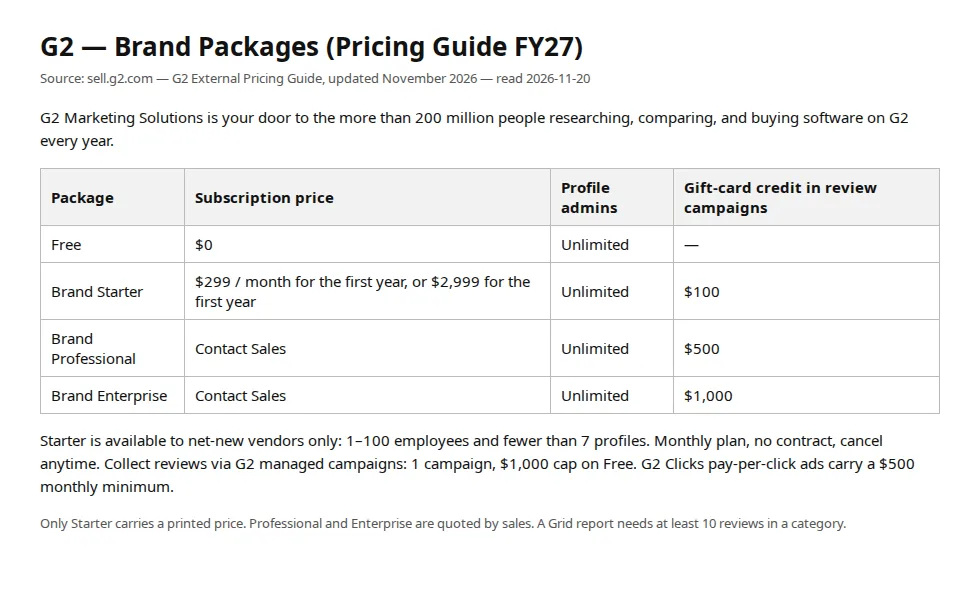
| G2 | Subscription per vendor profile | Free; Starter $299/mo or $2,999 first year | Starter limited to 1–100 employees and fewer than 7 profiles | G2 External Pricing Guide FY27, updated Nov 2026 |
| Capterra | Pay per click (auction) | Free listing; PPC bids from $2/click, $500/mo minimum | No subscription ceiling — spend is the ceiling | G2 Digital Markets vendor terms, read Nov 2026 |
Trustpilot's page is explicit that its plans are a 12-month commitment and that prices depend on business size per domain and annual revenue — the $319 and $799 figures are "from" prices, not fixed prices. A large business should expect a higher quote. G2's Starter is the only tier in the whole comparison with a printed price and no contract: monthly, cancel anytime, for net-new vendors only. Capterra publishes no rates at all for its paid programs; the $2 floor and $500 minimum come from vendor guides and G2's own Clicks floor, not from a Capterra rate card.
Trustpilot: you pay per domain, and the invitation is the meter
Trustpilot's model is the most mechanical of the three: the business invites its own customers to leave reviews, and the plan caps how many invitations go out each month. Free collects reviews with a basic profile. Plus, from $319 a month per domain billed annually, allows 300 invitations a month, 3 users, and up to 3 domains, with a 14-day free trial. Premium, from $799 a month per domain billed annually, raises the cap to 1,000 invitations a month and adds feedback analytics. Enterprise is quoted by sales.
The per-domain unit is the trap to model before signing. A business with one domain pays $319 a month on Plus. A business with three domains — a main site, a regional site, a product site — pays the per-domain price three times, cap included. The annual math is worth doing before the sales call:
ext{Trustpilot Plus annual cost} = $319 imes 12 imes ext{domains} = $3{,}828 imes ext{domains}
One domain costs $3,828 a year. Three domains cost $11,484 a year, for 900 invitations a month across the three. Premium at one domain costs $9,588 a year for 1,000 invitations a month. The cost per invitation falls as the tier rises — $1.06 on Plus at full use, $0.80 on Premium — but only if the invitations are actually sent. A business sending 100 invitations a month on Plus pays $3.19 per invitation. The meter punishes the business that buys the tier and then forgets to run the invitation program. Trustpilot's value is the TrustScore widget and the branded profile page, which travel into ads and SEO results; the widget is the reason the subscription exists.
Trustpilot is built for B2C and B2B businesses whose buyers check a score before they buy — ecommerce, services, insurance, finance. It is not a software directory: a SaaS vendor whose buyers compare feature lists will find no category page on Trustpilot that ranks it against competitors. That is G2 and Capterra territory.
Founder & CEO Insight — Enow A. Jovial
G2: one printed price, and a year-two jump to plan around
G2's model is the mirror image of Trustpilot's. The vendor does not invite its own customers through a capped meter; buyers write reviews on the marketplace, and the vendor pays to promote, collect and license what the marketplace produces. The free profile covers a profile, basic review collection, and the Users Love Us badge once the product earns it. Starter, at $299 a month or $2,999 for the first year, adds custom calls to action, review campaigns, $100 in gift-card review credits, and report badge licences. Professional and Enterprise are quoted by sales, adding video reviews, $500 and $1,000 in gift-card credits, review management, profile visitor data and multi-product collection.
Two numbers deserve a second reading. First, the Grid report — the ranked category report most vendors pay G2 for — needs at least 10 reviews in a category. A product with 4 reviews buys Starter and still does not appear on the Grid. Second, the year-two price: buyer guides report that Starter rises to $599 a month, or $6,000 a year, from the second year. G2's own guide prints only the first-year figure, so the year-two number is buyer-reported, not vendor-published — but the direction is consistent across independent reads, and the two-year math is what a buyer should budget:
ext{G2 Starter two-year cost} = $2{,}999 + $6{,}000 = $8{,}999
That is $4,499 a year on average across two years, not $2,999. A vendor that budgets $2,999 a year for G2 will be $3,001 short in year two. G2 also sells buyer-intent data through an API and an MCP server that feed a buyer's CRM, and the same intent pool now covers G2, Capterra, Software Advice and GetApp. That data layer is priced as an add-on, and it is where the CAC math changes: a B2B SaaS vendor paying $299 a month for Starter plus intent data is buying pipeline, not just a profile, and the LTV of one enterprise deal can carry the whole annual subscription. G2 Clicks, the pay-per-click ad product, carries a $500 monthly minimum on top of any subscription, and the clicks run across all four sites since the November 2026 unification. A vendor that buys both Starter and Clicks pays a subscription plus an auction — the most expensive shape here, and the one needing the closest tracking, because the subscription buys presence, the clicks buy traffic, and neither guarantees a review.
G2 suits B2B software vendors with a customer base large enough to produce 10 reviews in a category. It is the wrong buy for a vendor with no customers yet: the free profile costs nothing and collects the first reviews, and Starter adds nothing until there are reviews to promote. Our Buffer vs Hootsuite vs Later social media scheduling pricing playbook covers the social channels where those first reviews are usually shared — pay for distribution only after the proof exists.
Capterra: free to list, and the auction sets the price
Capterra is the odd one out because it charges nothing to exist. Listing is free, displaying badges is free, and the profile feeds GetApp and Software Advice from the same backend. What costs money is attention: sponsored placement through pay-per-click, with bids from $2 a click in $0.25 steps and a $500 monthly minimum budget, run as a second-price auction. Pay-per-lead is the second paid program, where human advisors screen buyers before passing them on; prices are not published and typically run $30 to more than $100 per lead depending on category and filters.
The auction math is where Capterra is won or lost. At the $2 floor, $500 a month buys 250 clicks. In a competitive category, where bids run $15 to $65 a click, the same $500 buys between 7 and 33 clicks. A vendor in a crowded category such as CRM, help desk or project management should expect $20 or more per click, and should model the cost per demo, not the cost per click:
ext{Cost per demo} =
rac{ ext{Cost per click}}{ ext{Click-to-demo conversion rate}}
At $20 a click and a 2% click-to-demo rate, each demo costs $1,000. At $2 a click and the same 2% rate, each demo costs $100. The category, not the budget, decides which of those numbers the vendor lives with. Capterra suits vendors in categories where buyers shortlist by directory and the product has a self-serve trial — the click lands on a page that converts without a sales call. It is the wrong buy for a vendor whose product needs a demo to sell, unless the vendor can afford $20-plus clicks long enough to learn the conversion rate. The Mailchimp vs Brevo vs Omnisend email marketing pricing playbook shows the same auction-versus-subscription tension in email: a meter that charges per send punishes the sender who has not yet learned what converts.
The decision: which meter matches how you sell
| Buyer | Buy this | Skip this | Authority |
|---|---|---|---|
| B2C or services business, buyers check a score | Trustpilot Plus, one domain | Trustpilot Premium until invitations exceed 300/month | business.trustpilot.com/pricing |
| B2B SaaS vendor with 10+ reviews per category | G2 Starter, budget the year-two $6,000 | G2 Clicks until the profile converts | G2 Pricing Guide FY27 |
| SaaS vendor in a low-competition directory category | Capterra PPC at $2–$5/click | Capterra pay-per-lead until the click math is proven | G2 Digital Markets vendor terms |
| Vendor with no customers yet | All three free listings | Every paid tier | FTC 16 CFR Part 465 |
The annual totals at the entry tier are $3,828 for Trustpilot Plus, $2,999 for G2 Starter in year one and $6,000 from year two, and $6,000 a year for Capterra at the $500 monthly minimum. Capterra's floor is the highest entry cost of the three, which surprises buyers who stop at "free to list." The free listing is free; the traffic is not.
Buying in the right order
- Claim all three free listings in one week. They cost nothing and start the review clock on the same day.
- Invite the same 50 customers everywhere. Send the invitation through Trustpilot's tool and link the G2 and Capterra profiles in the same email.
- Count reviews, not clicks, at day 90. The platform with the most verified reviews from the same 50 invitations is the one whose audience is real for your buyers.
- Buy one paid tier, not three. Pay Trustpilot if your buyers check a score, G2 if your buyers compare software in categories, Capterra if your category auction is cheap and your trial converts.
- Re-price at month 12. Trustpilot renews at the same per-domain price; G2 Starter rises to $599 a month in year two on buyer-reported figures; Capterra's auction reprices every month. The renewal is the decision point, not the purchase.
- [x] Claim the free listings first: Trustpilot, G2 and Capterra profiles live before any paid tier is considered.
- [x] Count domains before buying Trustpilot: multiply the per-domain price by every domain the business operates.
- [x] Check the Grid threshold before buying G2: fewer than 10 reviews in a category means no Grid appearance, paid or not.
- [x] Model Capterra by cost per demo, not cost per click: a $2 click at 2% conversion is a $100 demo; a $20 click is a $1,000 demo.
- [x] Invite every customer and publish every review: the FTC rule bans sentiment-conditioned incentives and review suppression, with penalties up to $53,088 per violation.
- [x] Run the ROI calculator on the renewal: feed it the actual reviews collected and the actual demos booked, not the vendor's forecast.
The decision is not which platform is best. It is which meter matches how your buyers already behave: they check a score, they compare in a category, or they click a directory listing. Buy the meter that charges you for the behaviour your buyers already have, and let the free listings prove which behaviour that is before the first invoice arrives.