Todoist vs TickTick vs Any.do: Task Manager Pricing and the Per-User Cost at 1, 5, and 25 Seats
Three personal task managers, three different bills
Todoist, TickTick, and Any.do all sell the same promise: your tasks, your lists, your reminders, in one place. The prices look close — five dollars here, four dollars there — and that is exactly where the comparison goes wrong. The bill is not the headline monthly price: it is the headline price times the billing cycle, times the seat count, plus whatever the ceilings force you to pay for later.
The three apps price different things. Todoist charges for projects and people. TickTick charges for lists and tasks per list, with a single flat annual price and no team tier. Any.do charges per member on its team plan and per household on its family plan, and publishes no numeric caps on its free tier. Compare the ceilings, the billing cycle, and the seat count — not just the monthly numbers.
The price cards, side by side
The three vendors publish prices in three different shapes, so the table below puts them on one grid. Todoist and Any.do quote per month with an annual-billing discount. TickTick quotes a flat annual price on its upgrade page; the monthly figure comes from independent reads. The numbers are the list prices on each vendor's pricing page, fetched 2026-11-10.
| App | Free tier | Paid tier, annual billing | Paid tier, monthly billing | Authority |
|---|---|---|---|---|
| Todoist | Beginner, 0 dollars | Pro, 5 dollars per month | Pro, 7 dollars per month | todoist.com/pricing |
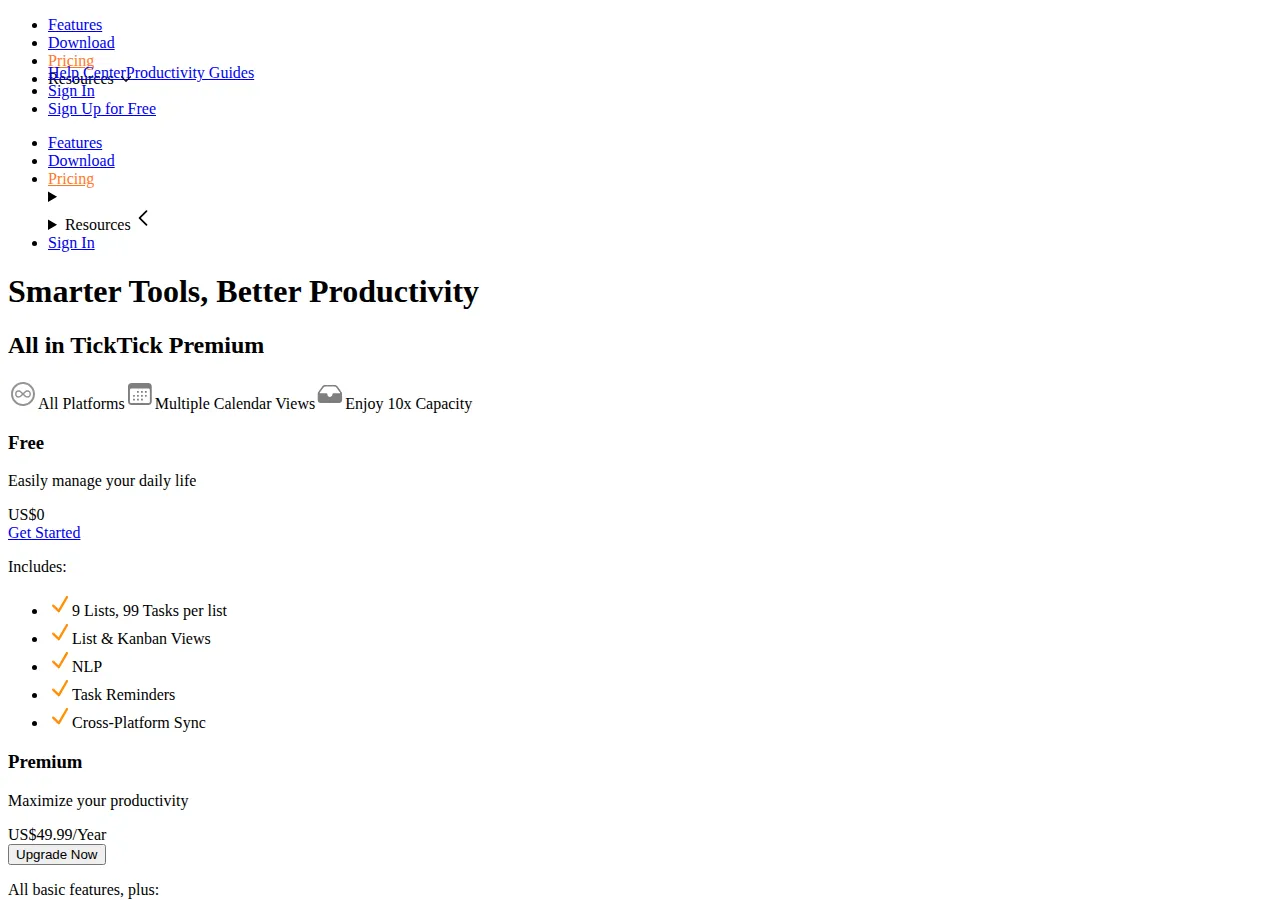
| TickTick | Free, 0 dollars | Premium, 49.99 dollars per year | Premium, 3.99 dollars per month | ticktick.com/about/upgrade |
| Any.do | Personal Free, 0 dollars | Premium, 4.99 dollars per month | Premium, 7.99 dollars per month | any.do/pricing |
Todoist and Any.do follow the same pattern: a free tier, a personal paid tier, and a team or family tier above it. TickTick has two tiers only, Free and Premium, and no team or family plan at any price. That missing tier is the first decision point: a household of four can buy one Any.do Family plan, while on TickTick each person buys their own Premium subscription.
What the free tiers actually cap
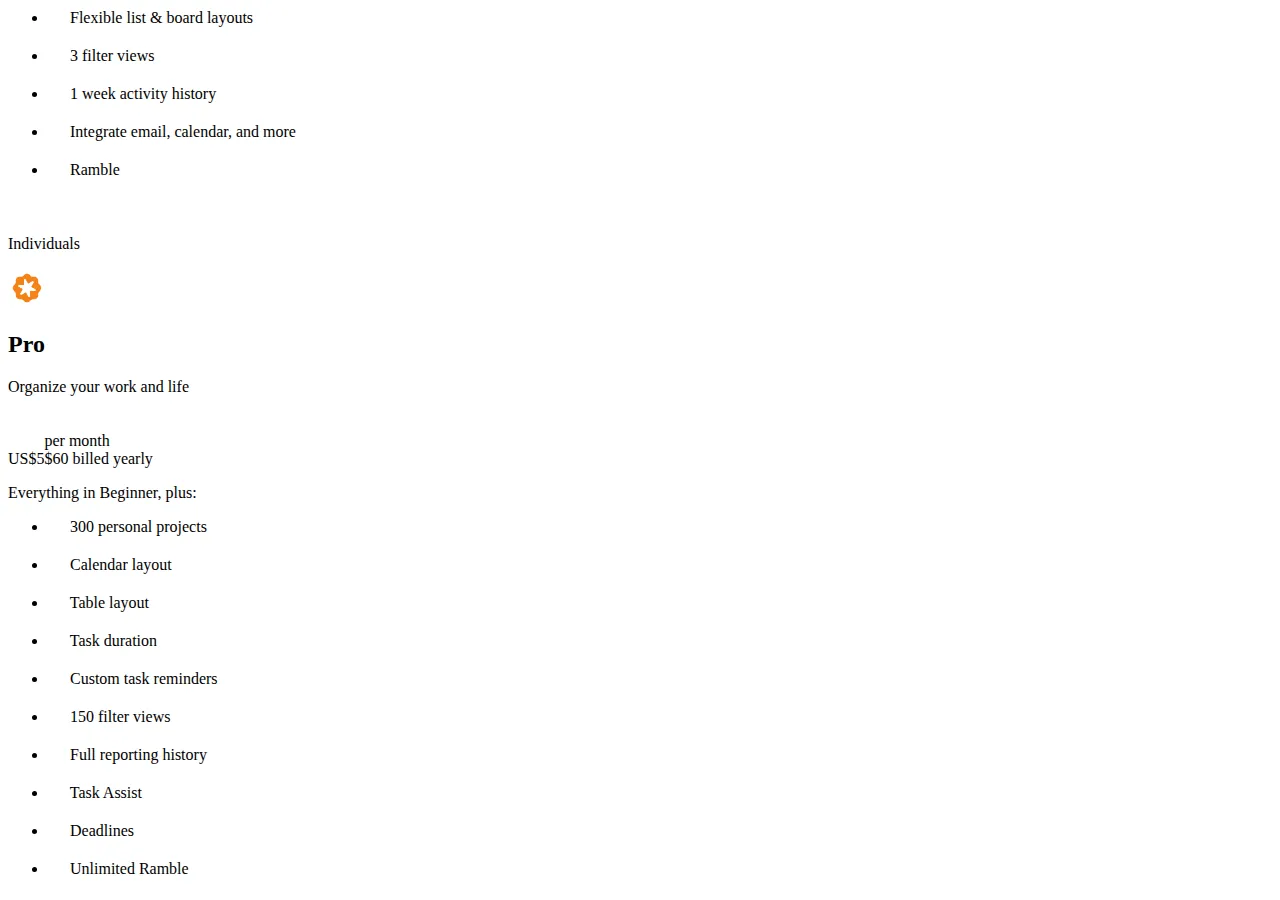
Todoist Beginner gives five personal projects, three filter views, one week of activity history, 5 MB uploads, and five people per personal project. Five projects is the binding limit: work, home, health, finance, and one hobby project fill it on day one.
TickTick Free gives nine lists, 99 tasks per list, list and Kanban views, natural-language input, task reminders, and cross-platform sync. Nine lists is generous next to Todoist's five projects. The binding limits sit elsewhere: one attachment per day with a 10 MB maximum, five habits, two shared members, and 19 checklist items per task. Sharing with a partner and a child hits the two-member cap fast.
Any.do Personal Free publishes no numeric caps: tasks and lists, reminders, calendar, daily planner, and sync across devices. No cap sounds generous: there is no published project count to hit. It also means the buyer cannot verify the ceiling before paying. The caps that matter are the features held back for Premium — recurring tasks, WhatsApp reminders, AI features, color tags, and location reminders — not a number on the free tier. If your work runs on recurring tasks, the free tier ends the week you set up your first weekly routine.
The paid tiers: what the money buys
Todoist Pro, at five dollars a month billed yearly or seven dollars billed monthly, raises the ceilings: 300 personal projects, 150 filter views, 100 MB uploads, calendar and table layouts, custom task reminders, task duration, full reporting history, Task Assist, and unlimited Ramble. The jump from five projects to 300 is the whole product. Custom reminders matter too — Beginner has none, so a person who needs one pays for Pro or lives with the default.
Todoist Business, at eight dollars per user per month billed yearly or ten dollars billed monthly, adds a shared team workspace, up to 500 team projects, 250 people per team project, 1,000 team members and guests, roles and permissions, centralized billing, and SOC2 Type II. Eight dollars a month sounds small; at 25 seats it is 2,400 dollars a year.
TickTick Premium, at 49.99 dollars a year on the list price, raises the ceilings to 299 lists, 999 tasks per list, multiple calendar views, task duration, email reminders, AI features, and themes. The jump from nine lists to 299 is the same move as Todoist's jump from five projects to 300. Premium also raises the caps that bind the free tier: 199 attachments per day, 299 habits, 29 shared members, and 199 checklist items per task. Five reminders per task is the agreed Premium figure.
Any.do Premium, at 4.99 dollars a month billed annually or 7.99 dollars billed monthly, unlocks recurring tasks, WhatsApp reminders, AI features, color tags, and location reminders. Recurring tasks justify the tier: without them, a weekly or monthly routine has to be recreated by hand every time it comes due.
Any.do Family, at 8.33 dollars a month for four members billed annually or 9.99 dollars billed monthly, buys a shared family space, a shared grocery list, and shared projects. Any.do Teams, at 4.99 dollars per member per month billed annually or 7.99 dollars billed monthly, buys a collaborative workspace, unlimited project boards, unlimited team members, more than 100 workflow templates, and admin tools and permissions, with a 14-day trial. Family is the cheapest way to cover four people here, and Teams is the cheapest per-seat team tier of the three.
The seat math: 1, 5, and 25 seats
The headline price tells you almost nothing about the bill: the bill is the per-seat price times the seat count times the billing cycle. Todoist Business and Any.do Teams charge per seat. TickTick Premium is a flat per-person annual price with no team tier, so its cost also grows with headcount — but from a lower base, with no volume discount. The table uses annual billing at list prices, the cheapest cycle for Todoist and Any.do.
| Seats | Todoist Business, annual | TickTick Premium, list annual | Any.do Teams, annual | Authority |
|---|---|---|---|---|
| 1 | 96 dollars | 49.99 dollars | 59.88 dollars | vendor pricing pages |
| 5 | 480 dollars | 249.95 dollars | 299.40 dollars | vendor pricing pages |
| 25 | 2,400 dollars | 1,249.75 dollars | 1,497 dollars | vendor pricing pages |
At 25 seats the spread is the decision. Per-user monthly cost at 25 seats: eight dollars for Todoist Business, 4.99 dollars for Any.do Teams, 4.17 dollars for TickTick Premium at list annual pricing — or 3.00 dollars on the promotional annual price.
At 25 seats, Todoist Business costs 1,150.25 dollars a year more than TickTick Premium, and Any.do Teams costs 247.25 dollars a year more. Those gaps buy different things: the Todoist premium buys roles, permissions, centralized billing, and a SOC2 Type II badge; the Any.do premium buys a shared workspace, unlimited project boards, workflow templates, and admin tools. If the team needs none of those, the gap is pure overspend.
The annual-vs-monthly gap
Annual billing is the cheapest cycle on Todoist and Any.do. Todoist Pro costs five dollars a month billed yearly and seven dollars billed monthly; Any.do Premium costs 4.99 dollars a month billed annually and 7.99 dollars billed monthly. The yearly plan saves real money on both, and the saving grows with the seat count.
A team that pays monthly on Any.do Teams pays 2,397 dollars for 25 seats instead of 1,497 dollars — a 900-dollar penalty for the billing cycle alone, larger than the entire TickTick bill for the same headcount.
The rule is simple: if you will use the app for a full year, pay yearly. Monthly billing fits only when the commitment is genuinely uncertain — a trial month, a short project, a team that may not exist in three months.
The TickTick oddity: monthly beats list annual
TickTick breaks the annual-is-cheaper rule. The list annual price on the TickTick upgrade page is 49.99 dollars a year. The monthly price, corroborated across independent reads, is 3.99 dollars a month. Twelve months at 3.99 dollars totals 47.88 dollars — 2.11 dollars less than the list annual price. Monthly billing is cheaper than the list annual price, the opposite of how Todoist and Any.do price their plans.
The promotional annual price fixes the oddity: 35.99 dollars a year, or 3.00 dollars a month, saving 11.89 dollars against monthly billing and 14.00 dollars against the list annual price. It is the cheapest per-seat price on any of the three apps. The catch is that it is a promotion, not a list price: confirm the 35.99-dollar figure at checkout, and expect the renewal at the list price unless the promotion is still running.
Where each one breaks
Todoist breaks on price at scale. The product is strong — 300 projects, 150 filter views, calendar and table layouts, Task Assist — and Business adds the roles and compliance badge a larger team needs. The break is the per-seat price: eight dollars a month per user is the highest of the three, and it never falls with volume. If the team uses the roles and the centralized billing, that is fair; if it uses shared projects and nothing else, it is 1,150.25 dollars more than TickTick.
TickTick breaks on sharing. The product is strong for one person — 299 lists, 999 tasks per list, multiple calendar views, AI features, and the cheapest per-seat price on the list. The break is the missing team tier: 29 shared members on Premium sounds generous, but shared members are not a team. There is no shared workspace, no admin console, and no way to bill 25 people on one invoice. A household can live with that. A company cannot.
Any.do breaks on transparency. The product is strong — recurring tasks, WhatsApp reminders, location reminders, a Family plan that covers four people for 99.96 dollars a year — and Teams is the cheapest per-seat team tier of the three. The break is the free tier: no numeric caps are published, so the buyer cannot verify the ceiling before paying, or compare it against Todoist's five projects or TickTick's nine lists. The buyer finds the limit by hitting it: for a person whose work runs on recurring tasks, the limit arrives the week the first weekly routine is set up.
Our Asana vs Monday vs Trello pricing and automation playbook covers the team project-management tier above these three apps. Our Linear vs Jira vs ClickUp engineering issue tracking playbook covers the engineering tracker tier. The buyer who outgrows these three is buying a different product, not a bigger version of the same one.
Founder & CEO Insight — Enow A. Jovial
The decision rule
- Count your projects first. Five or fewer personal projects fits Todoist Beginner; nine or fewer lists fits TickTick Free. More than either, pay for the tier that removes the ceiling.
- Count your people second. One person buys the cheapest Premium seat that fits. Four in a household buy Any.do Family at 99.96 dollars a year. Five or more buy Any.do Teams or Todoist Business.
- Pay yearly unless the commitment is uncertain. The annual saving is 24 dollars a seat on Todoist Pro and 36 dollars a seat on Any.do Premium.
- Check the TickTick promotion before you pay. The 35.99-dollar promotional annual price is the cheapest seat here at 3.00 dollars a month, but it is a promotion: confirm it at checkout and expect the renewal at the list price.
- Match the tier to the work, not the brand. Recurring tasks point to Any.do Premium; project counts to Todoist Pro; list counts and the lowest price to TickTick Premium.
- Run the seat math before the first invoice. Price the seats you will actually buy on the pricing calculator, at 1, 5, and 25 seats, on annual billing, and compare the yearly totals.