HCP Terraform, Spacelift, and env0 all run Terraform for you — remote state, remote runs, a private registry, and drift detection — and they meter three different things. HCP Terraform bills every managed resource, every hour, at the peak count. Spacelift bills a flat monthly fee with a user cliff at 10. env0 bills runs on a free tier and then stops publishing prices entirely. This guide prices all three meters at the same three workloads.
The short answer: at small scale, HCP Terraform Free and env0 Free both cost $0, and Spacelift costs $399 a month the moment your team passes two users — the flat fee is a cliff, not a ramp. At 1,000 resources and 20 users, only HCP Terraform still has a published price: $470 a month on Standard, $100 on Essentials. Spacelift's published ladder tops out at 10 users and env0's paid tiers are quote-only, so both become sales conversations at exactly the size where a team needs a number. Buy the meter that matches how your estate grows: resources for HCP, headcount for Spacelift, run volume for env0.
The price list, read from the vendors
Every figure below was read from the vendor's own pricing page on November 20, 2026, except HCP Terraform, whose pricing page returns a rate-limit error from this network — its figures are corroborated across independent 2026 reads of HashiCorp's pricing page and the IBM HashiCorp price list, and match the figures in our own Terraform pricing guide.
| Service | HCP Terraform | Spacelift | env0 | Authority |
|---|---|---|---|---|
| Free tier | $0, up to 500 managed resources, 1 concurrent run | $0 forever, 2 users, 1 API key | $0 forever, 250 runs/mo, 30 active environments, 1 concurrent run | Vendor pricing pages |
| Entry paid tier | Essentials $0.10/resource/mo ($0.00013/hr) | Starter starting at $399/mo | Cloud Navigator, custom quote | Vendor pricing pages |
| Mid paid tier | Standard $0.47/resource/mo ($0.00064/hr) | Business, custom quote | Cloud Pilot, custom quote | Vendor pricing pages |
| Top paid tier | Premium $0.99/resource/mo ($0.00135/hr) | Enterprise, custom quote | — | Vendor pricing pages |
| Meter | Managed resources, billed hourly at peak | Flat monthly fee; users and workers capped | Runs per month, then active environments | Vendor pricing pages |
| Concurrency | 1 run Free; 3 Essentials; 10 Standard; 200 Premium | 2 public workers on Starter | 1 run Free; unlimited on paid plans | Vendor pricing pages |
| Users | Unlimited on every tier | 2 Free; 10 Starter; unlimited Business | Unlimited on every tier | Vendor pricing pages |
HCP Terraform: the resource meter
HCP Terraform — the hosted Terraform Cloud, renamed under HashiCorp's HCP brand — prices the managed resource: any resource recorded in Terraform state with mode set to managed, counted from the first plan or apply. Billing is hourly: the peak number of managed resources in each hour sets that hour's charge, and a partial hour counts as a full hour. The rate card is Free at $0 for up to 500 managed resources, Essentials from $0.10 per resource per month, rated hourly at $0.00013, Standard from $0.47 per resource per month at $0.00064 an hour, and Premium from $0.99 per resource per month at $0.00135 an hour.
The tier jumps buy features, not capacity. Essentials adds teams and custom roles. Standard adds policy enforcement, cost estimation, drift detection, and HCP Waypoint. Premium adds audit logging and 200 concurrent runs. The free tier includes remote state, remote runs, VCS integration, and the private module registry — the whole operating core — so a small estate can run on HCP for $0 indefinitely under 500 resources and one concurrent run.
The meter has one sharp edge: it counts everything in state, including security group rules, IAM policies, and the objects a module creates that nobody counts by hand. A 1,000-resource estate is rarely 1,000 servers; it is a few hundred servers and several hundred rules, policies, and attachments. And the peak-hour rule means a spike at 2 PM inflates that hour's bill even after the resources are gone. Ephemeral environments bill for the hours they exist, so a 500-resource preview environment that lives eight hours costs real money on every tier above Free.
Spacelift: the $399 cliff
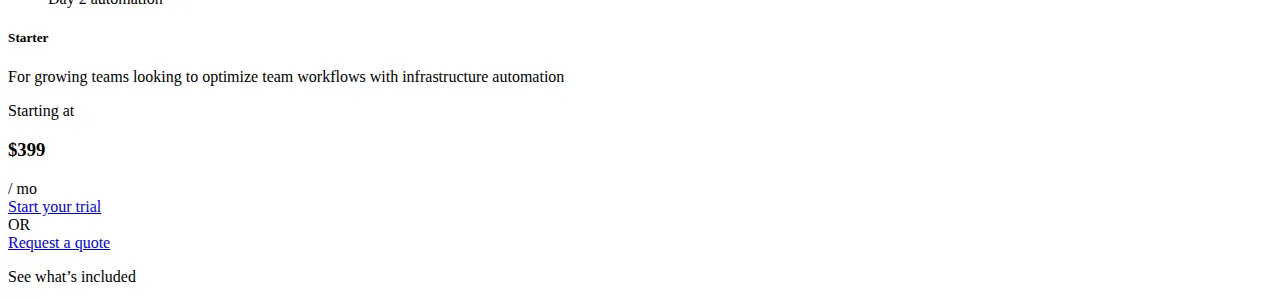
Spacelift prices the platform, not the resources. Free is $0 forever: 2 users, 1 API key, spaces, VCS integration, SSO with OIDC, cost estimation, and the Spacelift Terraform provider. Starter starts at $399 a month and adds 10 users, 2 public workers, OIDC integrations, a private module registry, webhooks, the policy-as-code engine, notifications, and custom tasks. Business is quote-only and adds unlimited users, workers public or private, drift detection, templates, blueprints, advanced scheduling, a private provider registry, targeted replans, a dedicated Slack channel, a named customer success manager from 3 workers, and Silver Support. Enterprise is quote-only.
The cliff is the user cap. Free allows 2 users; Starter allows 10. A three-person team cannot use Free, and an eleven-person team cannot use Starter — both must pay the next step, and the step from Starter to Business has no published price. The worker cap is the concurrency cap by another name: 2 public workers on Starter means two runs at once.
 There is no per-resource charge anywhere in Spacelift's price list — a 20,000-resource estate costs the same as a 200-resource estate on the same tier — but the estate has to fit inside the user and worker caps of a published tier, or the price becomes a sales conversation.
env0: the run counter that stops publishing prices
env0 prices runs and environments, and then stops publishing prices sooner than either rival. Free is $0 forever: 250 runs a month, 30 active environments, 1 concurrent run, a 20-minute maximum run duration, unlimited users, and one self-hosted runner. A run counts a successful apply, a destroy, or a drift detection. Cloud Navigator is a custom quote for up to 100 active environments with unlimited runs and concurrency. Cloud Pilot is a custom quote for unlimited environments, with the AI analyst, advanced drift cause analysis and remediation, and cost management.
The free tier is the most generous of the three for a small team: unlimited users where Spacelift allows two, 250 runs where HCP allows one concurrent run, and 30 environments where neither rival sets an environment cap. The paid tiers are the least transparent: env0 publishes no dollar figure for either paid plan, only "get a free quote." A team that outgrows the free tier — more than 250 runs a month, more than 30 environments, or runs longer than 20 minutes — cannot price the next step without a sales call.

Worked example: the same estate on three meters
Example: a platform team running three workloads through the same comparison. Workload 1 is a startup: 100 managed resources, 5 users, 20 runs a month, 5 environments. Workload 2 is a scaling team: 1,000 managed resources, 20 users, 500 runs a month, 40 environments. Workload 3 is a small team at the free-tier edge: 300 managed resources, 8 users, 100 runs a month, 10 environments.
Workload 1 is free on two platforms and $399 on the third. HCP Free covers 100 resources under its 500-resource allowance, and env0 Free covers 20 runs under its 250-run allowance. Spacelift Free fails on users — 5 exceeds 2 — so the team pays the full Starter price for runs the other two platforms execute free. The $399 buys 10 users, 2 public workers, and the policy engine; a five-person team that does not need those pays $399 for three extra seats.
Workload 2 has no published price on Spacelift or env0. Spacelift Starter caps at 10 users against 20 needed, so the team moves to Business, which is quote-only. env0 Free caps at 250 runs and 30 environments against 500 runs and 40 needed, so the team moves to Cloud Navigator, also quote-only. Only HCP Terraform answers with a number: $470 a month on Standard, $100 on Essentials, $990 on Premium. Standard is the honest comparison point, because a 20-person team running 500 applies a month needs policy enforcement and drift detection, which Essentials does not include.
Workload 3 is the free-tier edge case: 300 resources fits HCP Free, 100 runs and 10 environments fit env0 Free, and 8 users fit Spacelift Starter. Both free platforms cost $0; Spacelift $399. The breakevens make the pattern explicit: Spacelift Starter equals HCP Standard at 849 resources ($399 divided by $0.47) and HCP Essentials at 3,990 resources. Below 849 resources, Spacelift Starter is more expensive than HCP Standard for the same estate; above it, the flat fee wins — provided the team still fits in 10 users and 2 workers.
The ephemeral-environment cost is the hidden line on the HCP meter. A 500-resource preview environment that lives eight hours on Standard costs 500 times $0.00064 times 8, or $2.56 for the day — $76.80 a month if a fresh preview spins up every working day. On env0 the same environment costs runs, not resources: one apply and one destroy is two runs against the 250-run allowance. On Spacelift it costs nothing beyond the flat fee, as long as a worker is free.
| Decision | Buy this | Why | Authority |
|---|---|---|---|
| Smallest estate, smallest team | HCP Free or env0 Free | Both $0; HCP caps resources at 500, env0 caps runs at 250 | Vendor pricing pages |
| Small team, policy enforcement needed | HCP Standard | $0.47/resource/mo with drift detection and policy checks | HashiCorp pricing page |
| Large estate, small team | Spacelift Starter | $399 flat beats any per-resource meter past 849 resources | Spacelift pricing page |
| Many users, few runs | env0 Free | Unlimited users where Spacelift allows 2 | env0 pricing page |
| 20+ users or 500+ runs | HCP Standard | Only published price at that size; the other two are quote-only | Vendor pricing pages |
Who should not buy any of these
A team that runs Terraform from laptops with local state needs none of these platforms: the open-source CLI is free, and the first paid feature worth buying is remote state, which HCP Free includes. A team whose estate is mostly Kubernetes manifests should compare the managed control planes rather than the Terraform runners — our Cloudflare Workers vs Vercel edge pricing guide prices the compute layer these platforms deploy onto. And a team choosing between IaC languages rather than platforms should start with our Terraform vs Pulumi vs AWS CDK pricing playbook, which prices the same 1,000 resources at $100, $182.50, and $0 — the language decision comes before the platform decision, and the state migration between platforms is a project of its own, priced in our OpenTofu vs Terraform state migration playbook. Price the pipeline that runs the platform, too, with our CI/CD pricing playbook and the pricing calculator.
Founder & CEO Insight — Enow A. Jovial
The execution checklist
- Count the estate. List every resource in state across every environment, including security group rules and IAM policies. The count, not the team size, decides the HCP bill.
- Count the team. Two users fit Spacelift Free; ten fit Starter; eleven need a quote. Headcount, not resources, decides the Spacelift bill.
- Count the runs. Applies, destroys, and drift detections all count against env0's 250-run free allowance; a chatty drift schedule can exhaust it without a single deploy.
- Price the tier you actually need. If you need drift detection or policy enforcement, price HCP Standard or Spacelift Business, not the entry tier — the jump is 4.7x on HCP and unpublished on Spacelift.
- Apply the free allowances first. Subtract HCP's 500-resource free tier and env0's 250-run allowance before comparing — a 300-resource estate is $0 on both.
- Budget the ephemeral environments. Count how many resources exist for less than a day each week; on HCP's peak-hour meter they still bill for the hours they exist, at $2.56 a day per 500-resource preview on Standard.
- Get the quote before you migrate. Spacelift Business and both env0 paid tiers are quote-only. A migration without a written quote is a migration without a price.