Stripe Capital, Clearco, and Pipe sell the same product in different packaging: cash now, repaid as a slice of future sales, with one flat fee instead of interest. The packaging is where the money hides. On Stripe's own example page, a $25,000 advance carries a $2,500 fee — 10 percent — repaid at 15 percent of daily sales. Pipe's own help center gives the same structure with the same example fee: 10 percent on a $50,000 advance is a $5,000 fee. Clearco's own invoice-funding page prices its fees by term: 5.00 percent for a 4-month advance, 6.25 percent for 5 months, 8.00 percent for 6 months. The fee is fixed in every case, which means the annualized cost is not fixed at all — it is set by how fast your sales repay the advance. A 10 percent fee repaid in 183 days costs about 38 percent a year; the same fee repaid in 73 days costs about 95 percent a year. That is the whole comparison; eligibility and access decide whether you can even get the offer.
What each one actually sells
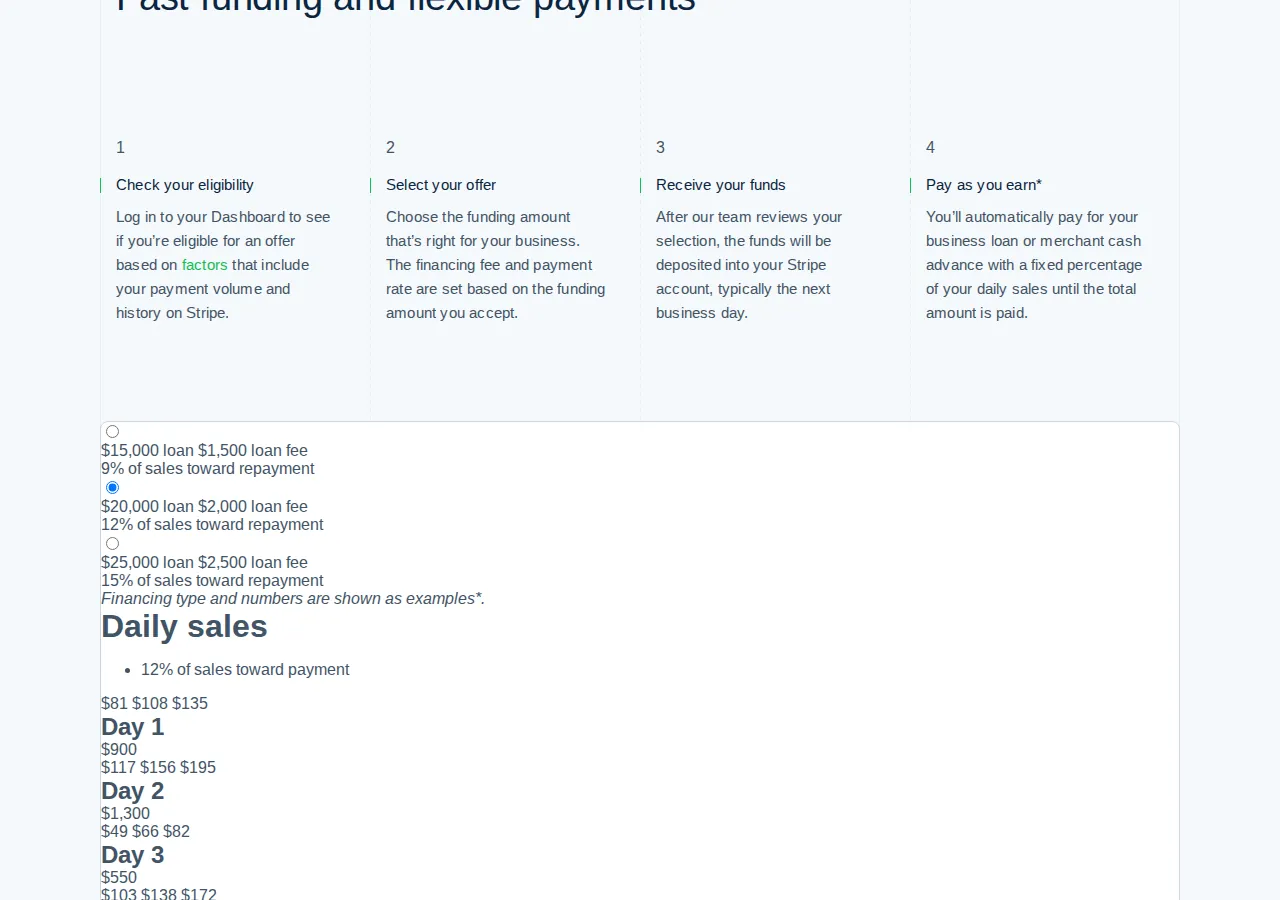
Stripe Capital is available only to businesses that process payments on Stripe. Eligibility is checked in the Stripe Dashboard and is based on factors that include payment volume and history on Stripe; there is no application form, no published minimum, and no credit check on the owner. The offer is a business loan or a merchant cash advance, with funds typically arriving the next business day, directly into the Stripe account by wire. The price is one flat fee that never changes, with no compounding interest charges and no late fees. Repayment is automatic: Stripe deducts a fixed percentage of daily sales until the total is paid. Its example page shows three offers — $15,000/$1,500 at 9 percent, $20,000/$2,000 at 12 percent, $25,000/$2,500 at 15 percent. The fee is 10 percent of the advance in all three; the repayment rate is what varies.
Clearco funds ecommerce and direct-to-consumer brands. Its homepage states funding up to $10 million with estimated payment terms up to 12 months, and over $3.3 billion invested in more than 11,000 businesses. The suite adds Rolling Funding Capacity, Fixed Funding Capacity, and Invoice Funding to the core Cash Advance. Clearco publishes no live rate card for Cash Advance — its own pages say rates are based on business performance, and third-party reviews report a flat fee of 6 to 12.5 percent. What it does publish, on its own invoice-funding page, is the term-priced fee: 5.00 percent for a 4-month advance, 6.25 percent for 5 months, 8.00 percent for 6 months, fixed at the offer and charged only when the invoice is funded. Its worked example is $1,000,000 for 4 months at 5.00 percent — $50,000 of fee, $1,050,000 total, in 17 weekly payments of roughly $62,000. Weekly payments are capped at 30 percent of that week's revenue. Clearco charges no blanket lien or standby fee.
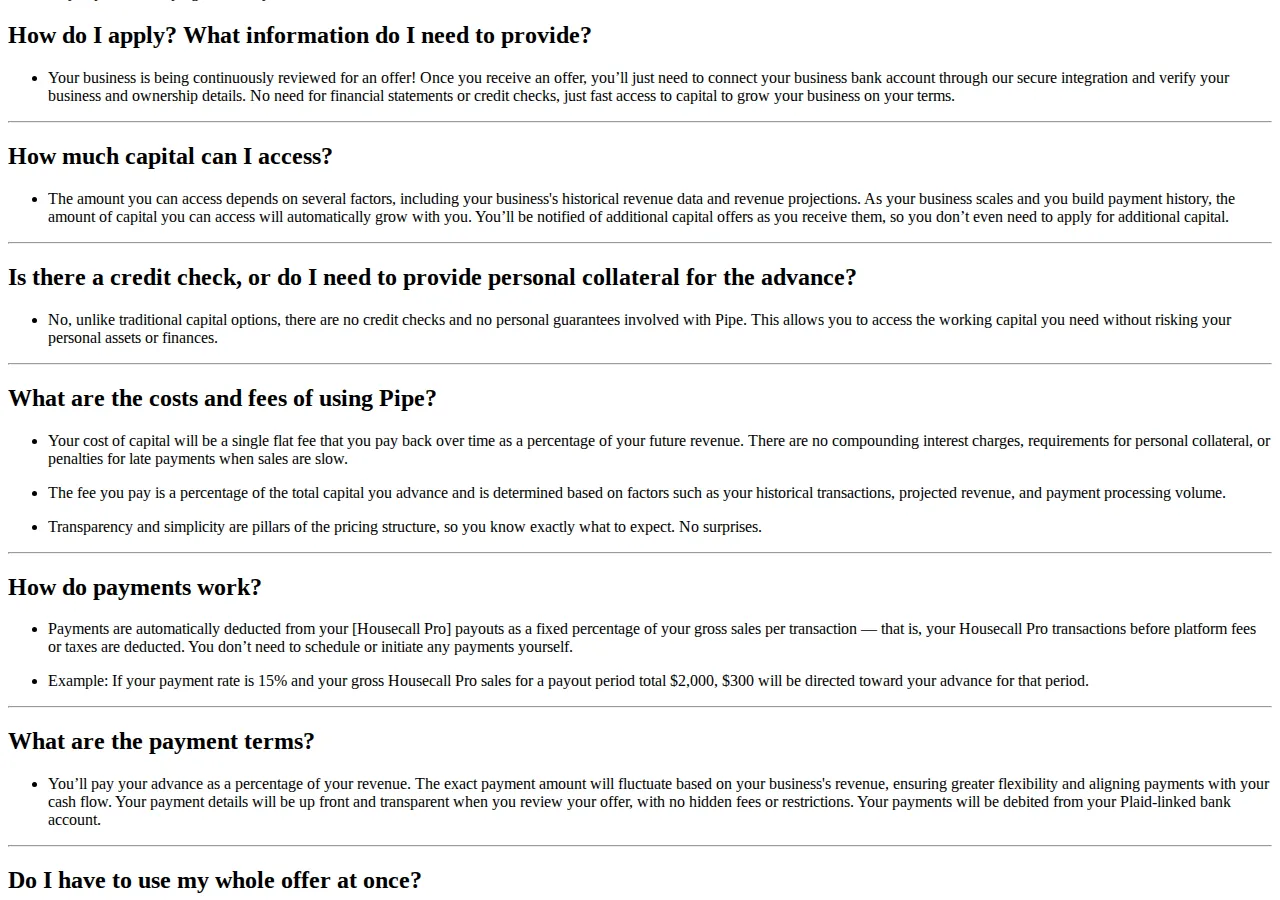
Pipe does not sell directly to a business at all. Pipe Capital is embedded inside the SaaS a business already uses — B2B marketplaces, vertical SaaS, payment facilitators — and the offer arrives through the platform's API. Pipe's help center states the structure plainly: a single flat fee, calculated as a percentage of the advance, paid over time as a percentage of future revenue, with no compounding interest, no personal collateral, and no late-payment penalties. Its own example is a 10 percent fee on a $50,000 advance, a $5,000 fee. Repayment is a fixed percentage of each sale, 15 percent or less, deducted automatically from payouts by ACH, with no monthly minimum. Underwriting runs on the partner platform's live transaction data: Pipe says it can underwrite on 3 to 6 months of history, and its partner GoCardless requires four or more months of processing history before an offer appears. Offers are live for a limited time, typically 30 days. Pipe Capital is structured as a merchant cash advance — a business sells a portion of its future revenue for up-front capital — and Pipe states it is not regulated as credit in the United States or the United Kingdom; it is available in the US, UK, and Canada.
The head-to-head
| Dimension | Stripe Capital | Clearco | Pipe Capital | Authority |
|---|---|---|---|---|
| Who can get it | Stripe processors only; eligibility from volume and history | Ecommerce/DTC brands; $10,000/mo revenue, 6 months trading history | Businesses on a Pipe partner SaaS platform; 3–6 months of history | Stripe, Clearco, Pipe pages |
| Maximum advance | Set by the offer; no published maximum | Up to $10 million per brand | Set by the offer; no published maximum | Clearco homepage; Stripe and Pipe publish no maximum |
| Fee structure | One flat fee; 10% in the published examples | Invoice funding 5.00% / 6.25% / 8.00% for 4 / 5 / 6 months; Cash Advance 6–12.5% reported | One flat fee; 10% in Pipe's own example | Stripe page; Clearco blog (Oct 17, 2026); Pipe Help Center |
| Repayment | Fixed % of daily sales: 9%, 12%, or 15% in the examples | Cash Advance: % of daily sales; Invoice Funding: fixed weekly payments capped at 30% of weekly revenue | Fixed % of sales, 15% or less, no monthly minimum | Stripe, Clearco, Pipe pages |
| Speed of funds | Next business day | On acceptance | Same-day, reported | Stripe Capital page; Clearco pages; partner documentation |
| Collateral / guarantee | No personal credit check; no collateral stated | No blanket lien; no personal guarantee | No personal collateral; no credit check | Stripe Capital page; Clearco homepage; Pipe Help Center |
| Late or slow sales | No late fees; payments shrink with sales | Weekly payment capped at 30% of weekly revenue | No late-payment penalties | Stripe Capital page; Clearco blog; Pipe Help Center |
The table makes the real difference visible: Stripe and Pipe publish the same 10 percent example fee and the same repayment mechanic, and differ mainly in access — Stripe requires Stripe processing, Pipe requires a partner platform. Clearco differs in structure: the only one with a published term-priced fee and a weekly-payment product, and the only one whose stated maximum ($10 million) a large brand can plan around.
The math: one advance, three costs
The honest comparison uses one scenario for all three and computes the annualized cost the same way for each: find the daily rate r that makes the present value of the repayments equal to the advance, then annualize it as a nominal APR, r × 365. The method reproduces an independent review's figure for Pipe: a $25,000 advance at a 10 percent fee, repaid at 15 percent of $1,000 a day in sales, is $150 a day for 183 days, or 38.4 percent nominal APR against the review's "roughly 38 percent" — verified, not assumed.
Scenario: a $50,000 advance, $5,000 a day in revenue.
- Stripe Capital, 15% hold: $750/day; $55,000 owed; 73.3 days; 95.2% nominal APR.
- Stripe Capital, 9% hold: $450/day; $55,000 owed; 122.2 days; 57.4% nominal APR.
- Pipe Capital, 15% hold: $750/day; $55,000 owed; 73.3 days; 95.2% nominal APR — identical to Stripe at the same hold, because the fee and the hold are the same.
- Clearco Invoice Funding, 6-month term at 8.00%: $54,000 total; 26 weekly payments of $2,076.92; 30.1% nominal APR.
- Clearco Invoice Funding, 4-month term at 5.00%: $52,500 total; 17 weekly payments of $3,088.24; 28.5% nominal APR.
Three conclusions, all arithmetic. First, the fee percentage tells you almost nothing on its own: a 10 percent fee is 38 percent a year when repaid over six months and 95 percent a year when repaid in ten weeks, because the fee is fixed and the time is not. Second, Clearco's longer, weekly schedule is what makes its annualized cost the lowest of the three at the same advance — not a lower fee, but a longer clock. Third, Stripe's 9 percent hold is worth real money against its 15 percent hold on the same fee: 57.4 percent against 95.2 percent, a 38-point difference bought by taking the advance more slowly. A business that can choose its repayment rate should choose the slowest rate its cash flow allows.
Founder & CEO Insight — Enow A. Jovial
Access is the real filter
Most businesses do not choose between the three; the three choose them. Stripe Capital appears only in the Stripe Dashboard, for businesses whose Stripe volume and history qualify. Clearco requires an ecommerce business with at least $10,000 a month in revenue and six months of trading history, per third-party reviews. Pipe requires a partner platform — Uber Eats, Housecall Pro, Boulevard, GoCardless — with three to six months of transaction history; without a partner-platform footprint there is no application page at all.
That filter changes the decision: if you process on Stripe, compare against a bank term loan; if you sell on Shopify or Amazon, Clearco's invoice funding pays suppliers directly; If your revenue runs through Housecall Pro or GoCardless, Pipe is the offer inside the software you open every morning. The Ramp vs Brex vs Mercury spend management pricing playbook prices the corporate cards that sit on top of the same cash flow, the Mercury vs Relay vs Wise business banking playbook prices the FDIC-insured accounts the advance lands in, and the Novo vs Bluevine vs Found business banking pricing playbook prices the small-business accounts that hold the balance while the advance is repaid.
Who should not use each one
Do not take Stripe Capital if your Stripe volume is seasonal: the fixed percentage takes its share of whatever sales exist, and a 15 percent hold on a thin month is a 15 percent tax on the revenue you need for payroll. Do not take Clearco Cash Advance if you need a published rate before you apply — Clearco publishes no live rate card for it, and the 6 to 12.5 percent range comes from third-party reviews, so the only number you can rely on is the one in your own offer. Do not take Clearco if you expect to stack a second advance while the first is outstanding: third-party reviews report an exclusivity clause barring additional financing of the same type without Clearco's consent. Do not take Pipe if your business is outside the US, UK, or Canada, or in an excluded category — cryptocurrency, gambling, cannabis, firearms, nonprofits — because the offer will not appear. And do not take any of the three for a slow, predictable expense like a lease deposit: a flat fee repaid in weeks is the most expensive money in this comparison, and a bank term loan is cheaper for anything with a fixed schedule. A merchant cash advance is a sale of future revenue, not a loan, which is why none of the three charges interest.
Decision checklist
- [x] Step 1: Check which offers exist for you — Stripe Dashboard, Clearco, or a Pipe partner platform. If only one appears, compare it against a bank loan.
- [x] Step 2: Read the three numbers in your offer — Advance amount, flat fee as a percentage of the advance, and repayment rate as a percentage of sales. If any one is missing, the offer is not priced.
- [x] Step 3: Compute the repayment time — Total owed divided by daily payment: advance plus fee, divided by the repayment rate times daily revenue.
- [x] Step 4: Convert the fee to a nominal APR — Solve for the daily rate that equates the advance to the repayments and multiply by 365.
- [x] Step 5: Choose the slowest repayment rate you can afford — 9 percent of sales costs 57.4 percent a year against 95.2 percent at 15 percent.
- [x] Step 6: Confirm the fine print — No personal collateral and no credit check at Pipe; no blanket lien at Clearco; no late fees at Stripe; exclusivity at Clearco and the 30-day offer expiry at Pipe.
- [x] Step 7: Run the total cost against the return — $55,000 of repayments on a $50,000 advance needs $5,000 of profit from the inventory or ads it funds. Run the return through the ROI calculator before accepting, and keep the advance inside the account the Novo vs Bluevine vs Found business banking pricing playbook priced for the business.