State Income Tax Reciprocity Agreements: The Multi-State Withholding Playbook
The agreement that decides which state taxes your paycheck
A reciprocity agreement is a written pact between two states that answers one question: when you live in one state and work in another, which state taxes the wages? Without one, both states can claim the same paycheck, and the worker files two returns and claims a credit for the tax paid to the other state. With one, only the home state taxes those wages: the work state does not tax them, does not withhold on them, and the worker files no nonresident return for that wage income.
The mechanism is a certificate, not a filing with a tax agency. The worker completes the work state's exemption certificate and hands it to the employer, who stops withholding for the work state and withholds for the home state instead. No certificate, no protection: the employer withholds for the work state by default, and the money comes back only through a refund claim.
The map: 17 jurisdictions, 30 pairs, one rule per pair
Sixteen states and the District of Columbia hold reciprocity agreements in 2026, covering 30 bilateral pairs, plus Indiana's unilateral offer, which covers Arizona residents working in Indiana. Every pair is separate: a state with agreements on some borders has none on the others. The full map, with the certificate form for each work state:
| Work state | Reciprocal home states | Exemption form | Authority |
|---|---|---|---|
| Arizona | Indiana | WH-47 | Indiana Dept. of Revenue |
| District of Columbia | Maryland, Virginia | D-4A | D.C. Code 47-1805.02 |
| Illinois | Iowa, Kentucky, Michigan, Wisconsin | IL-W-5-NR | Illinois Dept. of Revenue |
| Indiana | Arizona, Kentucky, Michigan, Ohio, Pennsylvania, Wisconsin | WH-47 | Indiana Dept. of Revenue |
| Iowa | Illinois | IL-W-5-NR | Illinois Dept. of Revenue |
| Kentucky | Illinois, Indiana, Michigan, Ohio, Virginia, West Virginia, Wisconsin | 42A809 | Kentucky Dept. of Revenue |
| Maryland | District of Columbia, Pennsylvania, Virginia, West Virginia | MW507 | Maryland Comptroller |
| Michigan | Illinois, Indiana, Kentucky, Minnesota, Ohio, Wisconsin | MI-W4 | Michigan Treasury |
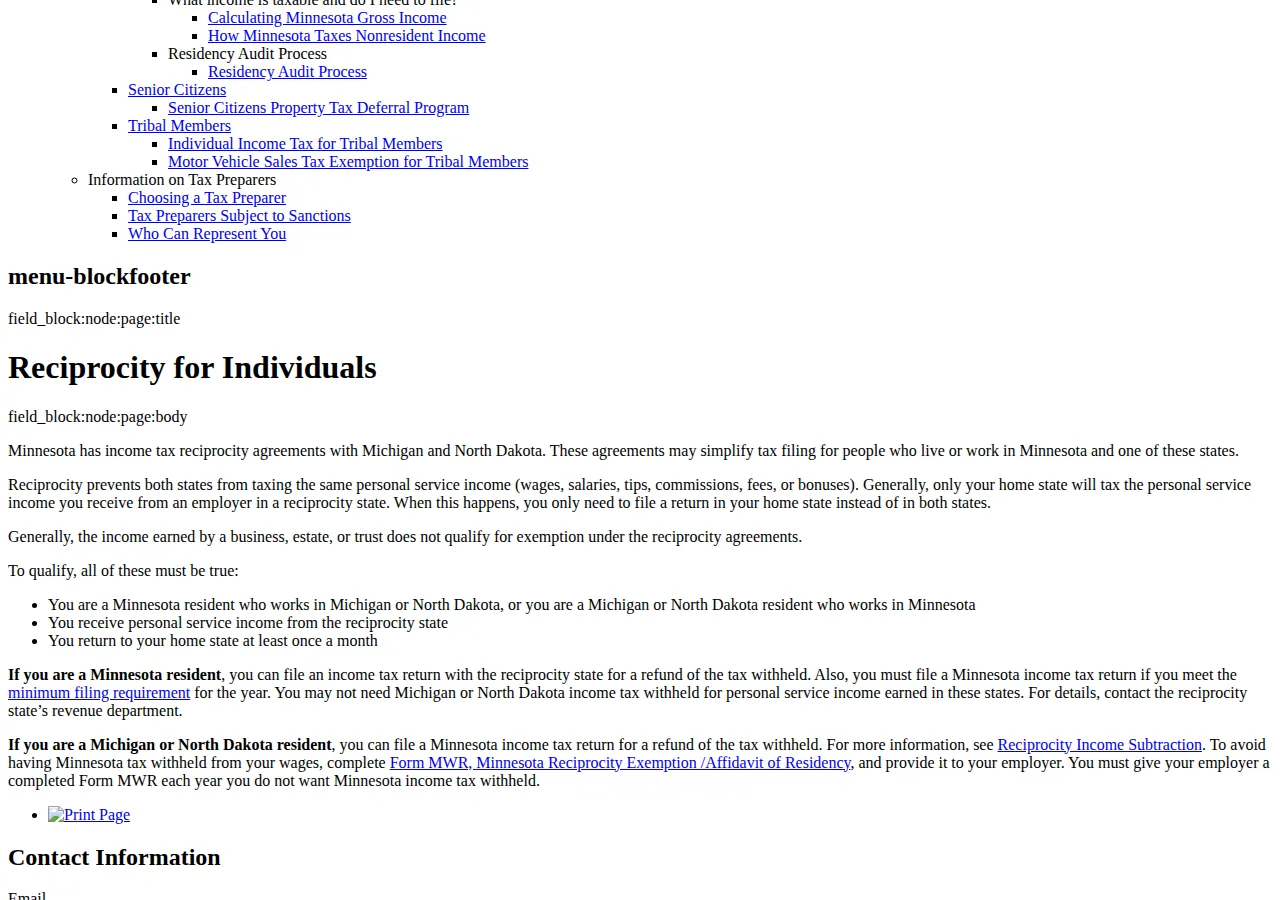
| Minnesota | Michigan, North Dakota | MWR | Minnesota Dept. of Revenue |
| Montana | North Dakota | MW-4 | Montana Dept. of Revenue |
| New Jersey | Pennsylvania | NJ-165 | NJ Taxation |
| North Dakota | Minnesota, Montana | NDW-R | ND Tax Commissioner |
| Ohio | Indiana, Kentucky, Michigan, Pennsylvania, West Virginia | IT 4NR | Ohio Dept. of Taxation |
| Pennsylvania | Indiana, Maryland, New Jersey, Ohio, Virginia, West Virginia | REV-419 | PA Dept. of Revenue |
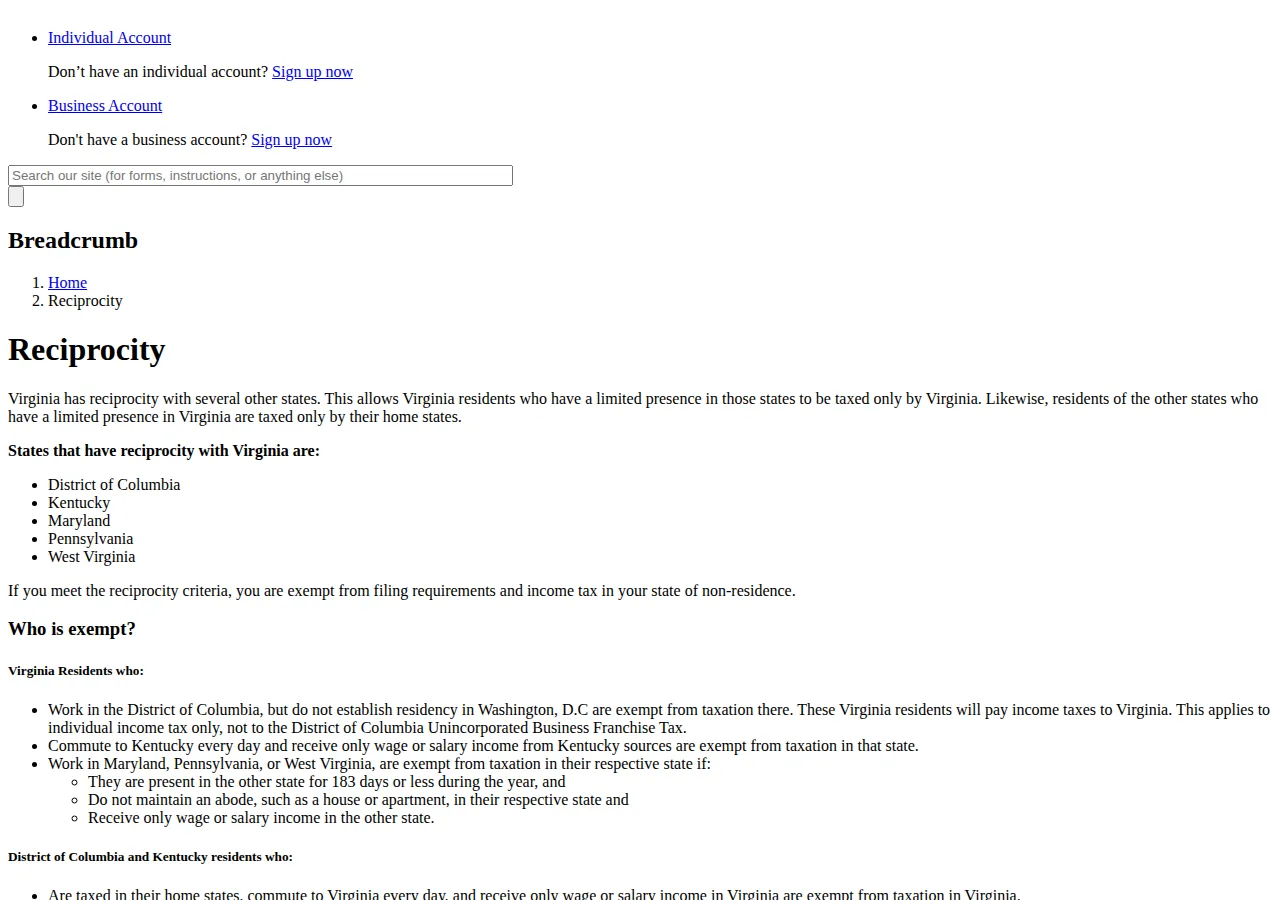
| Virginia | District of Columbia, Kentucky, Maryland, Pennsylvania, West Virginia | VA-4 | Virginia Tax |
| West Virginia | Kentucky, Maryland, Ohio, Pennsylvania, Virginia | WV/IT-104 | WV State Tax Dept. |
| Wisconsin | Illinois, Indiana, Kentucky, Michigan | W-220 | Wisconsin Dept. of Revenue |
Three states run on unilateral offers: Indiana, Minnesota, and Wisconsin extend reciprocity to any state that gives their residents the same treatment. Minnesota's page states it plainly: "Minnesota has income tax reciprocity agreements with Michigan and North Dakota." Wisconsin's is just as direct: "Wisconsin currently has reciprocity agreements with four states: Illinois, Indiana, Kentucky, and Michigan." Note what is missing: Minnesota. That agreement ended on January 1, 2010, and has not returned, so a worker crossing that border files in both states and claims the credit. Our remote employee state income tax nexus payroll playbook covers the no-agreement side of that border.
The certificate is the switch
The certificate goes to the employer, never to the revenue department — except in Pennsylvania, where an employer that agrees to withhold the resident state's tax must send a copy of the REV-419 to the Department. File a separate certificate with each employer as soon as the job starts: the change should show on the next pay stub.
Refiling rules differ by state, and the difference is the trap. Virginia requires the worker to re-certify the VA-4 every year, and Minnesota requires a new Form MWR every year the worker wants no Minnesota withholding. Pennsylvania is the exception: unless residence changes, residents of the reciprocal states on the REV-419 do not refile every year. Read the note on your state's form; the annual-renewal states punish a lapsed certificate with a full year of wrong-state withholding.
The certificate also carries a duty the worker cannot delegate: the REV-419 instructions require the employee to revoke it within 10 days of anticipating Pennsylvania tax liability for the current year, by written notice to the employer. Move, take a second job in the work state, or start earning 1099 income there, and the certificate has to go — it is signed under penalties of perjury.
Worked example — the certificate against the missing certificate
Take a Pennsylvania resident earning 80,000 dollars in wages from a Maryland employer. Pennsylvania levies its personal income tax at a flat 3.07 percent on taxable income, with no brackets and no standard deduction, so the home-state tax is fixed:
With a completed Form MW507 on file, the Maryland employer withholds nothing for Maryland and withholds the Pennsylvania tax instead. The worker's state tax for the year is 2,456 dollars, paid to the right state.
Without the certificate, the Maryland employer withholds Maryland tax at the nonresident rate of 7.0 percent for 2026:
The worker still owes Pennsylvania 2,456 dollars on the same wages, so the missing certificate parks the difference in Maryland until a Form 505 refund claim brings it back:
That 3,144 dollars is not a tax saving. It is cash the worker lent to the wrong state for months, interest-free, while still owing the home state its 2,456 dollars. The certificate is worth exactly the withholding it stops, and the cost of skipping it is the refund delay plus the second return. Run the same arithmetic for your own wages on the tax estimator before the first paycheck of a new job, not after the W-2 arrives.
The 183-day line
Most agreements carry a presence test, and the number is 183 days. Virginia states it three ways at once: a Virginia resident working in Maryland, Pennsylvania, or West Virginia is exempt only if present there for 183 days or less, maintains no abode there, and receives only wage or salary income there. Maryland applies the mirror test: the exemption fails for a District of Columbia, Virginia, or Pennsylvania resident who keeps an abode in Maryland for more than six months and is present for 183 days or more. Cross either line and the exemption fails:
West Virginia is the exception: its agreement with Maryland applies regardless of time spent in Maryland, so a West Virginia resident keeps the exemption where a Virginia resident would lose it. Minnesota draws its line differently: the worker must return home at least once a month, and the exemption covers personal service income only — wages, salaries, tips, commissions, fees, or bonuses.
The 183-day test is also why the daily-commute pairs read differently. A Virginia resident who commutes to Kentucky every day for wage or salary income only is exempt there with no day count to track. A District of Columbia resident who commutes to Virginia every day is exempt there on the same terms. The day count matters where the worker stays over, keeps a second address, or splits the week across the border.
What breaks reciprocity
Reciprocity covers wages and salaries only, and every way it breaks follows from that limit. Rental income, business profits, capital gains, and lottery winnings in the work state stay taxable there, and the worker files a nonresident return for them even while the wages stay exempt. Federal income tax, Social Security, and Medicare are untouched by every agreement.
Remote work breaks it in a way commuters never face: a worker who lives in a reciprocity state and works remotely for an employer in a state with no agreement gets no protection, because there is no pair to invoke. A worker who moves to the work state breaks it the day residency changes, and one who keeps the old address while living in the work state breaks it at 183 days. Pennsylvania adds two traps: the agreement excludes shareholder-employees with a 20 percent or greater interest in an S corporation, and it covers W-2 compensation only, so 1099 income is always taxable there. The District adds another: the Virginia exemption for DC work covers individual income tax only, not the Unincorporated Business Franchise Tax.
Local taxes sit outside the agreements too. Pennsylvania's flat 3.07 percent is the state rate only; municipalities and school districts levy their own earned income taxes, and a certificate that stops state withholding does not stop a local one. Maryland's local tax is the mirror problem: a Pennsylvania resident claiming the MW507 exemption uses line 5 for the state portion and may claim a local exemption on line 6 or line 7 by home municipality.
No agreement? The credit method
Where no agreement exists, the worker pays the work state and claims a credit on the resident return. Wisconsin states the mechanics: all income received by a Wisconsin resident is reportable to Wisconsin regardless of where it is earned, and Wisconsin allows a credit for the net income tax paid to other states on income taxed by both. Claiming it requires filing a return with the other state, the Wisconsin return, and attaching the other state's return, Schedule OS, and the W-2. Since 2017 the credit cannot exceed the lesser of the Wisconsin net tax liability, the tax paid to the other state, and the Wisconsin tax paid on that income. The credit method is the fallback, not the plan: it costs a second return and months of delay. That is the price of working across a border with no agreement, and why the map matters before the job is accepted rather than after the first W-2.
The refund path when withholding goes wrong
When an employer withholds the wrong state's tax, the fix has two steps, in order. First, correct the certificate with the employer so future paychecks withhold correctly. Second, claim the refund from the work state: Virginia names the form, Form 763-S; Maryland takes the Form 505 nonresident return; Ohio takes Form IT 1040; Pennsylvania takes a PA-40 marked nonresident. In every case the worker needs the W-2 showing the withholding, and the refund is a return, not a phone call. Pennsylvania's employer rule adds a step: if a Pennsylvania employer refuses to withhold Pennsylvania tax for a worker in a reciprocal state, the Department cannot force it to. The worker's protection is the estimated-payment rule: if the out-of-state employer does not withhold Pennsylvania tax and compensation exceeds 14,000 dollars in 2026, the worker must make quarterly estimated payments. The tax at that threshold is small, but the duty is real:
Our W-9 vs W-8BEN contractor onboarding playbook covers the withholding certificate on the federal side.
Founder & CEO Insight — Enow A. Jovial
The execution checklist
- Step 1 — Check the pair, not the state. Confirm your exact home-work pair is on the map.
- Step 2 — Pick the work state's form. REV-419, MW507, VA-4, D-4A, NJ-165, IT 4NR, WH-47, MI-W4, MWR, or W-220.
- Step 3 — File it with the employer before the first paycheck. A separate certificate for each employer.
- Step 4 — Confirm the first pay stub. Home-state withholding present, work-state withholding zero.
- Step 5 — Calendar the renewal. Virginia and Minnesota require a new certificate every year; Pennsylvania does not unless residence changes.
- Step 6 — Track presence days and the second address. 183 days or an abode in the work state ends the exemption.
- Step 7 — Keep non-wage income out of the exemption. Rent, business profits, gains, and lottery winnings in the work state still need a nonresident return.
- Step 8 — Check the local tax line. A certificate that stops state withholding may not stop a municipal earned income tax.
- Step 9 — Revoke within 10 days of a change. Move, second job, or 1099 income: written notice to the employer.
- Step 10 — If withholding went wrong, file the refund return. Form 763-S in Virginia, Form 505 in Maryland, Form IT 1040 in Ohio, nonresident PA-40 in Pennsylvania.