The formula that decides how much of your income each state taxes
A company doing business in ten states does not pay ten states tax on the same dollar. Each state taxes only the slice its apportionment formula assigns. Get it wrong and the company pays tax twice on the same income, or misses the state where it owes six figures. Nexus first, apportionment second — our Wayfair audit-defense playbook covers nexus. This guide works the formula from the statute up: the UDITPA three-factor calculation, the single-sales-factor wave, the sourcing rules, the federal shield, and the filing sequence.
The constitutional frame: four prongs, one of them is apportionment
A state tax on interstate business survives only if it passes the four-part test in Complete Auto Transit, Inc. v. Brady, 430 U.S. 274 (1977): substantial nexus, fair apportionment, no discrimination, and a fair relation to the services the state provides. The second prong is where apportionment lives: a formula passes when it does not tax income out of proportion to the company's actual in-state activity. A formula that taxes 80 percent of a company's income where it has 5 percent of its business fails that prong, and the assessment falls with it.
The formula is therefore a constitutional boundary, not an accounting convention. Every factor measures real activity — property on the ground, payroll paid in the state, sales delivered to customers there — and the courts police the measurement, not the arithmetic.
The UDITPA three-factor formula
The Uniform Division of Income for Tax Purposes Act, drafted in the 1950s and adopted in substance by most states, divides business income with three equally weighted factors: property, payroll, and sales. Each factor is a fraction — in-state over everywhere — and the percentage is the average of the three.
The Multistate Tax Commission's Allocation and Apportionment Regulations, adopted February 21, 1973 and revised through July 29, 2010, carry the operating detail. Property is valued at original cost, not depreciated book value. Rented property converts to an ownership-equivalent value at eight times net annual rent. Each factor averages beginning- and end-of-year values. Payroll is compensation paid to employees working in the state; sales are gross receipts from transactions in the regular course of business.
Worked example: three-factor against single-sales-factor
Take a software company with 10,000,000 dollars of business income: property 2,000,000 dollars in California of 10,000,000 dollars everywhere; payroll 1,500,000 dollars in California of 5,000,000 dollars everywhere; sales 4,000,000 dollars sourced to California of 20,000,000 dollars everywhere.
- Property factor: 2,000,000 / 10,000,000 = 20 percent
- Payroll factor: 1,500,000 / 5,000,000 = 30 percent
- Sales factor: 4,000,000 / 20,000,000 = 20 percent
- Three-factor apportionment percentage: (20 + 30 + 20) / 3 = 23.33 percent
- California business income under three-factor: 10,000,000 x 23.33 percent = 2,333,333 dollars
Under California's mandatory single-sales-factor formula the same company apportions 20 percent, or 2,000,000 dollars. The formula choice alone moves 333,333 dollars of income between the states — and the tax on that slice, at the state's enacted rate, is the dollar value of getting the formula right. A company with heavy in-state property and payroll and light in-state sales saves under single-sales-factor; a company with the reverse profile pays more. There is no universally cheaper formula, only the formula your facts produce.
The three factors, factor by factor
Property. The factor captures capital investment: real estate and tangible personal property owned or rented and used in the business during the year. Valuation at original cost means depreciation never shrinks the factor. Rented property at eight times net annual rent is the most consequential valuation rule — a 120,000-dollar annual lease adds 960,000 dollars to the numerator. Inventory counts, property in transit counts where it is, and partly nonbusiness property is allocated.
Payroll. The factor measures labor: compensation paid to employees for services performed in the state. Remote work moved this factor more than any other rule change in the last decade — an engineer who moved states moved payroll dollars with them. Compensation includes wages, salaries, commissions, and bonuses for services in the state, and excludes compensation tied to nonbusiness income. Independent contractors are not payroll, so the classification carries consequences beyond employment tax.
Sales. The factor measures the market: gross receipts from sales of tangible property, services, and intangibles, sourced under the state's rule. For tangible property the rule is destination — where the property is delivered. For services and intangibles the rule is where states now diverge most. Sales of nonbusiness assets, such as a one-off sale of a subsidiary, are excluded entirely.
Business income is apportioned; nonbusiness income is allocated
Before the formula runs, every item of income is classified. Business income — income from transactions in the regular course of business, including income from property integral to operations — goes through the formula. Nonbusiness income is allocated entirely to one state under fixed rules: rents, royalties, and capital gains from real property go to the state where the property sits; interest and dividends go to commercial domicile.
The classification fight is where real money sits. A gain on the sale of a business division is business income under the functional test when the asset served the business; a portfolio dividend is nonbusiness income allocated to commercial domicile. Misclassify a 2,000,000-dollar gain as nonbusiness income allocated to a no-tax state and the assessment arrives with interest for every open year once the auditor reclassifies it. The transactional test asks whether the income came from something the company does regularly; the functional test asks whether the underlying asset served the business.
The return follows the entity: an LLC taxed as a partnership files Form 1065, an S-Corp files Form 1120-S, and a C-Corp files Form 1120, but the formula is the same for each. The CPA who signs the return works from the EIN on file and reconciles GAAP book income to taxable income under FASB ASC 740. Federal items such as the QBI deduction do not enter the state formula, and receipts from licensing IP follow the market-based rule. Reclassifying a $2,000,000 gain moves the state tax on the full amount.
The single-sales-factor wave: California, New York, Texas
About two-thirds of the states with a corporate income tax have moved to a single-sales-factor formula, which ignores property and payroll and bases the percentage on where the customers are — rewarding companies that invest in a state and punishing companies that sell into one without investing there.
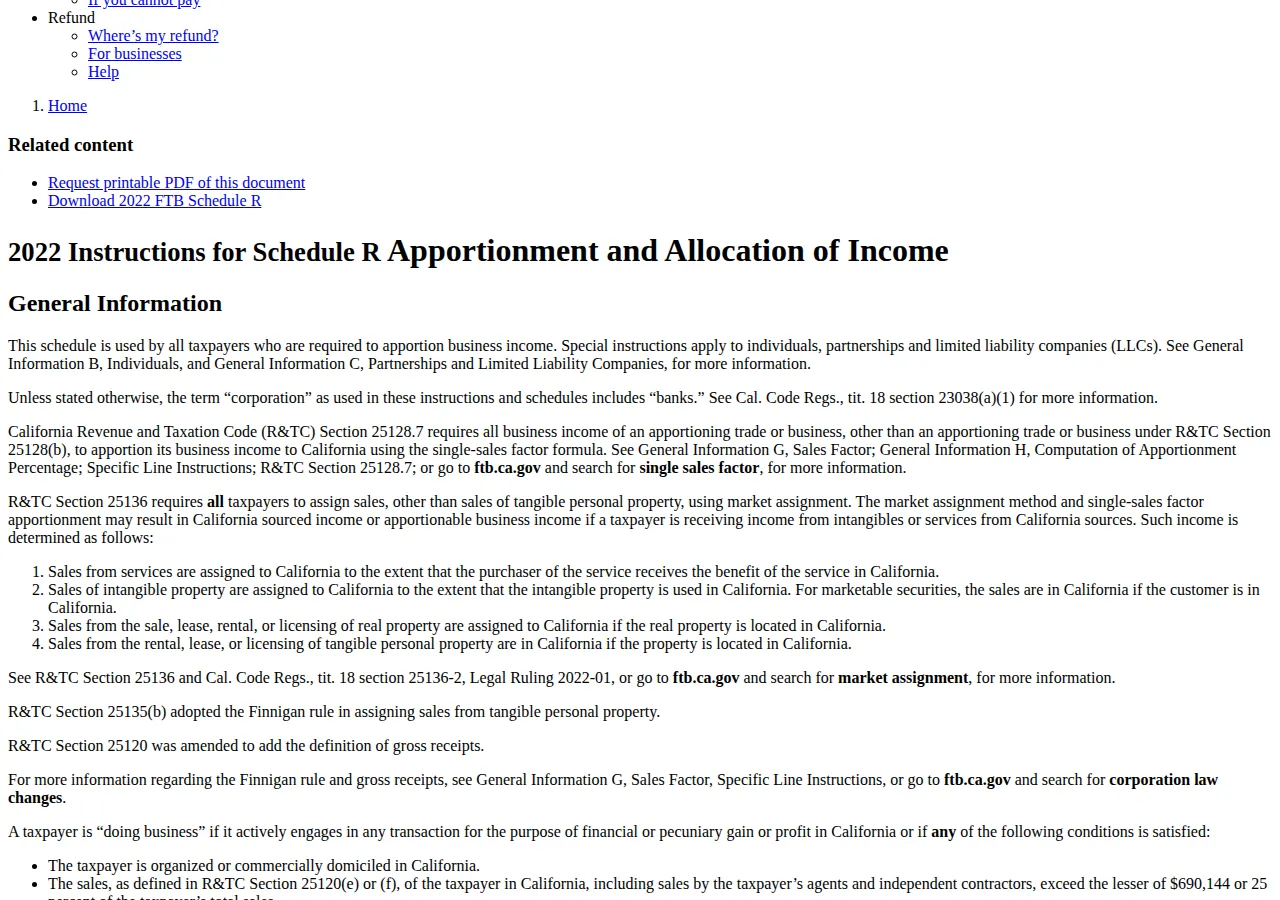
California requires a single-sales-factor formula under Revenue and Taxation Code section 25128.7 for taxable years beginning on or after January 1, 2013, except for trades or businesses deriving more than 50 percent of gross business receipts from qualified agricultural or extractive activities, which still use the three-factor formula. Market assignment applies under section 25136: receipts from services, intangibles, and rentals go to the market. Schedule R is the filing form, and the 2022 instructions state the doing-business sales test as exceeding the lesser of 690,144 dollars or 25 percent of total sales — a threshold the Franchise Tax Board adjusts.
New York apportions business income and business capital under Tax Law section 210-A with a single receipts factor, effective for tax years beginning on or after January 1, 2015, replacing the three-factor formula that weighted property, payroll, and sales equally. The factor is a fraction whose numerator is receipts sourced to New York under section 210-A and whose denominator is the same items from everywhere. Receipts from services, intangibles, and digital products are sourced under a market-based approach.
Texas has no corporate income tax. Its franchise tax is a margin tax, and the Texas Comptroller requires the single-factor gross receipts apportionment formula under Texas Tax Code sections 171.105 and 171.106 and Rule 3.591. The Comptroller's FAQ answers the obvious question directly: no, a taxpayer may not use the Multistate Tax Compact's three-factor formula to apportion margin. Texas is single-factor by statute, and the factor is gross receipts.
| State | Formula | Authority |
|---|---|---|
| California | Single sales factor, mandatory from 2013; market assignment for services | Cal. Rev. & Tax. Code sections 25128.7, 25136; FTB Schedule R |
| New York | Single receipts factor from 2015; market-based sourcing | N.Y. Tax Law section 210-A |
| Texas | Single-factor gross receipts for the margin tax; no three-factor option | Tex. Tax Code sections 171.105, 171.106; Comptroller Rule 3.591 |
| UDITPA model | Three equally weighted factors: property, payroll, sales | UDITPA sections 9-17; MTC Allocation and Apportionment Regulations |
Delaware's franchise tax is a separate calculation — our Delaware franchise tax playbook works both methods.
Sourcing: market-based against cost-of-performance
The sales factor is only as good as the sourcing rule behind it. Under cost-of-performance, a service receipt is sourced where the work was performed; under market-based sourcing, where the customer receives the benefit. California, New York, and most single-sales-factor states now use market-based sourcing, so a remote team in a low-tax state no longer pulls the sales factor home with it. The work state keeps payroll; the customer state takes sales.
Throwback and throwout. When a sale is made into a state where the seller is not taxable, UDITPA section 16 throws the sale back to the state of origin — it counts in the origin state's numerator even though the customer is elsewhere. The rule exists to prevent nowhere income: income taxed in no state at all. Some states use throwout instead, removing the nowhere sale from every denominator.
Worked example: the throwback that changes the percentage
A manufacturer ships 1,000,000 dollars of goods to customers in Nevada, where it has no nexus and pays no income tax. Total sales everywhere are 20,000,000 dollars; sales to the home state are 4,000,000 dollars. Without throwback, the home-state sales factor is 4,000,000 / 20,000,000 = 20 percent. With throwback, the Nevada sale is assigned to the home state: (4,000,000 + 1,000,000) / 20,000,000 = 25 percent. On 10,000,000 dollars of business income, the throwback moves 500,000 dollars into the home state. The delivery address did not change.
The federal shield: Public Law 86-272
There is one hard limit on the whole system. Under 15 U.S.C. section 381, Public Law 86-272, no state may impose a net income tax on income from interstate commerce if the only business activities there are soliciting orders for sales of tangible personal property, with orders sent outside the state for approval and filled by shipment from outside the state. The shield covers solicitation only and tangible personal property only, and it does not apply to a corporation incorporated in the state or an individual domiciled or resident there. Independent contractors selling for more than one principal do not break the shield.
What the shield does not cover is now the larger question. It does not cover services, intangibles, or digital products, nor a sale whose order is approved in-state or filled from in-state stock. The Multistate Tax Commission's updated guidance on internet activities makes the modern point plainly: when a business interacts with customers through its website or app, that interaction counts as business activity in the customer's state, and post-sale support through online chat, accepting online credit-card applications, or letting job seekers apply through the site can destroy the immunity. A company that assumed its website was only a digital storefront should revisit that assumption before the auditor does.
Founder & CEO Insight — Enow A. Jovial
The filing sequence
Run the position in this order every year:
- Classify. Separate business from nonbusiness income item by item, and document the test for each material item.
- Confirm nexus state by state. For each state, establish whether the company is taxable there at all, applying Public Law 86-272 first and the factor-presence thresholds — 50,000 dollars of property, 50,000 dollars of payroll, 500,000 dollars of sales, or 25 percent of any factor.
- Pick the formula per state. Single-sales-factor in California, New York, and Texas; three-factor or the state's weighted variant elsewhere.
- Compute each factor from source records. Property at original cost with rented property at eight times net annual rent; payroll by work state; sales by the state's sourcing rule, with throwback or throwout applied.
- Run the sensitivity. Recompute the percentage under the alternative formula and sourcing position, and carry the difference into the reserve decision.
- File and retain. Attach Schedule R in California and the equivalent schedule in each state, and keep the factor workpapers for the full lookback period.
- [x] Business income classified — every material item run through both tests.
- [x] Nexus confirmed per state — Public Law 86-272 first, then factor-presence thresholds.
- [x] Formula confirmed per state — the current statute read, not last year's formula.
- [x] Factors computed from source records — property at cost, rent at eight times, payroll by work state, sales by sourcing rule.
- [x] Throwback and throwout applied — nowhere sales assigned or excluded under the state's rule.
- [x] Sensitivity run — the alternative formula priced before the return is signed.
Apportionment is not a compliance afterthought. It converts a company's map — where it owns, where it employs, where it sells — into the tax bill each state sends. Read the statute for each state, compute the factors from source records, and keep the workpapers.