SSL/TLS Certificates: DV vs OV vs EV and the Let's Encrypt Playbook
A browser that cannot verify who runs a website shows a warning instead of a page. For a business that sells online, that warning lands directly on revenue: the visitor leaves and the sale never happens. An SSL/TLS certificate stops that from happening. It binds a public key to a domain name, it is signed by a certificate authority the browser already trusts, and it lets the browser confirm the site's identity and that the connection cannot be read or altered in transit.
The certificate does not encrypt the business. It encrypts the conversation between the visitor's browser and the server. A phishing site can hold a valid certificate: the padlock never meant the site was safe, only that the connection was private and the domain name matched the address bar.
What a certificate actually contains
Every public TLS certificate is an X.509 version 3 certificate, the format profiled for Internet use by RFC 5280, published by the IETF in May 2008. The fields that matter are the subject (the domain or organisation), the issuer (the signing certificate authority), the validity period (notBefore to notAfter), the subject public key, and the Subject Alternative Name extension, defined in section 4.2.1.6 of RFC 5280, which lists every domain name the certificate covers.
DV vs OV vs EV: the decision table
The three validation levels differ in exactly one dimension: how hard the certificate authority checks who you are before it signs. The cryptography is identical. What changes is the evidence behind the name.
| Validation level | What the CA checks | Who can see the identity | Typical issuance time | Authority |
|---|---|---|---|---|
| DV (Domain Validation) | Control of the domain name only, by HTTP, DNS, or email challenge | Nobody | Minutes | Baseline Requirements §3.2.2.4; RFC 8555 §1 |
| OV (Organisation Validation) | Domain control plus the organisation's legal existence, name, and address against public records | Certificate inspectors | 1 to 3 business days | Baseline Requirements §3.2.2.1 |
| EV (Extended Validation) | Domain control plus full EV vetting: legal, physical, and operational existence, and a verified authorising contact | Certificate inspectors | 1 to 5 business days, longer if documents are missing | EV Guidelines §11 |
Domain validation is the fastest path because the check is mechanical: place a token at a specific URL, publish a DNS record, or answer an email to an administrative address. ACME, the protocol standardised as RFC 8555 in March 2019, runs those checks without a human in the loop. RFC 8555 states the position plainly: in domain validation, the certificate authority must verify only that the requester has effective control of the domain, not the requester's real-world identity. Organisation validation adds a human check against a government registry, and takes a day or three. Extended validation goes further, verifying physical and operational existence and requiring a callback to a verified telephone number under the EV Guidelines.
The price gap is large. DigiCert's comparison page, opened 19 November 2026, lists a Basic DV certificate at $218, a Secure Site OV certificate at $399, and a Secure Site EV certificate at $995, with the Pro EV tier at $1,495. Sectigo's reseller list, read the same day, starts at $59.20 a year for DV, $79.20 for OV, and $199.20 for a DV wildcard. Treat any single price as a snapshot. EV costs roughly two and a half times OV at DigiCert — the question is whether the extra $596 a year buys anything your visitors can use.
Founder & CEO Insight — Enow A. Jovial
The shrinking lifetime clock
The most consequential change in certificate operations in years is a calendar. The rules come from the CA/Browser Forum Baseline Requirements, current version 2.3.1, published 4 October 2026. Ballot SC-081v3, adopted in April 2025, cuts the maximum lifetime of a publicly trusted TLS certificate in three steps: up to 398 days before 15 March 2026, at most 200 days from that date, 100 days from 15 March 2027, and 47 days from 15 March 2029. Validation reuse falls on the same schedule; organisation identity reuse drops from 825 days to 398 days.
The arithmetic is the whole operational story — editorial derivation from the Baseline Requirements schedule:
Under the old 398-day rule, one renewal a year sufficed. A 200-day certificate needs two, a 100-day certificate needs four, and a 47-day certificate needs eight. Each renewal is a chance for something to go wrong: a deleted DNS record, a validation email sent to a departed employee, a deployment script nobody has touched in a year. Manual renewal at eight times a year is a recurring incident waiting for a holiday weekend. Automation is now mandatory, at every validation level.
Let's Encrypt has been moving the same way for longer: 90 days today, a default of 64 days from 10 February 2027 and 45 days from 16 February 2028, with six-day short-lived certificates available since January 2026. A 90-day certificate renewed at two-thirds of its lifetime is renewed every 60 days, or about six times a year:
ACME renewal automation
ACME, the Automatic Certificate Management Environment defined in RFC 8555, is the protocol that makes short lifetimes survivable. An ACME client on the server requests a certificate, proves control by answering a challenge, and installs the issued certificate, all without a human. The two challenges in common use are HTTP-01, a token file the certificate authority fetches over HTTP, and DNS-01, a TXT record in DNS. Only DNS-01 can issue a wildcard certificate.
RFC 8555 notes that before ACME, obtaining and installing a certificate typically took a webmaster one to three hours of manual work. That is the cost automation removes. The protocol also covers revocation and account key rollover, and its renewal-information extension, standardised as RFC 9773 in June 2025, lets the certificate authority tell the client the best time to renew.
Four steps: pick a client your server supports — Certbot, Caddy, cert-manager, Traefik, or your host's automated certificates; use DNS-01 for wildcards, with API credentials scoped to TXT records only; test the renewal in staging before you need it; and monitor independently of the client, alerting when fewer than 21 days remain. A client that fails silently is worse than no client.
Wildcard vs multi-domain: the cost math
A single-domain certificate covers one hostname, plus www where the vendor includes it. A wildcard covers one domain and every first-level subdomain beneath it, but not the bare domain itself unless that name is also listed. A multi-domain certificate, also called SAN or UCC, lists each name explicitly in the Subject Alternative Name field and can mix different domains.
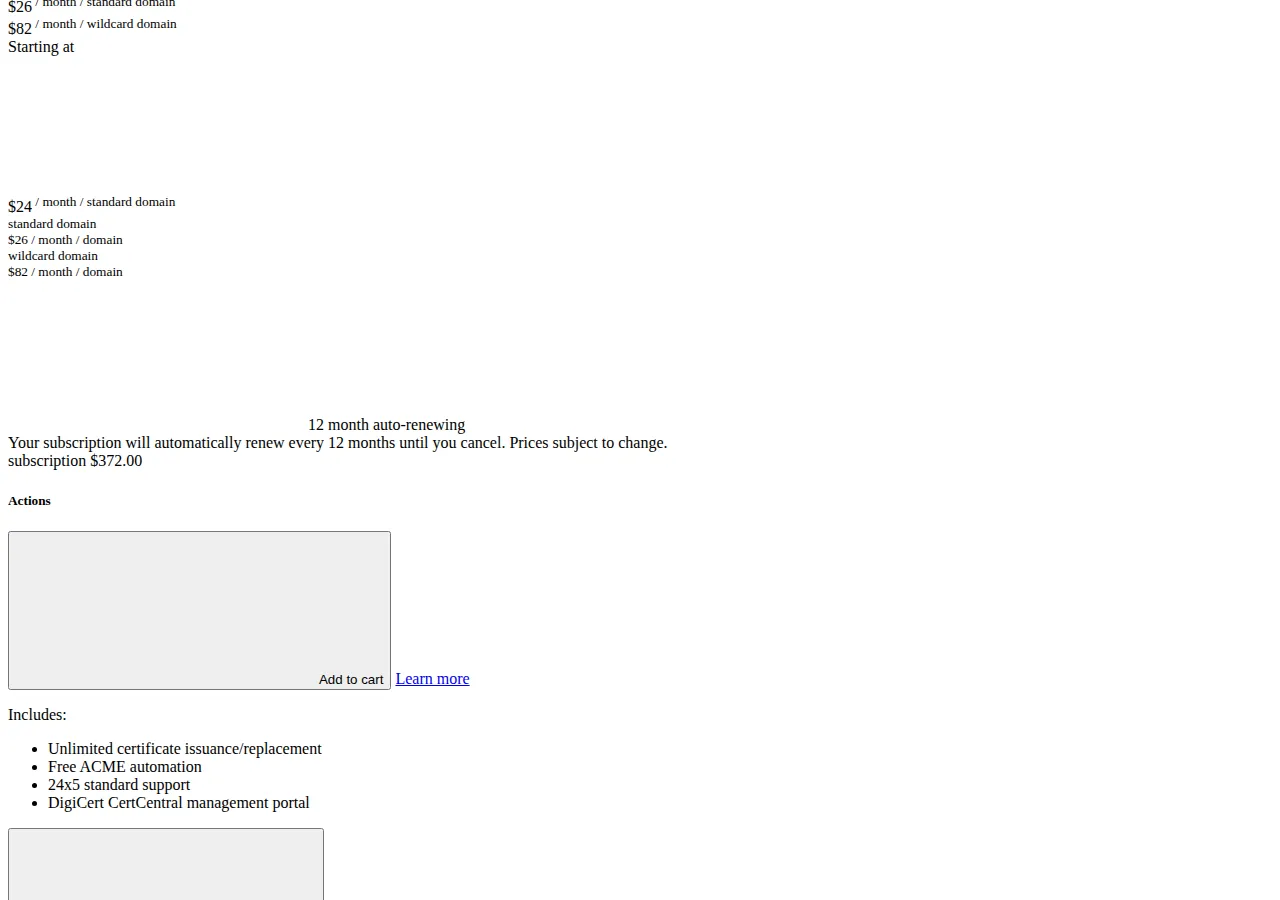
The choice is arithmetic, and it depends on how many names you serve. Using DigiCert's published multi-domain pricing, opened 19 November 2026, an OV multi-domain certificate costs $26 a month per standard domain, or $372 a year for one domain on the annual subscription, and a wildcard OV domain costs $82 a month, or $984 a year. Editorial derivation for twelve subdomains:
The same comparison at Sectigo's reseller list is smaller but the same shape: twelve DV certificates at $59.20 each cost $710.40 a year, against a DV wildcard at $199.20, a saving of $511.20 a year. The wildcard wins as soon as the subdomain count passes two or three.
A business with two domains that buys a wildcard for each pays twice for coverage one multi-domain certificate could hold. DigiCert's EV multi-domain tier starts at $44 a month per standard domain, or $624 a year, so two EV domains in one certificate cost $1,248 a year against $1,990 for two separate Secure Site EV certificates at $995 each. Editorial derivation:
Failure modes that cost real money
An expired certificate is the failure everyone pictures, and the easiest to prevent. The browser shows a full-page warning, visitors cannot proceed without clicking past a security interstitial, and most will not. Every hour the certificate is expired is an hour of lost checkout. Run the store's own daily revenue through the profit calculator to put a number on one day of downtime before deciding that manual renewal is acceptable. Prevention is automation plus independent monitoring.
Mixed content is quieter. The page loads over HTTPS, but an image, script, or stylesheet is fetched over plain HTTP. Modern browsers block the active mixed content, so the page looks broken or the checkout script never loads. The cause is usually a hard-coded http:// URL in a template, a third-party widget, or content migrated from an old site. The fix is to serve every asset over HTTPS and set a Content-Security-Policy upgrade-insecure-requests header. The PCI DSS scope and assessment guide covers the compliance side.
An incomplete chain produces an error that looks like an untrusted certificate. The certificate is valid and the chain exists; the server did not send the intermediate. Test with an external checker after every installation. A related failure is a name mismatch: the certificate covers example.com but the site also answers on example.net.
Who should NOT buy EV
Extended validation has a real audience, and it is narrower than the sales pages suggest. A bank, a payment processor, or a government service whose users are trained to inspect certificates, and whose brand is actively impersonated by phishing sites, can justify the vetting and the price. Everyone else should run the test honestly: if your customers arrive from search, pay through a payment provider whose name they recognise, and nobody on your team has ever opened a certificate's details in a browser, EV buys you nothing your visitors will ever see. Modern browsers no longer show the organisation name in the address bar for EV certificates.
The operator boundaries decide it. EV cannot be fully automated, its vetting must be repeated on the reuse schedule the Baseline Requirements set, and its issuance takes days rather than minutes, so a new domain cannot be brought under EV protection in an emergency. A business that launches subdomains weekly, or that has nobody available to answer a validation callback, will find EV actively obstructive. For those businesses, OV gives the organisation name without the EV vetting burden, and DV through ACME gives the encryption with no human process. The registrar pricing comparison is the companion decision: a registrar that supports API-driven DNS changes makes DNS-01 validation work.
Execution checklist
Work through this list in order the first time, then keep it as the runbook for every renewal cycle.
- Inventory every public hostname — www variants, API and app subdomains, staging hosts — and note which certificate covers each.
- [x] Choose the validation level per hostname by the decision table: DV for content, OV where the organisation name must be verifiable, EV only where phishing is a live threat.
- [x] Choose the structure by counting names: single-domain below three names, wildcard above three subdomains on one domain, multi-domain SAN where unrelated domains share one.
- [x] Confirm the domain's DNS is API-accessible for DNS-01 challenges if any wildcard is planned, with the API credential scoped to TXT records only.
- [x] Install an ACME client, or confirm the hosting platform or CDN renews certificates automatically.
- [x] Dry-run the renewal, force a real renewal in staging, and confirm the web server reloads the new certificate and serves the full chain.
- [x] Set independent monitoring that fetches the live certificate daily, checks expiry, chain, and Subject Alternative Name list, and alerts two people under 21 days.
- [x] Fix mixed content: move every asset URL to HTTPS and set the upgrade-insecure-requests header.
- [x] Record renewal dates, certificate authority, validation level, and cost per certificate in one register, and review it quarterly against the hostname inventory.
- [x] Put the certificate expiry check into the same incident runbook as the domain expiry check.
The certificate operation is not a purchase. It is a small system: the inventory of names, the validation level matched to each name, the automation that renews on schedule, and the monitoring that catches the automation when it fails. The businesses that handle this well count their names, automate the renewal, and check the live certificate every day. Read the CDN pricing and latency comparison alongside this guide: most content delivery networks issue and renew certificates for the domains they front, so when the CDN holds the certificate, make sure the origin certificate behind it also renews.