A founder with a $180,000 salary and a pottery studio on the side can lose $42,000 over five years and still owe tax on $98,000 of income from the studio. That is not a mistake in the arithmetic. It is IRC § 183 working exactly as written: when an activity is not engaged in for profit, the losses do not offset other income, and since the One Big Beautiful Bill Act made the miscellaneous itemized deduction suspension permanent, the operating deductions do not even survive as itemized deductions. The activity pays tax on its gross income while its costs buy nothing.
This guide is for the operator who runs a side activity that loses money: the founder selling ceramics, the engineer flipping vintage watches, the creator monetising a channel that has never cleared a profit. It is not for C corporations — § 183 does not apply to a corporation other than an S corporation.
The statute in four subsections
Section 183 is short. Four subsections carry the whole operation.
§ 183(a) — the general rule. "In the case of an activity engaged in by an individual or an S corporation, if such activity is not engaged in for profit, no deduction attributable to such activity shall be allowed under this chapter except as provided in this section." The scope matters: individuals and S corporations; the IRS states the limit also reaches partnerships, estates, and trusts, and does not apply to other corporations.
§ 183(b) — the deductions that survive. Two tiers, in order. Tier one, § 183(b)(1): deductions allowable without regard to whether the activity is for profit — mortgage interest and taxes attributable to the activity. Tier two, § 183(b)(2): deductions allowable only if the activity were for profit — advertising, insurance, wages, supplies — but only to the extent gross income exceeds the tier-one deductions. The ordering is the whole game: tier two is capped by gross income, so a loss can never be created inside § 183(b).
§ 183(c) — the definition. An activity not engaged in for profit is any activity other than one for which deductions are allowable under § 162 (trade or business expenses) or § 212(1) or (2) (expenses for the production of income). The test is therefore the § 162 test: is this a trade or business carried on with a profit objective?
§ 183(d) — the presumption. If gross income exceeds deductions for three or more of the five consecutive taxable years ending with the current year, the activity is presumed to be engaged in for profit, unless the Secretary establishes the contrary. For horse breeding, training, showing, or racing, the test is two of seven years. Failing the count does not prove the activity is a hobby, but it hands the question to the nine-factor test with no presumption helping the taxpayer.
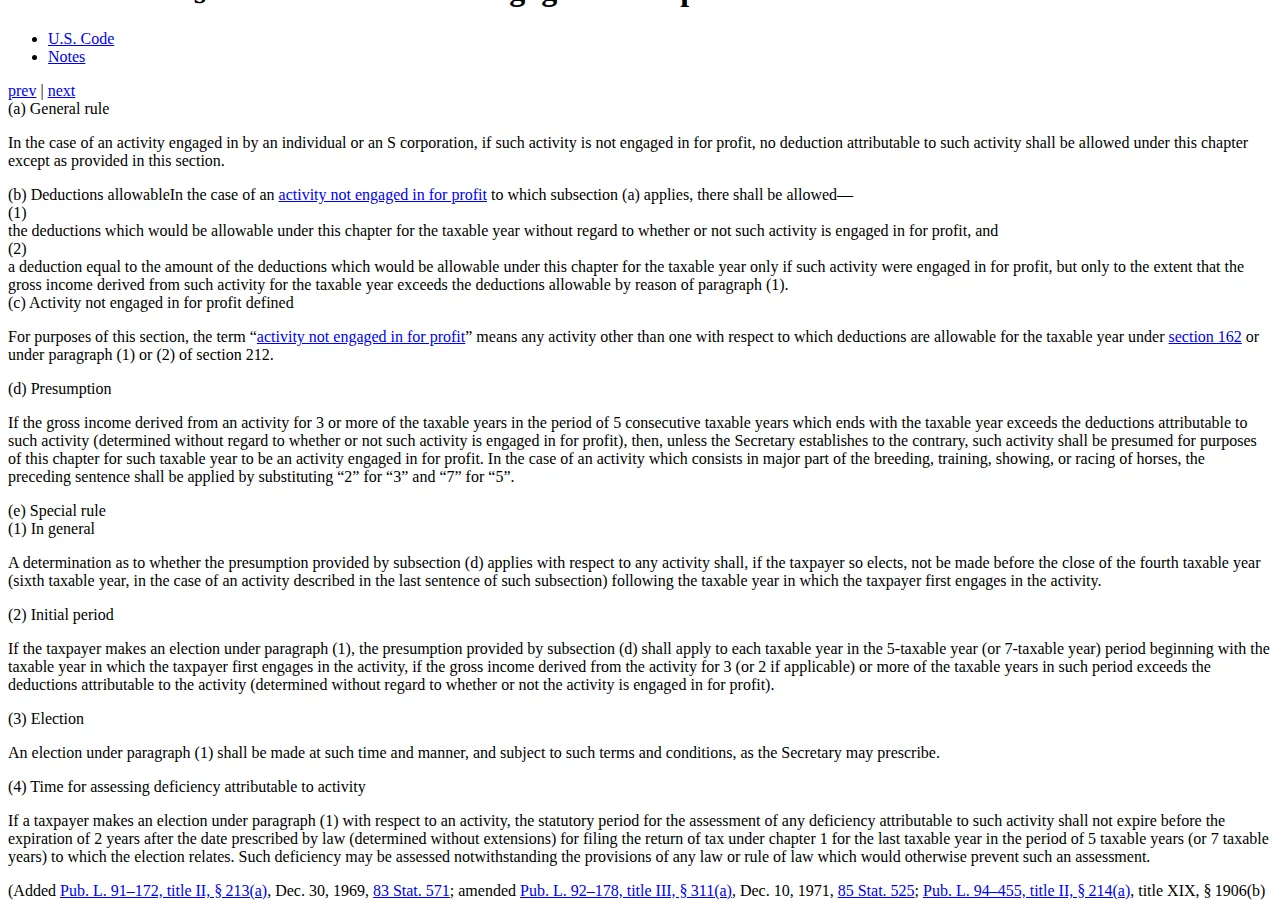
§ 183(e) — the postponement election. A taxpayer may elect, on Form 5213, to postpone the determination of whether the presumption applies until the close of the fourth taxable year following the year the activity began (sixth year for horses). The election buys time for a start-up to reach profitability — but it also extends the assessment period: under § 183(e)(4), a deficiency may be assessed until two years after the due date for the last year in the period. File early; the form's instructions tie its deadline to the first year's return.
The worked example: Maya's pottery studio
Take a founder we will call Maya. She earns a $180,000 salary and runs a pottery studio as a sole proprietorship:
| Year | Gross income | Deductions | Profit or loss |
|---|---|---|---|
| Year 1 | $18,000 | $28,000 | −$10,000 |
| Year 2 | $30,000 | $28,000 | +$2,000 |
| Year 3 | $12,000 | $28,000 | −$16,000 |
| Year 4 | $29,000 | $28,000 | +$1,000 |
| Year 5 | $9,000 | $28,000 | −$19,000 |
| Total | $98,000 | $140,000 | −$42,000 |
Gross income exceeds deductions in two of the five years — years 2 and 4. The § 183(d) presumption needs three. Maya gets no presumption, and the IRS may reclassify the studio as a hobby.
Each year's $28,000 of deductions splits into $4,000 of tier-one deductions (property tax and mortgage interest attributable to the studio) and $24,000 of tier-two operating deductions (clay, kiln power, market fees, packaging). Over five years that is $20,000 of tier-one and $120,000 of tier-two deductions against $98,000 of gross income.
As a business, the $42,000 loss offsets Maya's salary and saves $10,080 of tax over five years. As a hobby in 2026, the arithmetic inverts. The § 183(b) ordering allows tier one in full ($20,000) and tier two only up to gross income minus tier one ($98,000 − $20,000 = $78,000 of the $120,000). But tier two is a miscellaneous itemized deduction, and § 67(h) now disallows it permanently — so the $78,000 that § 183(b) nominally allows is worth $0 on the return.
Maya's studio lost $42,000 economically and still generates $18,720 of tax over five years, because the $20,000 of tier-one deductions were deductible anyway as personal mortgage interest and taxes. The swing between the two treatments is $28,800: $10,080 of lost benefit plus $18,720 of tax on income the activity did not keep. The lesson is not that the studio must close. It is that the loss is not a tax asset: a founder who budgets the studio as a $42,000 shelter for salary income is budgeting a benefit that does not exist, and the correction arrives as a deficiency notice with interest.
Founder & CEO Insight — Enow A. Jovial
The nine-factor test
When the presumption fails, the determination turns on Treas. Reg. § 1.183-2(b): all facts and circumstances, with greater weight to objective facts than to the taxpayer's stated intent. No single factor is determinative, and the test is not a vote — the regulation says expressly that the determination is not made by counting factors for and against.
| # | Factor (Reg. § 1.183-2(b)) | What helps the operator |
|---|---|---|
| 1 | Manner of carrying on the activity | Businesslike operation, complete books, changing unprofitable methods |
| 2 | Expertise of the taxpayer or advisors | Study of accepted practices, expert advice actually followed |
| 3 | Time and effort expended | Substantial personal time, or leaving another occupation |
| 4 | Expectation that assets may appreciate | Land or collectibles whose appreciation plus income beats expenses |
| 5 | Success in other similar activities | A record of turning unprofitable activities profitable |
| 6 | History of income or losses | Start-up losses expected; unexplained later losses are not |
| 7 | Amount of occasional profits | Substantial occasional profits relative to investment |
| 8 | Financial status of the taxpayer | No outside income suggests the activity must pay; large outside income suggests the opposite |
| 9 | Elements of personal pleasure | Recreational motives cut against profit objective; pleasure alone does not decide it |
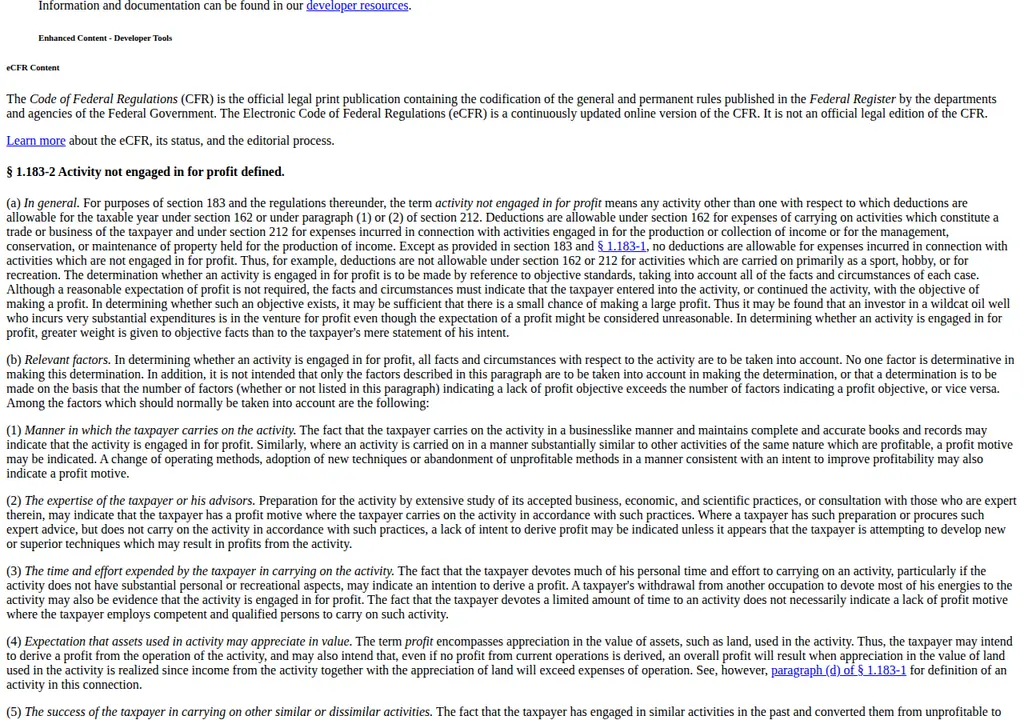
Three factors decide most real cases, and they are the cheapest to control. Factor 1 is won in the bookkeeping: a separate bank account, a written plan with a path to profit, and records that would satisfy a lender. Factor 3 is won with a contemporaneous time log — hours per week, by task. Factor 6 is won by explaining the losses in the language of the business: a dated start-up plan, a documented change of methods after a loss year, or a fortuitous event such as fire, theft, or a supplier failure.
Factor 8 is the one founders underestimate. A $180,000 salary plus a loss-making studio that shelters salary income is the fact pattern the regulation describes as indicating no profit objective, "especially if there are personal or recreational elements involved." The higher the outside income, the stronger the other factors must be. Factor 9 cuts the other way: personal pleasure does not by itself make an activity a hobby. Pleasure plus a profit objective is a business; pleasure as the objective is a hobby.
Hobby, business, or S corporation: the decision table
| Attribute | Hobby (§ 183) | Sole proprietorship (Schedule C) | S corporation |
|---|---|---|---|
| Loss offsets other income | No — capped at gross income | Yes, subject to basis and at-risk limits | Yes, subject to basis, at-risk, passive rules |
| Operating deductions, 2026 | $0 after § 67(h) | Fully deductible under § 162 | Fully deductible under § 162 |
| Self-employment tax | No — no net earnings | Yes, 15.3% on net earnings | No on distributions; salary subject to payroll tax |
| Presumption | 3 of 5 years (2 of 7, horses) | Same § 183(d) test | Same § 183(d) test |
| § 199A QBI deduction | No — no qualified business income | Yes, if the activity qualifies | Yes, if the activity qualifies |
| Authority | 26 U.S.C. § 183; § 67(h) | 26 U.S.C. §§ 162, 1402 | 26 U.S.C. §§ 1366, 1367, 183(a) |
Electing S status does not cure a hobby: § 183(a) applies to S corporations expressly. An S election changes how income is taxed, not whether the activity is engaged in for profit. The same is true of the LLC: a single-member LLC is disregarded for § 183 purposes, and a multi-member LLC taxed as a partnership faces the same test.
The conversion playbook
An activity that is a hobby today can become a business, but the conversion is a course of conduct, not a filing.
- [x] Separate the money: a dedicated bank account and card; no personal expenses through the account, ever.
- [x] Write the plan: one page with a dated path to profit — pricing, volume, and the month the activity turns cash-positive.
- [x] Keep books a lender would accept: complete records, monthly profit-and-loss, and a balance sheet for the activity.
- [x] Log the hours: a contemporaneous time log, hours per week by task; the log is factor 3's evidence.
- [x] Change something after a loss year: raise prices, drop an unprofitable line, change suppliers — and write down why.
- [x] Get expert advice and follow it: a consultation with an advisor in the field, documented, with the activity run in accordance with it.
- [x] File Form 5213 if the start-up needs time: postpone the presumption determination to the close of the fourth year — confirm the filing deadline on the form's instructions first, and remember the assessment period extends with it.
- [x] Re-test every December: count the profit years in the rolling five-year window; if the count is two, the next year's return is the one the IRS will read first.
Phase 1: separate the money — open the business bank account with the activity's EIN and have a CPA review the first year's books. Phase 2: change one method after the first loss year and write down why. Phase 3: re-test the five-year profit count every December.
Who this does not touch, and what to file
The IRS's own guidance states the not-for-profit limit applies to individuals, partnerships, estates, trusts, and S corporations, and does not apply to corporations other than S corporations. A C corporation's loss-making division is governed by other rules — § 162, § 382 after an ownership change, and the general substantiation requirements — not by § 183.
For the operator inside § 183, the filing mechanics are narrow. Report the activity's gross income whether it is a business or a hobby — the income is taxable either way. If it is a business, report it on Schedule C and deduct under § 162. If it is a hobby, the tier-one deductions ride on Schedule A as personal itemized deductions, and the tier-two deductions are not claimed at all in 2026. Do not carry a hobby loss forward, do not net it against another activity's income, and do not use it to reduce self-employment tax. The profit calculator will show the same numbers this guide shows: run the five-year table through it before you decide how to file.
The related guides complete the picture: the § 162 business expense guide sets out what "ordinary and necessary" requires, the Schedule C guide covers filing once the activity qualifies, and the § 199A QBI guide explains the 20% deduction hobby income never qualifies for.