Section 1033 Involuntary Conversion: The Deferral Playbook for Fire, Theft and Condemnation
Founder & CEO Insight — Enow A. Jovial
A warehouse burns on a Monday in June. The insurer pays $1,150,000 by ACH on a building with a $420,000 adjusted basis. The owner has lost a building and gained a $730,000 tax problem in the same month — unless Section 1033 of the Internal Revenue Code defers it. This playbook is the deferral operation.
Section 1033 is for owners whose property was taken from them — by fire, condemnation, theft or disaster — not for owners who decided to sell.
The decision in one table
| Your position | The move | Tax result | Authority |
|---|---|---|---|
| Converted directly into similar property | Do nothing; no election needed | No gain recognized | IRC § 1033(a)(1) |
| Converted into money, replacement costs at least as much | Elect under § 1033(a)(2), buy in time | No gain recognized | IRC § 1033(a)(2)(A) |
| Converted into money, replacement costs less | Elect and buy in time | Gain recognized only on the shortfall | IRC § 1033(a)(2)(A) |
| Business real property condemned | Elect, buy within 3 years | Gain postponed; like-kind test | IRC § 1033(g) |
What triggers Section 1033
The statute lists the triggers in one sentence: property converted "as a result of its destruction in whole or in part, theft, seizure, or requisition or condemnation or threat or imminence thereof" is compulsorily or involuntarily converted.
Destruction means fire, flood, storm or explosion — sudden, unexpected and unusual, not gradual wear or market decline. Theft means taking with criminal intent, including embezzlement — not an unprovable loss or a bad debt. Seizure and requisition mean the government takes possession for public use. Condemnation is a legal taking for public use with an award — "like a forced sale," in the IRS's words. A sale under threat counts as a condemnation, and the replacement period starts on the earlier of the disposition date or the threat date. Two exclusions matter: stock in trade is outside the real-property rule, and destroyed inventory is not a Section 1033 property — its cost leaves through COGS and the insurance recovery is ordinary income. (IRC § 1033(a); IRS Pub. 544; IRS Pub. 547)
Two doors: direct conversion and the money election
Section 1033(a)(1) is the simple door. If the converted property is replaced directly with property similar or related in service or use — the insurer rebuilds the warehouse, the condemning authority hands over a substitute parcel — no gain is recognized and no election is filed.
Section 1033(a)(2) is the door almost every real case walks through. The property is converted into money — an insurance check, a condemnation award — or into property that is not similar or related in service or use. The gain is recognized except to the extent the taxpayer elects to postpone it by buying replacement property within the period. The gain recognized is only the excess of the amount realized over the replacement cost.
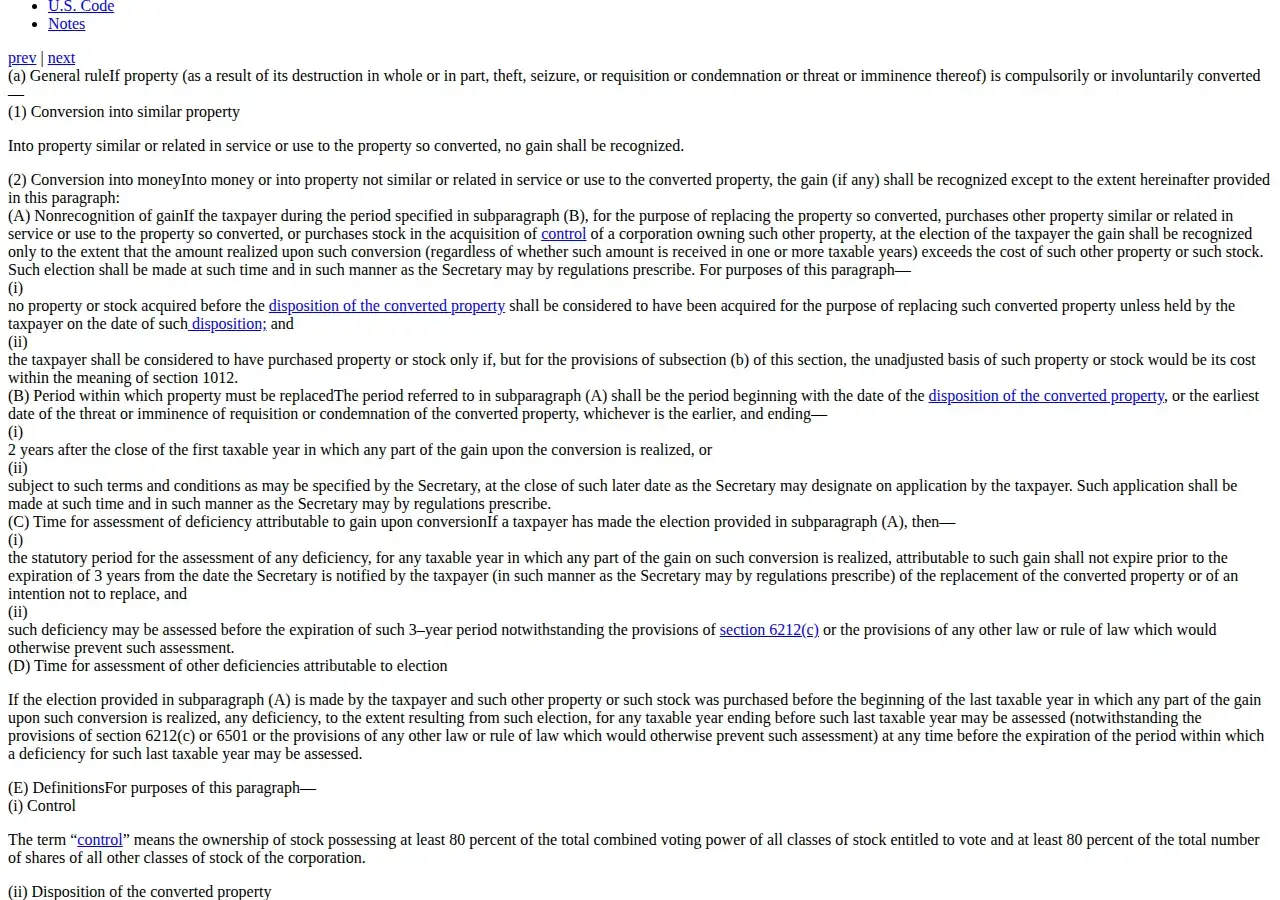
The election also covers buying control of a corporation that owns such property — control means at least 80 percent of the voting power and of the shares of all other classes.
Case Study: the warehouse fire
Example: a single-member LLC owns a distribution warehouse. Fire destroys it on Monday, June 15, 2026. The insurer pays $1,150,000. The adjusted basis is $420,000 — tax basis is the figure that matters, not the carrying value on the GAAP books. The gain realized is the difference:
The LLC elects under Section 1033(a)(2) and buys a replacement warehouse for $980,000. The recognized gain is the shortfall:
At the 21 percent corporate rate in Section 11(b), a C-Corp owner pays tax of $35,700 on the recognized $170,000; tax on the full $730,000 would have been $153,300. The deferral is worth $117,600 in cash this year. An insurance award is not wages, so no FICA or SECA tax applies to the proceeds.
Section 1033(b)(2) — cost decreased by the gain not recognized:
The replacement warehouse enters the books at $420,000 — the same basis as the warehouse that burned, so the basis follows the old property, not the price paid. Depreciation runs from a $420,000 basis, not $980,000. For an S-Corp or an LLC taxed as a partnership, the deferred gain flows through to the owners.
The replacement period: two years, three years, four years
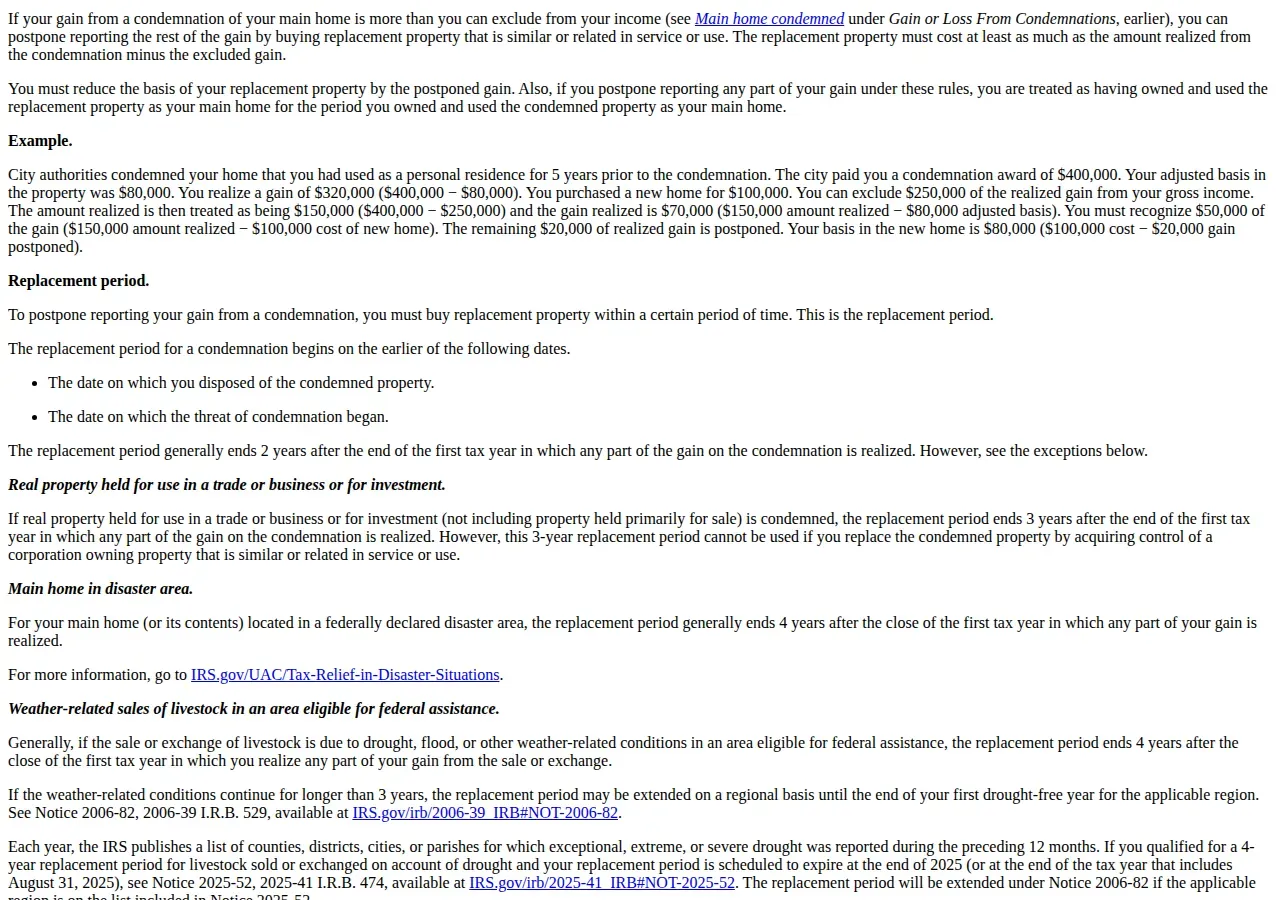
The period begins on the earlier of the disposition date or the earliest date of the threat of requisition or condemnation, and ends two years after the close of the first taxable year in which any part of the gain is realized. For a 2026 gain, the general period ends December 31, 2028 — a Sunday, so close before the Friday.
| Property | Replacement period | Deadline for a 2026 gain | Authority |
|---|---|---|---|
| General rule | 2 years after the close of the first year gain is realized | December 31, 2028 | IRC § 1033(a)(2)(B)(i) |
| Business / investment real property | 3 years | December 31, 2029 | IRC § 1033(g)(4) |
The warehouse is real property held for productive use in a trade or business, so Section 1033(g) gives it the three-year period ending Monday, December 31, 2029. A principal residence in a federally declared disaster area gets four years under Section 1033(h) — for a 2026 gain, the period ends Tuesday, December 31, 2030. A cash-basis taxpayer realizes gain when payments received exceed basis.
An extension is available on a showing of reasonable cause, usually limited to one year. Request it by fax to 877-477-9193 or by mail to the IRS in Detroit, listing name, address, and SSN or taxpayer identification number — the EIN for an entity, or an ITIN where the taxpayer files under one.
What counts as replacement property
Replacement property must be similar or related in service or use to the property converted, and the test turns on whether the taxpayer uses the property or holds it for investment. For an owner-user, the replacement must function the same way: a condemned home replaced with a grocery store fails. For an owner-investor, the test is the relationship of the property to the owner — similar service, similar risks, similar demands in management and relations to tenants.
For real property held for productive use in a trade or business or for investment, Section 1033(g) relaxes the test: like-kind property held for productive use or investment counts as similar or related in service or use.
Three limits sit on top of the test. The replacement must be bought for the specific purpose of replacing the converted property; property acquired by gift or inheritance does not qualify, and the taxpayer does not have to use the actual award funds. And advance payment to a contractor does not count unless the replacement property is finished before the period ends.
Section 1033 vs Section 1031
Our Section 1031 like-kind exchange playbook works the voluntary route in full.
| Feature | Section 1033 | Section 1031 | Authority |
|---|---|---|---|
| Trigger | Involuntary: fire, theft, condemnation | Voluntary exchange | IRC § 1033; IRC § 1031 |
| Property | Any property; like-kind only under § 1033(g) for business real property | Real property only | IRC § 1033(g); IRC § 1031(a) |
| Intermediary | None — taxpayer holds the cash | Qualified intermediary required | IRC § 1033(a)(2); Treas. Reg. § 1.1031(k)-1(g)(4) |
| Identification deadline | None | 45 days | IRC § 1031(a)(3) |
| Replacement deadline | 2 years; 3 for business real property; 4 for disaster homes | 180 days | IRC § 1033(a)(2)(B); IRC § 1031(a)(3) |
Section 1033 is the only route that lets the taxpayer hold the cash. Section 1031 forbids it: touch the proceeds and the exchange fails. Section 1033 is the route built for the event — no intermediary fee, no 45-day scramble, and a window measured in years, not days.
The principal residence: Section 121 first, Section 1033 second
When a condemned home is the taxpayer's principal residence, Section 121 applies before Section 1033. The owner can exclude up to $250,000 of gain — $500,000 on a joint return — if the ownership and use tests are met, and only the gain above the exclusion is left for Section 1033 to postpone. Our Section 121 primary-residence exclusion playbook works the tests.
Example: city authorities condemn a home used as a personal residence for five years. The award is $400,000; the adjusted basis is $80,000; the realized gain is $320,000. The owner excludes $250,000 under Section 121, so the amount realized is treated as $150,000 and the gain realized is $70,000. The owner buys a new home for $100,000 and must recognize $50,000. The remaining $20,000 is postponed, and the basis in the new home is $80,000.
Section 1033(h) adds disaster rules for a principal residence in a federally declared disaster area: insurance proceeds for unscheduled personal property produce no recognized gain at all.
Making the election and reporting the gain
The election is made by a statement attached to the return for the tax year in which the gain is realized, with all necessary details. If a partnership or corporation owns the converted property, only the partnership or corporation can elect. If replacement property is bought after the return is filed, a further statement is attached to the return for that year.
Reporting follows the property: casualty and theft gains go on Form 4684, business property on Form 4797, and gains from involuntary conversions of capital assets not used in a trade or business on Form 8949 and Schedule D. A CPA should review the return in the conversion year even for a straightforward case, because the election statement, the replacement-period computation and the basis carryover all have to agree.
Under Section 1033(a)(2)(C), the period for assessing a deficiency on the conversion gain does not expire until three years after the Secretary is notified of the replacement or of an intention not to replace.
Who should not use Section 1033
Section 1033 is not a shelter for a sale you wanted anyway. If the property was sold voluntarily, there is no conversion and no election. If the replacement property is a different business — a warehouse replaced with a retail store the owner will operate differently — the similar-or-related test fails for an owner-user. If the only available replacement is owned by a related person and the gain exceeds $100,000, the deferral is barred outright.
Run the deferral in seven steps
- Prove the trigger: fire report, police report, or condemnation notice with the threat date.
- Fix the numbers: amount realized, adjusted basis from the tax records (not the GAAP books), and the gain realized.
- Choose the door: direct conversion under Section 1033(a)(1) needs no election; conversion into money needs the Section 1033(a)(2) election.
- Calendar the deadline: two years generally, three for business real property, four for a disaster-area home.
- Buy qualifying replacement property: similar or related in service or use, from an unrelated person where Section 1033(i) applies.
- Compute the basis: cost minus gain not recognized under Section 1033(b)(2).
- File the election statement and notify the IRS when the replacement is made or the decision not to replace is final.
Execution checklist
- [x] Prove the trigger: fire report, police report, or condemnation notice with the threat date.
- [x] Fix the gain: amount realized minus adjusted tax basis; keep the inventory claim separate.
- [x] Elect on the right return: statement attached to the return for the gain year.
- [x] Calendar the deadline: Dec. 31, 2028 generally; Dec. 31, 2029 for business real property; Dec. 31, 2030 for a disaster home.
- [x] Buy similar or related property: owner-user function test, or like-kind under Section 1033(g).
- [x] Check the seller: no related-person purchase where Section 1033(i) bars it.
- [x] Carry the basis: cost minus gain not recognized; depreciate from the carried-over basis.
- [x] Notify the IRS: replacement made or intention not to replace — the three-year assessment period runs from that notice.
Section 1033 lets the owner rebuild first and pay later — but only inside its own period, only with property that serves the same use, and only with the election filed on time. Run the numbers through our tax estimator before committing.