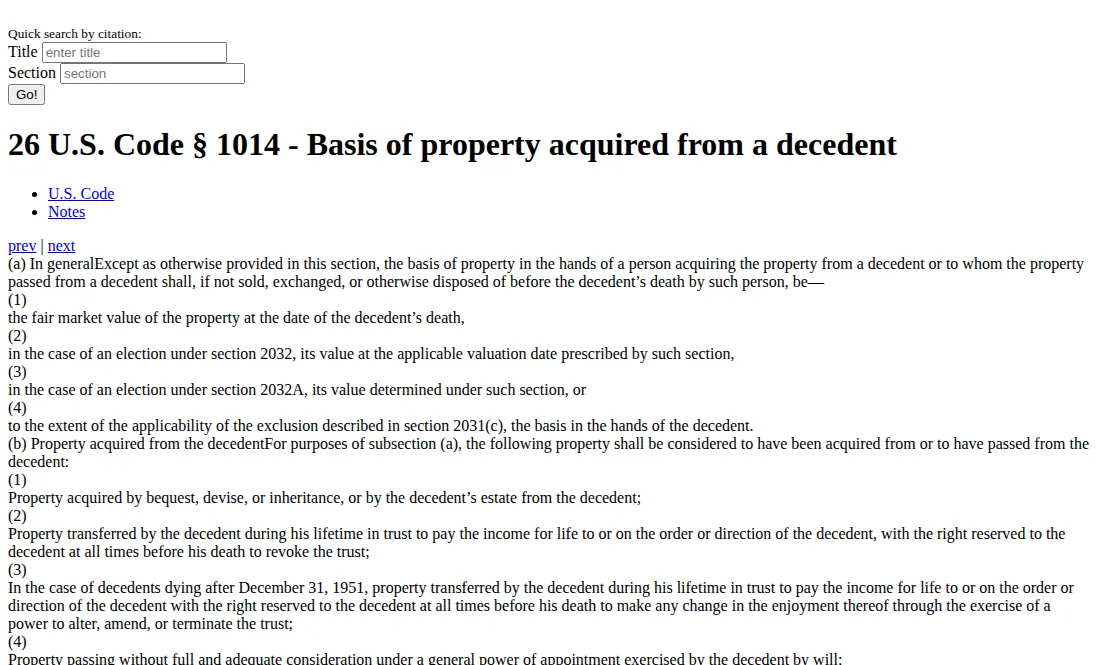
Section 1014 resets the basis of property acquired from a decedent to its fair market value at death. A share bought for $40,000, worth $250,000 at death, arrives in the heir's hands with a $250,000 basis; the $210,000 of appreciation accumulated in life is taxed to no one.
The statute in one paragraph
Section 1014(a)(1) states the rule: the basis of property acquired from a decedent is its fair market value at death, unless it was disposed of before death. Sections 1014(a)(2)-(4) substitute the alternate valuation date value on a section 2032 election, the special-use value under section 2032A, and the decedent's basis for the section 2031(c) conservation easement exclusion. Section 1014(b) lists the property treated as acquired from the decedent: bequest, devise, or inheritance; revocable trusts; general powers of appointment; the surviving spouse's community half; property includible in the gross estate; and QTIP property under section 2044. Inclusion in the gross estate is the thread: property entering the tax base leaves it with a fresh basis.
The gain eliminated: worked math
Worked example one — Scenario: stepped-up sale. A father buys 1,000 shares for $40,000. At his death the shares are worth $250,000. His daughter inherits a $250,000 basis under section 1014(a)(1); the $210,000 gain — $250,000 minus $40,000 — disappears. She sells a month later for $250,000, a gain of $0; she sells instead for $262,000, a gain of $12,000. At an assumed 15 percent rate the tax on $12,000 is $1,800: $12,000 multiplied by 0.15 equals $1,800. Without the step-up, the same sale would produce a gain of $222,000 — $262,000 minus $40,000 — and a tax of $33,300 at 15 percent: $222,000 multiplied by 0.15 equals $33,300. The step-up saves $31,500 on this sale: $33,300 minus $1,800 equals $31,500.
The rule is symmetric — Scenario: step-down. Land bought for $300,000 and worth $180,000 at death gives the heir a $180,000 basis, erasing the $120,000 loss — $300,000 minus $180,000; a later $190,000 sale produces a $10,000 gain. Holding a depreciated asset until death destroys a loss a lifetime sale would have harvested.
Community property: both halves step up
Section 1014(b)(6) gives community property states a second step-up. Where the decedent and the surviving spouse hold community property and at least one-half of the whole community interest was includible in the decedent's gross estate, the surviving spouse's half counts as acquired from the decedent, so the entire property takes a fair market value basis. Publication 551 works it: a couple owns community property with an $80,000 basis; the fair market value at the spouse's death is $100,000, and the basis of each half after death is $50,000. The surviving spouse's half rises from its $40,000 share of the old basis to $50,000. The rule applies whether or not a return is required.

What does not step up: income in respect of a decedent
Section 1014(c) withholds the step-up from property constituting a right to receive an item of income in respect of a decedent under section 691. A traditional IRA, an unpaid salary, a deferred bonus, or an installment receivable earned but untaxed passes to the beneficiary with the decedent's income tax character intact. Worked example three — Scenario: IRA against stock. A decedent leaves a traditional IRA worth $400,000 and stock worth $400,000 with a $100,000 adjusted basis. The heir's basis in the stock is $400,000 under section 1014(a)(1); a sale at $400,000 produces a gain of $0. The IRA beneficiary reports the $400,000 as ordinary income as distributions are taken; section 1014(c) denies the step-up. At an assumed 24 percent rate the IRA costs $96,000 in tax: $400,000 multiplied by 0.24 equals $96,000; the stock costs $0 on an immediate sale.
The one-year gift-back trap
Section 1014(e) blocks the oldest step-up maneuver. Where appreciated property came to the decedent by gift during the one-year period ending on the date of the decedent's death, and it passes to the donor or the donor's spouse, the basis in the donor's hands is the decedent's adjusted basis immediately before death — not the fair market value. Worked example four — Scenario: gift back. A daughter gives her dying father stock worth $500,000 with a $120,000 basis; he dies eight months later and the stock passes back to her. Her basis is $120,000; the $380,000 of appreciation — $500,000 minus $120,000 — stays in the tax base. She sells at $500,000 and reports a gain of $380,000, with a tax of $57,000 at an assumed 15 percent: $380,000 multiplied by 0.15 equals $57,000. Two changes defeat the trap: a gift made thirteen months before death escapes the one-year window in section 1014(e)(1)(A); stock passing to her brother escapes the donor condition in section 1014(e)(1)(B), giving him a $500,000 basis.
The consistency lock: section 1014(f)
Section 1014(f)(1), added by Public Law 114-41 in 2015, caps the heir's basis at the value finally determined for estate tax purposes, or at the Schedule A value furnished under section 6035 where no final value exists. The cap binds only where the property's inclusion increased the estate tax liability, under section 1014(f)(2). Publication 551 explains the mechanics: when an estate must file Form 706, beneficiaries receive a Schedule A (Form 8971) reporting the estate tax value, which certain beneficiaries must use as the initial basis. The Form 706 instructions set the deadline: the estate must report the value to the IRS and the recipient within 30 days of the Form 706 due date, including extensions. Worked example five — Scenario: overstated basis. An estate reports a block of stock at $800,000 on Form 706; the Schedule A furnished to the beneficiary states $800,000. The beneficiary believes the stock was worth $900,000 at death, claims that basis, and sells at $900,000. The correct gain is $100,000: $900,000 minus $800,000 is $100,000, and the underpaid tax at an assumed 15 percent is $15,000: $100,000 multiplied by 0.15 equals $15,000. Section 6662 imposes an accuracy-related penalty on an underpayment attributable to an inconsistent estate basis.
Alternate valuation: section 2032
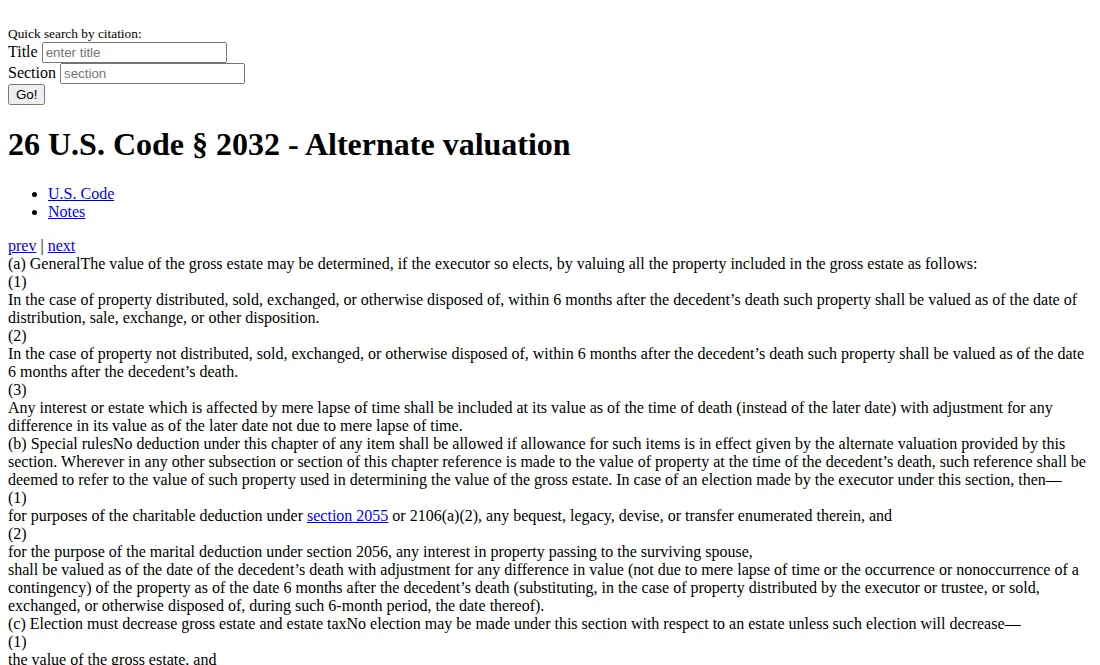
Section 1014(a)(2) points to the one election that changes the valuation date. Under section 2032(a), property disposed of within six months after death is valued as of the disposition date; the rest is valued six months after death. Section 2032(c) bars the election unless it decreases both the gross estate and the estate plus generation-skipping transfer tax, net of credits. Section 2032(d) requires the election on the return, makes it irrevocable, and forbids it if the return is filed more than one year late.
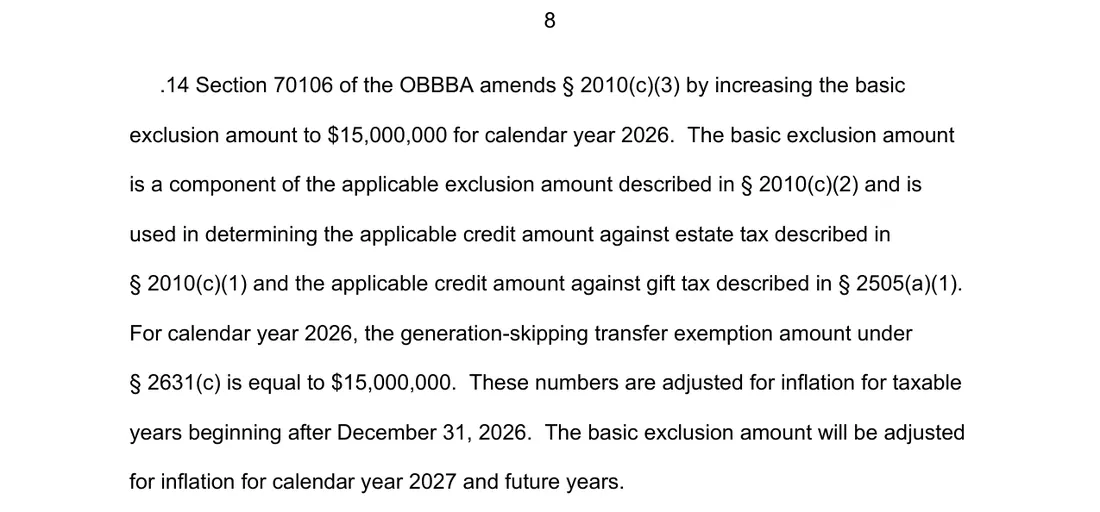
Worked example six — Scenario: alternate valuation. An estate holds stock worth $12,000,000 and real estate worth $6,000,000 at death, a gross estate of $18,000,000. Six months later the stock is worth $11,400,000 and the real estate is unchanged, an alternate value of $17,400,000. The 2026 basic exclusion amount is $15,000,000 under Rev. Proc. 2025-32, so the taxable estate is $3,000,000 at death-date values and $2,400,000 at alternate values. Under section 2001(c), amounts over $1,000,000 are taxed at $345,800 plus 40 percent of the excess: at death-date values the tentative tax is $345,800 plus 40 percent of $2,000,000, or $1,145,800; at alternate values, $345,800 plus 40 percent of $1,400,000, or $905,800. The election saves $240,000 of estate tax: $1,145,800 minus $905,800 equals $240,000. The heirs' basis falls by the same $600,000; a sale at the $12,000,000 death-date value produces $600,000 of extra gain, taxed at an assumed 20 percent rate as $120,000. The net benefit is $120,000: $240,000 minus $120,000 equals $120,000. The election wins because the 40 percent estate tax rate exceeds the assumed 20 percent rate; with no estate tax owed, section 2032(c) bars the election.
Depreciation after death
The step-up also resets the depreciation clock. Publication 551 provides that the basis for depreciation of property changed to rental use is the lesser of the fair market value at the change or the adjusted basis on that date; for inherited property, the value at death is the starting basis. Worked example seven — Scenario: rental reset. A decedent owns a rental house with an adjusted basis of $200,000, land $50,000 and building $150,000, and a fair market value at death of $600,000, land $150,000 and building $450,000. The heir's depreciable building basis is $450,000, not $150,000. Over the 27.5-year straight-line period the annual deduction is $16,363.64: $450,000 divided by 27.5 equals $16,363.64; on the decedent's $150,000 building basis it would have been $5,454.55 a year. The step-up therefore adds $10,909.09 of annual depreciation: $16,363.64 minus $5,454.55 equals $10,909.09; the depreciation the decedent claimed is not recaptured from the heir.
The decision table
| Situation | Basis result | Authority |
|---|---|---|
| Outright bequest, devise, or inheritance | FMV at date of death | § 1014(a)(1); § 1014(b)(1) |
| Surviving spouse's half of community property | FMV of the whole property | § 1014(b)(6); Pub. 551 |
| Traditional IRA, unpaid salary, installment receivable | No step-up; ordinary income | § 1014(c); § 691 |
| Appreciated property gifted within 1 year, back to donor | Decedent's adjusted basis | § 1014(e); Pub. 551 |
| Special-use farm or business property | Special-use value, ceiling $1,460,000 | § 1014(a)(3); § 2032A |
| Basis claimed above the return value | Capped at the finally determined value | § 1014(f); § 6035 |
Filing mechanics: the paperwork that makes the basis real
The estate obtains its own employer identification number, the EIN, on Form SS-4; the executor files the estate's income tax return on Form 1041 for income the estate earns during administration. Where Form 706 is required, the executor reports each asset's value, elects alternate valuation on Part III if section 2032 is chosen, and furnishes Schedule A (Form 8971) within 30 days of the due date, including extensions. A nonresident alien beneficiary reporting the sale needs an individual taxpayer identification number, the ITIN. Inherited property is not wages, so no FICA or SECA tax applies. Where the decedent owned an interest in an LLC, an S-Corp, or a C-Corp, the step-up applies to the owner's interest, while the entity's inside basis is unchanged absent a section 754 election. A CPA preparing both returns from one valuation file keeps them consistent.
Who should not rely on the step-up
First, property that will fall in value: the step-down erases a loss a lifetime sale would have preserved. Second, donors who gave appreciated property to a dying relative inside the last year: section 1014(e) returns the donor's old basis. Third, beneficiaries of IRAs and other section 691 items: no planning after death converts ordinary income into stepped-up gain. Fourth, a completed lifetime gift: the gift keeps the donor's basis under section 1015, and the step-up does not attach. Fifth, an heir claiming a $900,000 basis over an $800,000 Schedule A value: section 1014(f) caps the basis.
Related reading: the $15,000,000 exclusion is worked in the estate tax exemption playbook. The return that fixes the values is in the Form 706 filing playbook. The revocable trust route into section 1014(b) is in the revocable vs irrevocable trust playbook. Before deciding whether to hold or sell an inherited asset, run the numbers in the Self-Employed Tax and Quarterly Estimator.
Founder & CEO Insight — Enow A. Jovial
Execution protocol
- Inventory every asset and its inclusion status. List each asset, its adjusted basis, its fair market value at death, and its gross estate inclusion. Flag IRD items under section 691: IRAs, unpaid salary, deferred bonuses, installment receivables.
- Check the one-year gift window. Identify appreciated property received by gift in the year before death and confirm the recipient.
- Value at death and document it. Obtain appraisals dated at death for real estate, business interests, and collectibles.
- Decide on alternate valuation before filing. Run the section 2032(c) test and the worked example six trade.
- File Form 706 and furnish Schedule A. Report the values, meet the 30-day Schedule A deadline, and give each beneficiary the basis ceiling.
- Record the new basis per asset. Enter the fair market value, alternate value, or special-use value as the heir's starting basis, split land from building for rentals, and file the Schedule A with the deed.
Execution checklist
- [x] Confirm each asset is in section 1014(b).
- [x] Flag IRD items under section 1014(c).
- [x] Test recent gifts against section 1014(e).
- [x] Match the claimed basis to the Schedule A value.
- [x] Run the section 2032 trade before electing.
- [x] Split land from building; restart depreciation at the stepped-up value.