Three vendors, three meters
Retool, Appsmith, and Budibase all sell the same promise: internal tools without waiting on an engineering queue. A support lead builds the refund screen, an ops analyst builds the onboarding form, a finance manager builds the approvals dashboard — all against the same Postgres, REST API, or SaaS data the engineers already run. Retool splits every seat into builders and end users. Appsmith charges one flat rate per user. Budibase charges a 299 dollar monthly bundle — 2 creators, 20 end users, 250,000 actions — then sells extra creators and end users as add-ons. Every rate below comes from the vendors own pricing pages on November 21, 2026.
The three rate cards
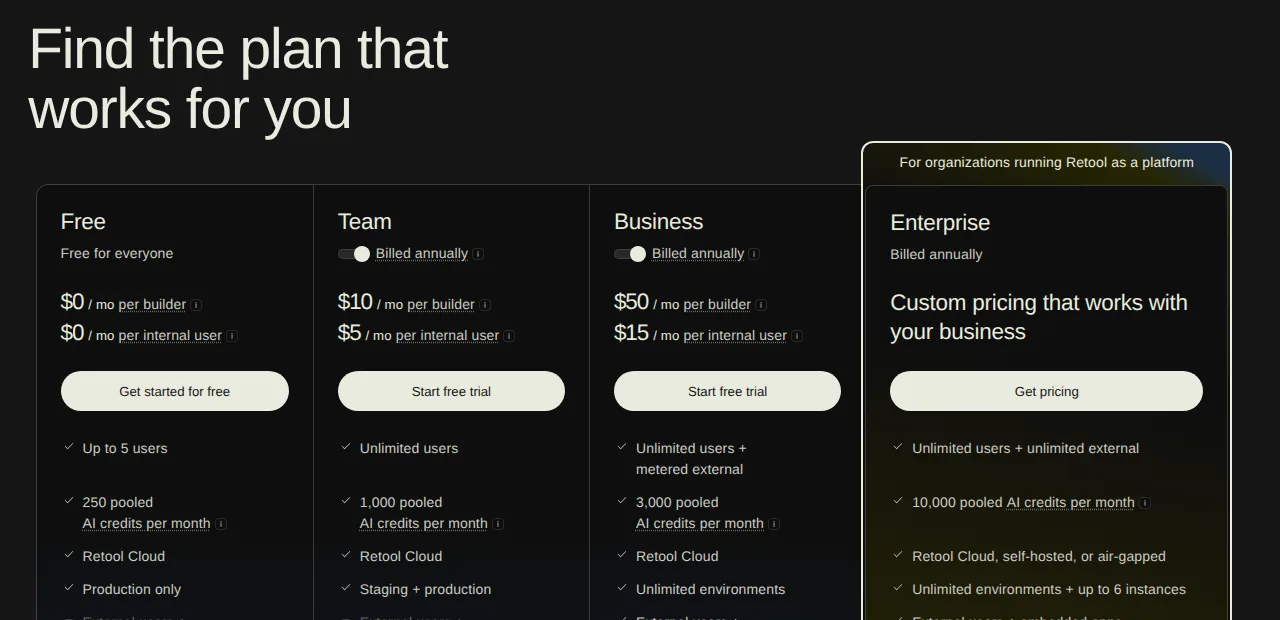
Retool prices builders and internal users separately, on annual billing with a stated 20 percent saving against monthly billing. Free is 0 dollars for up to 5 users: 250 AI credits, 500 workflow runs a month, production only, no external users, no audit logs, no SSO. Team is 10 dollars per builder and 5 dollars per internal user a month: unlimited users, 1,000 AI credits, 5,000 workflow runs, staging plus production. Business is 50 dollars per builder and 15 dollars per internal user: 3,000 AI credits, unlimited environments, external users, audit logs, rich permissions. Enterprise is custom: unlimited users, 10,000 AI credits, self-hosting, SSO, SCIM, Git.
Appsmith prices one thing: users. Free is 0 dollars for up to 5 cloud users: 5 workspaces, Git on 3 repos, Google SSO, 3 roles, public apps. Business is 15 dollars a month per user, up to 99 users: unlimited environments, repos, and workspaces, workflows, reusable packages, premium integrations, custom roles, audit logs, branding removal. Enterprise is 2,500 dollars a month for 100 users: SSO, SCIM, CI/CD, private embedding, airgapped edition, managed hosting.
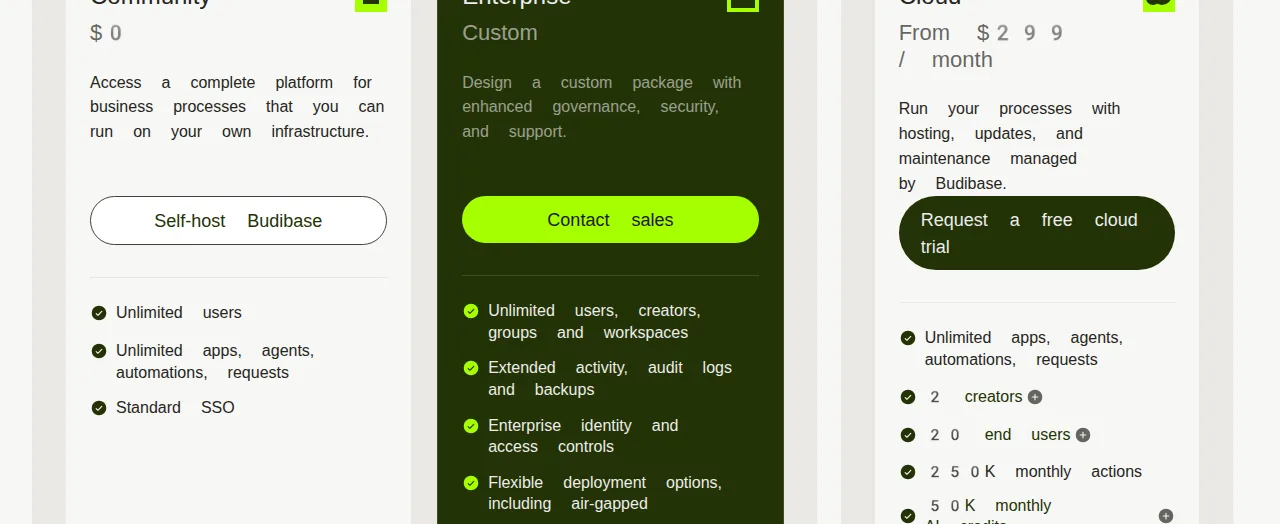
Budibase prices a bundle, not seats. Community is self-hosted at 0 dollars: unlimited users, apps, agents, and automations, standard SSO, 1 workspace, 1-day log retention. Enterprise self-hosted is custom: unlimited users, creators, groups, and workspaces, extended audit logs, enterprise identity, air-gapped deployment. Cloud starts at 299 dollars a month and includes 2 creators, 20 end users, 250,000 monthly actions, and 50,000 monthly AI credits. Extra creators cost 50 dollars a month on annual billing (60 dollars monthly); extra end users cost 5 dollars (6 dollars monthly). Actions are hard monthly limits: when the allowance is reached, agents and automations stop until it is raised through a higher-capacity package — no overage billing. Extra AI credits are sold one-off — 10,000 credits for 20 dollars, up to 1,000,000 for 2,000 dollars, or 0.002 dollars per credit.
| Meter | Retool Team / Business | Appsmith Business | Budibase Cloud |
|---|---|---|---|
| Base price | 10 / 50 dollars per builder, annual | 15 dollars per user | 299 dollars a month |
| End users | 5 / 15 dollars per internal user | Same 15 dollars, no split | 5 dollars each over 20 included |
| Workflow runs | 5,000 a month, then 75 dollars per 5,000 | Included, no published meter | 250,000 actions, hard cap |
| Self-host | Enterprise only | Airgapped edition on Enterprise | Community free, Enterprise custom |
| SSO and audit | Business audit logs; SSO on Enterprise | Business audit logs; SSO on Enterprise | Standard SSO free; audit on Enterprise |
The modeling rules
Three stated assumptions make the comparison reproducible. First, a builder is a creator seat on every vendor: Retool builders, Appsmith users who build, Budibase creators. Second, every price is the annual-billing rate in US dollars before tax — Retool states a 20 percent saving on annual billing, Budibase add-ons cost 20 percent more on monthly billing, and Appsmith prints no billing-term split. Third, workflow volume is held constant except where a meter forces a line: Retool gets a runs line, Budibase an actions ceiling note, Appsmith neither.
W1: the small team
The first workload is a small team: 3 builders and 10 end users, 13 seats, building internal tools against a Postgres database and a REST API. Retool Free cannot hold it — 13 users exceeds the 5-user cap — so the entry tier is Team: 3 builders at 10 dollars plus 10 internal users at 5 dollars, total 80 dollars a month.
Appsmith Free fails the same way at 13 users, so the entry tier is Business: 13 users at 15 dollars, total 195 dollars a month. Budibase Cloud starts at 299 dollars, which includes 2 creators and 20 end users; the third creator needs one add-on at 50 dollars, so the total is 349 dollars a month.
W1: Retool 80 dollars, Appsmith 195 dollars, Budibase 349 dollars. The builder split decides it: Retool charges the 10 app-only users 5 dollars instead of 15.
W2: the growth company
The second workload is a growth company: 8 builders and 80 end users, 88 seats, with audit logs required for SOC 2 evidence. Retool Team: 8 builders at 10 dollars plus 80 internal users at 5 dollars, total 480 dollars a month, or 5,760 dollars a year. Retool Business, the tier that actually carries audit logs, costs 8 builders at 50 dollars plus 80 users at 15 dollars, total 1,600 dollars a month.
Appsmith Business: 88 users at 15 dollars, 1,320 dollars a month, 15,840 dollars a year, under the 99-user cap, audit logs included. Budibase Cloud: 299 dollars base plus 6 creators at 50 dollars plus 60 end users at 5 dollars, 899 dollars a month, 10,788 dollars a year.
W2: Retool Team 480 dollars, Budibase 899 dollars, Appsmith 1,320 dollars, Retool Business 1,600 dollars. Team has no audit logs, so SOC 2 evidence costs 899 dollars on Budibase or 1,600 dollars on Retool Business. Appsmith sits between them — its problem is the next workload.
W3: the 425-seat estate
The third workload is a 425-seat estate: 25 builders and 400 end users, with SSO required. Retool Team: 25 builders at 10 dollars plus 400 users at 5 dollars, total 2,250 dollars a month. Retool Business: 25 at 50 dollars plus 400 at 15 dollars, total 7,250 dollars a month. Appsmith Business caps at 99 users, so the buyer moves to Enterprise at 2,500 dollars a month for 100 users, with the other 325 unpriced: quote-only, never estimated here. Budibase Cloud: 299 dollars base, plus 23 extra creators at 50 dollars, plus 380 extra end users at 5 dollars, total 3,349 dollars a month.
W3: Retool Team 2,250 dollars, Appsmith Enterprise 2,500 dollars for 100 users with 325 unpriced, Budibase 3,349 dollars, Retool Business 7,250 dollars. Retool Team is cheapest on paper and unusable here: no SSO, no audit logs, no self-hosting. The real contest is Budibase at 3,349 dollars against Retool Business at 7,250 dollars — a 3,901 dollar monthly gap, 46,812 dollars a year — with Appsmith Enterprise quote-only past 100 users.
The cliffs nobody prints on the card
Three cliffs matter more than the headline rates. A 99-user estate on Appsmith Business pays 1,485 dollars a month. The 100th user forces Enterprise at 2,500 dollars a month, so the marginal cost of one user is 1,015 dollars a month — 67 times the 15 dollar rate the buyer thought they were paying.
Second, the Retool external-user ladder: free on Business only up to 50, then 8 dollars each to 250, 6 dollars to 500, 4 dollars above 500. A portal with 300 external users costs 1,900 dollars a month on top of the builder and internal-user bill — and Team cannot serve external users at any price.
Third, the Budibase hard action cap: 250,000 actions a month, a hard limit, not an overage line — when it is reached, agents and automations stop until the allowance is raised through a higher-capacity package whose price is not published. Retool differs: Team and Business include 5,000 runs a month, and every extra 5,000 costs 75 dollars, so a 20,000-run estate pays 225 dollars a month in overage and keeps running. Appsmith publishes no workflow meter at all: the limit, if one exists, is discovered in production.
Monthly billing and the AI credit pool
Annual billing is cheapest on all three pages. Retool states a 20 percent saving on annual billing, so the monthly-billed Team rate is 12.50 dollars per builder and 6.25 dollars per internal user — derived by dividing by 0.8. On the W2 team that is 600 dollars a month instead of 480 — a 120 dollar monthly penalty, 1,440 dollars a year. Budibase add-ons cost 20 percent more monthly — 60 dollars per creator and 6 dollars per end user instead of 50 and 5 — and the page does not state whether the 299 dollar Cloud base is the annual or monthly rate, so this comparison prices it as listed.
Retool includes 250 credits a month on Free, 1,000 on Team, 3,000 on Business, 10,000 on Enterprise, pooled and renewed monthly. Retool own FAQ says each prompt uses about 12 credits and a typical app takes 3 to 6 prompts, so Business covers 36 to 84 apps a month — the pool, not the seat count, caps how fast a team generates apps. Budibase Cloud includes 50,000 AI credits a month, top-ups at 0.002 dollars per credit.
Self-hosting and the governance ceiling
Self-hosting splits the trio cleanly. Budibase Community is free to self-host: unlimited users, apps, agents, and automations, standard SSO, 1-day log retention. Retool self-hosting is Enterprise only — Team and Business are cloud-only. Appsmith lists an airgapped edition under Enterprise, so a self-hosted estate is an Enterprise conversation. Governance follows the same split: audit logs arrive on Retool Business and Appsmith Business, but SSO waits for Enterprise on both, while Budibase ships standard SSO on free Community and reserves enforceable SSO and SCIM for Enterprise. A team needing SSO and self-hosting without an Enterprise quote has one option here: Budibase Community.
Founder & CEO Insight — Enow A. Jovial
Who should NOT buy each
Do not buy Retool Team if you need audit logs, SSO, or external users — it has none of the three, and Business triples the builder rate to 50 dollars and the end-user rate to 15 dollars. Do not buy Appsmith Business if the team is growing past 90 users — the 99-user cap turns the 100th user into a 1,015 dollar monthly event, and Enterprise past 100 users is quote-only. Do not buy Budibase Cloud if the estate burns more than 250,000 actions a month — the hard cap stops automations instead of billing overage, and the higher-capacity price is unpublished. Do not self-host on Retool or Appsmith without an Enterprise quote.
The execution sequence
- Count builders and end users separately: creators and editors are builders; everyone else is an end user. The split decides the Retool and Budibase totals.
- Price W1, W2, and W3 on each meter with the real headcounts, and record monthly and annual totals side by side.
- Check the ceilings: Appsmith 99 users, Retool Free 5 users, Budibase 250,000 actions. Price the cliff, not just the tier.
- Add the workflow meter: Retool runs at 75 dollars per 5,000 over the included 5,000; Budibase actions against the 250,000 hard cap.
- Price governance separately: list the audit log, SSO, SCIM, and self-hosting requirements, then read which tier each forces — the governance tier is usually the real price.
- Get the quotes in writing: Appsmith Enterprise past 100 users, Retool Enterprise for self-hosting, Budibase past 250,000 actions.
- Run the final numbers through the pricing calculator and keep the arithmetic next to the decision so the next person can re-run it.
The execution checklist
- [x] Seats counted: builders and end users listed separately.
- [x] Three workloads priced: W1, W2, W3 totals on all three vendors.
- [x] Ceilings checked: Appsmith 99-user cap, Retool 5-user Free cap, Budibase 250,000-action cap.
- [x] Workflow meter added: Retool runs at 75 dollars per 5,000 overage; Budibase actions against the hard cap.
- [x] Governance priced: audit logs, SSO, SCIM, and self-hosting mapped to their tier.
- [x] Quotes requested: Enterprise and higher-capacity pricing in writing.
- [x] Monthly penalty priced: annual versus monthly compared on the chosen tier.
The cheapest team here is Retool Team at every workload — 80 dollars at W1, 480 at W2, 2,250 at W3 — and the cheapest with audit logs is Budibase Cloud at W2 and W3. Appsmith Business is never the cheapest, and its 99-user cap makes it the riskiest pick for a growing team. The meter is the decision. The n8n versus Zapier versus Make automation pricing playbook prices the workflow layer that feeds these apps, and the Sentry versus Grafana versus Honeycomb observability pricing playbook prices the monitoring layer that watches them.