Resend, Postmark, and Amazon SES all deliver the same password reset — a triggered message that must arrive in seconds — but they do not sell it the same way. Resend sells flat monthly tiers with a hard included allowance. Postmark sells a cheap base with a steep per-thousand overage rate. Amazon SES sells raw usage at $0.10 per 1,000 emails with no monthly fee. That one difference decides the bill: at 10,000 emails a month the three cost $20.00, $15.00, and $1.00; at 1,000,000, $875.00, $1,206.00, and $100.00. Every price below was read from the vendor's own pricing page on 14 November 2026.
The billing model is the whole decision
Resend is a tier with a cliff: $20 a month for 50,000 emails, then $0.90 per 1,000 more — but only if pay-as-you-go is switched on. Postmark is a low base with expensive overage: every paid plan starts at the same 10,000 included emails, and the plan sets the overage rate. SES is a meter: $0.10 per 1,000 emails, no base, no cliff.
Resend: priced per tier, generous at the bottom
Free costs $0: 3,000 emails a month, capped at 100 a day, 3 domains, 30-day retention. Pro costs $20 a month: 50,000 emails, overage at $0.90 per 1,000, 10 domains, no daily limit. Scale costs $90 a month: 100,000 emails, the same $0.90 overage, 1,000 domains. Enterprise is a custom quote.
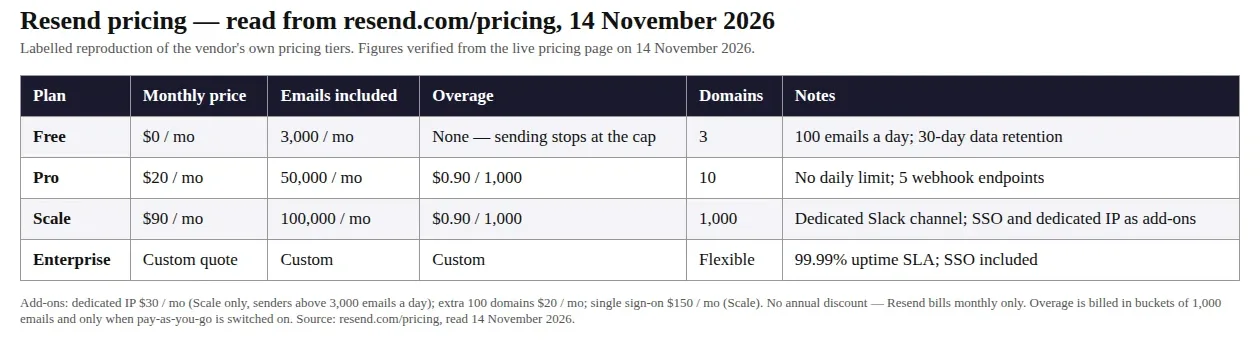
Resend's free tier is the most generous of the three — 3,000 emails a month against Postmark's 100 — but it ends hard at 100 emails a day, and there is no plan between Free and Pro: the jump from $0 to $20 happens at 3,001. A dedicated IP costs $30 a month on Scale only, for senders above 3,000 emails a day. There is no annual discount — monthly plans only.
Postmark: priced by overage, cheapest base, dearest extra thousand
The free developer plan costs $0: 100 emails a month, no overages allowed, and it does not expire. Basic costs $15 a month: 10,000 emails, overage at $1.80 per 1,000, 5 domains, 45-day retention. Pro costs $16.50 a month: the same 10,000 included emails, overage at $1.30 per 1,000, 10 domains, inbound processing. Platform costs $18 a month: the same 10,000 included emails, overage at $1.20 per 1,000, unlimited domains and users.
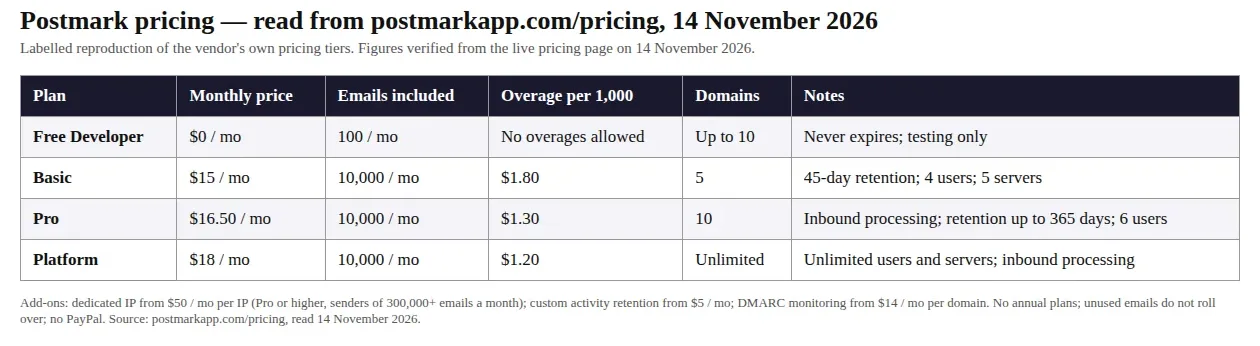
All three paid plans include the same 10,000 emails, so the plan choice is really an overage-rate choice. Basic looks cheapest at $15, but its $1.80 overage rate is the highest, and it stops being cheapest at 13,000 a month. Platform beats Pro above 25,000 a month. Unused emails do not roll over, there are no annual plans, and Postmark accepts card payments only.
Amazon SES: priced by the meter, cheapest by far, barest by design
SES a la carte costs $0.10 per 1,000 outbound emails, with no monthly fee and no minimum: attachments add $0.12 per gigabyte, inbound email costs $0.10 per 1,000. Since July 2026 AWS also sells three named plans. Essentials costs $0.16 per 1,000 with no monthly fee. Pro costs $0.22 per 1,000 plus $105 a month per account per region. Enterprise costs $0.23 per 1,000 plus $500 a month. New SES accounts default to Essentials from 21 July 2026; a switch to a la carte is possible at any time.
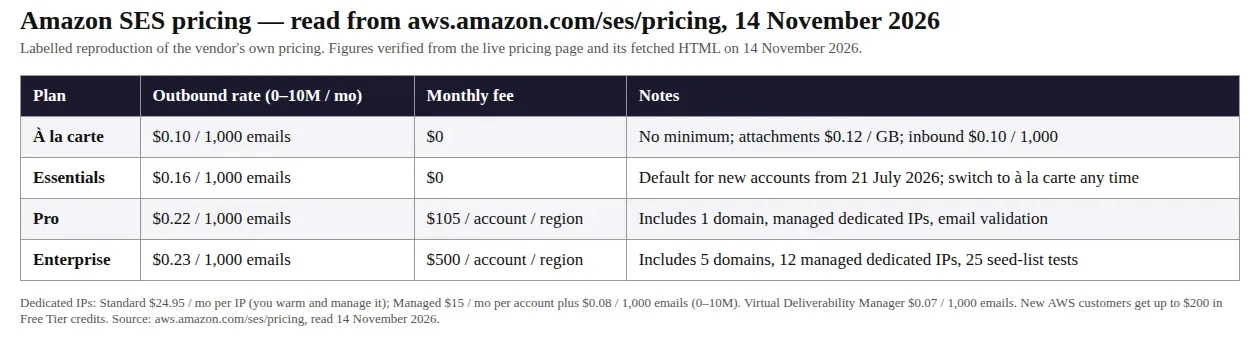
SES is raw sending infrastructure, not a finished product: no visual template editor, no campaign builder, no open-rate dashboard. The sender builds suppression handling, bounce processing, and templating in their own code. A standard dedicated IP costs $24.95 a month per IP and the sender warms it manually; a managed one costs $15 a month per account plus $0.08 per 1,000.
The decision table
| Factor | Resend | Postmark | Amazon SES | Authority |
|---|---|---|---|---|
| Billing model | Flat monthly tier | Low base + overage | Pure usage meter | Vendor pricing pages |
| Free allowance | 3,000/mo, 100/day | 100/mo | $200 AWS credits, new customers | Vendor pricing pages |
| Entry paid price | Pro $20/mo, 50,000 | Basic $15/mo, 10,000 | $0.10/1,000 | Vendor pricing pages |
| Overage per 1,000 | $0.90 | $1.80/$1.30/$1.20 | None | Vendor pricing pages |
| Dedicated IP | $30/mo, Scale, 3,000+/day | From $50/mo, Pro+, 300,000+/mo | $24.95 standard; $15 + $0.08/1,000 | Vendor pricing pages |
| DKIM/SPF/DMARC | Generated DKIM + SPF, DMARC by user | Listed; DMARC monitoring $14/mo | Easy DKIM, 2048-bit | Vendor docs |
The reproducible math: 10k, 100k, and 1M emails
— A1, Resend at 10,000: Free caps at 3,000 a month and 100 a day, so Pro is required — $20.00 a month, $2.00 per 1,000.
— A1, Resend at 100,000: Pro with overage is $20.00 + (100,000 − 50,000) ÷ 1,000 × $0.90 = $65.00 a month. Scale flat is $90.00; $0.65 per 1,000.
— A1, Resend at 1,000,000: Pro with overage is $20.00 + 950 × $0.90 = $875.00 a month. Scale with overage is $90.00 + 900 × $0.90 = $900.00 a month.
— A2, Postmark at 10,000: Basic $15.00 a month; Pro $16.50; Platform $18.00; $1.50 per 1,000 on Basic.
— A2, Postmark at 100,000: Basic $15.00 + 90 × $1.80 = $177.00; Pro $16.50 + 90 × $1.30 = $133.50; Platform $18.00 + 90 × $1.20 = $126.00.
— A2, Postmark at 1,000,000: Basic $15.00 + 990 × $1.80 = $1,797.00; Pro $16.50 + 990 × $1.30 = $1,303.50; Platform $18.00 + 990 × $1.20 = $1,206.00.
— A3, SES a la carte at 10,000: 10 × $0.10 = $1.00 a month.
— A3, SES a la carte at 100,000: 100 × $0.10 = $10.00 a month. Essentials $16.00; Pro $127.00.
— A3, SES a la carte at 1,000,000: 1,000 × $0.10 = $100.00 a month, $1,200.00 a year. Essentials $160.00; Pro $325.00; Enterprise $730.00.
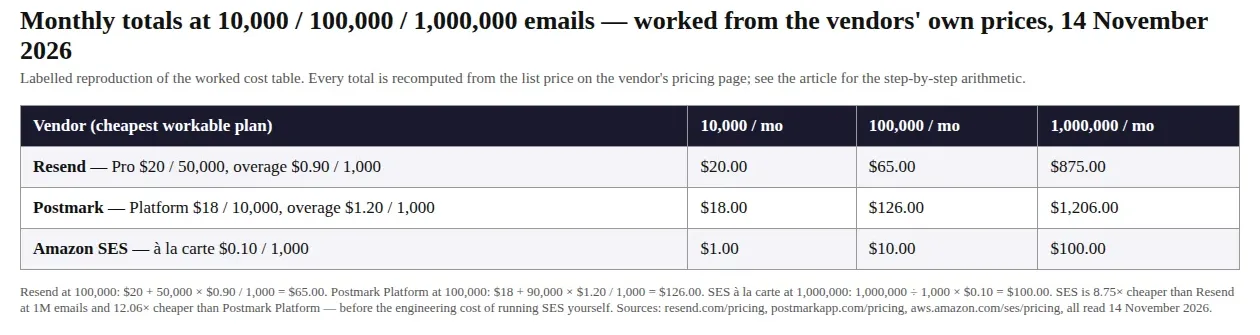
— A4, the SES multiple: at 1,000,000, $875.00 ÷ $100.00 is 8.75 times; $1,206.00 ÷ $100.00 is 12.06 times. At 100,000 the multiples are 6.5 and 12.6 times.
— A5, Postmark break-evens: Basic against Pro is $15.00 + 0.0018 × (V − 10,000) = $16.50 + 0.0013 × (V − 10,000), which solves to V = 13,000 a month; Pro against Platform, V = 25,000.
— A5, Resend Pro against Scale: both charge the same $0.90 overage, so Pro with overage minus Scale with overage is ($20.00 − $90.00) + 0.0009 × 50,000 = −$25.00 a month at every volume above 100,000. There is no price break-even.
— A6, annual totals: Resend Pro route at 1,000,000 is $10,500.00 a year; Postmark Platform is $14,472.00; SES a la carte is $1,200.00. Switching to SES a la carte saves $9,300.00 a year from Resend, $13,272.00 from Postmark Platform.
— A7, dedicated-IP amortisation: Resend's $30.00 IP on Scale at 100,000 adds $0.30 per 1,000, taking Scale plus IP to $120.00. Postmark's $50.00 IP at 1,000,000 adds $0.05 per 1,000, taking Platform plus IP to $1,256.00. SES standard IP at 1,000,000 takes a la carte from $100.00 to $124.95; managed IP costs $95.00 on top of sending, $195.00 total.
— A8, effective cost per 1,000: Resend is U-shaped — $2.00 at 10,000, $0.40 at 50,000, $0.65 at 100,000, $0.875 at 1,000,000. Postmark Platform falls from $1.80 at 10,000 to $1.206 at 1,000,000. SES a la carte is flat at $0.10.
— A9, SES attachment data: 100,000 emails at 32 KB each is 3.2 GB, and 3.2 × $0.12 = $0.38 a month against a $10.00 bill. At 1,000,000 emails the data charge is $3.84 a month. Resend and Postmark list no per-gigabyte attachment charge.
Deliverability and reputation: shared pools, dedicated IPs, and the warm-up bill
No vendor here publishes an inbox-placement percentage on its pricing page, so this playbook makes no such claim. On Resend's Free and Pro plans you send from a shared IP pool, and Resend states it maintains the shared IPs in good standing. A dedicated IP is available only on Scale, above 3,000 emails a day, warmed and monitored by Resend for $30 a month. On Postmark the shared pool is the default too; dedicated IPs start at $50 a month on Pro or higher, for senders of 300,000 or more a month. On SES the shared pool is the default; a standard dedicated IP costs $24.95 a month with manual warm-up.
Authentication is the same job on all three. Resend generates the DNS records for each domain — a DKIM TXT record at resend._domainkey, an SPF TXT and an MX record on a send subdomain — and the domain often verifies within 15 minutes, though DNS can take up to 72 hours. The DMARC record is the sender's job. Postmark lists DKIM, SPF, and DMARC authentication on its pricing page. SES Easy DKIM signs with a 2048-bit key by default and publishes three CNAME records. Suppression is where the vendors part company: Postmark manages it automatically, Resend surfaces bounces and complaints through signed webhooks the sender must consume, and SES leaves it to the sender's code unless the Virtual Deliverability Manager is bought at $0.07 per 1,000.
API and developer experience
Resend is built for a TypeScript and React stack: official SDKs from Node.js to Rust, templates as React components, a batch API that sends up to 100 emails in one request, and webhooks for delivery events. Its API rate limit is set per team and is the same on every plan. Postmark offers a REST API and SMTP, official SDKs, sandbox mode, and inbound email processing that turns an incoming message into a JSON object posted to a webhook — a Pro and Platform feature, not a Basic one. SES offers a REST API and SMTP through the AWS SDKs, with sending scoped per AWS region; templates, suppression lists, and dashboards are built by the sender. The difference is staffing: Resend and Postmark are products a single developer can run; SES needs an engineer who owns the pipeline.
The buying protocol
- Measure thirty days of real volume first — transactional sends only.
- Price your volume on all three with the formulas above, at your 10th and 90th percentile months.
- Check the free-tier ceiling against your worst single day: Resend Free stops at 100 emails a day; Postmark Free stops at 100 a month.
- Run the Postmark break-even check: below 13,000 emails a month Basic is cheapest; between 13,000 and 25,000 Pro is; above 25,000 Platform is.
- Decide the IP question before the first send: below 300,000 emails a month, stay on the shared pool; above it, price the dedicated IP into the monthly total.
- Verify the domain and read the headers before going live: add the DKIM, SPF, and DMARC records, send one real message to a Gmail account, and confirm all three pass.
Who should not buy which
A team sending under 3,000 emails a month with no engineer to spare should not buy SES — the $1.00 bill is real, but suppression handling is the sender's job. A team whose volume sits between 50,000 and 100,000 emails a month should not buy Resend Scale for price — Pro with overage is $25.00 a month cheaper. A team sending over 300,000 emails a month that needs a dedicated IP should not buy Postmark Basic — it needs Pro or higher. A team that needs inbound email processing should not buy Postmark Basic either. A team whose volume swings wildly month to month should not buy Postmark without running its calculator first.
Related: Mailgun vs SendGrid vs Amazon SES pricing and Cold email deliverability: SPF, DKIM and DMARC. Try the Pricing Calculator.
Founder & CEO Insight — Enow A. Jovial
Execution checklist
- [x] Measure thirty days of transactional volume.
- [x] Price the 10th and 90th percentile months on all three vendors.
- [x] Check the free-tier ceiling against the worst day.
- [x] Run the Postmark break-even check: Basic below 13,000, Platform above 25,000.
- [x] Decide the dedicated-IP question before the first send.
- [x] Verify DKIM, SPF, and DMARC, then read one real message's headers.