Referral Program vs Loyalty Program: The Customer Retention Playbook
Which constraint are you buying your way out of?
A referral program and a loyalty program look like two flavors of the same thing. A referral program buys new customers at a CAC you can compute to the cent. A loyalty program buys repeat purchases from customers you already have, at a cost set by breakage.
This playbook prices both from the vendor pages on November 10, 2026, runs the monthly math at stated volumes, and gives the rule for which to launch first. The affiliate channel is a different purchase, priced in our affiliate marketing program setup playbook; creator rates are priced in our influencer rate card playbook.
What each program actually buys
A referral program has one input and one output: a reward offered to an existing customer and usually to the friend they bring, in exchange for a first order from a person you had no cheap paid path to. ReferralCandy's 2026 benchmarks put median conversion on referred visits at 3 to 5 percent, top quartile above 8 percent, and the global average referral rate at about 2.35 percent of purchases — roughly 1 in 50 sales. Top programs drive 10 to 30 percent of store revenue from referrals, at 5 to 8 times ROI.
A loyalty program buys a higher repeat purchase rate and AOV from members. Yotpo's CFO guide sets year-one targets: 5 percent participation, 7 percent revenue share, 8 to 18 percent redemption. Members were already your better customers: McKinsey found redeemers spend 25 percent more than enrolled-but-inactive members. Judge loyalty on your repeat purchase rate against your own trailing twelve months. Bain found that a 5 percent increase in retention can lift profits by 25 to 95 percent.
The decision table
| Situation | Launch first | Why | Authority |
|---|---|---|---|
| Paid CAC above $50 and rising | Referral | Referred CAC runs 60 to 80 percent below paid | Eightx 2026 referral analysis |
| Repeat purchase rate below 20 percent | Loyalty | Points and tiers attack the repeat gap | Yotpo CFO guide |
| AOV below $40, one-time purchase | Neither yet | Reward cost eats the order | Program-cost math below |
| Subscription, AOV above $50 | Referral, then loyalty | Referral fills the funnel; loyalty keeps the subscriber | ReferralCandy category data |
| B2B or SaaS, annual contracts | Referral | Referred accounts carry NRR and ARR upside | Schmitt et al., Journal of Marketing 2011 |
That B2B row deserves a second look: referred customers carry a lifetime value 16 to 25 percent higher than non-referred customers, per Schmitt, Skiera, and Van den Bulte in the Journal of Marketing (2011), a study of roughly 10,000 bank customers over nearly three years.
Reward structures
Referral rewards come in three currencies, and the currency is the economics. Cash is the most motivating and the most expensive: the advocate gets money, via PayPal, and the cost leaves the business in full. Store credit is cheaper by the margin on the redemption order: a $10 credit redeemed against a $65 order costs the cost of goods on $10 of product, not $10. Points are the cheapest on paper and the slowest to motivate.
The standard design is two-sided: the advocate gets $10, the friend gets $10 off a first order. Two-sided rewards beat one-sided designs on participation — benchmark summaries put the lift at roughly 27 to 29 percent — because the advocate hands the friend a discount, not a favor request. Size the reward as a share of AOV: $10 is 40 percent of a $25 order and 8 percent of a $120 order.
| Reward | Cost per $10 | Motivation speed | Best for |
|---|---|---|---|
| Cash via PayPal or ACH | $10.00 plus payout fees | Fastest | High AOV, B2B |
| Store credit | $10.00 minus margin on redemption | Fast | DTC, repeat likely |
| Points | Face value minus breakage | Slowest | Frequent buyers |
Cash has a second cost: administration. Cash rewards paid to U.S. advocates can trigger information-reporting duties, so collect the advocate's legal name, tax ID, and a Form W-9 before the first payout, and keep payout records in a CSV export. An LLC paying cash rewards without a W-9 process is building a January problem.
Loyalty rewards work differently: an earn rate and a redemption threshold — commonly 1 point per $1, 100 points for $5, a 5 percent rebate on paper. The earn rate is the promise; the redemption rate is the cost.
Attribution and fraud controls
A referral program without attribution is a discount program. Three links must hold: a unique link or code per advocate; the referred customer's first order tied to that link before checkout; and the reward firing only after the order clears the return window. Hold the reward for 14 to 30 days.
Fraud is ordinary behavior at scale: self-referral through a second email address, advocates referring their own household, coupon sites harvesting links. The controls are unglamorous: one reward per referred customer, enforced on payment method and shipping address, not email alone; links that expire and single-use codes; and a velocity check that sends any advocate referring 40 customers in a day to manual review.
The fraud tax is measurable: if 5 percent of referred orders are self-referrals or coupon-site harvests, true CAC on genuine referrals is $23.96 divided by 0.95, or $25.22 — still far below a $78 paid CAC.
Loyalty tiers and breakage
Yotpo's CFO guide recommends 5 to 10 percent of customers in the top tier, 20 to 30 percent in the middle tier, and the rest in the base tier. A top tier holding 40 percent of members is not a top tier; it is a discount with a name. Set thresholds from your own order data: top tier above the 90th percentile of annual spend, middle above the 70th.
Breakage is the quiet engine of loyalty economics: the share of issued points never redeemed. A program with a 5 percent earn value and 40 percent breakage costs 3 percent of member spend, not 5 percent. Breakage falls when redemption gets easier. Budget at the redeemed rate.
Worked example — loyalty breakage
A store runs Smile.io Standard at $79 per month: 1 point per $1, 100 points for $5. Members spend $10,000 in a month, issuing points with a $500 face value. If 40 percent go unredeemed, redeemed value is $300 and breakage is $200. Monthly cost is $79 plus $300, or $379.
If redemption climbs to 80 percent, the same spend costs $479. Set the earn rate so the program survives at 80 percent redemption.
CAC and LTV math: the gate
Every retention program answers to one ratio: lifetime value over customer acquisition cost. Yotpo's 2026 benchmarks treat an LTV to CAC ratio below 3 to 1 as unstable. Referral CAC is the fully loaded cost of one referred customer: platform fee, success fee, reward cost, and payout fees, divided by referred customers. Loyalty has no CAC; its test is whether the lift in repeat purchase rate and AOV covers the platform fee plus redeemed value.
Worked example — referral CAC
Take a store doing 2,000 orders a month at a $65 AOV, on ReferralCandy Grow at $79 per month plus a 3.5 percent success fee. At ReferralCandy's 2.35 percent global average referral rate, the program drives 47 referred orders a month. The reward is two-sided at $10 to the advocate and $10 to the friend.
Against a paid-channel CAC of $78 — the 2026 UpCounting average, after paid CAC rose 40 percent in two years — referral CAC is 69.3 percent lower. Gross return is 2.71 times; net margin is $1,929.07 a month. The gate: a $195 lifetime value — three $65 orders — against a $23.96 referral CAC gives 8.14 to 1, while the same LTV against a $78 paid CAC gives 2.5 to 1, below the 3 to 1 line.
That 8.14 is not a promise: it assumes the 2.35 percent referral rate, the $65 AOV, and the $195 LTV all hold at once. Run it with your own numbers first. Our break-even calculator runs the threshold version: the referral rate at which the program stops paying for itself.
Monthly program cost
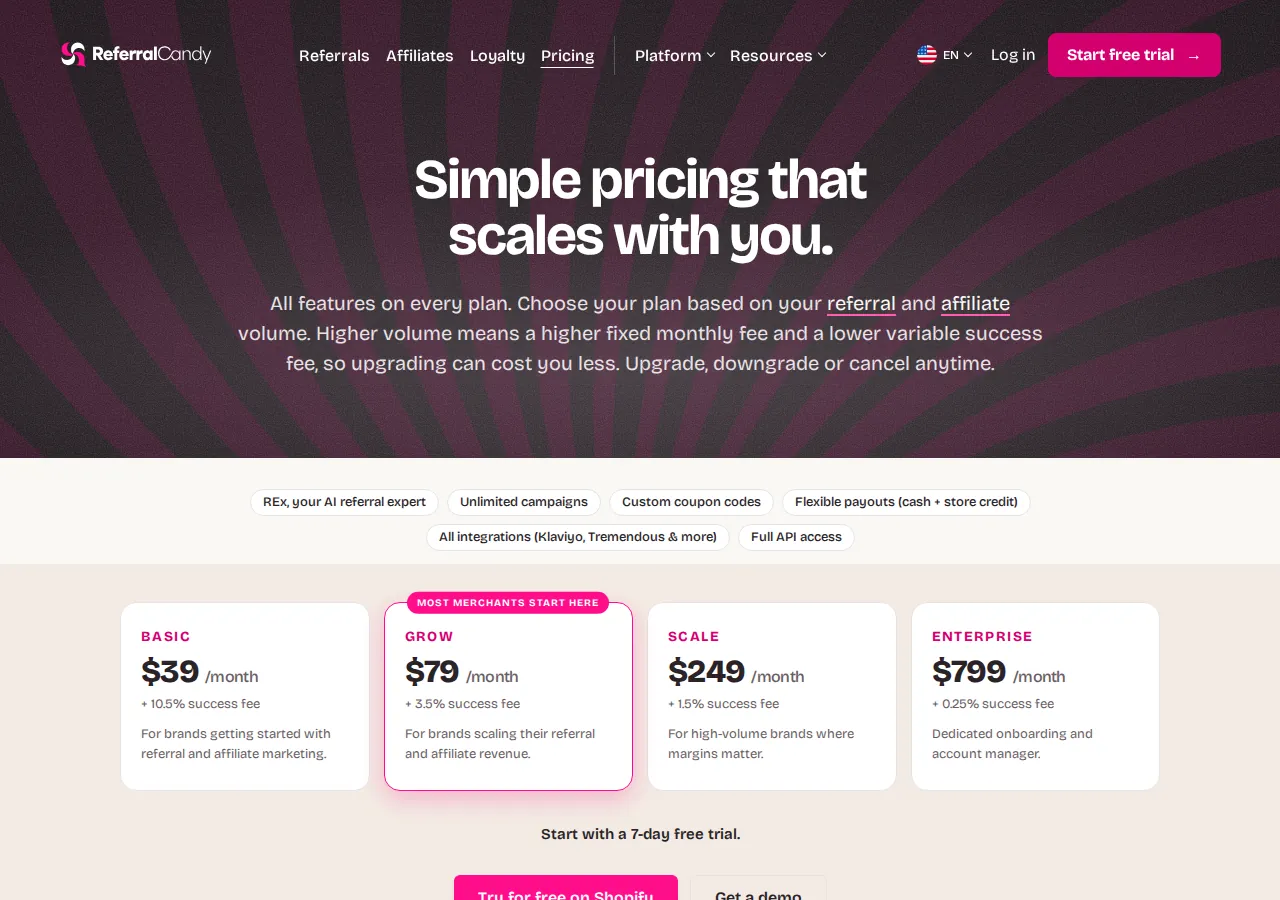
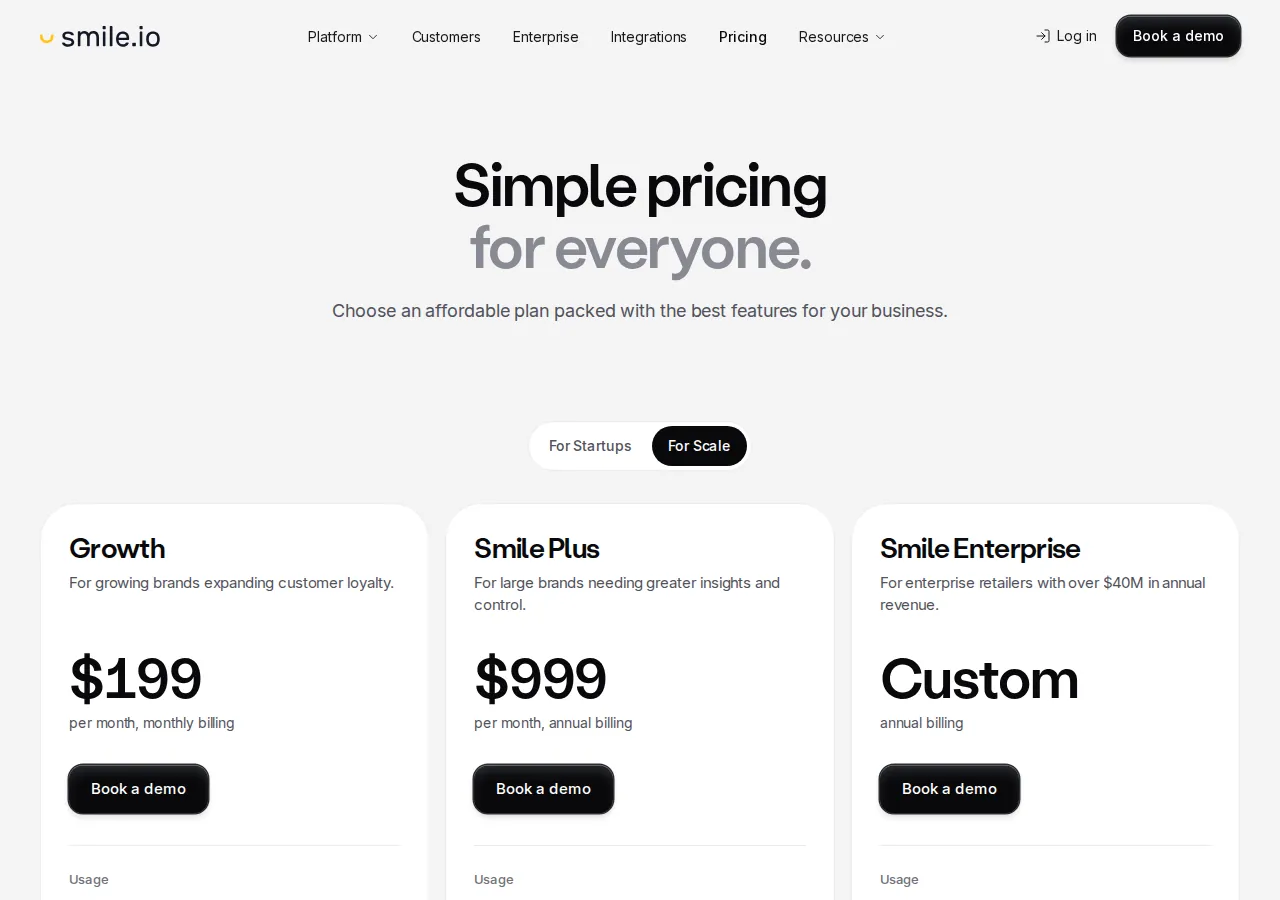
Every platform prices on volume. Smile.io prices on monthly orders: Free to 200, Essential $15 to 500, Standard $79 to 1,000, Growth $199 to 2,500, Smile Plus $999 to 7,500. Go 400 orders over the Standard cap and the overage is $80 — a $79 plan becomes a $159 plan. LoyaltyLion Classic is $199 a month including 500 orders. Yotpo Loyalty & Referrals has a Free plan with paid tiers from $199 a month; Premium and Enterprise are quoted. Mention Me publishes no price list — its pricing is quoted.
| Platform | Paid tier | Covers | Overage or success fee |
|---|---|---|---|
| ReferralCandy Basic | $39/mo | Referral plus affiliate | 10.5% success fee |
| ReferralCandy Grow | $79/mo | Referral plus affiliate | 3.5% success fee |
| ReferralCandy Scale | $249/mo | Referral plus affiliate | 1.5% success fee |
| ReferralCandy Enterprise | $799/mo | Referral plus affiliate | 0.25% success fee |
| Smile.io Essential | $15/mo | 500 orders/mo | $20 per 100 orders over |
| Smile.io Standard | $79/mo | 1,000 orders/mo | $20 per 100 orders over |
| Smile.io Growth | $199/mo | 2,500 orders/mo | $5 per 100 orders over |
| LoyaltyLion Classic | $199/mo | 500 orders/mo | Volume-priced above |
All prices above were read from the vendors' own pricing pages on November 10, 2026. ReferralCandy charges every plan the same features and varies only the success fee: Grow beats Basic once referred revenue passes $571.43 a month; Scale beats Grow at $8,500; Enterprise beats Scale at $44,000.
At the 2,000-order example, referred revenue is $3,055 a month — past Basic-to-Grow, far below Grow-to-Scale. Grow is the right tier: the $40 a month saved by dropping to Basic costs $213.85 a month in extra success fees.
The 7-step launch checklist
- Pull your trailing-twelve-months numbers: orders, AOV, repeat purchase rate, paid CAC, LTV.
- Pick the constraint: referral for paid CAC, loyalty for repeat purchase rate, neither if AOV is below $40.
- Set the reward as a share of AOV: 10 to 15 percent two-sided for referral, 5 percent earn rate for loyalty.
- Write the program terms before launch: reward hold until the return window closes, one reward per referred customer, disclosure per 16 CFR Part 255, section 255.5.
- Wire the attribution: unique links per advocate, first-order tie before checkout, payout records exported to CSV weekly.
- Launch to your best 10 percent first. Measure referral rate, conversion rate, and fraud share for 30 days.
- Review monthly: referral CAC against paid CAC, loyalty repeat rate against your trailing twelve months, LTV to CAC against 3 to 1.
Founder & CEO Insight — Enow A. Jovial
Who should not run either
Do not launch a referral program if your return rate is above 20 percent. Do not launch a loyalty program if customers buy once and never return — a mattress, a wedding dress, a one-time service. Do not launch either if your AOV is below $40, or on a store with broken checkout, late shipping, or unanswered support: a program amplifies the experience you already deliver.
The two programs are not rivals: referral first when acquisition is expensive, loyalty first when retention is leaking, both only when the monthly math clears the gate.