Prisma vs Drizzle vs TypeORM: ORM Pricing, Migrations, and Type Safety
Ask three TypeScript teams what their ORM costs and the vendors' own pages agree: the ORM layer is free in all three cases. Prisma states that every plan includes Prisma ORM, always free, and team size never adds to the bill. Drizzle ships as a library with opt-in tools and no per-developer price. TypeORM is MIT-licensed open source with no paid tier. So "which ORM is cheapest per developer" has a flat answer — $0, $0, and $0 — and the real question is what the managed platform around the ORM costs.
This guide prices the honest lines: the ORM line, the platform line, and the ceilings.
Step 1: What each ORM actually charges
The table below uses only the vendors' own pages, as read on 2026-11-12.
| Product | Monthly price | What the price covers | Authority |
|---|---|---|---|
| Prisma ORM | $0 | ORM, Prisma Client, Prisma Migrate, Studio CLI | Prisma pricing page |
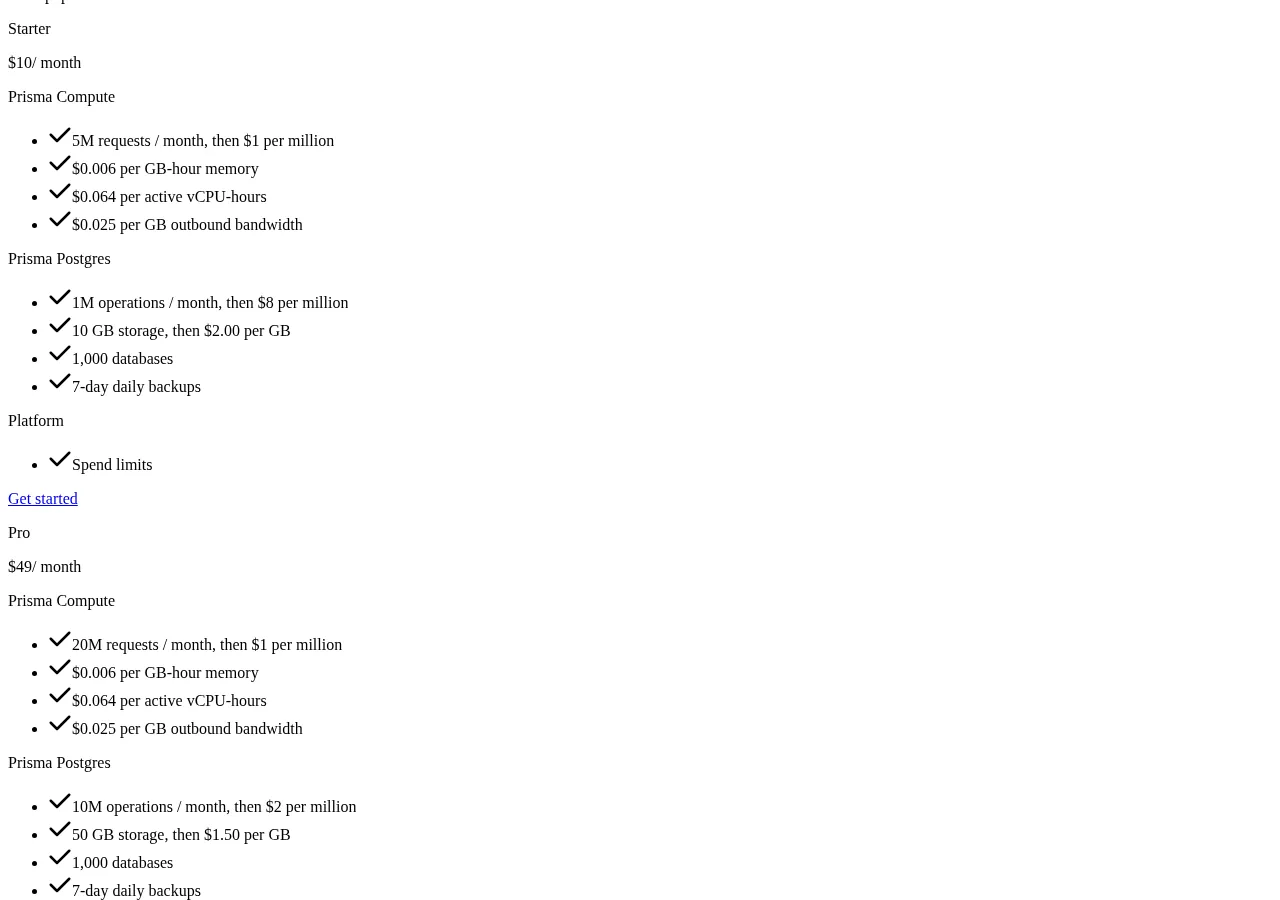
| Prisma platform, Free | $0 | 1M Compute requests, 200k Postgres operations, 2 GB storage, 50 databases | Prisma pricing page |
| Prisma platform, Starter | $10 | 5M Compute requests, 1M Postgres operations, 10 GB storage, 1,000 databases, 7-day backups | Prisma pricing page |
| Prisma platform, Pro | $49 | 20M Compute requests, 10M Postgres operations, 50 GB storage, GDPR | Prisma pricing page |
| Prisma platform, Business | $129 | 100M Compute requests, 50M Postgres operations, 100 GB storage, 30-day backups, GDPR, HIPAA, SOC 2, ISO 27001 | Prisma pricing page |
| Drizzle ORM and Drizzle Kit | $0 | ORM, relational and SQL-like query APIs, Kit CLI | Drizzle ORM docs |
| Drizzle Studio | No price published | Browser UI for browsing data, from Kit | Drizzle Kit docs |
| TypeORM | $0 | Full ORM under the MIT License, DataMapper and ActiveRecord | TypeORM docs; MIT License |
Prisma's compute overage rates are the same on every paid tier: $1 per million requests past the allowance, $0.006 per GB-hour of memory, $0.064 per active vCPU-hour, and $0.025 per GB of outbound bandwidth. What changes is the allowance and the Postgres overage rate: $8 per million past 1M on Starter, $2 per million past 10M on Pro, $1 per million past 50M on Business. Drizzle Studio has no price I could verify from a vendor page, so I print none here.
Step 2: The monthly math at 1, 5, and 20 developers
Prisma publishes three example workloads: a side project at 200,000 operations and 500 MB, a startup at 1M operations and 8 GB, and a scaleup at 20M operations and 40 GB. Run each through the tier table.
The side project fits Free exactly — 200,000 operations against a 200,000 allowance, 500 MB against 2 GB — $0 a month. The startup fits Starter — 1M operations against a 1M allowance, 8 GB against 10 GB — $10 a month. The scaleup needs Pro: base $49, plus 10M operations of overage at $2 per million, or $20; 40 GB sits inside the 50 GB allowance — $69 a month. Business would charge $129 for the same workload, so Pro wins by $60.
Per-developer cost is the platform bill divided by headcount:
At the $10 startup profile that is $10.00 with one developer, $2.00 with five, and $0.50 with 20. At the $69 scaleup profile it is $69.00, $13.80, and $3.45. Drizzle and TypeORM stay $0 at every team size. Annualized, the startup profile costs $120 a year and the scaleup $828 a year, against $0 for the bare ORM line of either rival — but the $828 buys managed Postgres, compute, backups, and a spend limit, not the ORM. A Drizzle or TypeORM team pays $0 for the ORM and pays its host separately, so compare Prisma platform against ORM plus host, never against $0 alone. Run it through our ROI calculator with your host invoice.
Starter costs $10 plus $8 per million operations past 1M; Pro costs a flat $49 up to 10M:
At 5.875M operations a month both plans cost $49. At 5M operations Starter costs $42 against Pro's $49; at 6M, $50 against $49. The second crossing is Pro versus Business: Pro costs $49 plus $2 per million past 10M, Business costs a flat $129 up to 50M, and the two meet at 50M, where both cost $129. Past that Business pulls away: at 60M operations Pro costs $149 while Business costs $139, a $10 a month saving worth $120 a year.
Step 3: Migrations — where each tool stops
Prisma Migrate is a migration system driven by a schema file and a CLI, and the current docs describe a break: in Prisma ORM 8, migrate dev becomes a migration plan step followed by db migrate, migrate deploy becomes db migrate, and migrate reset has no equivalent, because ORM 8 never resets a database. The schema file changes too: schema.prisma becomes contract.prisma, and prisma generate becomes npx prisma contract emit. Upgrading means relearning the commands and renaming the contract file.
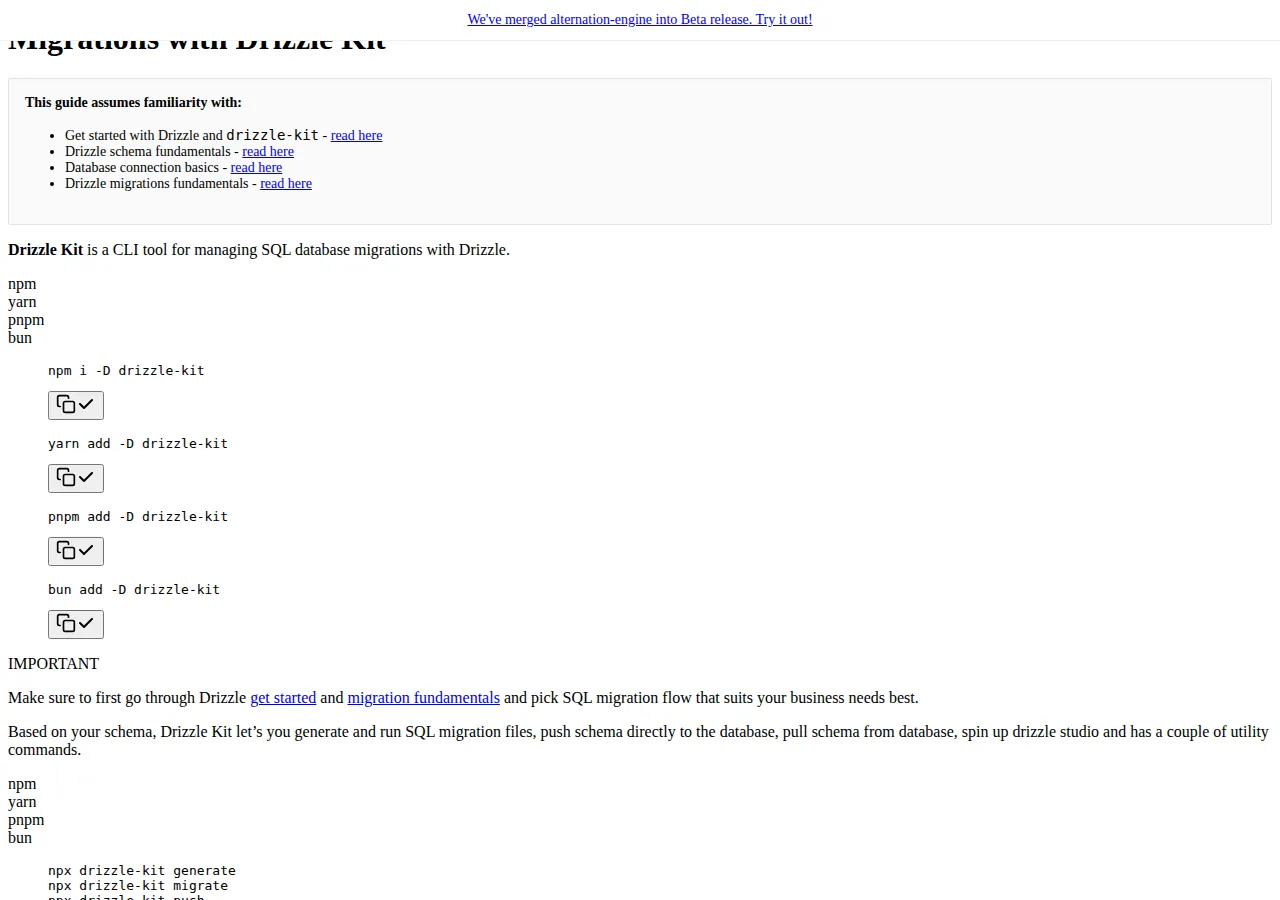
Drizzle Kit takes the opposite approach: it generates plain SQL migration files from the TS schema. The commands are generate to write the files, migrate to apply them, push to send a schema straight to the database, and pull to introspect a live database back into schema code, plus check, up, studio, and export. Because the migration is a SQL file you can read and review, a DBA can approve it, and a failed deploy leaves a readable artifact behind. The ceiling is discipline: push skips the file step, so a team that leans on it in production has no history to roll back.
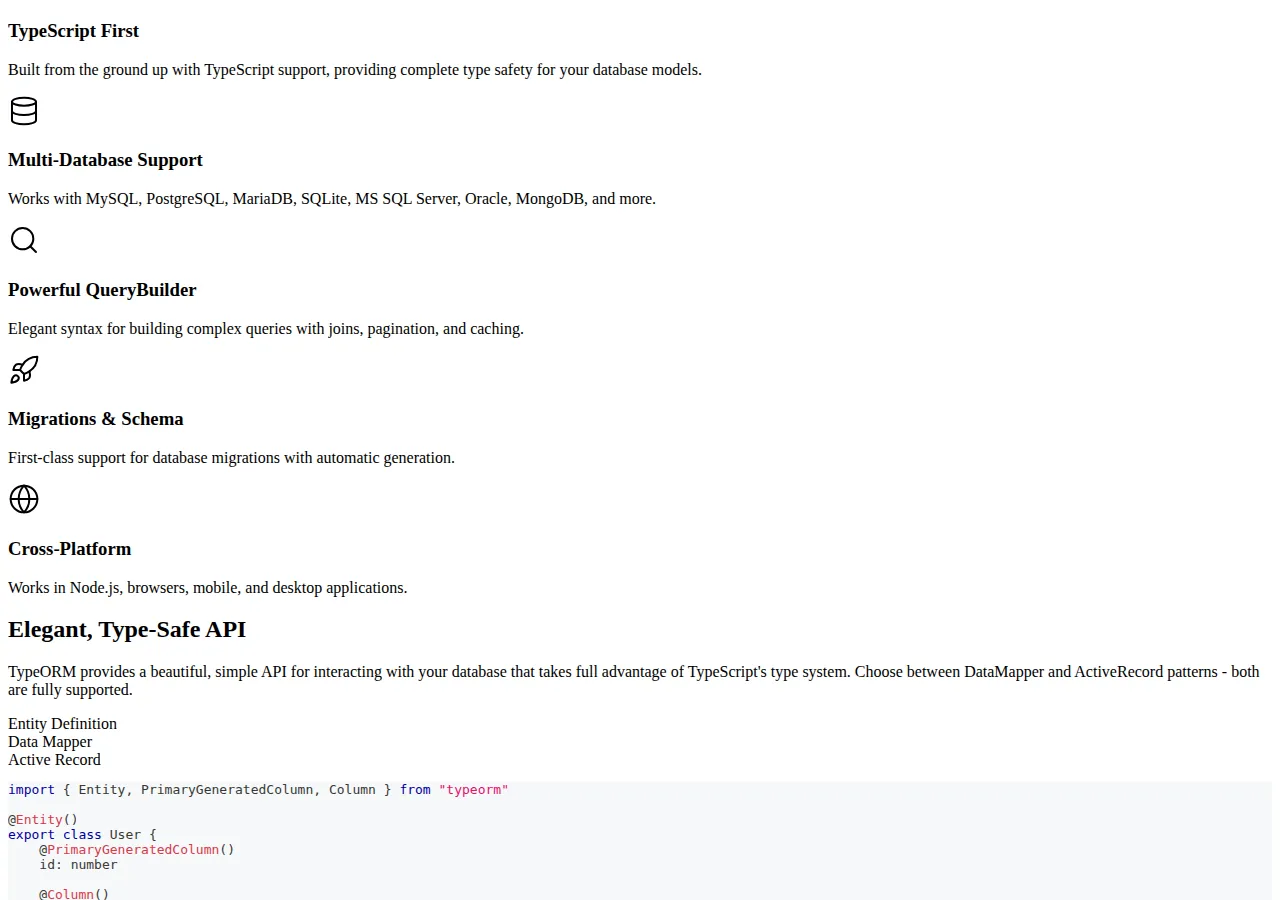
TypeORM sits between the two, with first-class migrations and automatic generation: define entities, generate a migration, review it, run it. The ceiling is breadth: TypeORM supports MySQL, PostgreSQL, MariaDB, SQLite, MS SQL Server, Oracle, MongoDB, and more from one codebase — a genuine advantage for a team running more than one engine — but each dialect gets less depth than a Postgres-only tool gives Postgres.
Step 4: Type safety — what the compiler catches
All three promise type safety in a different shape. Prisma Client is auto-generated and type-safe by construction: the vendor's overview calls it an auto-generated, type-safe query builder for Node.js and TypeScript, and the generated client carries the schema's types into every query, so a renamed column breaks the build instead of production. The cost is the generation step — in ORM 8 the emit step is npx prisma contract emit, writing files next to a contract.prisma file you commit. Prisma Studio is the one part of Prisma ORM that is not open source, and it runs locally only.
Drizzle's claim is narrower. Its docs call it the only ORM with both relational and SQL-like query APIs, and the type safety comes from the TS schema definitions themselves, not a generated client. No generation step goes stale; the types are the code you wrote. The trade: the safety is only as good as the schema definitions, and a query that drops to raw SQL through the sql operator leaves the typed world behind.
TypeORM's homepage states it plainly: built from the ground up with TypeScript support, providing complete type safety for your database models. It delivers that through decorators — @Entity(), @Column(), @PrimaryGeneratedColumn() — and supports both the DataMapper and ActiveRecord patterns, so a team picks the style that fits. The ceiling is age and surface area: TypeORM is the oldest of the three, its API surface is the widest, and its decorator-first style puts type information in metadata a reader must learn to parse.
The practical test is a rename. With Prisma, rename a field, re-emit, and the compiler lists every broken query. With Drizzle, rename a column and the compiler lists every broken reference in typed queries, while raw SQL strings stay silent. With TypeORM, rename a decorated property and the compiler catches the typed usages, while QueryBuilder strings stay silent. Mostly typed queries, and all three catch the rename; heavy on raw SQL, and none of them will save you.
Step 5: Which one to pick
The decision turns on traffic, migration discipline, and how much of your SQL is raw. A solo developer pays $0 on any of the three, so the choice is about feel: Prisma for the generated client and managed platform, Drizzle for SQL you can read, TypeORM for the widest support. A startup at 1M operations pays $10 a month on Prisma or $0 plus a host bill on the other two; the $10 buys managed Postgres, backups, and a spend limit. A scaleup at 20M operations pays $69 on Prisma Pro — whether the team's own host, backups, and on-call load cost more or less, only the real host invoice can answer.
For the database layer behind the ORM, see the Supabase vs Firebase vs PlanetScale backend pricing guide and the Postgres connection pooling playbook. For provisioning, the Terraform vs Pulumi vs AWS CDK pricing guide prices the tools that create the database the ORM talks to.
Step 6: The decision checklist
Work through these steps before you commit to one of the three:
- [x] Count one week of real Postgres operations against the 200,000, 1M, 10M, and 50M boundaries.
- [x] List every database engine the product must support next year, and strike any ORM that lacks it.
- [x] Count the raw SQL queries in the codebase; raw strings escape the type safety of all three tools.
- [x] Run one migration end to end in each finalist; keep the one whose failure mode your team understands.
- [x] Price the host bill for the Drizzle or TypeORM path, backups and VPS included, against Prisma's $10, $49, or $129 tiers.
- [x] Set the spend limit on any paid Prisma plan on day one, with a tripwire at 200,000 operations.
- [x] Check the ORM version your tutorials target: ORM 8 renamed the migration commands.
Founder & CEO Insight — Enow A. Jovial
What this guide does not cover
Three gaps are worth naming. First, Drizzle Studio has no verified price here because the vendor pages I could read this cycle do not publish one; treat any Studio figure elsewhere as unverified. Second, the Drizzle and TypeORM totals cover the ORM line only — host, backups, and monitoring are a separate bill, because host prices vary by provider and region. Third, this guide uses Prisma's published list prices as read on 2026-11-12, and Prisma bills usage, so a traffic spike costs more than the base tier price. Nothing here is a benchmark: no load test was run.