Pinterest and Snapchat sit at opposite ends of the same question. Pinterest reaches people while they plan a purchase; Snapchat reaches people while they live their social life. Both sell to ecommerce brands, both run on auctions, and neither publishes a rate card — so this guide lines up third-party benchmarks from the same year and runs the same budget through both sets of numbers.
Every figure below comes from a benchmark opened in November 2026: AdLiftr's 2,431 Snapchat campaigns, February 1 to May 28, 2026, and the WebFX survey plus AdBacklog table for Pinterest, published August 20, 2026.
Why it matters
Pinterest is a planning tool: people save sofas, dresses, and skincare routines for later. Snapchat is a messaging and camera app built on short vertical video. Pinterest traffic arrives with intent and converts slowly; Snapchat traffic arrives cheap and converts only when the creative earns the swipe. A brand that buys one expecting the other's behaviour will misread both dashboards.
> [!FOUNDER]
> Most advertisers pick a platform the way they pick a restaurant: by what their friends liked. The right test is arithmetic. If your gross margin is 50 percent and your average order is 60 dollars, your break-even cost per acquisition is 30 dollars. Any channel that cannot beat that number is not a growth channel for you, however cheap its clicks look. Run that number before you open either Ads Manager.
> — Enow A. Jovial, Founder & Chief Executive Officer
What Pinterest ads actually cost in 2026
Pinterest sells by auction, so there is no published price list. The WebFX survey of active Pinterest marketers, republished by Cropink in August 2026, puts the middle range at 21 cents to 2.00 dollars per click, 1.51 to 7.00 dollars per 1,000 impressions, and 4.01 to 16.00 dollars per conversion. Trackbee's 2026 guide agrees: 50 cents to 1.50 dollars per click and 3 to 10 dollars per 1,000 impressions.
The industry table below, from AdBacklog's global benchmarks republished by Cropink, shows how far those ranges move by vertical.
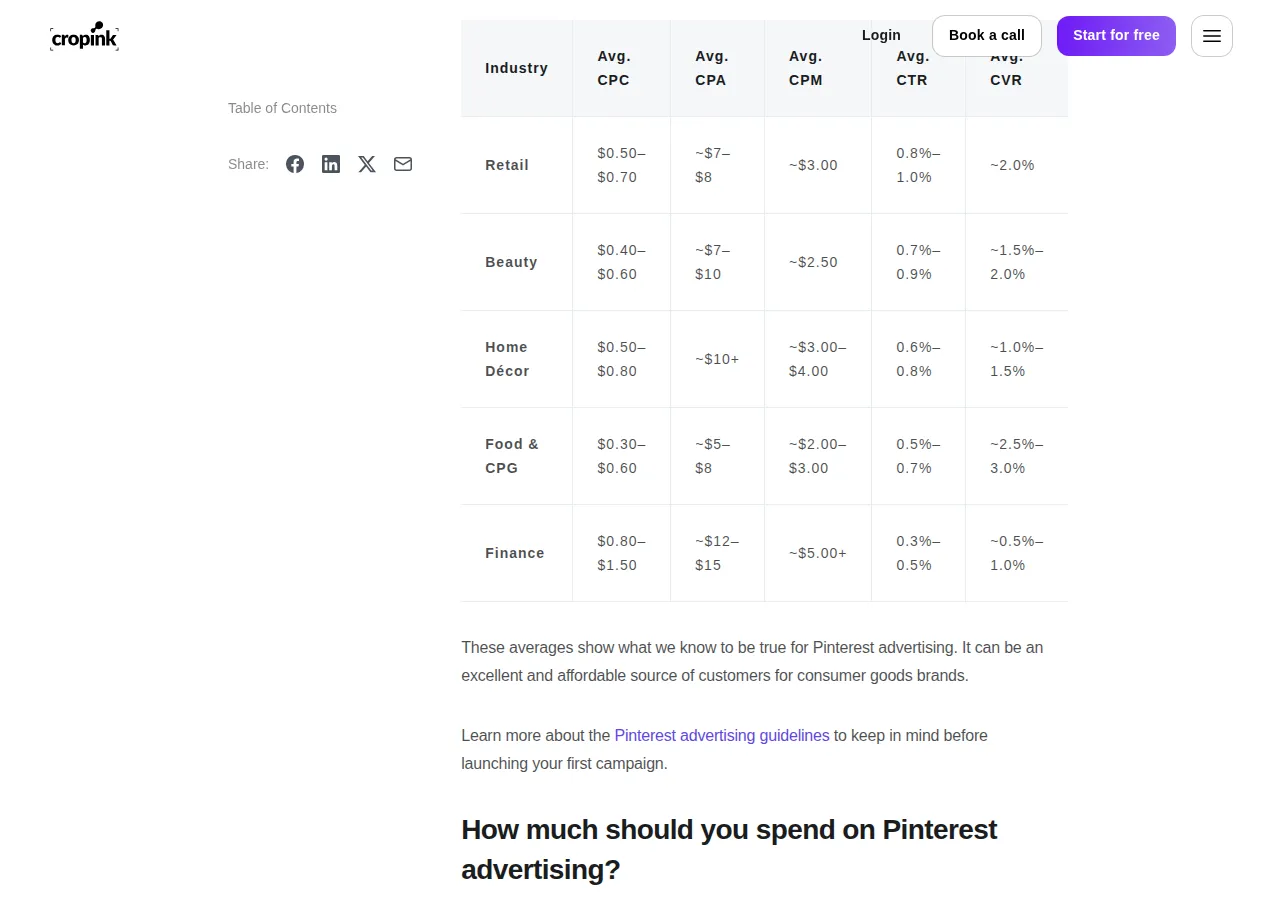
The table does not fully reconcile with itself: a 50 to 70 cent click at a 2.0 percent conversion rate implies a 25 to 35 dollar cost per acquisition, yet the same retail row lists 7 to 8 dollars. Those numbers come from different samples inside one benchmark, so treat the cost-per-acquisition row as the planning figure. Our editorial analysis found the same mismatch in most blended Pinterest tables.
Pinterest's own help documentation lists four shopping ad types once a catalog is uploaded: standard, video, personalized collections, and carousel. A business account, a product catalog, and product groups are prerequisites. Pinterest also reports that shopping ads deliver roughly 15 percent higher return on ad spend and 2.6 times the conversion rate versus not running them — a vendor claim, not an independent benchmark.
What Snapchat ads actually cost in 2026
Snapchat's numbers are stronger because they come from one documented sample: AdLiftr aggregated 2,431 campaigns across 412 advertisers from February 1 to May 28, 2026, totalling 11.4 million dollars in spend, and published medians with 25th to 75th percentile ranges.
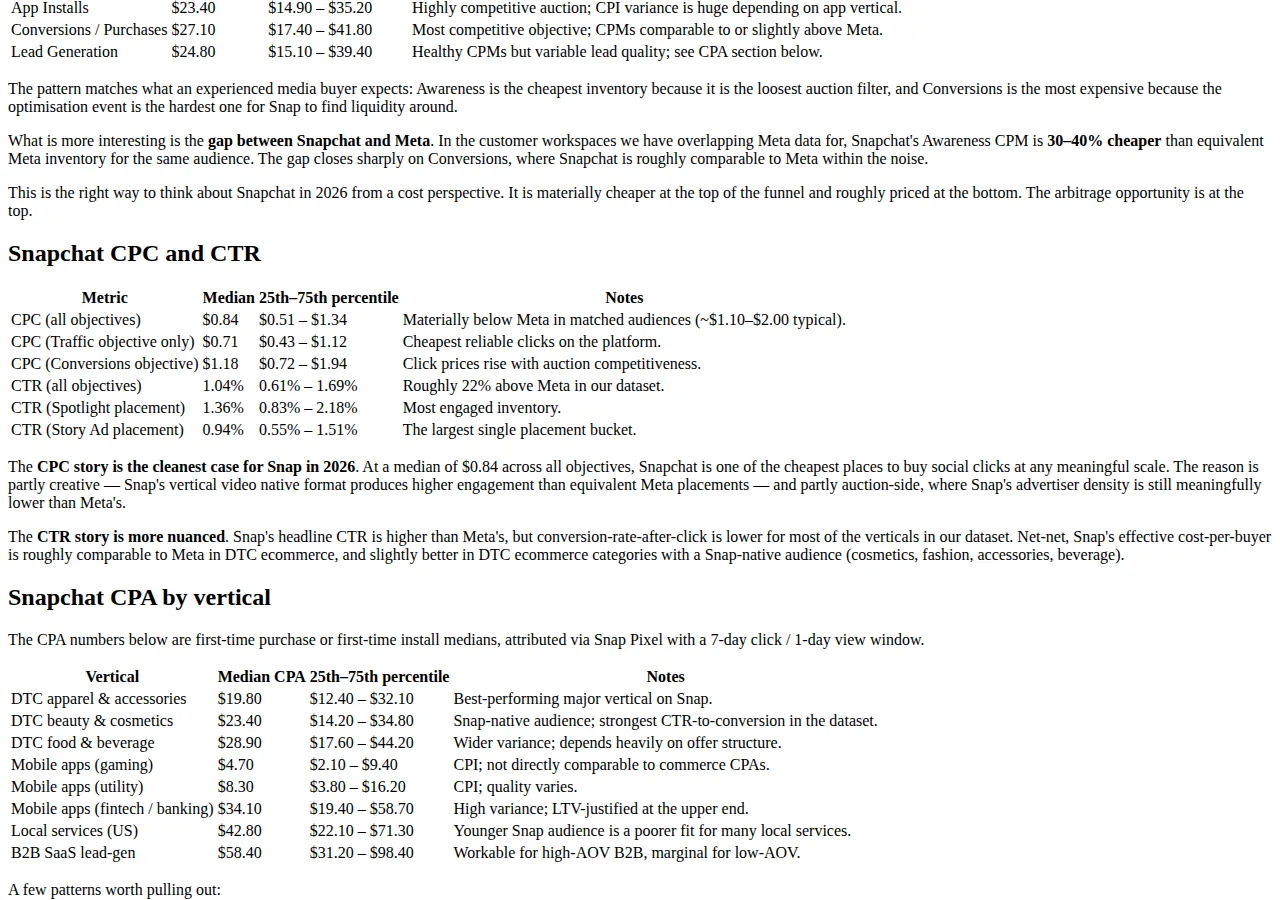
Median cost per 1,000 impressions by objective: awareness 5.84 dollars, traffic 11.20 dollars, engagement 9.10 dollars, catalog sales 19.40 dollars, app installs 23.40 dollars, lead generation 24.80 dollars, and conversions or purchases 27.10 dollars. Awareness is roughly 35 percent cheaper than equivalent Meta inventory in AdLiftr's overlapping dataset; conversions are roughly comparable to Meta.
Median cost per click across all objectives is 84 cents. Traffic-objective clicks are cheapest at 71 cents; conversion-objective clicks rise to 1.18 dollars. Median click-through rate is 1.04 percent overall, 1.36 percent on Spotlight, and 0.94 percent on Story Ads.
Median cost per acquisition for first-time purchasers, on a 7-day click and 1-day view window: DTC apparel and accessories 19.80 dollars, DTC beauty and cosmetics 23.40 dollars, and DTC food and beverage 28.90 dollars. The top quartile pays under 14 dollars; the bottom quartile pays over 48 dollars — a spread AdLiftr attributes mostly to creative quality, not to the platform.
The decision table
| Decision | Pinterest | Snapchat | Authority |
| --- | --- | --- | --- |
| Cheapest impressions | 3 to 10 dollars per 1,000 | 5.84 dollars awareness, 27.10 dollars conversions | Trackbee 2026; AdLiftr 2026 |
| Cheapest clicks | 50 cents to 1.50 dollars | 84 cents median, 71 cents traffic | Trackbee 2026; AdLiftr 2026 |
| Cheapest first purchase | Retail about 7 to 8 dollars | Apparel 19.80 dollars, beauty 23.40 dollars | AdBacklog via Cropink; AdLiftr 2026 |
| Best audience | Planners, 631M monthly users | Under-35 users, 483M daily users | Pinterest Q1 2026; Snap Q1 2026 |
| Attribution window | 30-day click, 1-day view | 7-day click, 1-day view | Growth-onomics; AdLiftr 2026 |
> [!KEY TAKEAWAY]
> Pinterest wins on cheap impressions and cheap first purchases in retail, beauty, and home goods. Snapchat wins on cheap clicks and on apparel and beauty brands whose buyers are under 35. Snapchat's conversion cost per 1,000 impressions is roughly 4.6 times its awareness price, so the objective matters more than the platform.
Audience and targeting
Pinterest reported 631 million monthly users in the first quarter of 2026 and reaches around 40 percent of United States households earning over 150,000 dollars. Searches are often unbranded: people look for a style of lamp, not a lamp brand. Shopping ads need little extra targeting once the catalog is uploaded — Pinterest uses product data to show relevant products to people browsing product Pins.
Snapchat reported 483 million daily users and 956 million monthly users in the first quarter of 2026. The audience skews young; AdLiftr's best-performing verticals are apparel, beauty, accessories, and beverage. B2B software lead generation posts a 58.40 dollar median cost per acquisition in the same dataset, and local services sit at 42.80 dollars — both poor fits for an audience that is mostly under 35.
Creative formats that move the numbers
On Pinterest, the catalog is the creative. Standard shopping ads pull a product image, price, and title straight from the feed and deep-link to the product page. Video shopping ads add motion for products that need demonstration. Collections ads pair a hero lifestyle image with a product grid, and carousel ads tell a multi-product story in chapters.
On Snapchat, format and length decide the price. AdLiftr segmented the same 2,431 campaigns by creative. Vertical video under 7 seconds posts a 9.40 dollar median cost per 1,000 impressions, a 1.42 percent click-through rate, and a 19.80 dollar DTC cost per acquisition. Stretch that video past 30 seconds and the same three numbers become 16.40 dollars, 0.52 percent, and 39.20 dollars. A landscape image repurposed from another platform is worst of all: 15.10 dollars per 1,000 impressions, 0.41 percent click-through, and a 43.80 dollar cost per acquisition. Collection ads at 26.10 dollars and Story ads at 22.30 dollars per acquisition sit near the top of the range.
Start on Stories, which carry 64 percent of impressions at a 22.40 dollar cost per acquisition; test Spotlight, at 19.80 dollars, once the creative is short and vertical.
Attribution windows: the quiet reason the two dashboards disagree
Pinterest's default reporting window is 30-day click and 1-day view, configurable up to 30 days on click, engagement, and view. Snapchat attributes first-time purchases on a 7-day click and 1-day view window through the Snap Pixel. Around 75 percent of Pinterest conversions happen a week after ad exposure, and up to 95 percent of conversions tracked by the Pinterest tag are attributed to views rather than clicks. Snapchat's window is short because its behaviour is short: a user swipes, watches a few seconds, and either buys or moves on.
Compare the two platforms on the same window, in your own analytics, before you move budget. If you compare Pinterest's 30-day view-attributed return against Snapchat's 7-day click-attributed return, Pinterest will always look better and the comparison will be worthless. Hold both to a 7-day click window for the head-to-head, then let each platform keep its native window for its own optimisation.
The ROAS math, worked twice
Use the same 3,000 dollar month on both platforms. The arithmetic is shown in full; replace the assumptions with your own numbers before you spend.
Snapchat, apparel, conversions objective. At a 27.10 dollar cost per 1,000 impressions, 3,000 dollars buys 110,701 impressions. At a 1.18 dollar conversion-objective cost per click, it buys 2,542 clicks. At the apparel median cost per acquisition of 19.80 dollars, it buys 151 orders. At a 65 dollar average order value, those orders produce 9,815 dollars of revenue.
$
\text{ROAS} = \frac{\text{Revenue}}{\text{Ad spend}} = \frac{151 \times \$65}{\$3{,}000} = \frac{\$9{,}815}{\$3{,}000} = 3.27
$
$
\text{CPA} = \frac{\text{Spend}}{\text{Orders}} = \frac{\$3{,}000}{151} = \$19.87
$
The 19.87 dollar figure sits a few cents above the 19.80 dollar median because 151 whole orders cost 2,989.80 dollars, not the full 3,000.
Pinterest, retail, using the cost-per-acquisition row of the AdBacklog table. At a 7.50 dollar midpoint, 3,000 dollars buys 400 orders. At a 45 dollar average order value, those orders produce 18,000 dollars of revenue, a 6.00x return. Across the full 7 to 8 dollar range, the return runs from 5.63x to 6.42x. The Pinterest figure is higher, but it rests on a cost-per-acquisition row that does not reconcile with the same table's click and conversion-rate rows, so treat it as a planning range and verify it against your own account.
$
\text{Break-even ROAS} = \frac{1}{\text{Gross margin}} = \frac{1}{0.60} = 1.67
$
$
\text{Break-even CPA} = \text{Average order value} \times \text{Gross margin} = \$65 \times 0.60 = \$39.00
$
At a 60 percent gross margin, any return above 1.67x is profitable and any cost per acquisition below 39.00 dollars is profitable. Snapchat apparel at 19.80 dollars clears that line with 19.20 dollars of headroom per order; Pinterest retail at 7 to 8 dollars clears it by more. The margin, not the platform, sets the bar.
> [!WARNING]
> Do not copy a benchmark cost per acquisition into a forecast and call it a plan. The AdLiftr top quartile pays under 14 dollars on Snapchat while the bottom quartile pays over 48 dollars for the same first purchase, and the difference is mostly creative quality and budget, not luck. A forecast built on a median without a range is a promise the median never made.
Budgets and the learning phase
Pinterest's rule, from its own guidance and repeated by Trackbee, is to set the daily budget to at least 4 to 5 times the target cost per acquisition: 30 to 37.50 dollars a day at a 7.50 dollar target. Below that threshold the campaign starves. A realistic test budget is 10 to 50 dollars a day, with at least 20 dollars a day for conversion campaigns, and a two to four week window before judging the channel.
Snapchat's floor is lower and its learning phase is harsher. The platform allows a 5 dollar daily minimum, but AdLiftr's data shows campaigns spending under 20 dollars a day exit the learning phase only 8 percent of the time within two weeks. At 20 to 50 dollars a day the median exit takes 7.4 days and 24 percent find a stable cost per acquisition in 14 days; at 50 to 100 dollars a day, 5.1 days and 41 percent; at 100 to 250 dollars a day, 3.2 days and 67 percent. The pragmatic minimum for a conversion campaign is 50 to 100 dollars a day, and the comfortable minimum is 250 dollars a day or more.
Plan the test as one month per platform: Pinterest needs time for saves to turn into purchases, and Snapchat needs daily spend high enough to exit learning inside a week. A 3,000 dollar month split as 1,500 dollars per platform gives Snapchat 50 dollars a day — the bottom of its workable range. A 1,000 dollar month does neither.
Launch checklist
> [!TIP]
> Run the two platforms on different jobs: Pinterest gets the full catalog and the long window to find planners; Snapchat gets short vertical video to find buyers under 35. Ask either platform to do the other's job and the benchmarks above stop applying to you.
Who should NOT run either platform
Pinterest is the wrong buy for a brand whose buyers decide in minutes rather than days, for low-margin products under 20 dollars, and for any store without a clean product catalog.
Snapchat is the wrong buy for luxury goods, for B2B lead generation below a high average order value, and for any brand that cannot produce short vertical video. A 58.40 dollar median cost per acquisition for B2B software leads and a 42.80 dollar median for local services show what happens when the audience and the offer do not match. It is also the wrong buy at 5 or 10 dollars a day: the campaign will not exit learning.
The verdict
For most ecommerce brands, the answer is Pinterest first and Snapchat second. Pinterest's retail cost per acquisition near 7 to 8 dollars makes it the cheaper discovery channel for home goods, beauty, fashion, and food. Snapchat's 84 cent median click and 19.80 dollar apparel cost per acquisition make it the sharper channel for brands whose buyers are under 35 and whose team can shoot native vertical video under 7 seconds.
For the wider paid-social picture, the Google Ads vs Meta Ads ROAS playbook runs both auctions on the same 3,000 dollar budget, the TikTok Ads vs Meta Ads ecommerce ROAS playbook prices both on the same 10,000 dollar month, and the YouTube Ads vs TikTok Ads video ROAS playbook compares video-first buying. Before you commit, run your own break-even line through the ROI calculator.