A creator selling a $20 ebook keeps $18.50 after Paddle or Lemon Squeezy take their cut on a domestic card sale, $17.00 on Gumroad, and $13.50 through Gumroad Discover. The headline rate is only the first of five charges that decide what lands in your bank account: the surcharges, the fee base, the payout fees, the payout lag, and the minimum threshold that can hold a small seller's money for a month.
Paddle and Lemon Squeezy both charge 5% + 50¢ per transaction with no monthly fee; Gumroad charges 10% + 50¢ direct and 30% + 50¢ through Discover. The tie breaks on surcharges — Lemon Squeezy adds 1.5% international, 1.5% PayPal, and 0.5% on subscriptions, and computes its percentage on the tax-inclusive total — while payouts run fastest on Gumroad (weekly), twice-monthly on Lemon Squeezy, and monthly on Paddle.
What merchant of record actually means
All three platforms sell as the merchant of record. It collects payment, issues the receipt, absorbs fraud and chargeback liability, and collects and remits the sales tax or VAT for the buyer's jurisdiction. Paddle's page describes payments, checkout, and billing in one platform with global tax compliance. Lemon Squeezy's docs say the same: the platform fee covers card transaction fees, currency conversion, and taxes. Gumroad's pricing page states that since January 1, 2025 it handles all tax obligations worldwide as merchant of record.
Doing it yourself means registering for sales tax in dozens of jurisdictions, which no solo creator does. The comparison is between three bundled offers that each include tax handling, fraud protection, and checkout. The merchant-of-record versus direct merchant account comparison works the same trade-off for a whole business.
The headline rates, from the vendors' own pages
| Platform | Headline fee | Monthly fee | Tax handling | Authority |
|---|---|---|---|---|
| Paddle | 5% + 50¢ per checkout transaction | None | Included, global | Paddle Pricing |
| Lemon Squeezy | 5% + 50¢ per transaction | None | Included, global | Lemon Squeezy Pricing; LS Docs: Fees |
| Gumroad direct | 10% + 50¢ per transaction | None | Included since Jan 1, 2025 | Gumroad Pricing |
| Gumroad Discover | 30% + 50¢ per transaction | None | Included since Jan 1, 2025 | Gumroad Pricing |
Paddle adds one qualification its rivals do not print: for products under $10, and for high-volume businesses, it offers bespoke pricing on request — the published 5% + 50¢ is the standard rate. Lemon Squeezy prints the same qualification for fast-growing or large-scale businesses, products under $10, or high transaction volumes.
The per-sale net on a domestic card sale follows one formula:
At $20 that is $20 − $1.50 = $18.50 before tax is considered. Note the tax subtlety below: Lemon Squeezy's percentage is computed on the tax-inclusive total. Our editorial analysis found no Paddle example showing whether its 5% applies to the listed price or the tax-inclusive total, so the Paddle math here applies the rate to the listed price.
The Lemon Squeezy surcharges, worked from its own example
The platform fee is calculated on the total order value, and three surcharges stack on top of it: +1.5% for international (outside the US) transactions, +1.5% for PayPal transactions, and +0.5% for subscription payments. Its worked example is a buyer in France paying 20% VAT on a $20 digital product:
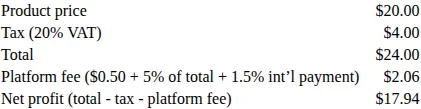
The fee arithmetic in that example is:
Two things matter here. First, the 5% is charged on $24.00, the tax-inclusive total — not on the $20.00 product price. Second, the effective rate on the product price is $2.06 / $20.00 = 10.3%, more than double the headline 5%. A mostly European audience therefore pays a materially higher effective rate, because the fee base includes VAT the creator never keeps.
The same $49 course through all three
Take a $49 course, 200 sales in a month, all domestic card payments except where a row says otherwise. The Stripe versus Paddle merchant-of-record comparison prices the same surcharge-stacking question for the SaaS side of Paddle's business.
| Scenario | Fee per sale | Net per sale | Monthly net (200 sales) | Authority |
|---|---|---|---|---|
| Paddle, card | $0.50 + 5% × $49 = $2.95 | $46.05 | $9,210.00 | Paddle Pricing |
| Lemon Squeezy, card | $0.50 + 5% × $49 = $2.95 | $46.05 | $9,210.00 | LS Docs: Fees |
| Lemon Squeezy, PayPal | $0.50 + 5% × $49 + 1.5% × $49 = $3.69 | $45.32 | $9,063.00 | LS Docs: Fees |
| Lemon Squeezy, subscription renewal | $0.50 + 5% × $49 + 0.5% × $49 = $3.20 | $45.80 | $9,161.00 | LS Docs: Fees |
| Gumroad direct | $0.50 + 10% × $49 = $5.40 | $43.60 | $8,720.00 | Gumroad Pricing |
| Gumroad Discover | $0.50 + 30% × $49 = $15.20 | $33.80 | $6,760.00 | Gumroad Pricing |
The worked totals come from the per-sale formula applied 200 times:
Paddle and Lemon Squeezy tie exactly on domestic card sales: $9,210.00. PayPal costs $147.00 a month extra on Lemon Squeezy ($9,210.00 − $9,063.00). Gumroad direct costs $490.00 a month more ($9,210.00 − $8,720.00). Discover costs $2,450.00 a month more ($9,210.00 − $6,760.00) — more than a quarter of the month's revenue handed to the marketplace. Discover is only defensible when the buyer is incremental.
Scale the same math to a year at $5,000 a month of revenue in $25 sales — 2,400 a year:
The gap is $3,000 a year — 5% of the entire year's revenue — for the same product, the same buyers, and the same tax handling. That is the number that should drive the decision past the first few hundred dollars a month.
Getting paid: the clock and the floor
The fee is only half the economics. The other half is when the money arrives and how much must accumulate before it moves.
| Platform | Payout cadence | Hold before payout | Minimum payout | Payout fee | Authority |
|---|---|---|---|---|---|
| Paddle | Monthly | None stated; balance converts on the 1st | $100, adjustable to $100,000 | $15 SWIFT fee in some countries | Paddle Help: When and how do I get paid? |
| Lemon Squeezy | Twice monthly | 13 days | $50 | US bank free; non-US bank 1%; US PayPal $0.50; non-US PayPal 3%, max $30 | LS Docs: Getting Paid; LS Docs: Fees |
| Gumroad | Daily, weekly, monthly, or quarterly (your choice) | 7 days on weekly, monthly, quarterly | $100 | Bank free; PayPal 2% | Gumroad Help: Getting paid |
Paddle's cycle is the slowest and the most rigid. There is no on-demand withdrawal. On the 1st of the month, if your balance clears the threshold you set (minimum $100, maximum $100,000), it converts to a payout and enters the in-progress queue. Paddle sends it by the 15th, and it takes up to 3 working days after that to arrive, by wire transfer or Payoneer. A sale on the 2nd therefore waits until the 1st of the next month to convert, then until the 15th to be sent — roughly six weeks from sale to bank.

Lemon Squeezy is twice as fast and fully automatic. Payouts are created on the 1st and 15th, net sales are held 13 days, and the money is paid out on the 14th and 28th, taking 1 to 5 days to appear in your bank. The docs' example: a sale on the 4th joins the payout created on the 15th and is paid on the 28th — 24 days from sale to payout, plus transit. The $50 minimum is the lowest of the three. Payout fees are the quiet cost: free to a US bank, but 1% to a bank outside the US, $0.50 to a US PayPal account, and 3% capped at $30 to a PayPal account outside the US.
Gumroad is the fastest and the most flexible. You choose daily, weekly, monthly, or quarterly payouts and set your own threshold above the $100 minimum. On the weekly, monthly, and quarterly schedules each sale waits a minimum of 7 days in your balance, and every payout covers sales made through the previous Friday (UTC). Your payout day depends on how you are paid: Thursday for US bank accounts, Friday for PayPal and connected Stripe accounts, Wednesday for euro accounts, Tuesday for most other countries. Bank payouts take 2 to 7 business days; PayPal payouts arrive in 1 to 3 business days with a 2% payout fee. US creators can also use instant payouts up to $10,000 for a 3% fee. Gumroad pays no Payoneer, Wise, check, or wire — bank deposit or PayPal only.
The payout minimums bite hardest exactly when a creator is smallest. A Gumroad seller earning $60 in a month receives nothing that month — the $100 minimum holds it. A Paddle seller with the same $60 waits until the balance crosses $100, which at that run rate is a second month. Before choosing on fees alone, model your first three months of expected revenue against each platform's floor.
What each platform is actually for
The fee tables suggest a three-way tie with a clear loser, but the products are built for different sellers, and the right choice follows the seller, not the rate card.
Paddle is built for software and SaaS. Its checkout, subscription management, invoicing, and fraud protection are designed around recurring billing, and its customer stories are SaaS companies. A creator selling one-off digital products can use it, but the monthly payout cycle and the SaaS-shaped tooling are a poor fit for a stream of small one-off sales. Choose Paddle if you sell software or subscriptions and can live with monthly payouts.
Lemon Squeezy is built for software makers and digital-product sellers who want a storefront, license keys, discount codes, and an email list in the same place — email marketing is free up to 500 subscribers. Choose it if you sell digital downloads or software and your buyers are mostly domestic card payers.
Gumroad is built for creators with an audience. Its advantage is not price — it is the most expensive per sale by a wide margin — but distribution through Discover and the fastest payouts. The Patreon versus Ko-fi versus Gumroad comparison covers the same audience-first logic from the membership side: when the audience is the asset, the platform that reaches it wins even at a higher rate. Choose Gumroad if your buyers already find you through Gumroad, if weekly cash flow matters more than a few points of fee, or if you are starting from zero and want the simplest possible setup.
Who should not use each one
Do not choose Paddle if you need the money weekly — there is no faster rail, and no on-demand withdrawal. Do not choose Lemon Squeezy if your buyers are predominantly outside the US and pay by PayPal, because the stacked 1.5% surcharges and the tax-inclusive base quietly raise the effective rate above Gumroad's direct rate on some European sales. Do not choose Gumroad if you sell subscriptions at volume: the 10% rate compounds monthly against the same customer, and there is no volume tier to grow into. Do not choose any of them if you sell physical goods at scale — all three are built for digital products and software.
Run your own numbers before migrating: take last month's sales, split them by buyer country and payment method, and apply each platform's published fee rules line by line. The headline tie between Paddle and Lemon Squeezy survives only for domestic card sales — one European PayPal buyer in four is enough to make Paddle cheaper.
Execution checklist
- List last month's sales by country and payment method: the split decides the winner, not the headline rate.
- Apply the fee rules to your own mix: 5% + 50¢ Paddle and Lemon Squeezy domestic card; +1.5% international, +1.5% PayPal, +0.5% subscription on Lemon Squeezy; 10% + 50¢ direct, 30% + 50¢ Discover.
- Price the tax-inclusive base on Lemon Squeezy: where VAT applies, the percentage is charged on the total including tax.
- Model the payout floor: $100 on Paddle and Gumroad, $50 on Lemon Squeezy; check your first three months clear it.
- Add the payout fee: 1% to a non-US bank on Lemon Squeezy, 2% to PayPal on Gumroad, $15 SWIFT in some countries on Paddle.
- Count the Discover share honestly: only sales that would not have happened without the marketplace justify 30%.
- Check the subscription migration cost: moving subscribers is the expensive step; one-off sales move freely.
- Ask about custom pricing for under-$10 products or high volume: both publish the invitation.
Founder & CEO Insight — Enow A. Jovial
Related reading: the Stripe versus Paddle merchant-of-record comparison prices the same decision for SaaS teams; the merchant-of-record versus direct merchant account comparison works the unit economics of handing the sale to a platform; and the Patreon versus Ko-fi versus Gumroad comparison covers the audience-first side. Check the per-sale math against your own prices with the pricing calculator before you migrate.