Odoo vs ERPNext vs NetSuite: The ERP Pricing Playbook for 5, 25, and 100 Users
Odoo vs ERPNext vs NetSuite: The ERP Pricing Playbook for 5, 25, and 100 Users
Picking an ERP on sticker price is how a $9,000 license turns into a $90,000 year. Odoo charges per user with every app included. ERPNext charges nothing for the software and bills hosting by compute. NetSuite publishes no price at all and quotes every deal. This playbook prices all three at 5, 25, and 100 users.
How each vendor charges
Odoo sells Enterprise as a per-user subscription with all apps in one price. One App Free costs $0 for a single app with unlimited users. Standard costs $24.90 per user per month for the first 12 months on annual billing, renewing at $31.10. Custom costs $49.00 per user per month for the first 12 months, renewing at $61.00. Monthly billing costs about 25 percent more: Standard $31.10 then $38.90, Custom $61.10 then $76.20. A Light User tier at $8.90 per user per month (corroborated-secondary; not on the fetched pricing page) covers staff with restricted access. These are US list prices from Odoo's pricing page, read November 11, 2026, and confirmed against independent 2026 reads. Prices vary by country.
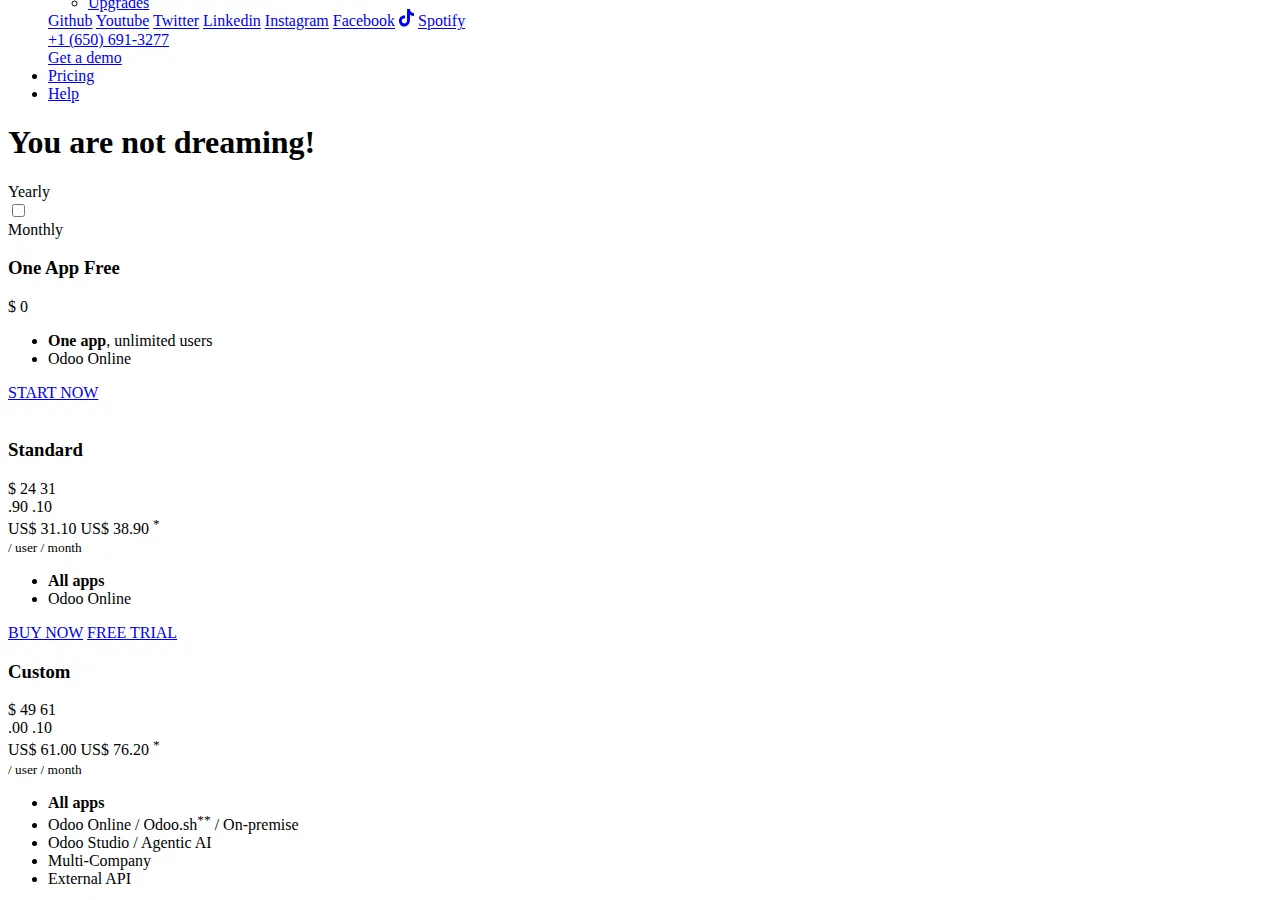
The split is about rights, not apps. Standard includes every app and Odoo Online hosting. Custom adds Studio, multi-company, external API access, and the choice of Odoo Online, Odoo.sh, or on-premise hosting; Standard allows no custom modules. That is the usual reason a Standard buyer moves up: the day you need a custom module, an API integration, or a second company, Standard stops being an option. Odoo 20 arrived in September 2026; Custom rose about 20 percent while Standard stayed put.
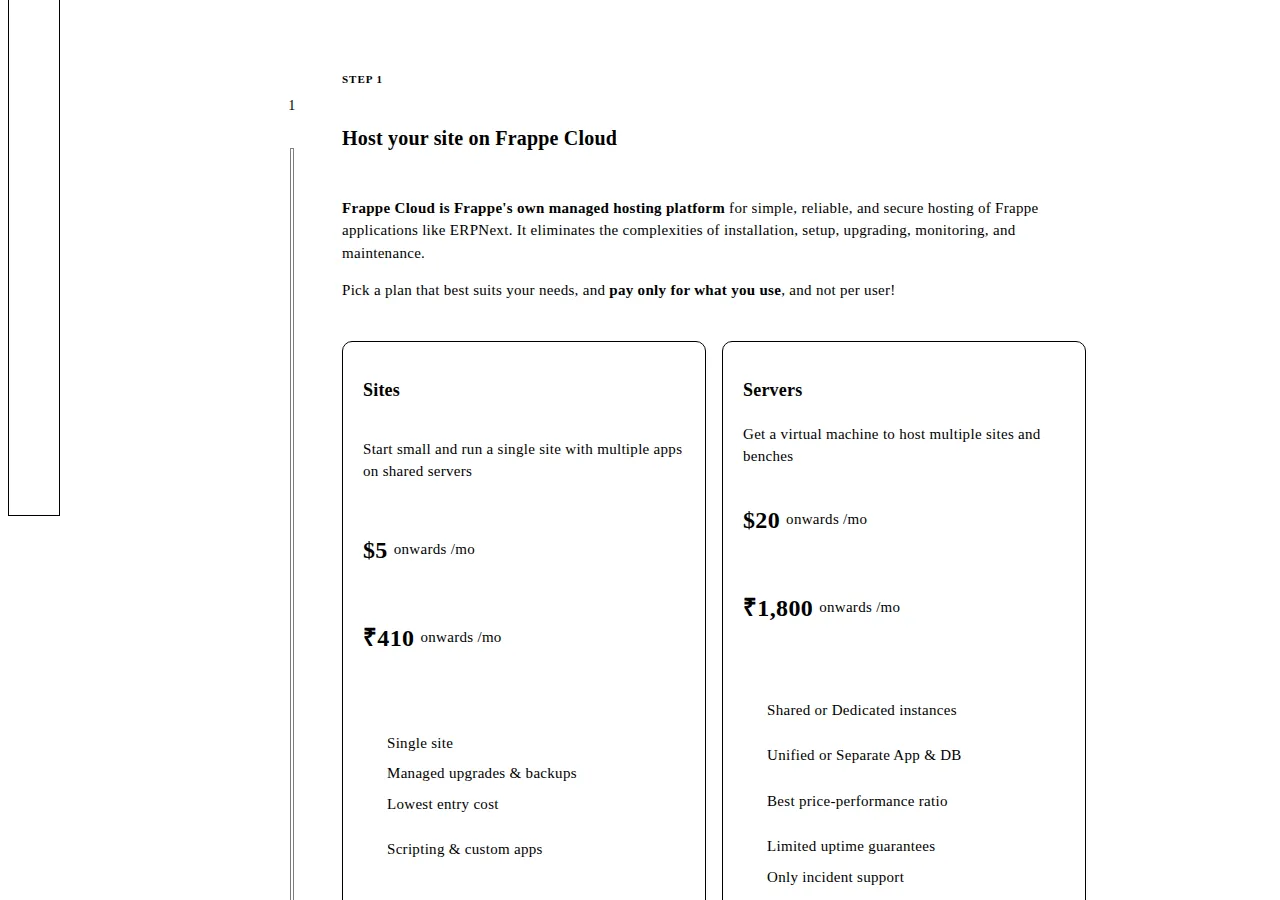
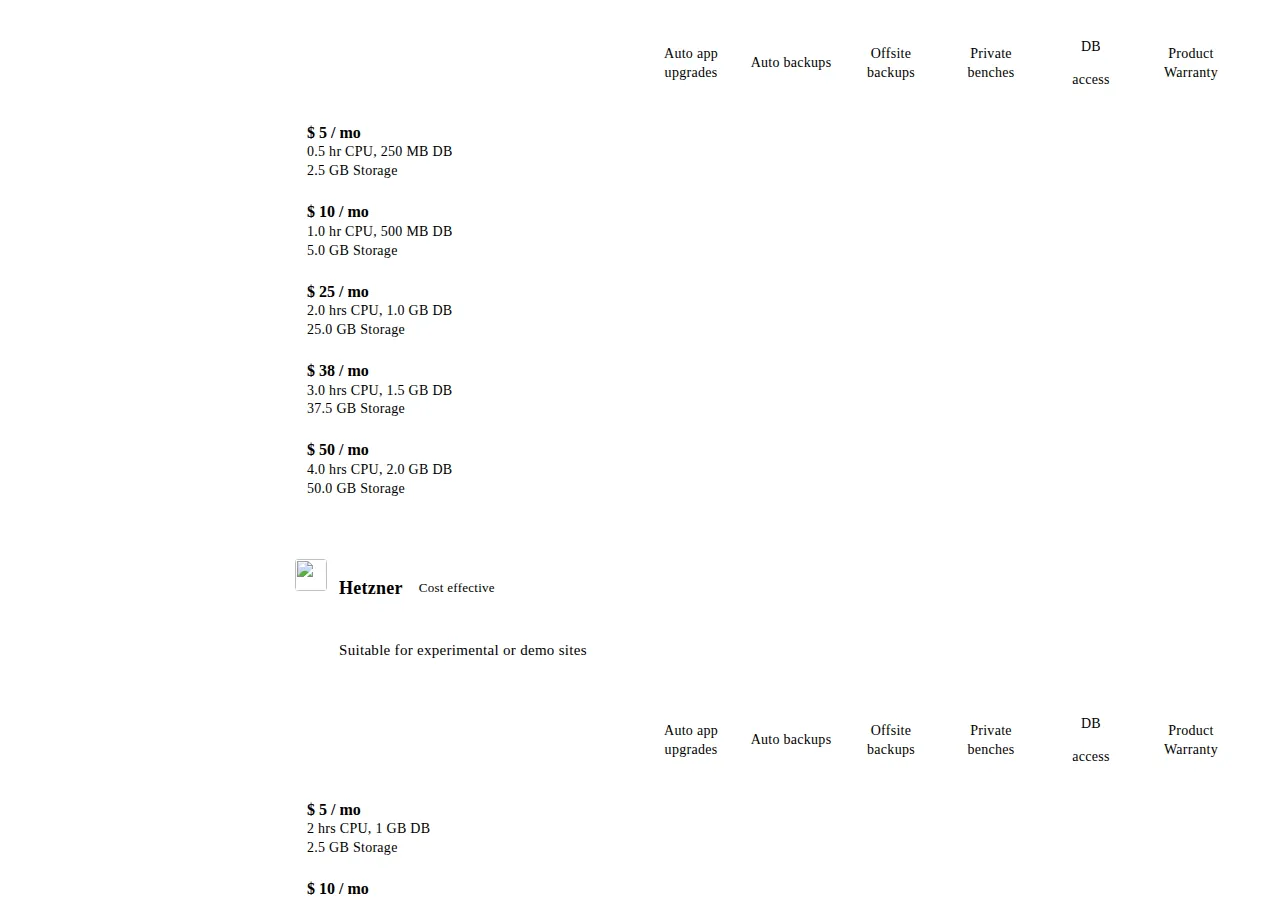
ERPNext charges nothing for the software itself. The license is GPLv3, every feature is included, and there is no per-user fee at all. What you pay for is hosting, support, and implementation. Frappe Cloud, the vendor's own managed hosting, prices sites by compute rather than by headcount: $5, $10, $25, $38, and $50 a month, with CPU hours per day rising from 0.5 to 4.0 and storage from 2.5 GB to 50 GB. Sites carry no user limit; the ceiling is CPU hours per day. Private bench sites start at $25 a month, standard support at $50, and premium dedicated hosting at $400. Self-hosting is the other route: free software, your server, your DevOps work.
NetSuite is the opposite of transparent. Oracle publishes no NetSuite price list, and every deal is quoted and negotiated. Three attempts to open NetSuite's pricing pages returned HTTP 403, so the figures here come from two independent 2026 guides that agree, and every NetSuite number below is a planning range, not a vendor fact. The guides agree: a base platform license of about $999 a month, full-user licenses of $125 to $199 per user per month, self-service licenses of $15 to $25, and a 10-user minimum. Modules run $550 to $1,550 a month each, per one guide.
The monthly math at 5, 25, and 100 users
The Odoo formula is users times the per-user rate times 12 months; the intro rate applies to the first 12 months on initial users.
5 users: Standard $124.50 a month in year one ($1,494 a year), renewing at $155.50 a month ($1,866 a year); Custom $245.00 a month ($2,940 a year), renewing at $305.00 a month ($3,660 a year). 25 users: Standard $622.50 a month ($7,470 a year), renewing at $777.50 a month ($9,330 a year); Custom $1,225.00 a month ($14,700 a year), renewing at $1,525.00 a month ($18,300 a year). 100 users: Standard $2,490.00 a month ($29,880 a year), renewing at $3,110.00 a month ($37,320 a year); Custom $4,900.00 a month ($58,800 a year), renewing at $6,100.00 a month ($73,200 a year). The first-year discount is worth $1,860 at 25 users on Standard and $3,600 on Custom.
ERPNext hosting does not scale with headcount, so the honest way to price it is by scenario. 5 users: the $10-a-month plan, $120 a year, $2.00 per user per month. 25 users: the $25-a-month plan, $300 a year, $1.00 per user per month. 100 users: the $50-a-month plan, $600 a year, $0.50 per user per month. Those are site-plan ceilings, not guarantees: if 100 users hammer the system all day, the 4.0 CPU-hours-per-day cap on the $50 plan will bite, and the next step is a server plan. Servers start at $20 a month on the ERPNext page and $40 on the Frappe Cloud page.
NetSuite math is a base fee plus users times the per-user rate, times 12; the 10-user minimum changes the small-team result.
5 users: $1,624 to $1,994 a month ($19,488 to $23,928 a year); with the 10-seat floor, $2,249 to $2,989 a month ($26,988 to $35,868 a year). 25 users: $4,124 to $5,974 a month ($49,488 to $71,688 a year). 100 users: $13,499 to $20,899 a month ($161,988 to $250,788 a year). Those figures are license only, before modules, support, and implementation. At 25 users, NetSuite's license alone runs $40,158 to $62,358 a year more than Odoo Standard's renewal rate, which is 5.3 to 7.7 times the Odoo license. That multiple is the price of NetSuite's depth.
The decision table
| Factor | Odoo | ERPNext | NetSuite | Authority |
|---|---|---|---|---|
| License, 25 users, renewal year | $9,330 Standard; $18,300 Custom | $0 | $49,488 to $71,688 planning range | Odoo, ERPNext, Broken Rubik, EPIQ 2026 |
| Pricing unit | Per named user per month | Per site, by compute | Base fee plus per named user | odoo.com/pricing; frappe.io/cloud/sites; EPIQ 2026 |
| All apps included | Yes, Standard and Custom | Yes, GPLv3, every feature | No, modules priced separately | odoo.com/pricing; erpnext.com/pricing |
| User ceiling | None stated; Light User $8.90 | None; CPU hours per day cap | 10-user minimum | odoo.com/pricing; frappe.io/cloud/sites; EPIQ 2026 |
| Custom code and API | Custom plan only | Yes, on any plan | Yes, SuiteScript | odoo.com/pricing; erpnext.com/pricing |
| Multi-company | Custom plan only | Yes, built in | Yes, OneWorld multi-subsidiary | odoo.com/pricing; erpnext.com/pricing |
| Hosting included | Odoo Online on Standard | No, Frappe Cloud or self-host | Yes, Oracle Cloud | odoo.com/pricing; frappecloud.com/pricing |
| Implementation, small business | $15,000 to $40,000 | Partner quotes; year-1 all-in $25,000 to $120,000 | $25,000 to $150,000 plus | UpBusiness 2026; ERPLenz 2026; EPIQ 2026 |
Feature ceilings that change the price
The cheapest plan is only cheap if you can stay on it. Odoo Standard bars custom modules, external API access, Studio, multi-company, and anything but Odoo Online hosting. At 25 users the renewal-year gap between Standard and Custom is $8,970, and over five years it is $43,110.
ERPNext has no feature ceiling at all. Every module, every API, and every customization ships in the free license. The ceiling is operational: CPU hours per day on a site plan, and the scarcity of implementation partners. Where partners are scarce, a small business without in-house skill can spend more on implementation than it saved on the license.
NetSuite's ceiling is contractual. The 10-user minimum, the annual contract, and the negotiated quote mean a 5-user business pays for seats it does not have. Renewal reports conflict — 15 to 50 percent a year in one guide, 3 to 15 percent in another — so this playbook asserts no single figure. The 2025 full-user increase of about 30 percent caught existing customers at renewal, and a buyer without a negotiated cap has no protection against the next one.
Implementation and migration: the bill behind the bill
Licenses are the visible cost. Implementation is the larger one. For Odoo, US partner rates run $15,000 to $40,000 for a small business with 10 to 25 users over 6 to 12 weeks. A mid-size company often spends $50,000 to $150,000 over 3 to 6 months. One guide puts the project at two to five times the first year's license.
Year-one all-in totals at 25 users come out as $22,470 to $47,470 for Odoo Standard, $29,700 to $54,700 for Odoo Custom, and $74,488 to $221,688 for NetSuite. ERPNext has no vendor implementation price; one 2026 buyers guide puts the year-one all-in figure at $25,000 to $120,000 for a small business. Over five years at 25 users, Odoo Standard licenses total $44,790 against $87,900 for Custom, a gap of $43,110, while ERPNext hosting on the $25-a-month plan totals $1,500.
Migration deserves its own line. Data migration, integrations, and training are where ERP projects overrun: NetSuite guides list data migration at $3,500 to $15,000 and up, SuiteScript customization at $2,500 to $5,000 per script, and integrations at $3,500 to $10,000 each. Odoo migration is cheaper because the project is smaller, but the failure mode is the same: dirty data, undocumented custom fields, and untrained staff. Price migration as its own project.
Who should buy which
Buy Odoo Standard for standard processes on one company with hosting included and no custom code. Buy Odoo Custom if you need the API, Studio, multi-company, or Odoo.sh, and price it from the start. Buy ERPNext if you have in-house skill or a trusted partner and can carry the implementation. Buy NetSuite for multiple subsidiaries and advanced revenue recognition. Do not buy NetSuite with five users, Odoo Standard if you already need an integration, or ERPNext on the $5-a-month plan for 100 users.
Founder & CEO Insight — Enow A. Jovial
The comparison that matters is your user count, your entities, your integrations, and your in-house skill against three pricing machines that charge for different things. Odoo charges for people. ERPNext charges for compute and the partner who implements it. NetSuite charges for the platform, the people, the modules, and the negotiation. Run your own numbers through the formulas above and add the implementation range for your size. For the accounting side, read QuickBooks vs Xero, Notion vs Airtable vs Coda, and Ramp vs Brex vs Mercury. To test the return on the implementation spend, run it through the ROI Calculator.
- [x] Step 1: Count real users by access level. Split full users from light or self-service users.
- [x] Step 2: List entities and integrations before you price. One API or custom module moves Odoo from Standard to Custom, a $43,110 five-year change at 25 users.
- [x] Step 3: Price the renewal year, not the intro year. Rebuild the quote at renewal rates.
- [x] Step 4: Get the implementation quote in writing. Ask for migration, integrations, and training as separate lines.
- [x] Step 5: Negotiate the renewal cap. A cap beats a year-one discount.
- [x] Step 6: Pilot with real data, not demo data. Run one full month of real transactions through the pilot.
Related reading on Ibravra: compare the bookkeeping layer in QuickBooks vs Xero, the workspace layer in Notion vs Airtable vs Coda, and spend controls in Ramp vs Brex vs Mercury. To test the return on your implementation spend, run the numbers through the ROI Calculator.