Nevada has no corporate income tax and no personal income tax — a fact that has launched a thousand entity-formation pitches. What the pitches skip is the tax Nevada does impose: the Commerce Tax, a gross-revenue tax under NRS 363C on every business entity whose Nevada gross revenue exceeds $4,000,000 in a fiscal year. It taxes revenue, not profit, and the return is due August 14.
This playbook is the filing operation: who must file, the line-by-line computation, which NAICS rate applies, what you can and cannot deduct, how to file, and what late filing costs. It is for Nevada businesses crossing the $4,000,000 line, out-of-state businesses with Nevada revenue, and founders weighing Nevada as a formation state.
Who must file — and who is exempt
The filing test has two parts. First, you must be a business entity engaged in business in Nevada. The definition is deliberately wide: banks, business associations, business trusts, C- and S-corporations, holding companies, joint stock companies, joint ventures, LLCs, LLPs, partnerships, professional associations, savings and loan associations, and sole proprietorships. A natural person filing Schedule C, E (Part I), or F with a federal return counts too, as does an independent contractor receiving a Form 1099-MISC — the Department's FAQ answers that directly: yes.
Second, your Nevada gross revenue for the taxable year must exceed $4,000,000. Revenue is sitused to Nevada, not simply earned by a Nevada company. A business incorporated outside Nevada is subject to the tax when it has a minimum connection with Nevada and more than $4,000,000 of Nevada gross revenue; the Department publishes a Nexus Questionnaire to test that connection. Each entity files its own return — a consolidated federal return does not create a consolidated Commerce Tax return.
The exempt list is short: natural persons not engaged in a business, governmental entities, 501(c) nonprofits, entities under NRS 82 or NRS 84, credit unions, grantor trusts and estates not taxable as business entities, certain REITs, REMICs, 401(a)-qualified trusts, passive entities, and entities that only own and manage intangible investments. Rent is not passive income — the FAQ states it plainly, so a Nevada rental business over the threshold files. A business that closes during the year files a final return.
Founder & CEO Insight — Enow A. Jovial
The math: three worked returns
Form EXC-F025 (V2026.1) computes the tax in four steps: total Nevada gross revenue (lines 1–8); subtract the $4,000,000 threshold (line 10) for adjusted gross revenue (line 11); subtract allowed deductions (lines 12–25) for Nevada taxable revenue (line 27); multiply by your NAICS rate (line 28) for the tax due (line 29).
Three businesses, three rates. A Las Vegas retailer with $6,500,000 of Nevada gross revenue and $200,000 of allowed deductions has taxable revenue of $2,300,000. Retail trade, NAICS 44–45, is taxed at 0.111%:
A software company with $12,000,000 of Nevada gross revenue and $500,000 of deductions has taxable revenue of $7,500,000. Publishing, software, and data processing, NAICS 512, 513, 516, and 518, is taxed at 0.253%:
A rail transportation business with $20,000,000 of Nevada gross revenue and $1,000,000 of deductions has taxable revenue of $15,000,000. Rail transportation, NAICS 482, carries the highest rate at 0.331%:
The rate spread is the planning point. The same $15,000,000 of taxable revenue costs $7,650 in mining at 0.051% and $49,650 in rail at 0.331% — a 6.5-times difference driven entirely by the NAICS category. The category is selected on the first return filed, based on the activity generating the highest percentage of Nevada gross revenue, and it can be changed afterward only with the Department's permission.
The NAICS rate chart: all 26 categories
The Department's rate chart on page 7 of the return instructions lists 26 business categories. The rate is the only variable you do not control after the category is set. Software at 0.253% costs more than twice retail at 0.111%, and professional services at 0.181% cost more than manufacturing at 0.091%.
| Business category | NAICS code | Tax rate |
|---|---|---|
| Mining, quarrying, oil and gas | 21 | 0.051% |
| Air transportation | 481 | 0.058% |
| Agriculture, forestry, fishing | 11 | 0.063% |
| Construction | 23 | 0.083% |
| Manufacturing | 31, 32, 33 | 0.091% |
| Wholesale trade | 42 | 0.101% |
| Retail trade | 44, 45 | 0.111% |
| Finance and insurance | 52 | 0.111% |
| Warehousing and storage | 493 | 0.128% |
| Unclassified | 519, 92 | 0.128% |
| Other transportation | 483, 485–488, 491, 492 | 0.129% |
| Utilities and telecommunications | 22 | 0.136% |
| Utilities and telecommunications | 517 | 0.136% |
| Management of companies | 55 | 0.137% |
| Other services | 81 | 0.142% |
| Administrative and support | 561 | 0.154% |
| Professional, scientific, technical services | 54 | 0.181% |
| Health care, social assistance | 62 | 0.190% |
| Food services, drinking places | 722 | 0.194% |
| Accommodation | 721 | 0.200% |
| Truck transportation | 484 | 0.202% |
| Arts, entertainment, recreation | 71 | 0.240% |
| Real estate, rental, leasing | 53 | 0.250% |
| Publishing, software, data processing | 512, 513, 516, 518 | 0.253% |
| Waste management and remediation | 562 | 0.261% |
| Educational services | 61 | 0.281% |
| Rail transportation | 482 | 0.331% |
Situsing: which revenue counts as Nevada revenue
Only revenue sitused to Nevada enters the computation. For tangible personal property, revenue is sitused to Nevada if the property is delivered or shipped to a buyer in Nevada, regardless of the F.O.B. point. The instructions' worked example: a raincoat seller with $4,800,000 in total sales, $2,200,000 in Oregon and $2,500,000 in Washington, has $100,000 sitused to Nevada. For real property, revenue is sitused where the property is located. For transportation services, when both origin and destination are in Nevada. For all other services, situsing follows the purchaser's use or benefit.
A long list of receipts never enters gross revenue: cash discounts, complimentary goods and services, 501(c)(3) donations, interest and dividends (except interest on credit sales and customer loans), corporate distributions including S-corporations, partnership and LLC distributive shares, hedging revenue under IRC § 1221 unless title transfers, revenue from affiliated-group members, loan principal repayments, stock issuance proceeds, liquidation amounts, like-kind exchanges under IRC § 1031, proceeds from selling receivables, trademarks, patents, and copyrights, capital-asset dispositions under IRC § 1221 and § 1231, involuntary conversions under IRC § 1033, and insurance proceeds other than for loss of business revenue. A receipt on that list does not count toward the $4,000,000 threshold either.
Deductions: what comes off, and the one that does not
Deductions are limited to those specifically stated in Commerce Tax law, and only to the extent included in gross revenue. The general deductions on lines 12 through 18 are returns and refunds to customers, bad debt, distributions required by fiduciary duty or law, distributions under certain written contracts, reimbursement of client expenses and advances, and taxes collected from a third party and remitted to a taxing authority. The industry deductions on lines 19 through 25 are employee leasing, gaming, health care provider, insurance, liquor tax, mining, and US Armed Forces housing.
The deduction that does not exist is the one every founder asks for first: cost of goods sold is not deductible. The instructions state it without qualification — the cost of goods sold or other expenses incurred that contribute to the production of gross income are not deductible. A retailer with $6,500,000 of revenue and $4,000,000 of inventory cost still computes the tax on revenue minus the threshold minus the narrow statutory deductions, not on margin.
Filing: calendar, channels, and the extension
The Commerce Tax year runs July 1 through June 30, independent of your federal or calendar year — keep a separate bridge from your books. The return is due on the 45th day after the fiscal year ends, which is August 14 in an ordinary year; for 2025–2026 the due date is August 14, 2026, and if it falls on a weekend or holiday it moves to the next business day. No estimated payments are required.
File online through My Nevada Tax, or mail the paper return with payment to the Nevada Department of Taxation, ATTN: Commerce Tax Remittance, 3850 Arrowhead Drive, Carson City, NV 89706. Payments of $10,000 or more in aggregate must be made electronically. The accounting method must match the federal method, and records must be kept for four years from filing or payment, or until any litigation is finally determined, whichever is longer.
Before you file, have your EIN, your Nevada Business ID (NVBID), and a CSV export of sitused Nevada revenue by return line ready; ask your CPA to reconcile the CSV to the federal return, since the accounting method must match the federal method and the return files as a PDF through My Nevada Tax. If you cannot meet August 14, request a 30-day extension before the due date. If the tax is paid during the extension, no penalty or late charge is imposed — but interest still accrues at 0.75% per month from the original due date. If the original return was based on estimates, or you discover an error after filing, file an amended return with supporting worksheets.
The threshold is not being indexed — yet
One legislative fact belongs in every 2026 filing guide. Assembly Bill 276, introduced in Nevada's 83rd legislative session, would have replaced the fixed $4,000,000 threshold with an annually inflation-indexed threshold tied to the Consumer Price Index for All Urban Consumers, West Region. The Assembly Committee on Revenue heard the bill; the hearing closed without a recorded committee vote, and no floor action followed. The bill did not become law. The threshold for 2025–2026 remains $4,000,000.
Who should NOT file
Do not file if your Nevada gross revenue is $4,000,000 or less: since the 2018–2019 tax year there is no filing requirement at or under the threshold. Do not file on behalf of an exempt entity — a 501(c) nonprofit, a credit union, a passive entity, or an entity that only manages intangible investments — but an exempt entity that has registered and whose revenue exceeds $4,000,000 should file the Exempt Status Entity Form instead. Do not file a consolidated return: each entity files its own.
The filing checklist
- [x] Step 1: Test the threshold — sitused Nevada revenue over $4,000,000?
- [x] Step 2: Confirm the entity — engaged in business in Nevada; check the exempt list.
- [x] Step 3: Register — Nexus Questionnaire if not yet registered.
- [x] Step 4: Pick the NAICS category — highest share of Nevada revenue; first choice locks.
- [x] Step 5: Build the return — lines 1–8, line 10 minus $4,000,000, lines 12–25, line 27, line 28, line 29.
- [x] Step 6: File by August 14 — My Nevada Tax, or mail to Carson City; $10,000+ electronically.
- [x] Step 7: If late, extend first — 30-day extension; interest 0.75%/month still runs.
- [x] Step 8: Claim the MBT credit — 50% of Commerce Tax paid, next four MBT quarters.
- [x] Step 9: Keep records four years — longer if litigation is pending.
- [x] Step 10: Re-test next year — revenue, situsing, category.
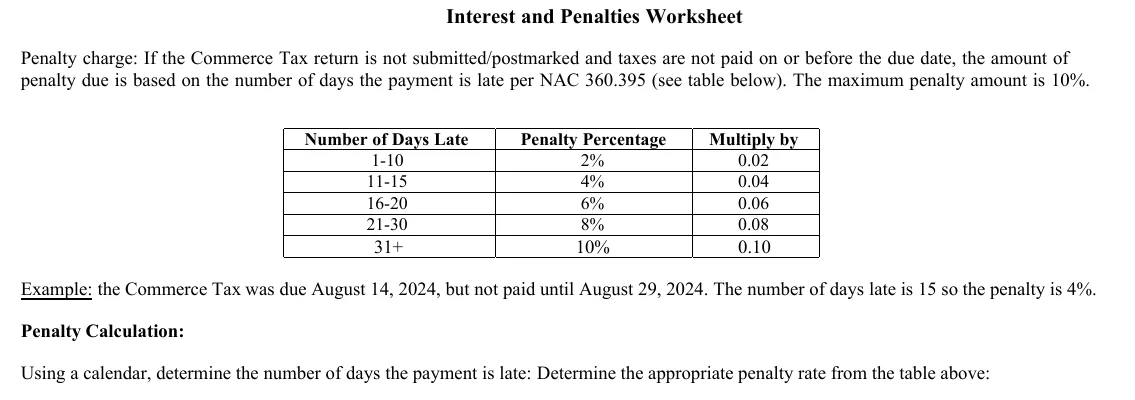
Nevada's Commerce Tax is small in rate and large in consequence: a gross-revenue tax with a hard deadline, a locked-in category rate, and a penalty table that reaches 10% in a month. Test the threshold in July, set the category on purpose, and file early in August. Use the tax estimator to model the liability before the fiscal year closes, and our California LLC $800 franchise tax playbook if you are weighing Nevada against California on state tax cost.