NetSuite vs Sage Intacct vs Acumatica: Mid-Market Cloud ERP Pricing Playbook
A finance director asks three vendors for a price and gets three kinds of silence. Oracle NetSuite publishes no price list. Sage publishes no Intacct price list. Acumatica publishes a pricing page with no dollar figure on it. Every number below carries its provenance, every total shows its arithmetic, and every figure no vendor page verifies is labelled a third-party estimate, not a vendor fact. Sources, 2026-11-13: Acumatica pricing page; accounting.events NetSuite guide (updated 2026-11-03); ERP Research Intacct review (reviewed 2026-11-01).
The honesty rule: what each vendor actually publishes
Before any comparison means anything, the reader deserves to know which numbers come from the vendor and which from everyone else. Our editorial analysis found the same pattern on all three: the vendors describe the shape of the bill and hide the size of it.
| Vendor | Publishes a price list? | Pricing unit | Authority |
|---|---|---|---|
| NetSuite (Oracle) | No — quote-only, annual contract | Base licence + per-user licences + modules + support | accounting.events NetSuite pricing guide, 2026-11-03 |
| Sage Intacct | No — quote-only, annual contract | Per-user subscription + entities + modules | ERP Research Sage Intacct review, 2026-11-01 |
| Acumatica | Page, but no dollar figure | Applications + usage/resources + deployment | Acumatica pricing page, accessed 2026-11-13 |
NetSuite's legacy pricing URL returned Page Not Found when checked on 2026-11-13, and a direct fetch of the NetSuite domain was refused by its edge protection; Sage Intacct's pricing page answered our fetch with a Cloudflare challenge the same day. A buyer who waits for a published NetSuite or Intacct price will wait forever. Budget from the ranges buyers report, reproduce the totals by hand, and treat the vendor quote as the number that must beat the range, not the number that defines it.
NetSuite: the quote-only full suite
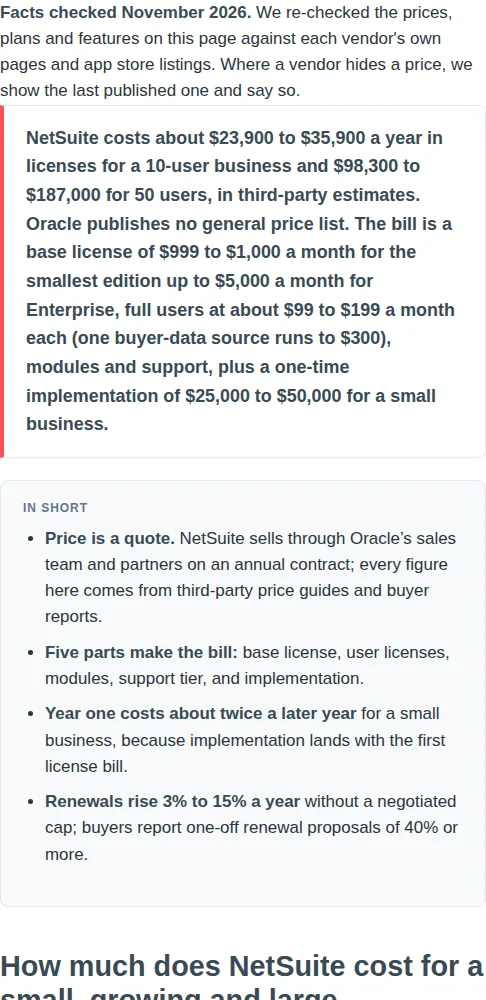
NetSuite is the broadest of the three: financials, CRM, inventory, order management, manufacturing, warehouse, and e-commerce in one system, sold through Oracle's sales team and partners on an annual contract. The bill has five parts: base licence, user licences, modules, support, implementation.
Third-party guides that collate buyer reports price the base licence at $999 to $1,000 a month for Starter, $2,500 for Mid-Market, and $5,000 for Enterprise. Starter fits roughly 1 to 15 users in a single entity, Mid-Market the $5 million to $100 million band, Enterprise above about $100 million. Oracle also sells SuiteSuccess industry editions — preconfigured sector packages that bundle the modules a sector normally buys separately, usually cheaper than licensing them one by one; a well-scoped rollout is commonly quoted in three to four months.
User licences are where the per-head cost lives. A full user — anyone who works in NetSuite every day — costs $99 to $300 a month in third-party estimates, with most guides clustering at $99 to $199 and one buyer-data source running to $300. Employee self-service users cost $10 to $99 a month; limited users $50 to $150; customer, vendor, and partner logins cost little or nothing.
Modules are priced on top, each a separate monthly line: Advanced Financials $400 to $1,000 a month; SuiteBilling $417 to $2,500; revenue recognition $500 to $1,000; fixed assets $300 to $1,000. Support is the quiet multiplier: Basic is included, Premium adds 10% to 25% of the licence bill, and Advanced Customer Support adds 15% to 30% — budget the licence and forget the support tier, and you have under-budgeted by up to a third.
Implementation is the largest cost outside the licence: $25,000 to $50,000 for a small business, $50,000 to $250,000 mid-market, and $120,000 to $500,000 for enterprise. Partners bill $100 to $350 an hour, and data migration, each integration build, and training are often priced as separate lines.
Worked math 1: NetSuite, 10 full users, Starter edition
Ten full users, Starter base licence, no extra modules, Basic support included. Run the low end and the high end of the published ranges:
The guide's published range is $23,900 to $35,900 a year; we reproduce it to within $32 low and $20 high — rounding, not a different model. That is the test for any NetSuite quote: rebuild the total, and if it cannot be rebuilt, ask which line is doing the extra work.
 For the open-source end of the same market, see the Odoo vs ERPNext vs NetSuite pricing playbook.
Worked math 2: NetSuite three-year cost, and the renewal clause
The first year is not the cost; the contract is. Run the low-end 10-user licence bill forward at 3% a year, the gentle end of the renewal range, with the $25,000 low-end implementation in year one only:
The guide's published three-year low for the same setup is $98,800 — our total lands $26.40 below it, again a rounding difference. At the harsh end, 15% a year with the $50,000 implementation, year 2 is $27,448.20, year 3 $31,565.43, and the three-year total $132,881.63: the renewal rate alone moves the bill by more than $34,000, which is why the cap belongs in the negotiation, not in the renewal meeting.
Sage Intacct: finance-first, per-user, AICPA-endorsed
Sage Intacct is not a full ERP and does not pretend to be one: a cloud-native financial management platform — general ledger, payables, receivables, cash, reporting, dashboards — with its depth in multi-entity consolidation, dimensional reporting, project accounting, revenue recognition, and nonprofit fund accounting. It is the only financial management solution endorsed by the AICPA, counts 19,000-plus customers, and was first released in 1999; Sage acquired it in 2017 for approximately $850 million.
The pricing unit is the user, the entity, and the module. ERP Research's indicative ranges: base subscription about $400 to $800 a month for core general ledger, accounts payable, accounts receivable, and cash management; user licences about $50 to $200 per user per month by role; modules about $100 to $500 per module per month for project accounting, multi-entity, revenue recognition, and fixed assets. Implementation typically runs $5,000 to $50,000. Most small-to-mid teams land between $15,000 and $50,000 a year in total; mid-market organisations with multi-entity, subscription billing, and revenue recognition typically fall in the $50,000 to $200,000 range. Billing is annual; renewals commonly rise 3% to 7% a year.
The boundary that matters is the one Intacct draws around itself: no manufacturing, warehouse, field service, inventory, native payroll, or CRM. A services firm, SaaS company, or nonprofit that lives in its general ledger gets the deepest finance tool of the three. A company that also picks, packs, and ships needs a second system or a full suite instead. Go-live runs 3 to 6 months.
Worked math 3: Sage Intacct, 5 business users, 2 modules
Five business users, core financials, plus project accounting and multi-entity as the two paid modules. Low, middle, and high:
The $21,900 mid-case sits inside ERP Research's typical $15,000 to $50,000 a year band for small-to-mid finance teams — the consistency check the arithmetic has to pass. The year-one range is wide because implementation, not the subscription, swings it: $5,000 for a clean single-entity migration against $50,000 for a complex multi-entity one. A quote above $50,000 a year in subscription for five users should prompt a question about the modules and entities in the count.
Acumatica: the resource-priced challenger
Acumatica is the only vendor of the three that states its pricing logic in public. Its page leads with "Unlimited Users. One Transparent Price. Tailored to Your Business." and "pay only for the functionality you need — not for user seats." The price is set by three factors: the applications you implement, your expected usage and resource requirements — transaction volumes, resource levels, data storage — and your deployment preference. No dollar figure appears on the page.
The consequence is a different cost curve: on NetSuite or Intacct, every additional full user adds $99 to $199, or $50 to $200, a month to the bill, every month, forever. On Acumatica, the marginal licence cost of one more user is zero:
The price moves only when transaction volume or storage crosses a resource tier. The break-even against a per-user system follows one formula, where R is the quoted monthly resource fee and p is the per-user monthly rate:
To show the shape of it, take an illustrative quoted resource fee of $1,980 a month — an example value, not a published Acumatica price — against NetSuite's low per-user rate of $99 a month: $1,980 divided by $99 is 20 users. Below 20 users the per-user system is cheaper; above 20 the resource-priced system wins, widening the gap by $99 a month per user. Your own R comes from the Acumatica partner quote. Run the totals through the profit calculator before signing, so the licence bill is tested against the margin it must leave intact.
The decision table
| Question | NetSuite | Sage Intacct | Acumatica | Authority |
|---|---|---|---|---|
| Publishes a price? | No — quote-only | No — quote-only | Page, no dollar figure | Vendor pages, 2026-11-13 |
| 10-user annual licences | $23,900–$35,900 (est.) | $15,000–$50,000 total (est.) | Quoted by resource tier | Guides, 2026-11-13 |
| Implementation | $25,000–$50,000 small | $5,000–$50,000 typical | Partner-quoted, unpublished | Guides, 2026-11-13 |
| Renewal increase | 3%–15% a year | 3%–7% a year | Quoted per contract | Guides, 2026-11-13 |
Who each system fits — and who must walk away
NetSuite fits the company outgrowing its accounting system in every direction at once: subsidiaries, currencies, inventory and warehouse alongside the ledger. It does not fit the 3-person finance team that only needs a better general ledger — that buyer pays a full-suite price and a $25,000 implementation for a finance problem. Sage Intacct fits the services firm, the SaaS company, and the US nonprofit that need dimensional reporting, multi-entity consolidation, and revenue recognition done properly; for a nonprofit it is the strongest choice of the three, on the AICPA endorsement and native fund accounting alone. It does not fit the manufacturer or distributor who needs inventory and warehouse in the same system — that buyer pays for Intacct, then pays again for the operations system. Acumatica fits the operations-led company whose headcount grows faster than its transaction volume, because each new user costs $0 in licence fees; it does not fit the buyer who needs a published price before engaging a partner, because there is not one. For the step below this tier, the QuickBooks Online vs Xero comparison covers the two systems most buyers outgrow first.
Every suite here is SaaS with a REST API and CSV import for the GL; all three push JSON journals into a SQL warehouse for the B2B close, so the question is which API your team can run, not whether one exists.
Founder & CEO Insight — Enow A. Jovial
Run the operation
- Count users by type, not headcount: full, limited, and self-service users price differently on NetSuite and Intacct; Acumatica does not price them at all.
- Rebuild each quote from its parts against the published ranges in this playbook.
- Price implementation separately: the fixed-scope SuiteSuccess figure from NetSuite, the migration scope from Intacct, the partner quote from Acumatica — never as a percentage of an unverified licence.
- Negotiate the renewal cap in the first contract: 3% to 15% on NetSuite and 3% to 7% on Intacct compound into tens of thousands over three years.
- Run the break-even division for Acumatica: quoted monthly resource fee divided by the per-user rate quoted elsewhere, against your hiring plan for the next two years.
The year-one checklist
- [x] Users counted by licence type, not headcount
- [x] Quote rebuilt from base, users, modules, and support
- [x] Implementation quoted as a fixed scope, not a percentage
- [x] Renewal cap negotiated and written into the contract
- [x] Acumatica break-even division run against the hiring plan
- [x] Year-three total obtained in writing from every finalist
The decision in advance
Mid-market ERP pricing is not a price list; it is a negotiation with three different pricing logics. NetSuite charges for the suite and the seat, Sage Intacct for the finance seat and the entity, Acumatica for the resources the business consumes. Budget from the ranges, reproduce the totals by hand, cap the renewal before you sign.