The Meals and Entertainment Deduction: The 50 Percent Playbook
A client dinner costs $480. A suite at the ballgame costs $4,000. A staff cafeteria costs $60,000 a year. Three meals, three answers: $240 deductible, $0 deductible, and — starting in 2026 — $0 deductible. The difference is one statute, IRC section 274.
What section 274 actually says
IRC section 162(a) allows ordinary and necessary business expenses. Section 274 is the gate on top of section 162, taking deductions away in three moves. First, section 274(a)(1): "no deduction otherwise allowable under this chapter shall be allowed for any item" with respect to an activity "of a type generally considered to constitute entertainment, amusement, or recreation," or a facility used in connection with one. Second, section 274(n)(1) caps every food and beverage deduction: "the amount allowable as a deduction under this chapter for any expense for food or beverages shall not exceed 50 percent of the amount of such expense." Third, section 274(k)(1) adds two conditions to any meal deduction: the expense must not be "lavish or extravagant under the circumstances," and the taxpayer or an employee must "be present at the furnishing of such food or beverages."
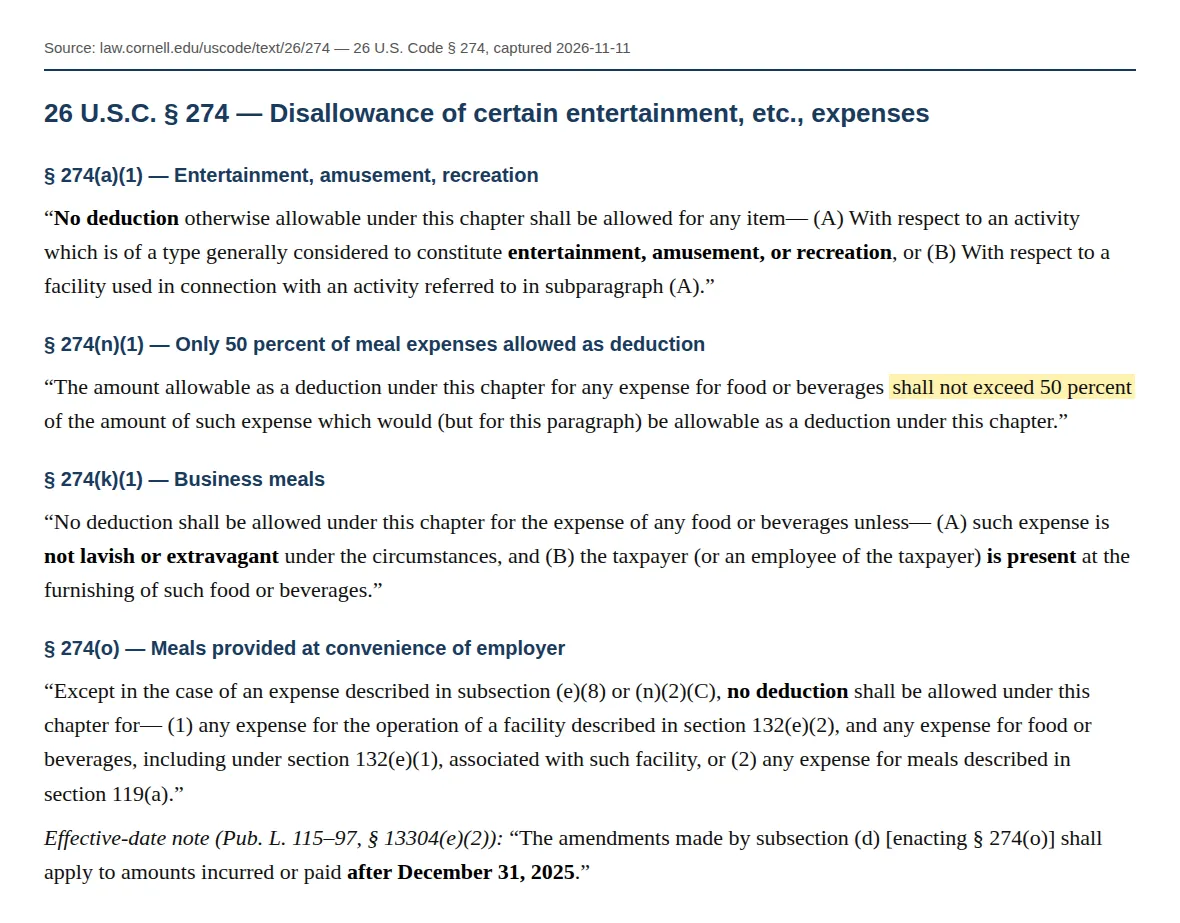
Before the Tax Cuts and Jobs Act of 2017, entertainment was 50 percent deductible if directly related to the business; the Act repealed that exception. Notice 2018-76: "Thus, entertainment expenses are no longer deductible." Meals survived at 50 percent.
The five-condition test that saves a business meal
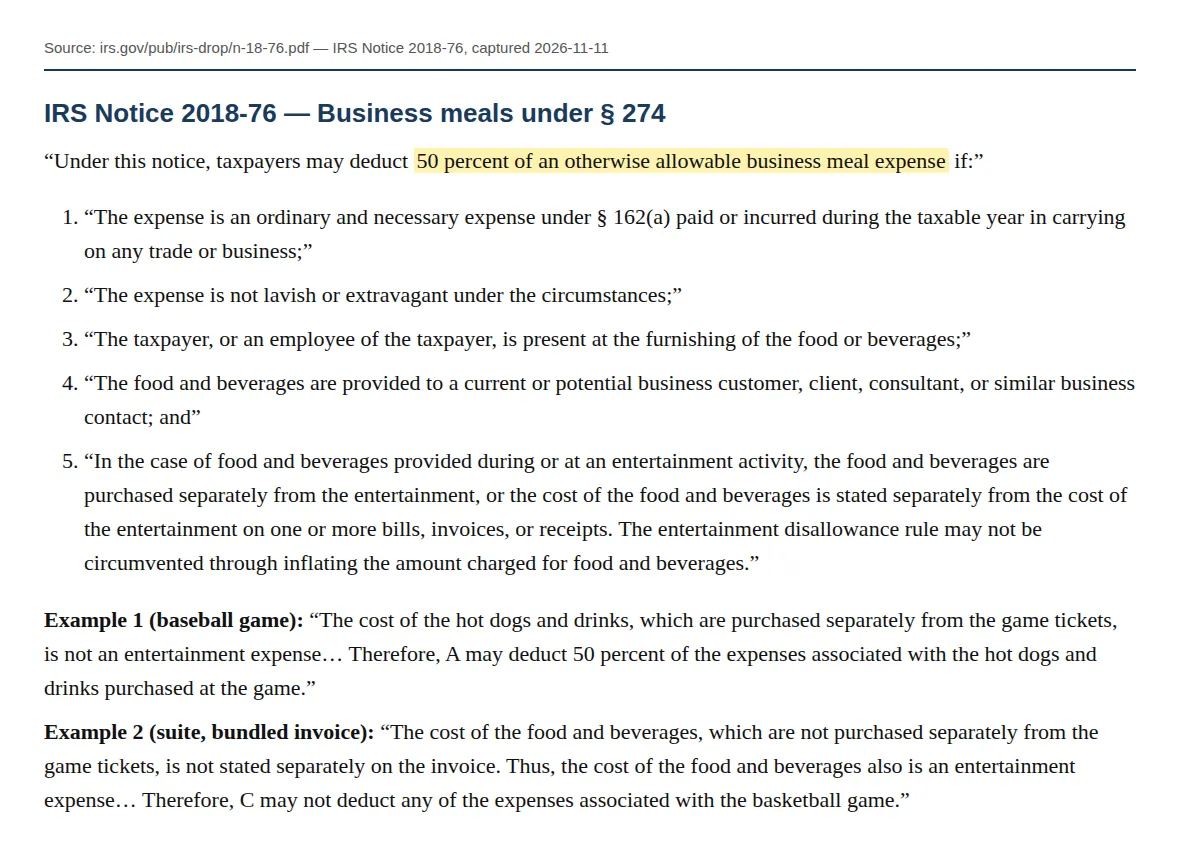
Notice 2018-76 remains the working test because the promised regulations were never finalized. Under it, a meal is 50 percent deductible only if all five conditions hold:
- Ordinary and necessary under section 162(a), paid or incurred in carrying on a trade or business.
- Not lavish or extravagant under the circumstances.
- The taxpayer, or an employee of the taxpayer, is present when the food or beverages are furnished.
- The food and beverages go to a current or potential business customer, client, consultant, or similar business contact.
- If provided during or at an entertainment activity, the food and beverages are purchased separately from the entertainment, or their cost is stated separately on the bill or receipt. The notice adds: "The entertainment disallowance rule may not be circumvented through inflating the amount charged for food and beverages."
Condition 4 surprises owners most. A meal eaten alone while traveling on business can still qualify, but a meal with friends or a contact with no business connection fails at the first step. Condition 3 kills the drop-off dinner.
The annual math: what 50 percent actually costs you
Take an illustrative consulting firm that spends $12,000 a year on qualifying business meals. Every dollar passes the five-condition test. The deduction is half the spend, and the tax saving is the deduction times the marginal rate. At an assumed 22 percent marginal rate:
The other $6,000 is cash out the door with no tax benefit: the effective cost of a $12,000 meal program is $10,680 after tax. Run this math before approving a meal budget, not after the year closes. Check your own numbers in the tax estimator before you set next year's budget.
Entertainment: the zero percent rule, worked twice
Entertainment is where owners lose the most money: the rule is absolute and the exceptions are gone. Publication 463: "You can no longer take a deduction for any expense related to activities generally considered entertainment, amusement, or recreation." Concerts, games, theater, golf, hunting and fishing trips, and club dues all fall under section 274(a)(1), and section 274(a)(3) bans club dues outright.
Notice 2018-76 gives three examples that decide most real cases. Example 1: A invites a business contact to a baseball game and buys hot dogs and drinks separately. The tickets are entertainment and not deductible; the food, "purchased separately from the game tickets," is not entertainment, so A may deduct 50 percent of its cost. Example 2: C buys basketball suite tickets whose invoice includes food with no separate stated cost — the whole amount is entertainment, and C "may not deduct any of the expenses associated with the basketball game." Example 3: the same suite invoice separately states the food cost, and that amount becomes 50 percent deductible.
A firm buys a $4,000 suite package and $600 of food inside it. If the invoice states the $600 separately, the deduction is $300; on one bundled invoice, the deduction is $0:
One line on one invoice separates a $300 deduction from a $0 deduction. Ask the venue for an itemized receipt before you pay.
The lavish line and the client dinner
"Lavish or extravagant" has no dollar threshold in the statute: reasonableness turns on facts and circumstances. Publication 463 states the test — "An expense isn't considered lavish or extravagant if it is reasonable based on the facts and circumstances" — and then works an example. A taxpayer spends $200, including tax and tip, on a business meal. If $110 is not allowable because it is lavish and extravagant, the remaining $90 is subject to the 50 percent limit, and the deduction "can't be more than $45 (50% (0.50) × $90)."
Taxes and tips are included as a cost of the meal and are subject to the 50 percent limit — the tip does not escape the haircut. Transportation to and from the meal is not part of the meal. A $480 client dinner that is entirely reasonable deducts $240. But if $180 of it was a bottle of wine no reasonable business purpose supports, the base falls to $300 and the deduction falls to $150.
The decision table: every common meal, one line each
| Expense | Deductible portion | Authority |
|---|---|---|
| Business meal with client, you present | 50% | § 274(n)(1); Notice 2018-76 |
| Food bought separately at a game | 50% of food cost | Notice 2018-76, Example 1 |
| Food bundled into ticket invoice, not separately stated | 0% | Notice 2018-76, Example 2 |
| Concert, game, or theater tickets themselves | 0% | § 274(a)(1) |
| Club dues, social or athletic | 0% | § 274(a)(3) |
| Employee meals on premises: through 2025 / after 2025 | 50% / 0% | § 274(n)(1); § 274(o) |
| Holiday party or picnic for employees | 100% | § 274(e)(4); § 274(n)(2)(A) |
| DOT hours-of-service workers' meals | 80% | § 274(n)(3); Pub. 463, Ch. 2 |
| Restaurant meals, paid or incurred before Jan 1, 2023 | 100% | § 274(n)(2)(D) — expired |
The last row is a trap: the temporary 100 percent restaurant-meal deduction applied only before January 1, 2023.
Employee meals, de minimis fringes, and the 2026 cliff
The most expensive misunderstanding here concerns meals an employer provides to its own staff. Section 119(a) excludes from an employee's gross income meals furnished "for the convenience of the employer," but only if "the meals are furnished on the business premises of the employer." Section 132(e)(2) treats an eating facility as a de minimis fringe when it is on or near the business premises and its revenue normally equals or exceeds its direct operating costs.
Section 274(e)(1) excepts food and beverages "furnished on the business premises of the taxpayer primarily for his employees." Through 2025, that exception plus the 50 percent limit meant an employer cafeteria was 50 percent deductible. But section 274(o) eliminates the deduction for amounts paid or incurred after December 31, 2025: "no deduction shall be allowed" for operating a section 132(e)(2) facility, or for meals described in section 119(a).
A C-Corp spending $60,000 a year on a staff cafeteria deducts $30,000 through 2025 and $0 from 2026. At the 21 percent corporate rate in section 11(b), the lost deduction is worth:
Do not confuse the two tax treatments: the meals can still be excludable from the employee's income under section 119 while being entirely nondeductible to the employer under section 274(o). The surviving exceptions are narrow: section 274(e)(4) covers the holiday party and the summer picnic for employees other than highly compensated employees, and section 274(n)(2)(A) takes those outside the 50 percent limit. Section 274(e)(2) does the same for expenses treated as compensation and reported as wages.
Founder & CEO Insight — Enow A. Jovial
Per diem: the federal rate that replaces receipts
Not every meal needs a receipt. The standard meal allowance lets a traveler use the federal meals and incidental expenses (M&IE) rate for the locality instead of tracking actual costs. Publication 463 states that the standard meal allowance "refers to the federal rate for M&IE," published by the General Services Administration. The standard rate for unlisted locations within the continental United States is $178 for fiscal years 2025 and 2026 — $110 for lodging and $68 for M&IE.
A four-day business trip to an unlisted locality produces $272 of meal allowance, and the 50 percent limit still applies:
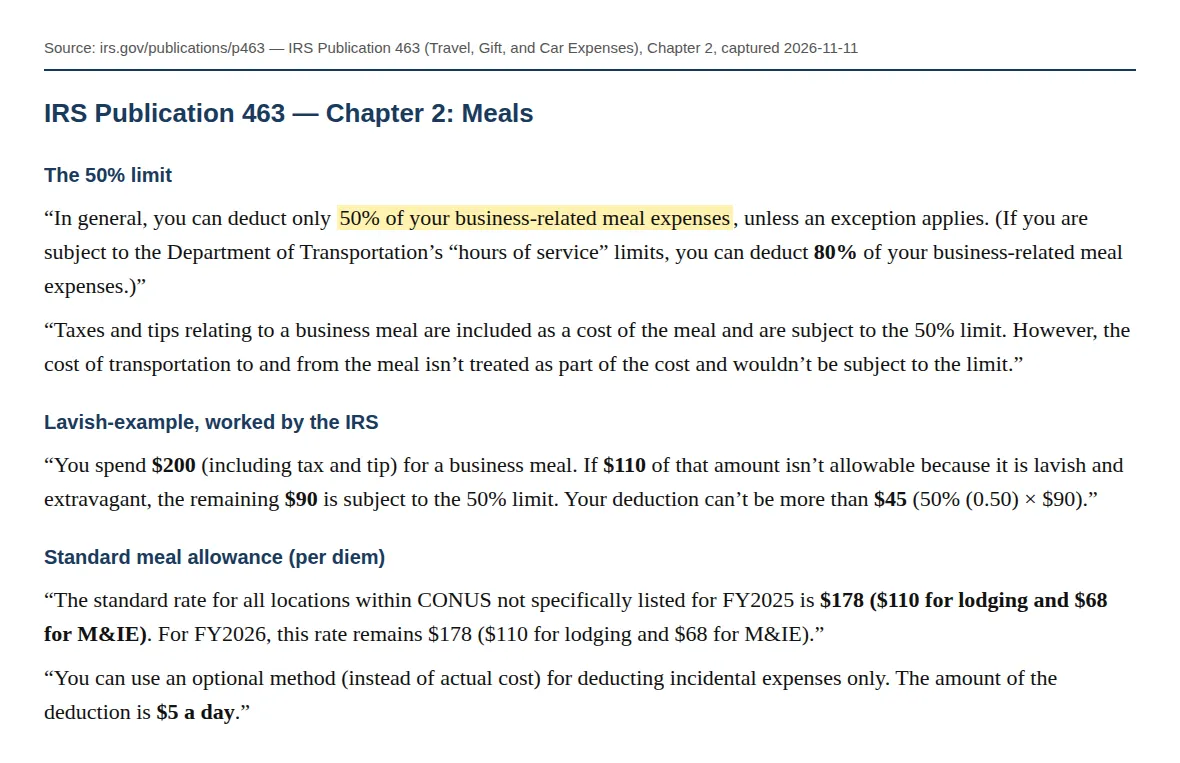
The traveler keeps no food receipts under this method, but must still prove the time, place, and business purpose of the travel. An incidental-expenses-only method of $5 a day is available only on days when no meal expenses were paid or incurred, and never on a day the standard meal allowance is used.
Workers subject to the Department of Transportation's hours of service limits deduct 80 percent of business meal expenses under section 274(n)(3) — the only percentage in the section that beats one half.
Substantiation: the four facts the IRS demands
Section 274(d) is the strictest recordkeeping rule in the Code: "No deduction or credit shall be allowed" for traveling expenses, including meals and lodging while away from home, "unless the taxpayer substantiates by adequate records or by sufficient evidence corroborating the taxpayer's own statement" four facts — (A) the amount of the expense, (B) the time and place of the travel, (C) the business purpose of the expense, and (D) the business relationship to the taxpayer of the person receiving the benefit.
Turn those four elements into a habit: an itemized receipt for the amount, a calendar entry for the time and place, a note of the business purpose written the same day, and the name and business relationship of every person at the table. A credit-card statement proves the amount and the place — not purpose or relationship.
Where this sits in your books
The deduction lives or dies in the accounting before it reaches the return. A sole proprietor with an EIN claims business meals on Schedule C, where the 50 percent limit is applied on the form itself — see the Schedule C playbook for the full return map. An LLC taxed as a partnership flows the limited deduction through to its members; an S-Corp reports it on its own return and a C-Corp claims it against the 21 percent corporate rate. A sole proprietor pays self-employment tax under SECA on the net profit after the meals limit; an S-Corp owner pays FICA only on a reasonable salary. Under GAAP, the full cost of the meal is an expense in the period incurred — the 50 percent limit is a tax rule, not an accounting rule — so the books and the return disagree by exactly the disallowed half. Your CPA should review the meals ledger once a year. For when the expense hits the books at all, see the cash versus accrual playbook; for the fixed-asset side of the same return, see the depreciation playbook.
Execution checklist: run your meals deduction in one sitting
- Separate the ledger. Business meals (50%), entertainment (0%), employee meals (0% from 2026).
- Test every meal against the five conditions. Ordinary and necessary, not lavish, you or an employee present, a business contact, separately stated food.
- Get the itemized receipt at the venue, before you pay. A total-only slip proves nothing about the food-entertainment split.
- Write the four substantiation facts the same day. Amount, time and place, business purpose, each person's business relationship to you.
- Apply the 50 percent limit after the lavish cut. Halve what remains — $200 minus $110, then half of $90.
- Choose actual cost or per diem per trip and stay consistent. Standard M&IE is $68 a day in unlisted CONUS localities.
- Re-price the staff cafeteria for 2026. Section 274(o) ends the deduction.
- Reconcile books to return. GAAP expenses the full meal; the return deducts half.
- [x] Meals, entertainment, and employee-meal accounts separated; 50 percent limit applied after any lavish reduction
- [x] Five-condition test and substantiation recorded for every meal claimed
- [x] 2026 employer-meals cliff priced into the budget