Mastercard does not warn you into its Excessive Chargeback Program. It counts your chargebacks, divides by last month's transactions, and when both numbers cross a fixed line in the same month, your merchant ID is in the program — with fines that start in month two and climb to $100,000 a month. The thresholds are published, the exit takes three consecutive clean months, and this playbook gives you the arithmetic to know which side of the line you are on.
This playbook is for merchants who accept Mastercard at volume: subscription SaaS, e-commerce, travel and ticketing, digital goods, and any business whose chargebacks run in the dozens per month. Under 100 Mastercard chargebacks a month, ECP cannot touch you — the count is a hard floor.
The two numbers that put you in the program
Mastercard's program is the merchant-facing part of its Acquirer Chargeback Monitoring Program. The network measures every merchant ID separately, every calendar month, on two numbers: chargebacks received, and their share of transactions. Stripe's monitoring-programs documentation states the rule: a merchant is placed into ECP when it meets or exceeds the monthly thresholds for both the chargeback count and the chargeback rate.
| Tier | Monthly chargebacks | Chargeback rate | Authority |
|---|---|---|---|
| ECM — Excessive Chargeback Merchant | 100–299 | 1.5%–2.99% | Stripe monitoring-programs docs; Mastercard ECP |
| HECM — High Excessive Chargeback Merchant | 300 or more | 3.0% or more | Stripe monitoring-programs docs; Mastercard ECP |
| Below program | Under 100, or rate under 1.5% | — | Either condition alone is not enough |
The rate formula is the part most merchants get wrong, because Mastercard does not divide by the same month's sales. It divides this month's chargebacks by the preceding month's captured transactions:
In basis points the same ratio is chargebacks divided by preceding-month transactions, multiplied by 10,000: ECM at 1.5% is 150 basis points, HECM at 3.0% is 300. The data month is the month the network receives the chargeback, not the month the payment was captured.
Work it on a real shape. A SaaS merchant captures 8,000 Mastercard transactions in January; in February, 140 chargebacks arrive. The rate is 140 divided by 8,000, times 100 — 1.75%. The count sits inside the 100–299 band and the rate inside 1.5%–2.99%, so the merchant enters ECM in the March report month. Change one number and the answer flips: 140 chargebacks on 12,000 January transactions is 1.17% — under the line, no placement.
Founder & CEO Insight — Enow A. Jovial
What counts toward the ratio — and what does not
The counting rules are where merchants lose disputes they thought they had already won. Mastercard counts a chargeback regardless of whether it was hidden by a refund, regardless of liability shift, and regardless of its outcome — card-present (POS) and card-not-present alike.
First, refunds do not help. Monitoring programs do not consider refunds when identifying disputes: refund before the customer disputes and the chargeback still counts — the refund saves the dispute fee, not the ratio. Second, winning does not help. Represented chargebacks are not used to recalculate thresholds: win a representment and you recover the funds, but the chargeback stays in the count for the month it was raised. Our chargeback defense representment playbook is still worth running, because it recovers money; it simply does not move the ECP ratio.
Third, the count is per merchant ID, not per business. A business running two MIDs — one for subscriptions, one for one-off sales — is measured twice, and a clean MID does not dilute a dirty one. Splitting volume across MIDs to stay under the lines is treated as evasion. Fourth, some disputes never appear in your dashboard but still count: Stripe notes that disputes where you have no liability are handled on your behalf and do not appear in dashboard or API responses, yet the network still includes them. The usual cause of the mismatch is descriptor formatting, multiple MIDs, or double-counted charges — fixed with a support ticket to your processor.
The fine schedule: what each month in the program costs
Fines are assessed to the acquirer, which normally passes them to the merchant. Month one carries no fine. From month two the schedule escalates, and from month four an issuer recovery assessment stacks on top.
| Months above ECM thresholds | ECM fine per month | Issuer recovery assessment |
|---|---|---|
| Month 1 | $0 | No |
| Months 2–3 | $1,000 | No |
| Months 4–6 | $5,000 | Yes |
| Months 7–11 | $25,000 | Yes |
| Months 12–18 | $50,000 | Yes |
| Months 19+ | $100,000 | Yes |
| Months above HECM thresholds | HECM fine per month | Issuer recovery assessment |
|---|---|---|
| Month 1 | $0 | No |
| Month 2 | $1,000 | No |
| Month 3 | $2,000 | No |
| Months 4–6 | $10,000 | Yes |
| Months 7–11 | $50,000 | Yes |
| Months 12–18 | $100,000 | Yes |
| Months 19+ | $200,000 | Yes |
The issuer recovery assessment is $5 for each chargeback above 300, charged from month four in both tiers. Stripe's worked example: a merchant in month four of ECM with 400 disputes is assessed $5,500 — the $5,000 band fine plus (400 minus 300) times $5. The twelve-month totals: twelve months in ECM costs $192,000 in fines, and twelve months in HECM costs $383,000 — excluding the issuer recovery assessment and per-dispute fees.
The exit rule is as mechanical as the entry rule: Mastercard removes you when your chargebacks drop below the program threshold for three consecutive months. In HECM, dropping below the HECM threshold but still meeting the ECM threshold moves you down to ECM rather than exiting. There is no early release — three clean months is the only door out.
EFM: the fraud program that runs alongside ECP
ECP watches all chargebacks. The Excessive Fraud Merchant program watches fraud-coded chargebacks on card-not-present sales, with its own thresholds and fines, and one interaction rule: if you exceed both EFM and ECP thresholds, you are placed in EFM but not ECP — while Mastercard keeps tracking both. The months are counted separately.
EFM placement needs all four conditions at once: at least 1,000 e-commerce Mastercard payments; net fraud volume above $50,000 ($15,000 in Australia); a fraud chargeback rate above 0.50% (0.20% in Australia); and 3-D Secure usage at or below 10% of Mastercard payments in non-regulated countries, or 50% in regulated countries. The fraud chargebacks counted carry reason codes 4837 and 4863. The EFM fine schedule: month one $0, month two $500, month three $1,000, months four to six $5,000, months seven to eleven $25,000, months twelve to eighteen $50,000, month nineteen and beyond $100,000.
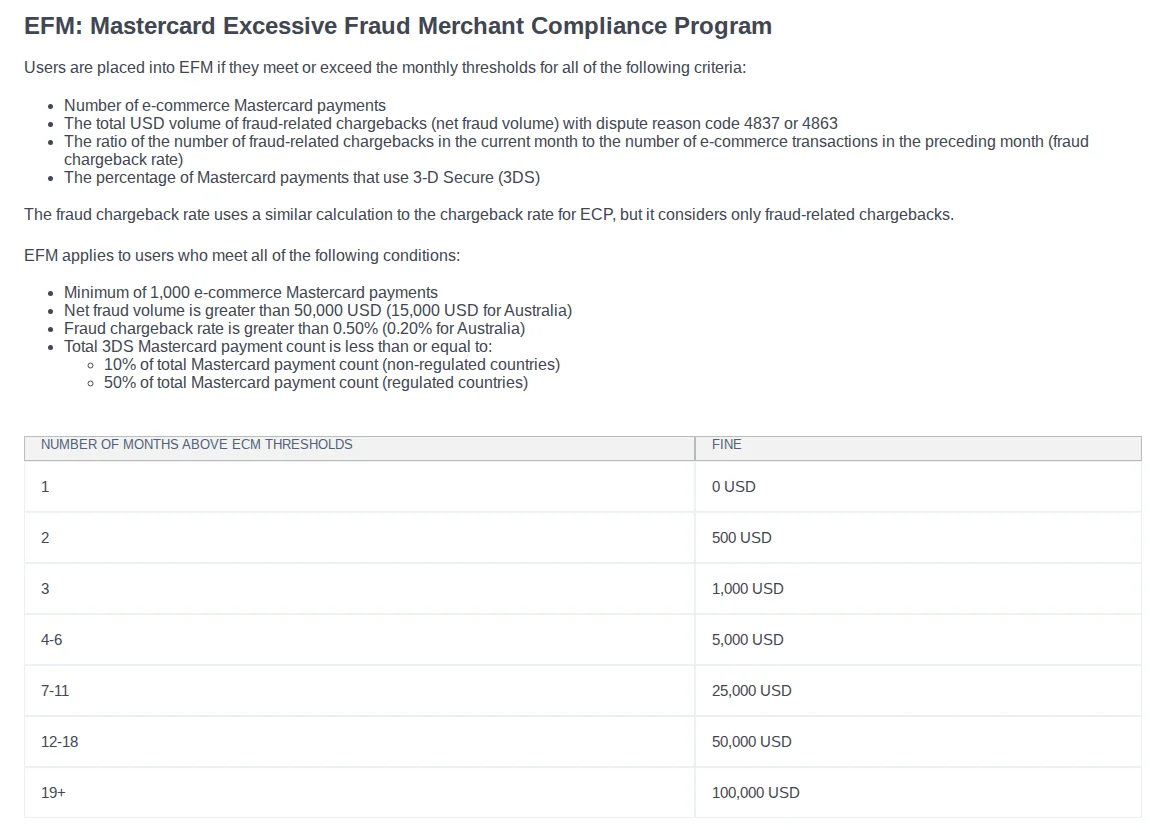
Two EFM details matter. First, the 3DS condition means the program is partly a test of whether you authenticate: a merchant running 3-D Secure on more than 10% of Mastercard payments in a non-regulated country cannot be placed in EFM at all. Second, you can ask Mastercard to suspend an assessed fine one time during an open case — but only if you are confident you will stay below the threshold for the next three months.
ECP vs VAMP: the same problem, two different rulers
| Dimension | Mastercard ECP | Visa VAMP |
|---|---|---|
| Excessive threshold | ECM: 100–299 chargebacks, 1.5%–2.99%; HECM: 300+, 3%+ | 1,500+ events, ratio 1.5% (2.2% CEMEA), volume $75,000 CEMEA |
| Rate denominator | Preceding month's captured transactions | Same month's captured payments |
| What counts | Chargebacks (first presentment) | Disputes plus fraud, including early fraud warnings |
| Non-compliant tier | None — ECM is the first tier | Count 5, ratio 0.5% |
| Fine basis | Fixed monthly schedule to the acquirer | Per-event assessments; Visa assesses at Excessive, may assess at Non-Compliant |
| Exit | 3 consecutive months below threshold | Sustained reduction; Stripe notifies on placement |
| Authority | Stripe monitoring-programs docs | Stripe monitoring-programs docs; Visa VAMP |
The remediation plan: seven steps, measured in months
Remediation is a sequence, not a purchase. Each step removes a class of chargebacks; the order runs from the fastest-acting to the slowest, because the three-month exit clock starts only when the count actually falls.
- Deploy pre-dispute alerts — Ethoca Alerts and Verifi's CDRN notify you the moment a cardholder contacts their bank. Refund inside the alert window and the chargeback never posts.
- Fix the statement descriptor — use one static descriptor prefix across all Mastercard volume, with a support contact where your acquirer allows it.
- Turn on 3-D Secure for card-not-present volume — authentication shifts liability and, for EFM, pushes you above the 10% gate that blocks placement entirely.
- Make cancellation and refund one click — an in-app cancellation button, reminders before trials convert and annual renewals bill, explicit confirmation on billing terms.
- Separate authorization from capture on risky orders — issuers must report possible fraud for a captured payment even if later refunded, but not for an authorization. Reverse a suspicious authorization before capture.
- Ship fast, track everything, require signatures on high value — tracking numbers out the same day, delays communicated with a refund option, signature on delivery for higher-value goods.
- File the remediation plan with your acquirer and track the ratio weekly in a CSV export from your processor's API — treat any week above 1.2% as the trigger to act: 1.2% is your internal tripwire, 1.5% is Mastercard's.
Who should NOT worry about ECP — and who should worry more
Do not spend on ECP remediation if your Mastercard chargebacks run under 100 a month and your rate sits under 1%. The program cannot place you. Do not buy representment services as an ECP fix: winning disputes recovers funds, but it does not move the ratio by a single basis point.
Worry more if you sit in any of these positions. A subscription business with annual renewals is exposed to a single bad billing month: one renewal cohort billing on the same day can produce 100 chargebacks in a week. A marketplace or platform with sub-merchants is exposed at the MID level — and from April 2027, Mastercard's Global Merchant Audit Program is reported to replace the Acquirer Chargeback Monitoring Program, with ECM measured by sub-merchant ID where one exists, which would end the shelter of a blended MID. That change rests on a non-public Mastercard bulletin cited by Chargeback Gurus and IXOPAY, not on the public rules, so treat the date as reported rather than confirmed — but a platform that cannot report chargebacks per sub-merchant today should build that reporting now. A merchant already on an acquirer-imposed reserve faces both pressures at once: our merchant account reserve holdback playbook covers the reserve mechanics.
The exit checklist
- [x] Step 1: Compute the ratio — this month's chargebacks divided by last month's transactions, times 100. Compare against 1.5% and 100 chargebacks.
- [x] Step 2: Deploy pre-dispute alerts — Ethoca and Verifi CDRN, refund inside the alert window.
- [x] Step 3: Fix the descriptor — one static prefix, recognizable, with a support contact.
- [x] Step 4: Authenticate card-not-present volume — risk-based 3DS first, full coverage where conversion allows.
- [x] Step 5: Make cancellation and refunds one click — in-app cancel, pre-renewal reminders, explicit billing-term confirmation.
- [x] Step 6: Separate authorization and capture — review and reverse suspicious authorizations before capture.
- [x] Step 7: File the remediation plan — steps and timeline to the acquirer; track the ratio weekly against a 1.2% tripwire.
- [x] Step 8: Hold three clean months — below threshold for three consecutive months; HECM steps down to ECM first.
- [x] Step 9: Price the stay — $192,000 for twelve months in ECM, $383,000 in HECM, plus $5 per chargeback above 300.
ECP is not a judgment on your business. It is a ratio with a fine schedule attached, computed from numbers you already have. Run the division monthly, keep it under 1.2%, and the program stays a page in someone else's playbook. Our Visa VAMP threshold defense playbook covers the Visa side in full, our Stripe Radar chargeback prevention playbook covers the fraud rules that keep the count down, and the profit calculator models what a month of fines does to your net margin.