The clause is only as strong as the state where the member works
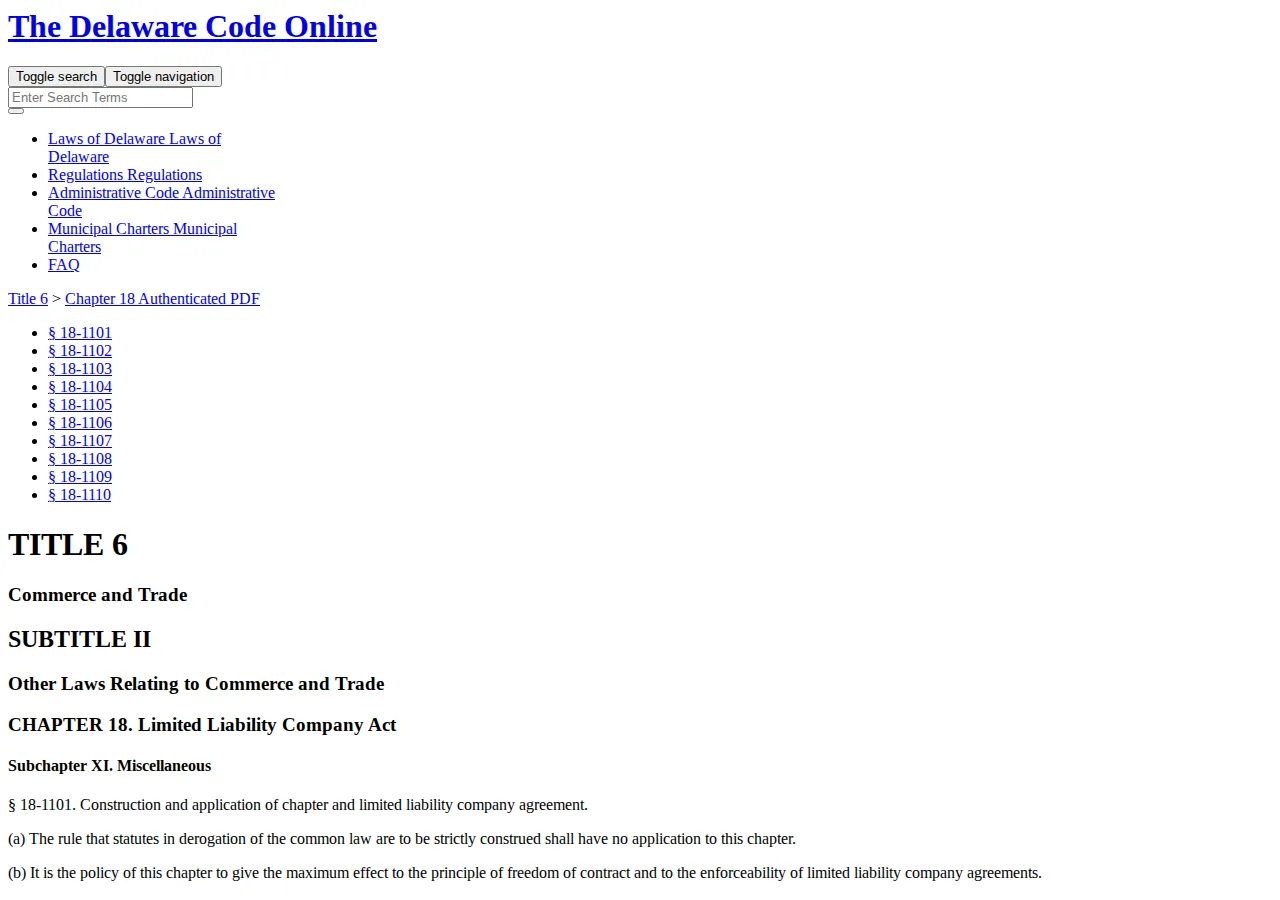
A founder forming a Delaware LLC writes the operating agreement as if Delaware law governed it all. For most provisions that is nearly true: section 18-1101(b) declares it the policy of the chapter to give the maximum effect to the principle of freedom of contract and to the enforceability of limited liability company agreements. Members may restrict or eliminate fiduciary duties and write covenants a Delaware court will enforce as written.
A non-compete is where that confidence breaks. Restrictive covenants are governed by the law of the state where the restricted person works, not where the entity was formed — and the states disagree by the widest margin in American business law. California voids the covenant outright and follows the worker across state lines. Colorado prices it: no covenant below $130,014 a year in 2026. Washington times it: every covenant dies on June 30, 2027. The FTC tried to ban non-competes nationwide in 2024, abandoned the rule in September 2025, and now sues one abusive covenant at a time.
Delaware gives, and Delaware's own gate takes back
Section 18-1101(b) is the strongest freedom-of-contract statement in American entity law, and subsection (c) lets the operating agreement expand, restrict, or eliminate the duties members and managers owe each other — everything except the implied covenant of good faith and fair dealing. A non-compete, a non-solicit, and a confidentiality covenant all sit inside that freedom.
The catch is in the choice-of-law statute, not the LLC Act. Section 2708 lets parties choose Delaware law and have that choice enforced — but only where the parties are subject to Delaware courts or arbitration in Delaware and may be served with process there, and subsection (c)(2) removes the statute's protection from any contract involving less than $100,000. A buyout covenant worth $60,000 does not get the section 2708 presumption at all. A founder who assumes Delaware law travels with the clause into every state is drafting on a promise the statute does not make. Our Delaware LLC operating agreement breakdown carries the general anatomy; this guide is about the one clause in it that other states refuse to honour.
California: the ban that follows the worker home
California's rule is the oldest and the bluntest. Section 16600(a) provides that, except as provided in the chapter, every contract by which anyone is restrained from engaging in a lawful profession, trade, or business of any kind is to that extent void. Subdivision (b)(1) reads the section broadly, following Edwards v. Arthur Andersen LLP (2008) 44 Cal.4th 937, to void any noncompete agreement in an employment context, or any noncompete clause in an employment contract, no matter how narrowly tailored, that does not satisfy an exception in the chapter. Narrow tailoring does not save a California covenant: there is no reasonableness test and no blue-pencil doctrine to shrink an overbroad clause into an enforceable one.
The 2023 amendments closed the two escapes founders used to reach. Section 16600.1 makes it unlawful to include a noncompete clause that does not satisfy an exception, and required employers by February 14, 2024 to notify current and former employees employed after January 1, 2022 that their clause was void, by written individualized communication to the last known address and email. Section 16600.5 goes further: any contract void under the chapter is unenforceable regardless of where and when it was signed, an employer shall not attempt to enforce a void contract even if it was signed and the employment was maintained outside California, and an employer that enters into or attempts to enforce a void contract commits a civil violation, enforceable by the employee for injunctive relief or actual damages. A Delaware LLC enforcing a Delaware-drafted covenant against a California member is committing a California civil violation.
One exception matters to founders, and its geography is the whole question. Section 16601 lets a person who sells the goodwill of a business, or an owner selling all of their ownership interest, agree with the buyer not to carry on a similar business within a specified geographic area where the business was carried on, so long as the buyer carries on a like business there. The exception covers the sale, not the employment: a departing member who sells their interest can be restrained where the business operated.
The threshold states: Colorado and Washington
Colorado replaced balancing tests with arithmetic. Under section 8-2-113, as rewritten by HB 22-1317 effective August 10, 2022, a covenant not to compete is void unless an exception applies, and the main exception is compensation-based: the worker must earn annualized cash compensation at or above the highly compensated worker threshold set each year by the Colorado Department of Labor and Employment. For 2026 that threshold is $130,014, up from $127,091 in 2025, set in the Department's PAY CALC Order. A customer non-solicitation covenant carries a lower threshold — 60 percent of the highly compensated figure, $78,008.40 for 2026. The worker must meet the threshold both when the agreement is signed and when the employer tries to enforce it, and the covenant must exist solely to protect trade secrets and be no broader than reasonably necessary. A 2025 amendment, SB 25-083, tightened the rules further for healthcare providers and minority business owners.
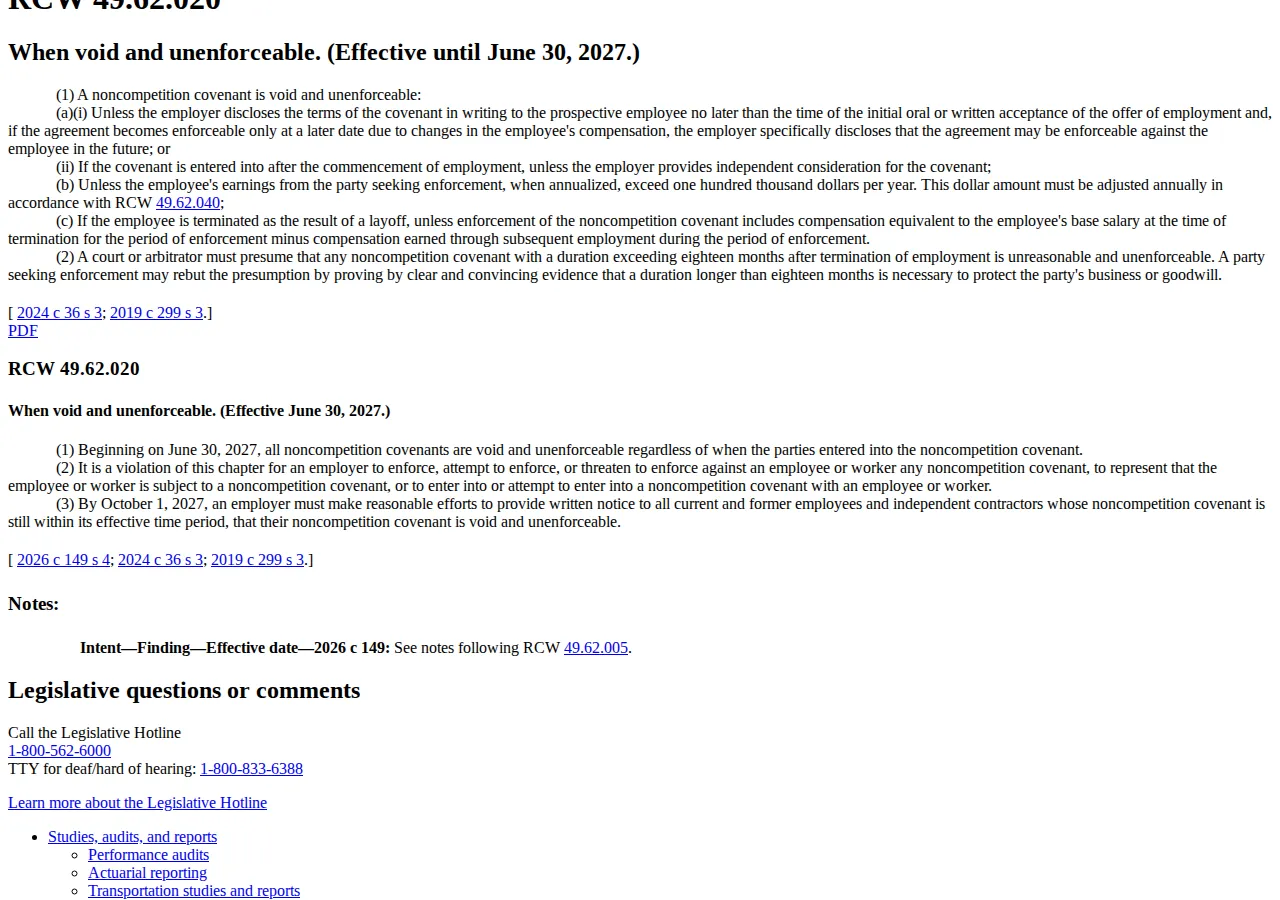
Washington's statute is a checklist with a sunset. Under RCW 49.62.020, a noncompetition covenant is void and unenforceable unless the employer disclosed its terms in writing no later than the prospective employee's acceptance of the offer — or, if the covenant is entered into after employment begins, provided independent consideration — and unless the employee's annualized earnings exceed $100,000 per year, adjusted annually under RCW 49.62.040. After a layoff, enforcement requires pay equivalent to base salary at termination for the enforcement period, minus earnings from subsequent employment in that period. A court or arbitrator must presume any covenant longer than 18 months after termination is unreasonable and unenforceable, rebuttable only by clear and convincing evidence that the longer duration is necessary to protect the business or its goodwill. From June 30, 2027, all noncompetition covenants are void and unenforceable regardless of when the parties signed them, and employers must make reasonable efforts by October 1, 2027 to notify every current and former employee and independent contractor whose covenant is still in effect that it is void.
The federal rule that never took effect
The FTC tried to settle the state-by-state patchwork in one stroke. In April 2024 the Commission voted 3-2 to adopt the Non-Compete Clause Rule, which would have banned almost all noncompete agreements nationwide from September 4, 2024. A Texas federal court set the rule aside before that date in Ryan, LLC v. FTC, holding the Commission had exceeded its rulemaking authority; a Florida court reached a similar result in Properties of the Villages. The Commission appealed both decisions — and on September 5, 2025 voted 3-1 to dismiss the appeals and accede to the vacatur, ending the rule. The day before, the FTC had settled with Gateway Services over its 12-month noncompetes and opened a public request for information on noncompete abuses. The policy now is case-by-case enforcement against individual abusive covenants under the antitrust laws — no nationwide ban. Our corporate bylaws vs operating agreement playbook explains where the covenant belongs in the governance documents; this guide is about whether it survives the state where it will be enforced.
The drafting math: five tests before the clause goes in
Test one: the Delaware choice-of-law gate. Section 2708(c)(2) removes the statute's protection from contracts involving less than $100,000:
A buyout covenant worth $60,000 does not get the presumption; a $150,000 buyout does. Price the covenant above the gate or do not rely on the gate.
Test two: the Colorado earnings test. The worker must clear the threshold at signing and at enforcement:
A member paid $120,000 at signing and $140,000 at departure fails — the signing figure controls as much as the departure figure. For a customer non-solicit, substitute $78,008.40, 60 percent of $130,014. Both figures move yearly with the PAY CALC Order — re-run the test at signing and at enforcement.
Test three: the Washington earnings test. The indexed base is $100,000:
A member on $95,000 salary plus a $15,000 bonus has $110,000 in annualized earnings and passes the earnings prong — but disclosure, consideration, duration, and layoff rules still apply, and from June 30, 2027 the test is moot: every covenant is void.
Test four: the Washington garden-leave cost. After a layoff, the statute requires pay equivalent to base salary for the enforcement period, minus earnings elsewhere in that period:
At a $10,000 monthly base salary and a 12-month enforcement period, the cost is $120,000 before subtracting whatever the former member earns in that year. Run that number through our break-even calculator before suing: if the garden-leave cost exceeds the value of the diverted business, the covenant is worth more unenforced than enforced.
Test five: the Washington duration presumption. Any covenant longer than 18 months is presumed unreasonable:
Rebuttal requires clear and convincing evidence that the longer duration is necessary to protect the business or its goodwill — a higher burden than preponderance in ordinary civil cases. A 24-month covenant needs a record built at drafting time: the goodwill, the customer relationships, and why 18 months does not protect them.
The decision, in one table
| Jurisdiction | Rule | Threshold | What survives | Authority |
|---|---|---|---|---|
| Delaware | Freedom of contract | Contract ≥ $100,000 for § 2708 presumption | Almost any covenant | 6 Del. C. §§ 18-1101(b), 2708 |
| California | Void outright | None — ban is total | Sale-of-goodwill covenants only | Bus. & Prof. Code §§ 16600, 16600.1, 16600.5, 16601 |
| Colorado | Void unless threshold met | $130,014 (2026); $78,008.40 non-solicit | Covenants above the threshold, tested twice | C.R.S. § 8-2-113; PAY CALC Order |
| Washington | Void unless all prongs met | $100,000 indexed; 18-month presumption | Passing covenants — until June 30, 2027 | RCW 49.62.020, 49.62.040 |
| Federal (FTC) | Case-by-case enforcement | None | Ordinary covenants | Ryan, LLC v. FTC; Sept 5, 2025 dismissal |
For the asset-protection view — when the entity itself, rather than the covenant, is the shield — read our Delaware statutory trust vs series LLC playbook.
Who should not draft which covenant
Do not draft an employment non-compete for a California member. No version of the clause survives section 16600: no duration, no geography, no narrow tailoring saves it, and the attempt itself is a civil violation with a private right of action. What survives is the sale-of-business covenant under section 16601 and the confidentiality protections the chapter does not reach. Draft those instead.
Do not draft a covenant below the Colorado threshold. A member earning $120,000 cannot be bound by a non-compete in Colorado in 2026, whatever the operating agreement says, and the failure is not curable by raising their pay later — the threshold is tested at signing as well as at enforcement. If the member's pay will cross the threshold, draft the covenant to take effect when it does.
Do not draft a long covenant in Washington after 2027. From June 30, 2027 every non-compete in the state is void regardless of when it was signed, and the notice obligation falls on the employer by October 1, 2027. A 24-month covenant signed in 2026 dies mid-term. Draft for the 2027 rule now: customer non-solicits and confidentiality survive where non-competes do not.
The signing routine
- Map every member to a state: where the member actually works, not where the LLC was formed.
- Run the California screen first: any member working in California gets no employment non-compete — only a section 16601 sale covenant if selling, plus confidentiality.
- Test Colorado and Washington earnings: pull annualized cash compensation for each member in those states and compare against $130,014 and the indexed $100,000 — at signing and projected at enforcement.
- Check the Delaware gate: if the covenant relies on a Delaware choice-of-law clause, confirm the contract involves at least $100,000 and the parties are subject to Delaware jurisdiction and service.
- Set the duration to the strictest state: 18 months where Washington applies, and no longer than the goodwill needs anywhere else.
- Write the garden-leave number into the budget: if a layoff could trigger enforcement in Washington, the base-salary cost belongs in the economics before signing.
- Calendar the 2027 dates: Washington's total ban on June 30, 2027 and the October 1, 2027 notice deadline, and re-issue every Washington exhibit before then.
Founder & CEO Insight — Enow A. Jovial