Corporate Bylaws vs Operating Agreement: The Governance Playbook
A founder forms a Delaware C-corp and a Delaware LLC. Then the bank asks for the governing document, an investor asks for the bylaws before wiring funds, and the LLC's two members disagree over a client contract. That is when the documents stop being paperwork.
What each document is
Corporate bylaws are the internal rulebook of a corporation: directors, meetings, officers, and how the rules change. Under 8 Del. C. § 109(b), bylaws may contain any provision not inconsistent with law or the certificate — but they may not make a stockholder liable for the corporation's attorneys' fees in an internal corporate claim.
An operating agreement is the internal rulebook of a limited liability company. Delaware calls it a limited liability company agreement, and 6 Del. C. § 18-101(9) defines it as any agreement of the members — written, oral or implied — as to the affairs of the company and the conduct of its business. Three consequences follow: an oral or implied agreement counts, so a course of dealing can become the governing document. A member or manager is bound whether or not they execute it, and the company is bound whether or not it executes it. A single-member agreement is enforceable, with no statute of frauds.
Neither document is filed with the State of Delaware. The public filing is the certificate of incorporation for a corporation, or the certificate of formation for an LLC — $70 to file, $180 for a certificate of amendment, under 6 Del. C. § 18-1105(a)(3). The governing document stays private until a bank, an investor, a court, or a departing owner asks for it.
See the LLC operating agreement breakdown for the LLC document clause by clause.
Who adopts it, and who can change it
Under 8 Del. C. § 109(a), the original bylaws may be adopted by the incorporators, the initial directors named in the certificate, or, before any payment for stock, by the board. Once stock is paid for, that power passes to the stockholders entitled to vote. The certificate may also confer it on the directors, without divesting the stockholders. Stockholders can always amend the bylaws; the board can only if the charter says so. A board committee can never amend bylaws (§ 141(c)(2)).
An operating agreement has no adoption ceremony: the members simply agree, in writing, orally, or by conduct. The amendment rule is whatever the agreement says: under 6 Del. C. § 18-302(e), if the agreement provides for the manner in which it may be amended, it may be amended only in that manner or as otherwise permitted by law. The agreement may even allow amendment with no member vote, and may give a member or class no voting rights (§ 18-302(a)). Voting follows the agreement (§ 18-302(b)).
A silent set of bylaws still leaves the stockholders with the amendment power under § 109(a), because the statute supplies it. A silent operating agreement leaves the harshest default: under § 18-302(f), if the agreement does not provide a manner of amendment, it may be amended only with the approval of all of the members, for companies whose original certificate of formation was filed on or after January 1, 2012. Every member holds a veto.
| Decision | C-corp bylaws | LLC operating agreement | Authority |
|---|---|---|---|
| Who adopts the original | Incorporators, initial directors, or board | The members, by written, oral or implied agreement | § 109(a); § 18-101(9) |
| Who amends after funding | Stockholders; directors too if the charter confers it | Whoever the agreement names | § 109(a); § 18-302(a), (e) |
Who actually runs the company
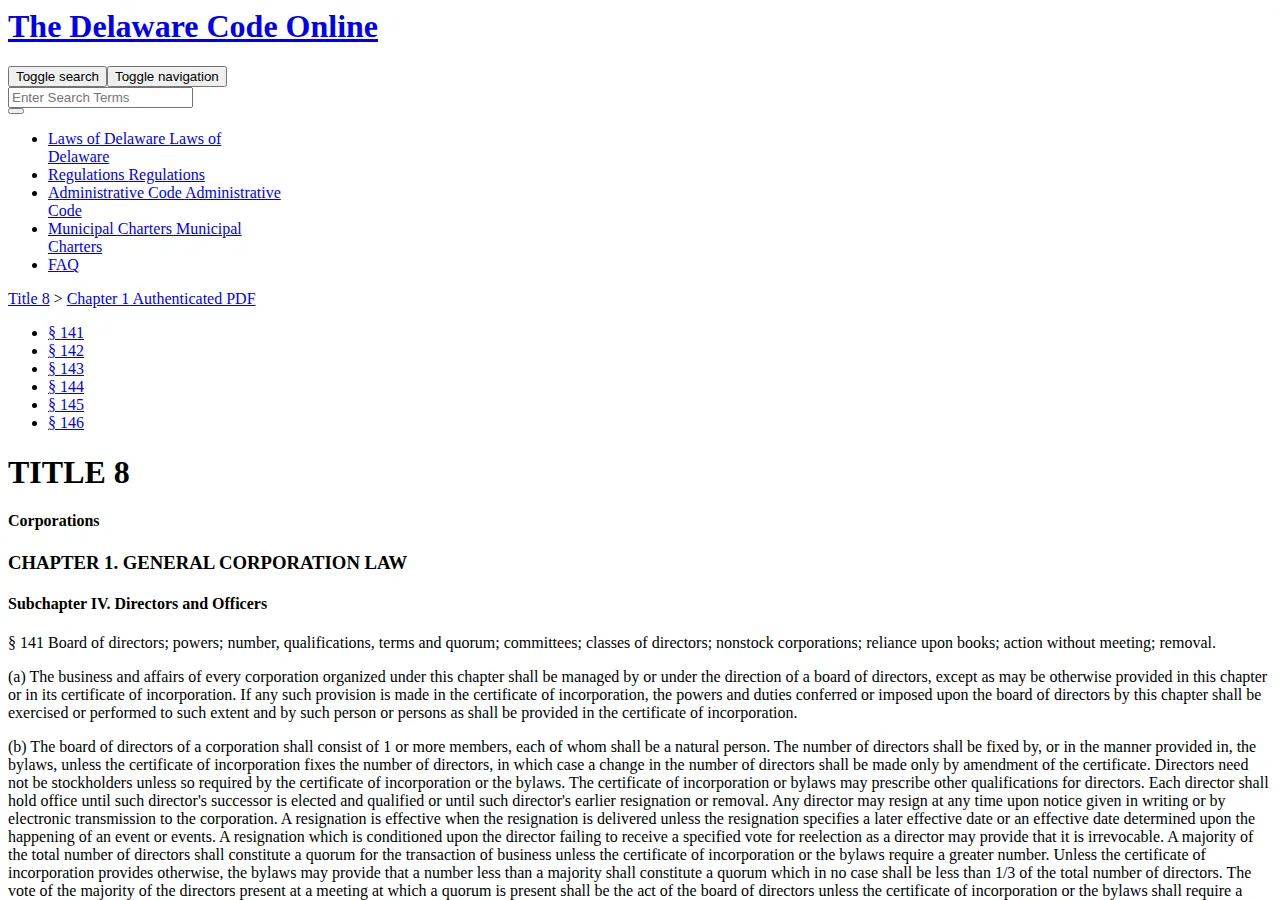
In a corporation, management sits with the board. Under 8 Del. C. § 141(a), the business and affairs of every corporation organised under the chapter shall be managed by or under the direction of a board of directors, except as otherwise provided in the chapter or in the certificate of incorporation. The board needs only one or more natural persons (§ 141(b)); the bylaws fix the number unless the certificate does. A majority of directors is a quorum unless the certificate or bylaws require more; the bylaws may lower it, but never below one third. On a five-director board the default quorum is three; the lowest the bylaws may set it is two.
In an LLC, the statute puts management wherever the agreement puts it. Under 6 Del. C. § 18-402, unless otherwise provided in the agreement, management is vested in the members in proportion to their then current percentage interest in the profits, with members owning more than 50 percent controlling. A manager-managed agreement vests management in the manager. Unless the agreement says otherwise, each member and manager has authority to bind the LLC. With no written agreement, every member can bind the company, checked only by the profit-percentage vote.
The freedom underneath the LLC rules is the point of the statute. Section 18-1101(b) gives maximum effect to freedom of contract and to the enforceability of these agreements. Section 18-1101(c) lets the agreement expand, restrict or eliminate fiduciary duties, and § 18-1101(e) lets it limit or eliminate liability for breach. Both stop at one floor: the agreement may not eliminate the implied covenant of good faith and fair dealing, or limit liability for a bad faith violation of it. A C-corp's bylaws cannot rewrite the directors' fiduciary duties this way; an LLC's agreement can, down to that single floor. That asymmetry, not tax, is why sophisticated parties choose one form over the other.
What banks and investors demand at diligence
Neither document is filed with the state, so neither is verified by any government office — and that is precisely why banks and investors ask for them. The governing document is the only paper that proves who may open the account, who may sign, and who may pledge the company's assets. A bank asks for the formation certificate, the employer identification number, and the governing document, then reads it for the authorised signers. If the bylaws name three directors and the minutes name two, the account stays shut until the paper matches. If the agreement is oral, there is nothing to show.
Investors read the same documents with a different question: can this company take my money and do what the term sheet requires? For a C-corp, counsel checks authorised shares, board size and quorum, and the consents for the preferred class. If the bylaws still show a three-director board and the term sheet requires five with an investor seat, the closing waits for a board resolution and a stockholder consent. For an LLC, the investor checks the amendment threshold, the admission procedure for new members, and any transfer restriction that would block the investment. If the agreement is silent on amendments, § 18-302(f) requires the approval of all members, so a single minority member who dislikes the valuation can hold the round hostage.
The same logic applies to founder shares: Delaware C-corp founder stock vesting and 83(b) guide.
Deadlock and buy-sell mechanics
A corporation has a built-in escape valve: the board can be outvoted, directors can be removed by a majority of the shares entitled to vote under § 141(k), and stockholders retain the power to amend the bylaws under § 109(a) no matter what the board does. A 50/50 split can still deadlock a board.
An LLC's deadlock is a contract problem, and the contract is whatever the members wrote. Section 18-302 gives the members the tools — classes, separate votes, written consent, their own amendment procedure — but none exists unless the agreement creates it. The two clauses that matter most are buy-sell and deadlock. A buy-sell clause sets the price or formula, the triggers, and the payment terms when a member dies, leaves, or is bought out. A deadlock clause names the procedure when members cannot agree: mediation, a tie-breaker, a shotgun buy-sell, or dissolution. Without them, the default is the profit-percentage vote under § 18-402 — no vote at all in a 50/50 company — and § 18-302(f), which needs all members to agree to add the missing clauses.
The cost math: what waiting actually costs
Governance documents are cheap at formation, expensive after a dispute. The cost of waiting is the stalled time, multiplied by the company's burn rate, plus the cost of fixing the document under pressure.
Take the C-corp first. A founder is raising an illustrative $750,000 seed round. The term sheet requires five directors, but the bylaws still show three, and the charter never gave the board that power. One stockholder is unreachable, so the consent takes six weeks. The company burns an illustrative $15,000 a week; counsel charges an illustrative $8,000 for the redraft.
Ninety-eight thousand dollars, spent on a document that would have cost an illustrative $2,500 at formation. Run your own numbers through the Break-Even Analysis Calculator.
Now the LLC. Two members own 50 percent each, with no written agreement, only an understanding. A $120,000 contract needs a signature, and they disagree about the payment terms. Neither will sign a contract the other opposes, and under § 18-302(f) they cannot adopt an agreement without both approving it. The contract waits eight weeks while counsel drafts an agreement for an illustrative $6,000; the company burns an illustrative $12,000 a week.
Against an illustrative $2,500 formation-time draft, the waiting cost is about 41 times the formation cost: $102,000 divided by $2,500 equals 40.8. The delay, not the document, is the cost — priced at the company's full burn rate.
Third: how many votes does an amendment need? Under a two-thirds supermajority clause, the votes required are the ceiling of the shares outstanding times the threshold.
On one million shares, a two-thirds clause needs 666,667 affirmative votes. A founder holding 600,000 shares cannot amend alone; a founder holding 700,000 can. Write the threshold down and count the votes you hold.
Failure modes: the three ways a missing document bites
The first failure mode is personal liability exposure. Limited liability protects owners who keep the company separate. With no governing document, there are no minutes or resolutions, and no record of who authorised what. A creditor finds no paper trail separating owners from business. The veil-piercing test is judge-made; this article cites no case for it. The governing document is the first exhibit in the owners' defence; a company without one starts with nothing to show.
The second failure mode is a frozen bank account. Banks freeze accounts when signers change, a signer dies or leaves, or two owners give conflicting instructions. To unfreeze it, produce the current document showing who may instruct the bank. With an oral agreement or a stale document, the account stays frozen while the owners negotiate. Payroll, rent, and vendor payments do not wait.
The third failure mode is the stalled fundraise. The round does not fail because the document costs $8,000 to fix. It fails because six weeks at full burn lets a competitor close first, lets an allocation expire, or lets the founders' cash run out.
Adopting or fixing your document, step by step
- Confirm the entity type and statute: Title 8 for a corporation, Title 6 Chapter 18 for an LLC.
- Pull the filed certificate; check names, shares, and agent.
- Find the current document, or confirm none exists; an oral understanding is an agreement under § 18-101(9).
- List what it must answer: who manages, who signs, votes, quorum, amendment.
- Set the amendment threshold: stockholder vote plus board power for a corporation; a named percentage or class vote for an LLC.
- Set the quorum: a majority of directors, never below the one-third floor (§ 141(b)); a profit-percentage or per-capita quorum for members.
- Write the deadlock and buy-sell clauses, with a pricing formula, before any disagreement.
- Name the bank signers and thresholds in the document, not in a side email.
- Adopt it: board or incorporator action for bylaws (§ 109(a)); written member consent for an operating agreement.
- File it with the certificate, consents, and ledger; review at every funding round or ownership change.
Execution checklist
- [x] Entity type and statute confirmed
- [x] Certificate matches the governing document
- [x] Amendment threshold and votes counted
- [x] Quorum above the statutory floor
- [x] Board or manager authority and signing thresholds named
- [x] Buy-sell clause with a pricing formula
- [x] Deadlock procedure named before any deadlock
- [x] Bank signers named in the document
- [x] Current copy filed with certificate and consents
- [x] Review diarised for the next funding round
Founder & CEO Insight — Enow A. Jovial
The decision in advance
Bylaws and operating agreements are the same job done under opposite philosophies. The corporation gives you a mandatory structure and lets you adjust it inside limits the statute sets. The LLC gives you a blank page and a statute that enforces whatever you write, down to eliminating fiduciary duties. Choose the corporation when you want the statute to hold the structure for you; choose the LLC when you want to write it yourself. Either way, write it down. The cheapest governance document is adopted on formation day; the most expensive is drafted during a dispute, at the company's full burn rate.