A U.S. founder owns a German GmbH through a Delaware LLC and elects disregarded status on Form 8832. The GmbH still exists under German law, signs contracts, and holds a bank account — but for U.S. tax purposes it has vanished into its owner. That vanishing act does not end the paperwork: the owner must file Form 8858 for the GmbH every year. Skip it for three years and the bill is $30,000 before the IRS even sends a notice.
What a foreign disregarded entity is
A foreign disregarded entity, or FDE, is a foreign entity with a single owner that has elected — or defaulted — to be disregarded as an entity separate from its owner for U.S. federal tax purposes. The election is made on Form 8832, Entity Classification Election: a foreign eligible entity with one owner is disregarded by default unless it elects corporate treatment. The election changes the U.S. tax treatment only. Under foreign law the entity keeps its own legal personality, its own contracts, and its own bank accounts, which is exactly why the IRS wants a separate information return for it.
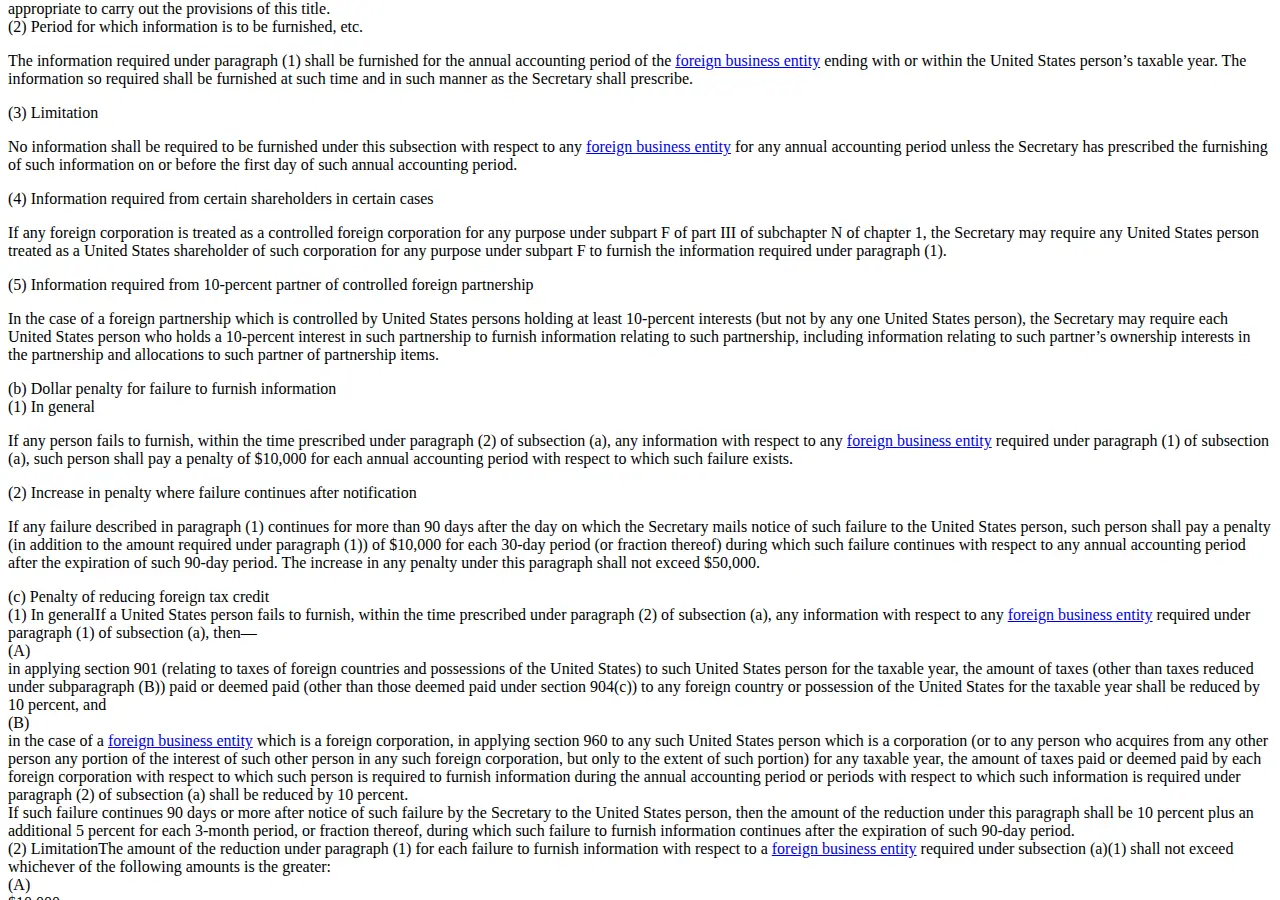
A foreign branch, or FB, is the other half of Form 8858. It is a trade or business activity of a U.S. person — or of a controlled foreign corporation — carried on outside the United States, where the activity is a qualified business unit with its own books and records. Regulations sections 1.989(a)-1(d) and 1.367(a)-6T(g) set the branch test: a separate set of books and records decides whether an activity qualifies.
Who must file
The Form 8858 instructions list the filers in categories — direct cases file the whole form including Schedule M, indirect and partner-level cases file less.
| Filer | What is filed | Authority |
|---|---|---|
| U.S. person, direct tax owner of an FDE or operator of an FB | Entire Form 8858, including Schedule M | Form 8858 instructions |
| U.S. person, indirect tax owner through tiers of FDEs | Entire Form 8858, including Schedule M | Form 8858 instructions |
| Category 4 or 5 filer of Form 5471 | Entire Form 8858, including Schedule M | Form 8858 instructions |
| Category 1 filer of Form 8865 | Entire Form 8858, including Schedule M | Form 8858 instructions |
| Partner applying section 987 at the partner level | Page 1 and Schedules G, H, J only; no Schedule M | Form 8858 instructions |
| U.S. corporation partner, dual consolidated loss | Page 1 and Schedules G, H, J, plus Schedule M | Form 8858 instructions |
A separate Form 8858 is completed for each FDE or FB — one entity, one form. Where the same information is owed by several persons for the same entity and period, one person may file for the others, attached to the Form 5471 or Form 8865 for the corporation or partnership that owns the entity. And the duty survives delegation: a person who has another person file for them is still subject to the penalties if the other person does not file a correct and proper form.
The schedules: what each one carries
| Schedule | What it reports | Authority |
|---|---|---|
| Schedule C | Income statement in functional currency under U.S. GAAP, translated to dollars | Form 8858 instructions |
| Schedule C-1 | Section 987 gain or loss information for the QBU | Form 8858 instructions |
| Schedule F | Balance sheet of the FDE or FB | Form 8858 instructions |
| Schedule G | Other information, including dual consolidated loss items | Form 8858 instructions |
| Schedule H | Current earnings and profits or taxable income | Form 8858 instructions |
| Schedule I | Transferred loss amount | Form 8858 instructions |
| Schedule J | Income taxes paid or accrued | Form 8858 instructions |
| Schedule M | Transactions between the FDE or FB and the filer or related entities | Form 8858 instructions |
Schedule C is the spine: the income statement. If the entity does not maintain U.S. GAAP statements in dollars, the filer may use the average exchange rate under section 989(b) — the rate on Schedule H, line 8 — and checks the box above line 1 of Schedule C to say so. Schedule H reconciles book income to current earnings and profits or taxable income, and its line 7 carries the functional currency amount translated at the average rate. Schedule C-1 reports section 987 gain or loss, and the Section 987 QBU translation playbook works the remittance proportion and the rates that feed it.
Functional currency and the divide-by rule
Every amount on Form 8858 starts in the entity's functional currency, entered as a three-letter ISO 4217 code under sections 985 and 989 and Regulations sections 1.985-1 and 1.989(a)-1.
The translation rule that trips filers is the divide-by convention. When translating amounts from functional currency to U.S. dollars, every exchange rate must be reported as the amount by which the functional currency amount is divided to reach dollars — the units of foreign currency that equal one U.S. dollar, rounded to at least four places. Never report the rate the other way round, as dollars per unit of foreign currency.
Example A — the translation. An FDE with a euro functional currency reports net income of 850,000 euros. The average exchange rate for the tax year is 1.0900 euros per U.S. dollar, so the U.S. dollar amount on Schedule H is 850,000 divided by 1.09: $779,816.51. The inverse rate, 0.9174 dollars per euro, gives the same arithmetic — but the form requires the divide-by figure.
Schedule M: the related-party ledger
Schedule M (Form 8858) reports transactions between the FDE or FB and the filer or other related entities. Sales of goods, services, rents, royalties, interest, management fees, loans, and capital contributions all belong here, priced as they happened. It is the schedule the IRS reads first when it suspects profit shifting, because the FDE's income is the owner's income and the transactions between them are the seams where income can be moved.
The penalty regime: Section 6038(b)
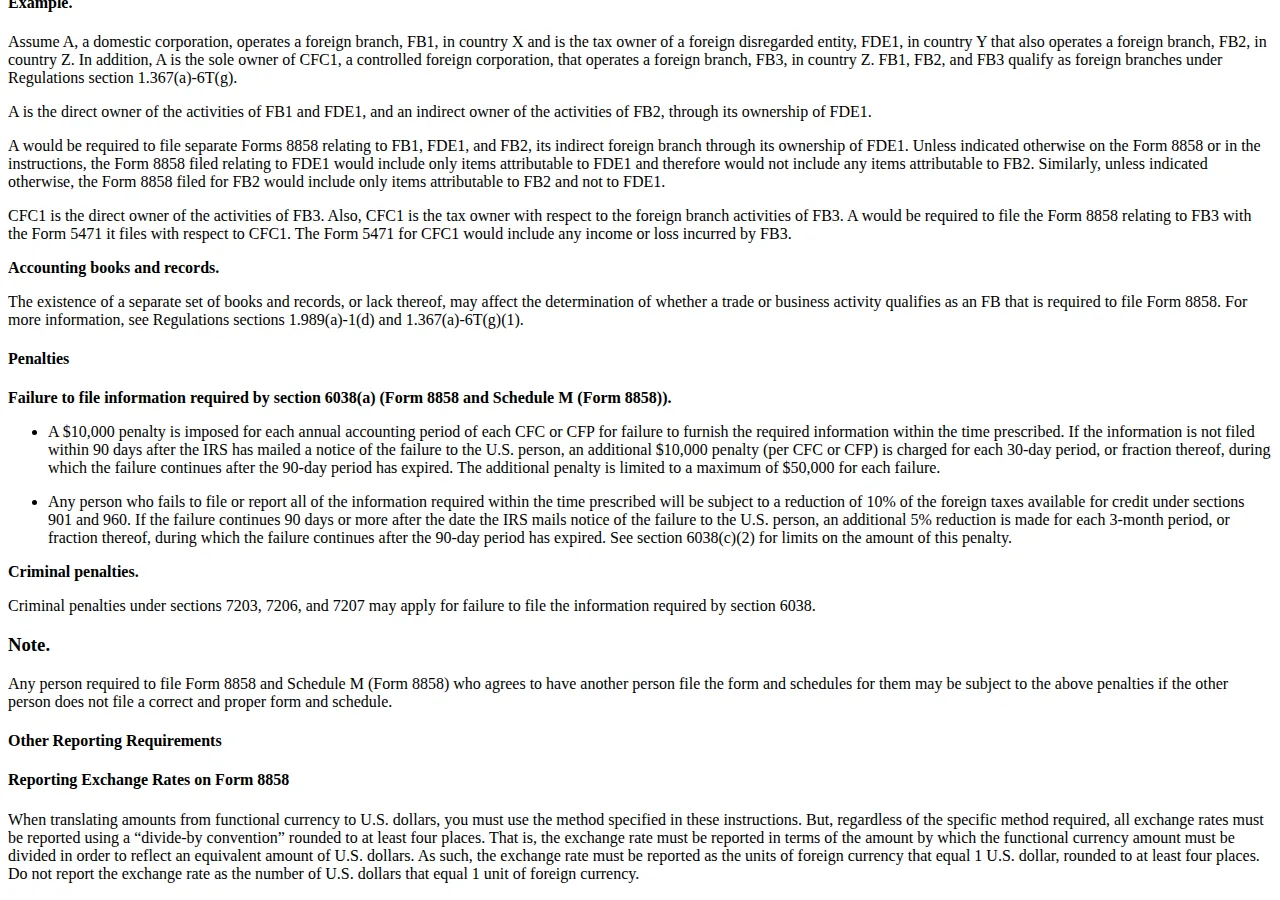
Section 6038(b)(1) states the base penalty in one sentence: a person who fails to furnish required information within the time prescribed pays $10,000 for each annual accounting period with respect to which the failure exists. Section 6038(b)(2) adds the continuation penalty: if the failure continues more than 90 days after the Secretary mails notice, the person pays a further $10,000 for each 30-day period, or fraction of one, after the 90-day period, capped at $50,000 more. The instructions add that criminal penalties under sections 7203, 7206, and 7207 may apply.
Example B — one entity, one missed year. A U.S. owner fails to file Form 8858 for a single FDE for one annual accounting period. The base penalty is $10,000.
Example C — the notice clock. The same failure continues, the IRS mails notice, and the owner still does not file for 200 days after the notice date. The first 90 days are free of the continuation charge. The remaining 110 days divide into four 30-day periods — 110 divided by 30 is 3.67, rounded up to 4 because a fraction counts as a full period. The continuation penalty is $40,000 and the total is $50,000.
Example D — the cap. The failure continues 400 days after notice. The continuation periods are 400 minus 90, divided by 30, which is 10.33, rounded up to 11 — $110,000 before the cap. The statute caps the increase at $50,000, so the continuation penalty is $50,000 and the total for that entity and period is $60,000.
Example E — three entities. An owner holds three FDEs and files none of their Forms 8858 for one year. The base penalty is per entity per period: three times $10,000, or $30,000, before any notice or continuation charge. Each entity's continuation clock then runs separately.
The foreign tax credit cut: Section 6038(c)
The dollar penalty is only half the cost. Section 6038(c)(1) cuts the foreign taxes available for credit under sections 901 and 960 by 10 percent for a failure to furnish the required information. If the failure continues 90 days or more after the IRS mails notice, section 6038(c)(2) adds a further 5 percent reduction for each 3-month period, or fraction, during which the failure continues after the 90-day period. $$
\text{Credit reduction} = \text{Foreign taxes available} \times 0.10
\
\text{Reduction}_{F, \text{extended}} = \$400,000 \times (0.10 + 0.05 + 0.05) = \$80,000
$$