Form 8829 is the filing operation, not the method debate
Most home-office writing stops at the choice: simplified or actual. That choice is one line on Schedule C. Form 8829 is everything after it — the form that turns a spare room into a number the IRS accepts, and a depreciation schedule that follows the home to the closing table. Claim actual expenses on Schedule C and Form 8829 computes the deduction, landing on Schedule C, line 30.
> [!KEY TAKEAWAY]
> Form 8829 does three jobs in one filing: it measures the business percentage, it applies the gross-income limit in statutory order, and it banks whatever the limit disallows as a carryover.
The gate: exclusive and regular use
Nothing on Form 8829 matters until the space passes the section 280A test. Section 280A(a) bars any deduction for a dwelling unit used as a residence, and section 280A(c)(1) opens the door only for a portion used exclusively and regularly as a principal place of business, as a place to meet patients, clients, or customers, or as a separate structure used in the trade or business. Exclusive means exclusive: the room cannot double as a guest bedroom on weekends.
Three exceptions matter. The principal-place test includes administrative or management work when no other fixed location handles substantial administrative or management work — the rule that lets a B2B consultancy run from a spare room qualify. Section 280A(c)(2) covers space used regularly to store inventory or product samples, and section 280A(c)(4) covers daycare. Daycare use must meet state licensing rules where the state requires a license. Employees cannot use the form; partners and Schedule F filers use the Publication 587 worksheet instead.
The entity matters too. A single-member LLC filing Schedule C uses Form 8829 under the owner's SSN, or under the business EIN where one is on file. An S-Corp or C-Corp owner does not file Form 8829: the corporation reimburses the owner through an accountable plan.
Part I: the area percentage
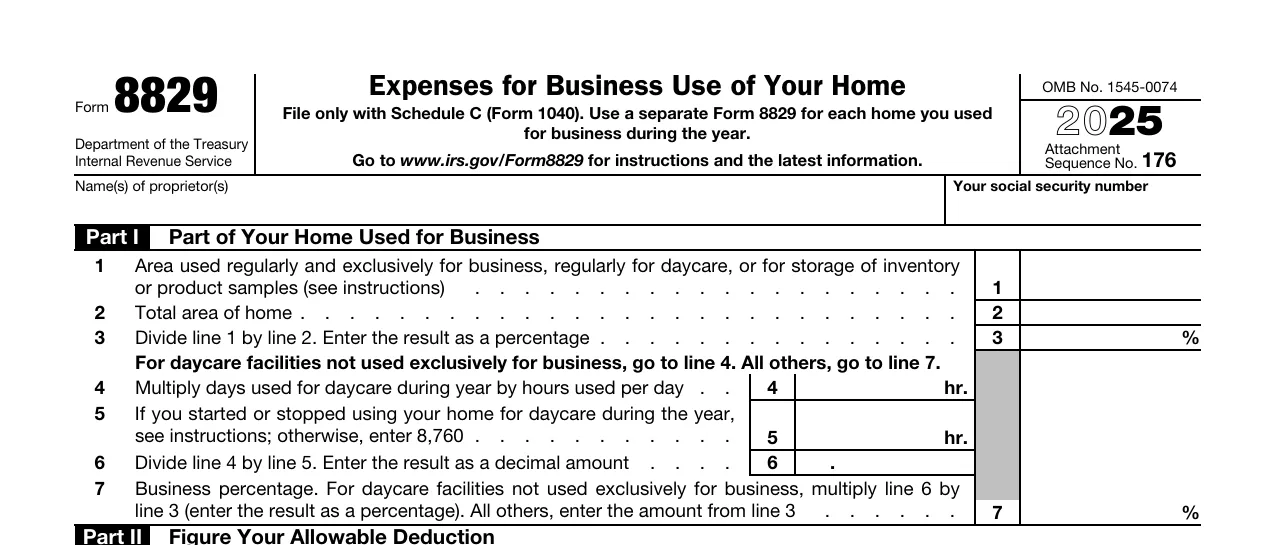
Part I is seven lines, and only line 7 leaves the part. Line 1 is the area used regularly and exclusively for business, line 2 is the total area of the home, and line 3 divides the first by the second. Square feet or any other reasonable method will do. Lines 4 through 6 are for daycare facilities not used exclusively for business: days times hours per day, divided by 8,760 hours in the year, then by the line 3 percentage.
Keep the record with the return. A floor plan with the office dimensioned settles most questions before they are asked. Use the same figure everywhere — the form multiplies by line 7 in four places.
!IRS Form 8829 Part I: business-use area percentage
> [!TIP]
> Measure the office to the inside of the walls and the home the same way. Mixing inside measurements for the office with outside measurements for the home inflates the percentage, and the instructions ask for a method that figures the percentage accurately — consistency is the method.
Part II: the three buckets in the order the statute demands
Part II opens at line 8: the amount from Schedule C, line 29, plus any gain from business use of the home, minus any loss from the trade or business not derived from business use of the home. That is the gross-income figure the limit in section 280A(c)(5) will test. Everything after line 8 runs in a fixed order: deductions the filer could claim anyway first, operating expenses second, casualty losses and depreciation last.
Lines 9 through 11 hold the expenses deductible whether or not the home is used for business: casualty losses, deductible mortgage interest, and real estate taxes. Line 12 totals them, line 13 multiplies the indirect column by the line 7 percentage, line 14 adds the direct column, and line 15 subtracts line 14 from line 8, floored at zero. Column (a) holds direct expenses; column (b) holds indirect expenses, where only the business percentage counts.
| Expense | Column | How it enters the form | Authority |
| :--- | :--- | :--- | :--- |
| Casualty losses | Either | Business portion only, line 9 | Form 8829 |
| Deductible mortgage interest | Either | Line 10; excess to line 16 | Form 8829 |
| Real estate taxes | Either | Line 11; excess to line 17 | Form 8829 |
| Insurance | Either | Line 18, operating bucket | Form 8829 |
| Repairs and maintenance | Either | Line 20; repaint direct, roof indirect | Form 8829 |
| Utilities | Indirect | Line 21; business percentage of bill | Form 8829 |
Lines 16 through 22 are the operating bucket: excess mortgage interest, excess real estate taxes, insurance, rent, repairs, utilities, and other expenses. Line 23 totals them, line 24 applies the business percentage to the indirect column, line 25 adds any prior-year operating carryover, and line 26 is the total operating claim. Line 27 allows the smaller of line 15 and line 26 — where the gross-income limit first bites.
Lines 29 through 33 close it: excess casualty losses on line 29, depreciation from line 42 on line 30, prior-year excess carryover on line 31, the total on line 32, and the allowable amount on line 33, the smaller of line 28 and line 32. Line 34 adds lines 14, 27, and 33. Line 35 pulls out any casualty-loss portion for Form 4684, line 27. Line 36 is the allowable expense, entered on Schedule C, line 30. The 2025 instructions note the overall state and local tax deduction limit rose to 40,000 dollars (20,000 dollars if married filing separately), which changes how much real estate tax reaches lines 11 and 17 for itemizers.
The gross-income limit: section 280A(c)(5)
Section 280A(c)(5) states the limit: deductions attributable to that use may not exceed the gross income derived from that use, minus deductions allowable whether or not the home was so used, minus business deductions not allocable to the use. Publication 587 restates it plainly: the deduction is limited to gross income from the use minus business deductions unrelated to use of the home.
$
\text{Allowable Deduction} = \text{Line 14} + \min(\text{Line 26}, \text{Line 15}) + \min(\text{Line 32}, \text{Line 28})
$
!Section 280A(c)(5): the gross-income limit in the statute's own words
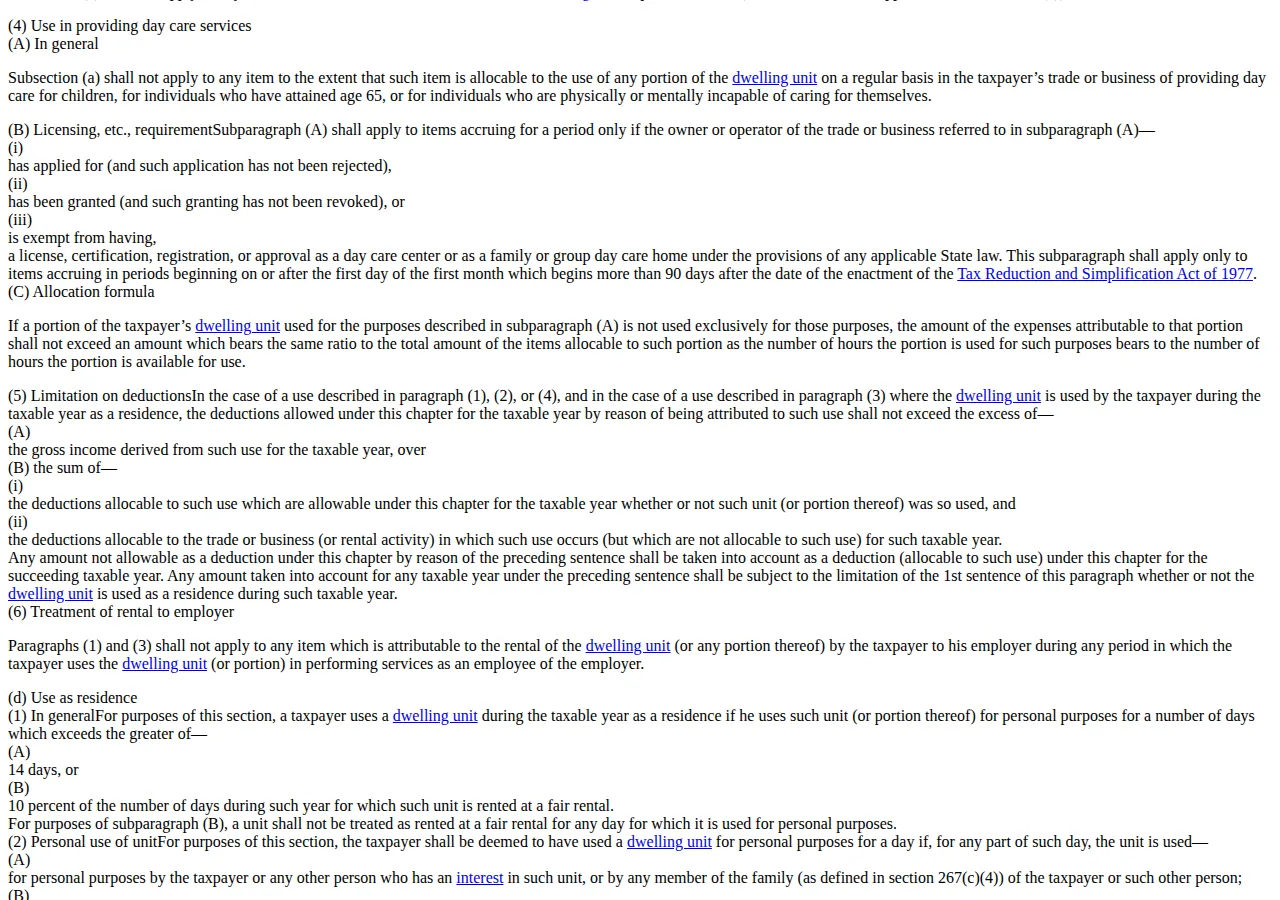
The second sentence of section 280A(c)(5) is the one founders miss: any amount not allowable because of the limit is taken into account as a deduction for the succeeding taxable year, subject to the same limit again. The deduction is deferred, not destroyed. Part IV is the ledger for that deferral.
Part III: depreciation of your home
Depreciation is the line that makes the actual method pay — and the line that collects on sale. Line 37 is the smaller of adjusted basis or fair market value when business use began. Line 38 is the value of the land. Line 39 subtracts the land for the basis of the building; line 40 multiplies by the line 7 percentage. Line 41 is the depreciation percentage — 2.564 percent for a home placed in service after May 12, 1993, the 39-year straight-line rate — and line 42 multiplies line 40 by line 41.
$
\text{Annual Depreciation} = (\text{Line 37} - \text{Line 38}) \times \text{Line 7} \times 2.564\%
$
Attach Form 4562 only when the home was first used for business this year or when additions and improvements were placed in service during the year. The basis on line 37 is frozen at the date business use began. An ITIN filer follows the same Part III math; the form asks for an SSN, and a filer without one uses the ITIN in that box.
Part IV: the carryover
Part IV is two subtractions. Line 43 is line 26 minus line 27: operating expenses the limit disallowed, carried to the next year. Line 44 is line 32 minus line 33: excess casualty losses and depreciation the limit disallowed, carried to the next year. Either result at zero or less means no carryover in that bucket. Next year they enter at lines 25 and 31.
The carryover is why a lean year is a bookkeeping event rather than a loss. A filer who earns little still files Form 8829 and records lines 43 and 44 — because the carryover only exists if the form was filed. Skip the form in the lean year and the deferred deduction never comes into being. Keep the prior year's Form 8829 with the current return's workpapers: lines 25 and 31 are filled from last year's lines 43 and 44.
Worked example: Maya, two years on one form
Maya is a freelance graphic designer, a sole proprietor filing Schedule C, working from a 240-square-foot office inside a 1,800-square-foot home. Her home cost 300,000 dollars including land; the land is worth 60,000 dollars. Annual totals: mortgage interest 9,600 dollars, real estate taxes 3,600 dollars, insurance 1,800 dollars, utilities 3,600 dollars, office repaint 900 dollars, security system 600 dollars.
$
\text{Business Percentage (Line 7)} = \frac{240}{1,800} = 13.33\%
$
$
\text{Annual Depreciation (Line 42)} = (\$300,000 - \$60,000) \times 13.33\% \times 2.564\% = \$820
$
Year one is the strong year. Schedule C, line 29 is 14,600 dollars, so line 8 is 14,600 dollars. Lines 9 through 11 total 13,200 dollars of indirect mortgage interest and taxes; line 13 takes 13.33 percent, which is 1,760 dollars. Line 15 leaves 12,840 dollars. Operating expenses total 1,700 dollars: the 900-dollar repaint in column (a), plus 13.33 percent of 6,000 dollars of indirect insurance, utilities, and security, which is 800 dollars. Line 27 allows the full 1,700 dollars; depreciation of 820 dollars fits inside line 28. Line 34 totals 4,280 dollars, and line 36 puts 4,280 dollars on Schedule C, line 30. The simplified method would have paid 1,200 dollars.
Year two is the lean year, and the limit bites. Gross profit falls to 2,100 dollars, so line 8 is 2,100 dollars. Line 14 is still 1,760 dollars, so line 15 is only 340 dollars. Line 27 allows 340 dollars of the 1,700-dollar operating claim. Line 28 is zero, so line 33 allows none of the 820-dollar depreciation. Line 36 is 2,100 dollars — the whole gross profit. The rest is not lost: line 43 carries 1,360 dollars forward, line 44 carries 820 dollars forward, and 2,180 dollars waits for year three. The arithmetic reconciles exactly.
The simplified method is a ceiling, not a rival
The simplified method pays 5 dollars per square foot up to 300 square feet, a maximum of 1,500 dollars, under the safe harbor in Revenue Procedure 2013-13. It needs no Form 8829 and no allocation of mortgage interest or utilities — and it caps the deduction at 1,500 dollars. A founder paying city rent leaves money behind whenever actual expenses exceed that ceiling, as Maya's year one shows: 4,280 dollars against 1,200 dollars.
Switching is allowed year by year, with one trap the instructions spell out: unallowed expenses from a prior Form 8829 can carry into a year after a simplified-method year, through lines 25 and 31. The simplified method also cannot create a loss — its deduction is limited to the same gross income, unlike the actual method's carryover. Choose the method each year by running both numbers.
Selling the home: depreciation recapture
Depreciation claimed on Form 8829 is not forgiven at sale. Gain equal to depreciation allowed or allowable after May 6, 1997 cannot be excluded under section 121; it is reported as unrecaptured section 1250 gain, taxed at a maximum rate of 25 percent under section 1(h)(1)(E). Publication 523 gives the example: Logan claimed 2,000 dollars of depreciation on an office inside the living area, then sold the house with a 13,000-dollar gain. Logan must recognize 2,000 dollars as unrecaptured section 1250 gain on Form 4797, and may exclude the remaining 11,000 dollars.
> [!WARNING]
> Depreciation recapture applies whether or not you claimed the depreciation. The statute reaches depreciation "allowed or allowable," so a filer who skipped Part III to dodge the recapture still faces it at sale — with no deduction banked in the years the depreciation was available.
For Maya, five years at 820 dollars a year is 4,100 dollars of depreciation, which becomes 4,100 dollars of unrecaptured section 1250 gain at sale — taxed at no more than 25 percent, or 1,025 dollars at the maximum rate. The rest of the gain keeps the section 121 exclusion, because the office sits within the living area. Keep a CSV export of every year's Form 8829 line 42, and pay the mortgage by ACH so the interest trail is complete.
> [!FOUNDER]
> "Form 8829 is the one tax form where doing the arithmetic honestly is the whole strategy. The filers who lose money are the ones who never file the form in a lean year and let a carryover die unrecorded, or who take depreciation for a decade and act surprised at the closing table. Measure the room, file the form every year you qualify."
> — Enow A. Jovial, Founder & Chief Executive Officer
The filing sequence: twelve steps, in order
1. [x] Confirm the gate: exclusive and regular use; no other fixed location for administrative work.
2. [x] Measure Part I: office and total areas, compute line 7, keep the floor plan.
3. [x] Pull Schedule C, line 29: gross profit onto line 8.
4. [x] Complete lines 9 through 11: casualty losses, mortgage interest, real estate taxes.
5. [x] Run lines 12 through 15: total the deductible-anyway bucket, apply the percentage.
6. [x] Complete lines 16 through 22: operating expenses — insurance, rent, repairs, utilities, other.
7. [x] Run lines 23 through 28: total operating expenses, add the prior-year carryover.
8. [x] Complete Part III first if depreciation is new: lines 37 through 42, Form 4562 when first used.
9. [x] Run lines 29 through 36: apply the line 28 limit, enter line 36 on Schedule C, line 30.
10. [x] Record Part IV: line 43 and line 44 carryovers even when the limit allowed everything.
11. [x] Test the simplified method: office area times 5 dollars, capped at 1,500 dollars.
12. [x] File the carryover chain: keep this year's Form 8829 with the return.
Form 8829 is a small form with a long memory: percentage in Part I, limit in Part II, depreciation in Part III, carryover in Part IV. File it every year the space qualifies. The home-office method comparison sets out when the simplified method wins, the Schedule C playbook walks the return Form 8829 feeds, and the Schedule SE playbook covers the SECA tax after line 30. The tax estimator models the liability the home-office deduction reduces.