IRS Form 8812: The Child Tax Credit Playbook for 2025
A family with two children under 17 can cut its 2025 federal tax bill by $4,400. A family with the same two children, the same income, and one missing Social Security number can cut it by $0. That is the whole story of the Child Tax Credit (CTC): the money is large, the rules are exact, and Schedule 8812 is where the two meet. Every figure below was read from the IRS and the statute on 11 November 2026.
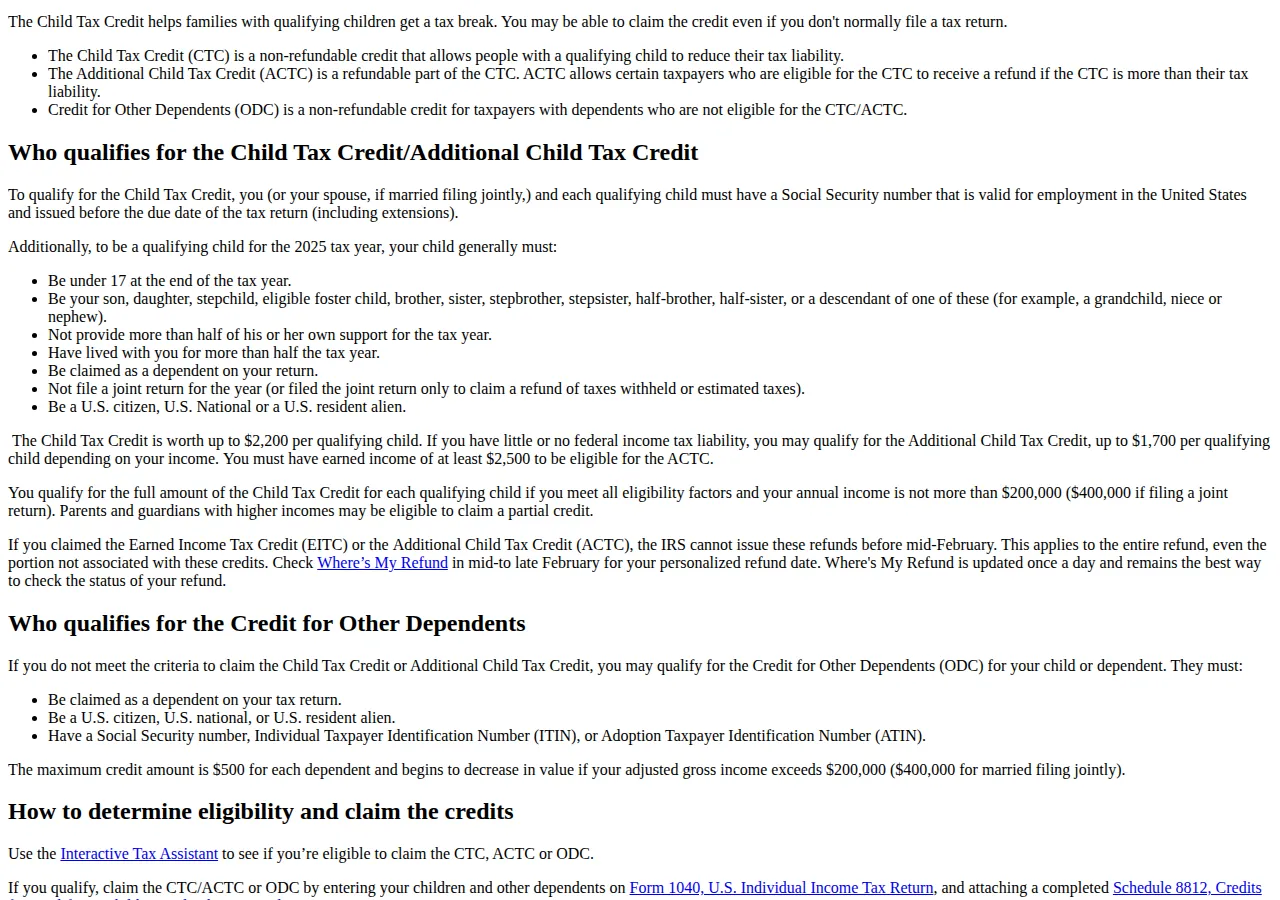
The credit is a federal income tax credit for each qualifying child. Its main form is nonrefundable: it can reduce your tax to zero but not below it. The part that can pay out as a refund even when you owe no tax is the Additional Child Tax Credit (ACTC), run through the same schedule. A third, smaller credit rides along: the Credit for Other Dependents (ODC), $500 per dependent who does not qualify.
What changed for 2025: the One Big Beautiful Bill Act
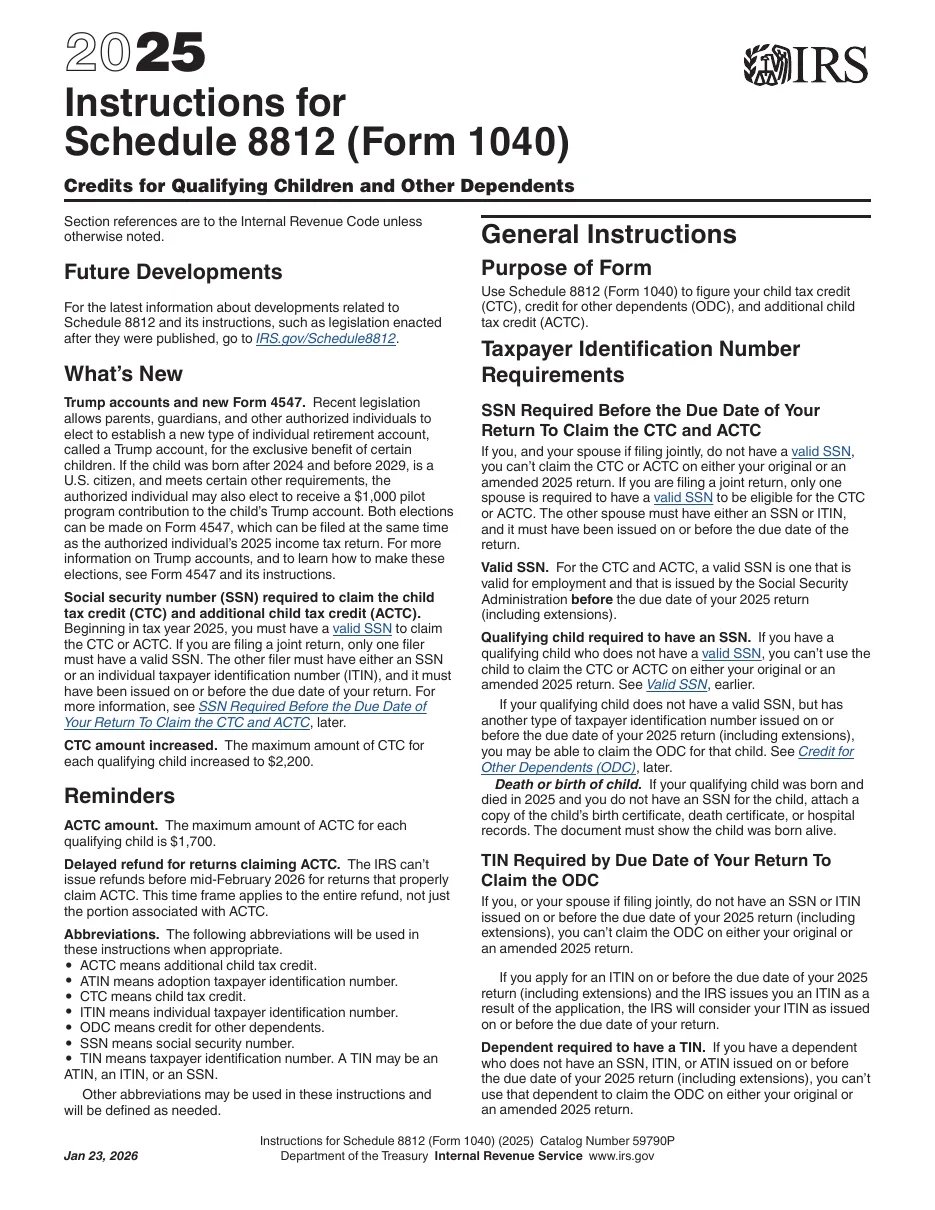
For 2024 the credit was $2,000 per child, and the old rules were set to expire at the end of 2025, which would have dropped it to $1,000. The One Big Beautiful Bill Act (OBBBA), Public Law 119-21, changed that in section 70104, "Extension and enhancement of increased child tax credit." The amount rose to $2,200 per qualifying child, made permanent and indexed to inflation after 2025. The same section added a hard identification rule: the taxpayer claiming the credit must have a valid Social Security number (SSN), and so must each qualifying child. The changes apply to tax year 2025, filed in early 2026.
One correction is worth stating plainly: section 70201 of the same law is "No tax on tips," a different provision. The child tax credit lives in section 70104, verified against the enrolled text of the law.
Who qualifies: the six tests
A child counts only if all six conditions hold, as the IRS states them and the statute states them in 26 U.S.C. § 24(c) and § 152(c).
- Age. Under 17 at the end of the tax year. A child who turned 17 on 30 December 2025 does not qualify for 2025.
- Relationship. Your son, daughter, stepchild, eligible foster child, brother, sister, or a descendant of any of these. An adopted child is always treated as your own child.
- Residency. The child lived with you for more than half the tax year.
- Support. The child did not provide more than half of his or her own support.
- Dependent. Claimed as a dependent on your return, and did not file a joint return (unless filed only to claim a refund of withheld tax).
- Citizenship. The child is a U.S. citizen, U.S. national, or U.S. resident alien.
Fail any one test and the child is not a qualifying child for the CTC — but a 17-year-old dependent, or a child without the required SSN, can still support the $500 ODC, covered below.
The SSN rule: the new gate for 2025
Beginning in tax year 2025, you must have a valid SSN to claim the CTC or the ACTC: one valid for employment in the United States, issued by the Social Security Administration before the due date of your return, including extensions. The same timing rule applies to each qualifying child: a child whose SSN was issued after the due date cannot be used for the CTC or ACTC, on the original return or an amended one.
For joint filers, only one spouse needs a valid SSN; the other needs an SSN or an Individual Taxpayer Identification Number (ITIN), issued on or before the due date. And if your qualifying child has no valid SSN but holds another taxpayer identification number issued on or before the due date, you may still claim the $500 ODC for that child. The ITIN is a fallback for the ODC, and no help at all for the CTC.
The base credit math
The starting credit is simple multiplication, done on Schedule 8812 line 5:
Worked example 1 — the full credit. A married couple filing jointly has two qualifying children and modified adjusted gross income (MAGI) of $80,000. Their tax before credits, Form 1040 line 18, is $5,000, with no other nonrefundable credits. On Schedule 8812: line 4 is 2; line 5 is 2 × $2,200 = $4,400; line 10 is $0 (MAGI below the $400,000 joint threshold); line 12 is $4,400; line 13, from Credit Limit Worksheet A, is $5,000; line 14 is the smaller, $4,400, to Form 1040 line 19. Tax after the credit: $5,000 − $4,400 = $600. The refundable part is $0: line 16a is $4,400 − $4,400 = $0, so Part II-A stops there.
The phaseout: $50 per $1,000 over the line
Above the threshold, the credit shrinks by $50 for each $1,000 — or fraction of $1,000 — of MAGI over the threshold. Line 10 rounds the excess up to the next multiple of $1,000, then line 11 multiplies by 5 percent, the same as $50 per $1,000. MAGI is adjusted gross income plus excluded foreign earned income, the amount on Schedule 8812 line 3.

Worked example 2 — the phaseout. A single filer with two qualifying children and MAGI of $250,000 is $50,000 over the $200,000 threshold: line 10 is $50,000, line 11 is 5 percent, or $2,500, and line 12 is $4,400 − $2,500 = $1,900. A married couple filing jointly with MAGI of $450,000 is $50,000 over the $400,000 threshold, so the same $2,500 reduction applies and their credit is also $1,900. The rounding rule bites on odd amounts: a single filer at $210,500 has an excess of $10,500, which line 10 rounds up to $11,000, so the reduction is $550 and the credit is $3,850. The credit reaches zero at $244,000 (one child, single), $288,000 (two children, single), $488,000 (two children, joint), and $532,000 (three children, joint).
The refundable part: when the credit exceeds your tax
The CTC is nonrefundable, so it stops at zero tax. The ACTC is the refundable part, figured in Part II-A from two ingredients: the credit you could not use, and your earned income. The formula is:
Earned income means wages, salaries, tips, and net earnings from self-employment; you must have at least $2,500 of it. Nontaxable combat pay can be added on line 18b. If you file Form 2555 to exclude foreign earned income, you cannot claim the ACTC.
Worked example 3 — the refundable split. A single parent with one qualifying child, $20,000 of earned income, and $0 tax liability: line 16a is the unused credit, $2,200; line 16b is 1 × $1,700 = $1,700; line 17 is the smaller, $1,700; line 19 is $20,000 − $2,500 = $17,500; line 20 is 15 percent of $17,500, or $2,625; line 27 is the smaller of line 17 and line 20, $1,700 — a $1,700 refund on Form 1040 line 28. The formula, not the cap, decides smaller earners: at $10,000 of earned income the refund is 15 percent of $7,500, or $1,125; at $2,500 it is $0. The split case shows both halves at once: two children, $30,000 of earned income, $1,000 of tax before credits. Line 14 takes $1,000 to Form 1040 line 19; line 16a is $3,400; line 20 is 15 percent of $27,500, or $4,125; line 27 is $3,400 to Form 1040 line 28. Total benefit: $1,000 of tax cut plus a $3,400 refund, the full $4,400.
The Credit for Other Dependents: $500, and no refund
The ODC covers dependents who cannot be used for the CTC or ACTC: a 17-year-old child, a dependent parent, or a child without the required SSN who holds another taxpayer identification number. It is $500 per dependent, nonrefundable, phasing out on the same thresholds. On Schedule 8812 it is lines 6 and 7 — the count times $500 — added to the CTC on line 8 before the phaseout and the tax limit. Two children plus one other dependent start at $4,900, before any phaseout.
The Schedule 8812 line flow, end to end
Part I, lines 1–14, figures the CTC and ODC. Line 1 is adjusted gross income; lines 2a–2d add back excluded foreign and Puerto Rico income to reach MAGI on line 3; line 4 counts the qualifying children; line 5 multiplies by $2,200; lines 6–7 add the ODC; lines 9–11 apply the phaseout; line 13 applies the tax limit; line 14 is the smaller of lines 12 and 13 and goes to Form 1040 line 19. Part II-A, lines 16a–20, figures the ACTC from the unused credit and earned income; Part II-B, lines 21–26, applies only to filers with three or more qualifying children and to bona fide residents of Puerto Rico; line 27 is the ACTC, to Form 1040 line 28. Finish Form 1040 through line 27a and Schedule 3 line 11 before Part II-A. The Schedule 3 additional credits playbook walks through the schedule where the nonrefundable credits stack up before the CTC is limited.
Timing, errors, and the cost of getting it wrong
Two timing facts catch filers every year. First, the IRS cannot issue refunds before mid-February 2026 for returns that claim the ACTC, and the delay applies to the entire refund. Second, claiming the CTC, ACTC, or ODC in error can cost more than the credit: reckless or intentional disregard brings a 2-year ban on all three credits; fraud brings a 10-year ban, plus penalties. If your credit was denied or reduced for any reason other than a math or clerical error, attach Form 8862 to a later return before claiming again.
The acronyms each name a different gate. The IRS administers the credit; your SSN, or an ITIN where the rules allow it, is the identification the return carries; AGI is the income on Form 1040, while MAGI adds back excluded foreign earnings and sets the phaseout; CTC is the nonrefundable credit, ACTC the refundable part, ODC the $500 credit for other dependents, and OBBBA the 2025 law that raised the credit to $2,200. For a self-employed filer — an LLC owner or an S-Corp shareholder reporting net earnings on Schedule C — earned income for the ACTC comes from that Schedule C profit, so the Schedule C profit and loss playbook is the companion read for getting line 18a right. The Form W-4 withholding playbook covers how the tax withheld during the year interacts with a credit that arrives at filing time.
The decision table
| Your situation | Claim | Why | Authority |
|---|---|---|---|
| 2 children under 17, MAGI under threshold, tax above $4,400 | Full CTC $4,400 | Credit fits inside the tax bill | 2025 Instructions |
| 1 child, $20,000 earned income, $0 tax | ACTC $1,700 refund | Formula gives $2,625, capped at $1,700 | 2025 Instructions |
| 2 children, MAGI $250,000 single | CTC $1,900 after phaseout | $50,000 excess × 5% = $2,500 cut | § 24(b)(1) |
| 17-year-old dependent, or child without valid SSN | ODC $500, nonrefundable | Fails CTC tests, still a dependent | IRS CTC page |
| MAGI above $488,000 joint, 2 children | $0 CTC | Phaseout consumed the $4,400 | § 24(b)(1) |
| No SSN, or child SSN issued after due date | $0 CTC and $0 ACTC | SSN-before-due-date is a hard gate | § 70104(b) |
Founder & CEO Insight — Enow A. Jovial
The execution checklist
- List every child and check the six tests: age, relationship, residency, support, dependent, citizenship.
- Confirm a valid SSN, issued before the due date including extensions, for yourself and each qualifying child. Joint filers: at least one spouse must hold one.
- Add up MAGI and compare it with $200,000 ($400,000 if married filing jointly).
- Work the phaseout on lines 9 through 11: round the excess up to the next $1,000, then take 5 percent.
- Figure the tax limit with Credit Limit Worksheet A.
- If the CTC does not fit inside your tax bill, complete Part II-A: earned income minus $2,500, times 15 percent, capped at $1,700 per child.
- Check the "Child tax credit" box for each qualifying child in the Dependents section of Form 1040, and the "Credit for other dependents" box for each ODC dependent — never both for the same person.
- Run the numbers through the ROI calculator, then attach Schedule 8812 and file. Expect no refund before mid-February 2026 if you claim the ACTC.