Form 3468 is where six different investment credits converge into one filing. A solar array, a semiconductor fab, a historic-building rehabilitation, and an advanced-energy factory all claim their credit on the same form — each through a different part, at a different rate, under a different statute. File the wrong part and the credit is disallowed; file the right part without the prevailing-wage paperwork and a 30 percent credit becomes a 6 percent credit.
The governing rule is in the instructions: complete a separate Form 3468 for each facility or property. Part I carries the facility information; the applicable part — Part II through Part VII — computes that property's credit. The totals flow to Form 3800, Part III, where the § 38(c) limit is applied. Form 3468 computes the credit. Form 3800 decides how much of it you keep this year.
The six credits, one map
Form 3468 (2025) has seven parts: Part I is information, Parts II through VII are the credit engines.
| Part | Credit | Statute | Rate |
|---|---|---|---|
| Part II | Qualifying advanced coal project / gasification project | § 48A / § 48B | Allocated; see certification |
| Part III | Qualifying advanced energy project | § 48C | 30% with PWA; 6% without |
| Part IV | Advanced manufacturing investment (semiconductors) | § 48D | 35% (2026+); 25% (before 2026) |
| Part V | Clean electricity investment | § 48E | 30% with PWA; 6% without |
| Part VI | Energy credit | § 48 | 6% base; 30% with PWA |
| Part VII | Rehabilitation credit | § 47 | 20%, ratable over 5 years |
Parts II and III are allocation credits: the credit does not exist until the Department of Energy allocates it. Section 48C caps total allocations at $10,000,000,000, of which no more than $6,000,000,000 may go to investments outside energy-community census tracts — at least $4,000,000,000 is reserved for energy communities. An operator who builds a § 48C project without an allocation certificate has built a project with no credit at all. The allocation is the credit; the form only computes it.
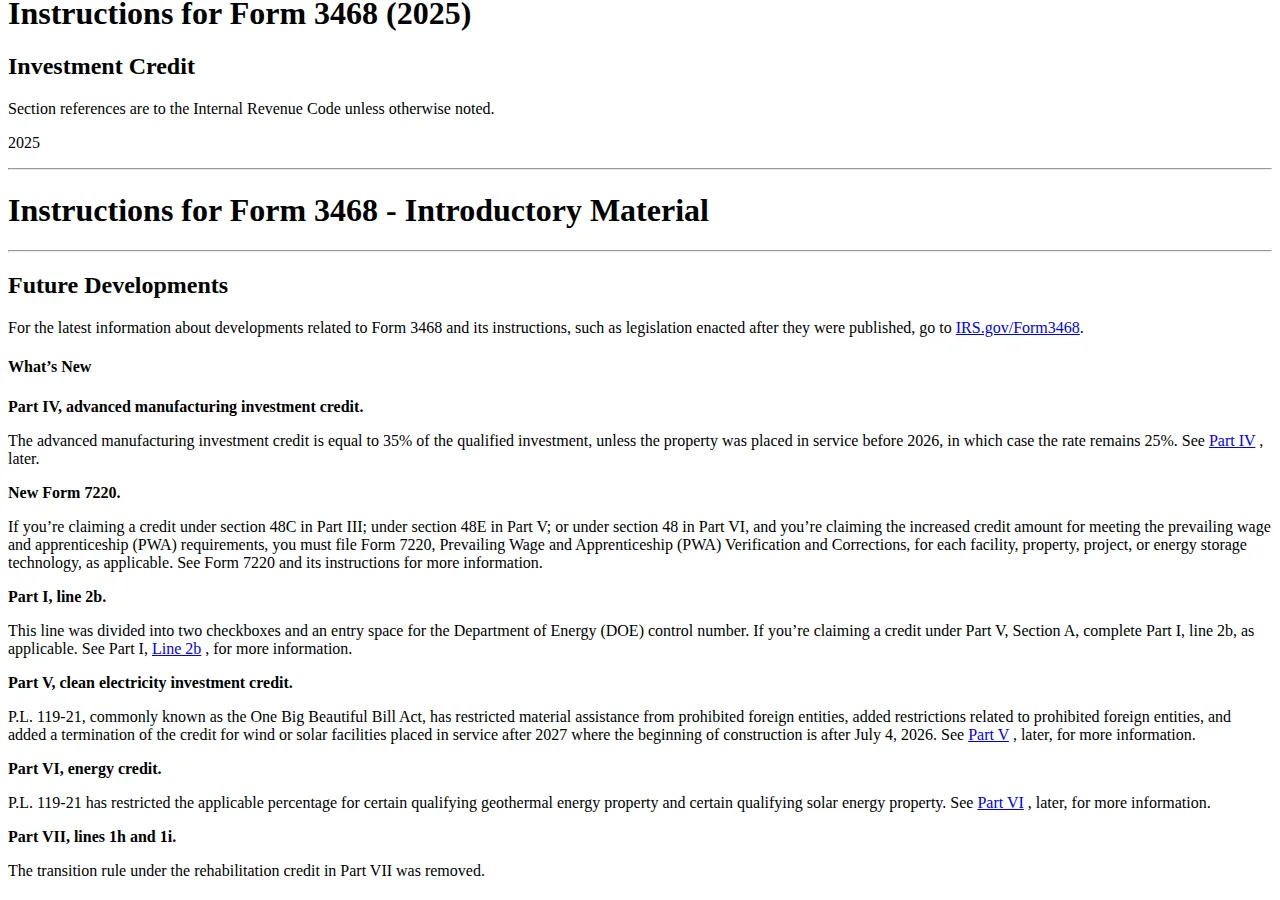
Parts V and VI are the volume credits — the ones most founders will actually claim. Section 48E covers qualified facilities and energy storage; § 48 covers energy property such as solar, geothermal, fuel cells, and storage. Both use the same structure: 6 percent without prevailing wage and apprenticeship, 30 percent with it. The instructions make the PWA gate explicit for Parts III, V, and VI: claim the increased amount and you must file Form 7220, Prevailing Wage and Apprenticeship (PWA) Verification and Corrections, for each facility, property, project, or energy storage technology. No Form 7220, no increase.
Two exceptions soften the PWA gate: a facility under 1 megawatt maximum net output (alternating current) is excepted, and the applicable percentage follows the year construction began, not the year the facility was placed in service.
The prevailing-wage multiplier, worked
Example: a $2,000,000 solar investment under § 48E:
ext{Credit}_{ ext{no PWA}} = $2{,}000{,}000 imes 6% = $120{,}000
ext{Credit}_{ ext{PWA}} = $2{,}000{,}000 imes 30% = $600{,}000
ext{PWA premium} = $600{,}000 - $120{,}000 = $480{,}000
The compliance that buys the increase costs a fraction of $480,000 — the multiplier is the first decision in the project plan, not the last item on the filing checklist. The bonuses stack on the 30 percent base: domestic content adds 10 points; an energy community adds 10 points:
ext{Credit}_{ ext{domestic}} = $2{,}000{,}000 imes 40% = $800{,}000
ext{Credit}_{ ext{both bonuses}} = $2{,}000{,}000 imes 50% = $1{,}000{,}000
Section 48 adds a low-income bonus under § 48(e): 10 points for property in a low-income community, 20 points for a qualified low-income residential building project or a project with low-income economic benefits. The bonuses are percentage-point additions — 30 plus 10 is 40, not 33. A model that multiplies 30 percent by 1.1 understates the credit by $140,000 on a $2,000,000 investment.
The semiconductor rate: 35 percent, and the date that decides it
Part IV is the simplest rate on the form and the easiest to get wrong by one year. The 2025 instructions state it plainly: the advanced manufacturing investment credit is equal to 35 percent of the qualified investment, unless the property was placed in service before 2026, in which case the rate remains 25 percent. The change comes from P.L. 119-21 § 70308, the One Big Beautiful Bill Act. The placed-in-service date is the switch:
ext{Credit}_{2026+} = $40{,}000{,}000 imes 35% = $14{,}000{,}000
ext{Credit}_{ ext{pre-2026}} = $40{,}000{,}000 imes 25% = $10{,}000{,}000
ext{Timing value} = $14{,}000{,}000 - $10{,}000{,}000 = $4{,}000{,}000
A fab placed in service on December 31, 2025 earns $10,000,000; the same fab on January 1, 2026 earns $14,000,000. No operator should cross that line without running this subtraction first. Section 48D also carries its own elective-payment election under § 48D(d) — a direct-pay route the other parts reach only through § 6417, and only for applicable entities.
A fab operator usually claims the § 41 research credit on the same year's process development — our § 41 research credit playbook runs the Form 6765 computation — and the two credits stack on the same return, subject to the same § 38(c) limit below.
Rehabilitation: 20 percent, paid over five years
Part VII is the oldest credit on the form and the slowest to arrive. Section 47(a) allows 20 percent of qualified rehabilitation expenditures for a certified historic structure. The credit is not taken in the placed-in-service year. Under § 47(b), the ratable share for any taxable year during the five-year period is 20 percent of the credit — the credit is spread evenly:
ext{Credit} = $1{,}500{,}000 imes 20% = $300{,}000
ext{Annual share} = $300{,}000 imes 20% = $60{,}000 ext{ per year for 5 years}
A $1,500,000 rehabilitation yields $60,000 a year for five years, not $300,000 in year one — a model that books the full amount overstates year-one cash by $240,000. The 2025 instructions record that the Part VII transition rule was removed.
The § 48C allocation race
Part III deserves its own warning because the credit is rationed. The $10,000,000,000 allocation cap is a national total, and the $6,000,000,000 sub-cap on non-energy-community allocations means at least $4,000,000,000 is reserved for energy communities. The credit rate is 30 percent with PWA and 6 percent without — $1,500,000 versus $300,000 on a $5,000,000 investment.
The allocation is applied for through the Department of Energy; the instructions require the DOE control number on Part I, line 2b and the allocation certification for Part III. A § 48C project without an allocation has a 0 percent rate, not a 6 percent rate — the PWA question is moot until the allocation exists. Allocation first, PWA second, filing third.
What the One Big Beautiful Bill Act changed
The 2025 instructions carry three OBBBA changes. First, § 48D rose from 25 percent to 35 percent for property placed in service in 2026 or later. Second, P.L. 119-21 restricted material assistance from prohibited foreign entities and terminated the § 48E credit for wind or solar facilities placed in service after 2027 where construction began after July 4, 2026 — a cliff, and the construction-beginning date is the date that matters. Third, P.L. 119-21 restricted the applicable percentage for certain qualifying geothermal and solar energy property under Part VI. A 2025-vintage § 48 rate assumption is unsafe for a 2026-vintage project.
Founder & CEO Insight — Enow A. Jovial
The limit: § 38(c) decides what you keep
Section 38(c) limits the general business credit to net income tax minus the greater of tentative minimum tax or 25 percent of net regular tax liability above $25,000:
Example: a corporation with $500,000 of net regular tax, no tentative minimum tax, and a $600,000 investment credit:
ext{Limit} = $500{,}000 - 25% imes ($500{,}000 - $25{,}000) = $381{,}250
ext{Unused credit} = $600{,}000 - $381{,}250 = $218{,}750
The corporation uses $381,250 this year. The remaining $218,750 is not lost: under § 39(a) it carries back 1 year and forward 20 years, in that order, and expires only if unused within the 20-year window. A founder who models a $600,000 credit as $600,000 of year-one saving has overstated it by $218,750. The limit, not the credit, belongs in the cash-flow model.
The limit also reaches the pass-through filer: an LLC, S-Corp, or C-Corp passes the credit to owners whose own § 38(c) limit is measured on their returns, with EIN, FICA, and payroll records feeding the PWA file; a CPA preparing the return under GAAP books and FASB ASC 730 guidance should confirm the credit flows to the right taxpayer. Our § 199A QBI deduction playbook runs the other side of the same return: a larger QBI deduction lowers net regular tax, which lowers the § 38(c) limit and pushes more credit into the carryforward.
Recapture: the five-year ladder
The credit is earned at placed-in-service, but it is not fully yours for five years: § 50(a) recaptures it if investment credit property is disposed of, or otherwise ceases to be investment credit property, before the close of the recapture period:
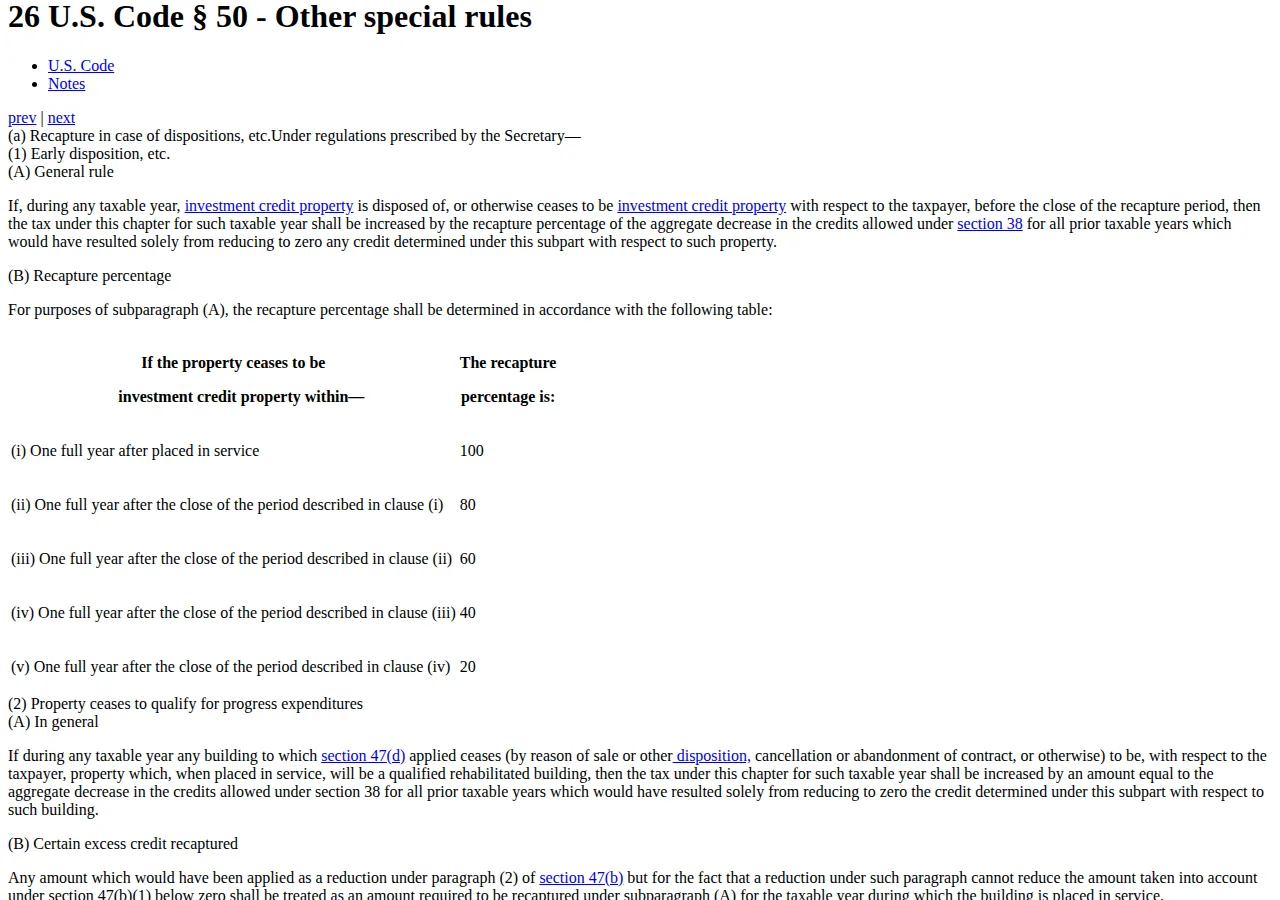
| Disposition within | Recapture percentage |
|---|---|
| One full year after placed in service | 100% |
| Second year | 80% |
| Third year | 60% |
| Fourth year | 40% |
| Fifth year | 20% |
| After five years | 0% |
Example: a $600,000 credit on equipment sold in the third year recaptures 60 percent:
ext{Recapture tax} = $600{,}000 imes 60% = $360{,}000
The $360,000 is added to the tax for the year of disposition and reported on Form 4255. The property's basis is increased by the recapture amount immediately before the disposition, softening the gain on the sale. A sale in year three is a recapture event; a sale in year six is not.
The filing operation, end to end
- Identify the credit and the part before spending: § 48C and § 48A/§ 48B need a DOE allocation, § 48D a semiconductor facility, § 47 a certified historic structure.
- Lock the rate: PWA compliance and Form 7220 for 30 percent, domestic-content and energy-community records for the bonuses, and the placed-in-service date for the § 48D 35 percent rate.
- Complete pre-filing registration before any § 6418 transfer or § 6417 elective payment.
- File one Form 3468 per facility or property, and report each total on Form 3800, Part III — Part III, line 3; Part IV, line 3; Part V, line 11; or Part VI, line 32.
- Run the § 38(c) limit before promising any saving.
- Diary the five-year recapture period; report dispositions on Form 4255.
- Check the OBBBA dates: § 48E wind/solar begun after July 4, 2026 and placed in service after 2027 loses the credit.
- [x] Identify the part first, and confirm whether a DOE allocation is required.
- [x] Lock the rate: PWA plus Form 7220 for 30 percent; bonus records; placed-in-service date for § 48D.
- [x] Complete pre-filing registration before any § 6418 transfer or § 6417 election.
- [x] File one Form 3468 per facility or property.
- [x] Report each total on Form 3800, Part III.
- [x] Run the § 38(c) limit before promising any saving.
- [x] Diary the five-year recapture period; report dispositions on Form 4255.
- [x] Check the OBBBA dates for § 48E wind/solar.
Who should not claim
Form 3468 is wrong for a taxpayer with no tax liability and no carryback room who cannot transfer or elect payment — the credit will sit in a 20-year carryforward that may expire unused. It is wrong for a project whose PWA compliance was never documented. It is wrong for a § 48C project without an allocation, and for a wind or solar project begun after July 4, 2026 that will not be placed in service by the end of 2027. The alternative is a different structure: a § 6418 transfer, a § 6417 elective payment where allowed, or a shift of the placed-in-service date. Run the numbers on the tax estimator with the § 38(c) limit applied.
Form 3468 rewards one discipline: read the instructions for the year the property is placed in service, not the year the project was conceived. The rates moved in 2026, the termination dates are cliffs, and the paperwork is the rate.